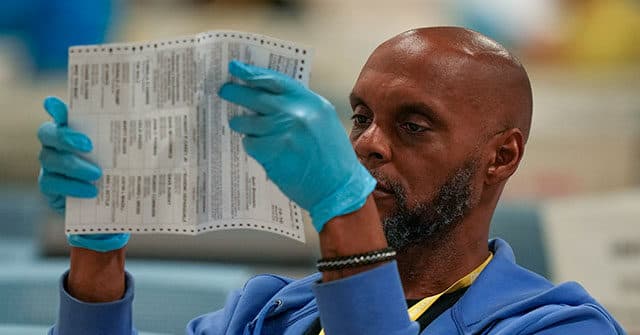
 Election worker examines mail-in ballot during vote counting process
Supreme Court May Invalidate Thousands of Mail-In Ballots
Left says
- •The Republican lawsuit relies on a frivolous legal theory that claims Congress banned counting absentee ballots in 1845, yet somehow no one noticed this prohibition for nearly two centuries
- •Trump's attacks on mail-in voting transformed previously nonpartisan election administration into a partisan weapon, as Democrats now disproportionately use mail ballots
- •Invalidating legally cast ballots that arrive after Election Day due to postal delays would disenfranchise thousands of eligible voters who followed proper procedures
- •Many red states including Mississippi have long allowed post-Election Day ballot receipt, demonstrating this was never controversial until it became politically advantageous to challenge
Right says
- •Federal law establishes Election Day as the definitive deadline when elections must be completed, and accepting ballots afterward undermines this constitutional framework
- •Counting ballots that arrive after polls close creates opportunities for fraud and manipulation, as demonstrated by 60% of voters believing this practice makes cheating easier
- •Public trust in elections requires clear, uniform deadlines, with 59% of voters saying they would not trust results that include late-arriving ballots
- •Bipartisan polling shows 83% of voters believe ballots should be received by Election Day, including 74% of Democrats, reflecting broad consensus on this principle
Common Take
High Consensus- Multiple Supreme Court justices from across the ideological spectrum expressed skepticism about accepting ballots after Election Day during oral arguments
- The case involves Mississippi's law allowing ballots postmarked by Election Day to be counted if received within five business days afterward
- Over a dozen states currently have similar grace periods for accepting mail-in ballots beyond Election Day
- The Supreme Court's ruling will have widespread implications for voting procedures across multiple states in future elections
The Arguments
Right argues
Federal law establishes Election Day as the definitive deadline when elections must be completed, and accepting ballots afterward undermines this constitutional framework that has governed American elections since 1845.
Left counters
The Republican lawsuit relies on a frivolous legal theory claiming Congress banned counting absentee ballots in 1845, yet somehow no one noticed this prohibition for nearly two centuries, including many red states like Mississippi that have long allowed post-Election Day ballot receipt.
Left argues
Invalidating legally cast ballots that arrive after Election Day due to postal delays would disenfranchise thousands of eligible voters who followed proper procedures by mailing their ballots on time.
Right counters
Clear, uniform deadlines are essential for public trust in elections, with 59% of voters saying they would not trust results that include late-arriving ballots, demonstrating that extending deadlines actually undermines electoral confidence.
Right argues
Bipartisan polling shows 83% of voters believe ballots should be received by Election Day, including 74% of Democrats, reflecting broad consensus that this practice maintains election integrity and prevents opportunities for fraud.
Left counters
Trump's attacks on mail-in voting transformed previously nonpartisan election administration into a partisan weapon, as Democrats now disproportionately use mail ballots, making any restriction on mail voting likely to skew elections toward Republicans.
Left argues
Many red states including Mississippi have long allowed post-Election Day ballot receipt without controversy, demonstrating this was never a genuine legal issue until it became politically advantageous for Republicans to challenge.
Right counters
Counting ballots that arrive after polls close creates opportunities for fraud and manipulation, with 60% of voters believing this practice makes cheating easier and threatens the security of the electoral process.
Challenge Questions
These questions target genuine internal contradictions — meant to provoke honest reflection.
Right asks Left
“If this legal theory about the 1845 federal law is truly frivolous, why are multiple Supreme Court justices expressing skepticism about post-Election Day ballot counting, and how do you reconcile your claim that this was 'never controversial' with the documented bipartisan polling showing majority opposition to the practice?”
Left asks Right
“If election integrity and uniform deadlines are your primary concerns, why did Republican-controlled states like Mississippi implement these post-Election Day counting provisions in the first place, and why did this only become a legal issue after Trump began attacking mail-in voting when it became politically disadvantageous?”
Outlier Report
Left Fringe
Progressive voting rights activists like Stacey Abrams and groups like Fair Fight Action who frame any ballot restrictions as voter suppression, representing roughly 15-20% of the left coalition.
Right Fringe
Election conspiracy theorists like Mike Lindell and some Trump-aligned figures who claim all mail-in voting is inherently fraudulent, representing about 25-30% of the right coalition.
Noise Assessment
Moderate noise level - while partisan media frames this as voter suppression vs. election integrity, the underlying polling shows broad public consensus that transcends typical partisan divides on voting issues.
Sources (6)
<p>The vast majority of likely voters believe ballots should be received by Election Day, an Honest Elections Project survey – released ahead of the Supreme Court hearing arguments on the matter – found.</p> <p>The post <a href="https://www.breitbart.com/politics/2026/03/24/poll-vast-majority-agree-ballots-should-be-received-by-election-day/" rel="nofollow">Poll: Vast Majority Agree Ballots Should Be Received by Election Day</a> appeared first on <a href="https://www.breitbart.com" rel="nofollow">Breitbart</a>.</p>
Several Supreme Court justices expressed skepticism Monday about states that allow ballots to be received and counted days after Election Day, though they worried about where to draw the line and whether tossing out late-arriving ballots also would eliminate early voting. The justices grappled with the morass that has become voting, with some states allowing ballots to be cast six weeks or more before Election Day and others allowing them to be received weeks afterward. In the specific case before the justices, ballots in Mississippi can be counted if received up to five days after Election Day, as long as they were mailed or sent by a "common carrier," such as FedEx, by Election Day. Opponents said that violates the idea that an election is "consummated" on Election Day.
<img alt="mailbox" class="webfeedsFeaturedVisual wp-post-image" src="https://thefederalist.com/wp-content/uploads/2026/03/pexels-wolfgang-vrede-9996223-33839270-1-1200x675.jpg" style="display: block; margin: auto; margin-bottom: 5px;" />While the Supreme Court on Monday expressed skepticism about states accepting mail-in ballots that arrive after Election Day, an overwhelming majority of voters have already decided against the practice, according to a recent poll conducted just days before the high court heard oral arguments in Watson v. RNC. As The Federalist’s Shawn Fleetwood reported, Watson […]
<img alt="A ballot drop box." class="webfeedsFeaturedVisual wp-post-image" src="https://thefederalist.com/wp-content/uploads/2026/03/Ballot-drop-box-1200x675.jpg" style="display: block; margin: auto; margin-bottom: 5px;" />'Is that something we should be thinking about? Confidence in the election process? ... Just curious how we factor that in here,' Justice Kavanaugh said.
If the United States had a nonpartisan judiciary, Watson v. Republican National Committee would have been laughed out of court months ago. The premise of the Republican Party’s lawsuit in Watson is that, beginning in 1845, Congress banned states from counting many absentee ballots — and somehow no one noticed this for the better part […]
Republican groups challenged a law in Mississippi that allows officials to count mail-in ballots received up to five days after polls close.