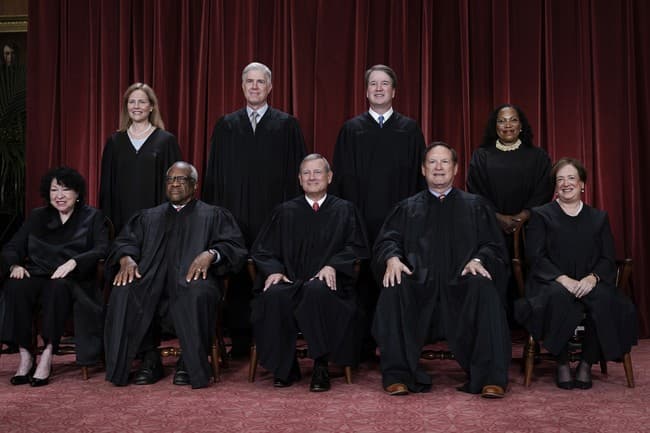
Supreme Court Rules 8-1 Against Colorado's Conversion Therapy Ban
Intra-Party Split Detected
Two liberal justices (Kagan and Sotomayor) joined the conservative majority, with only Jackson dissenting from the liberal bloc
Left says
- •The decision undermines protections for LGBTQ+ youth, who studies show are more than twice as likely to attempt suicide after experiencing conversion therapy
- •Justice Jackson's dissent warns this could unravel medical regulation by allowing healthcare professionals to claim free speech rights to provide substandard care
- •The ruling affects similar laws in over 20 states that were designed to protect minors from practices medical associations have deemed harmful and ineffective
- •This represents another rollback of LGBTQ+ protections by the conservative-majority Court, prioritizing therapists' speech over children's wellbeing
Right says
- •The decision protects fundamental First Amendment rights against government-imposed orthodoxy in speech and thought
- •Colorado's law created viewpoint-based discrimination by allowing therapists to affirm gender transitions while banning conversations about aligning with biological reality
- •The ruling preserves therapeutic options for families seeking counseling consistent with their religious beliefs and values
- •Even liberal justices Kagan and Sotomayor recognized this as a clear case of unconstitutional viewpoint discrimination
Common Take
High Consensus- The Supreme Court ruled 8-1 against Colorado's conversion therapy ban, with only Justice Ketanji Brown Jackson dissenting
- The case involved talk therapy rather than physical interventions or medical procedures
- The Court remanded the case back to lower courts to apply strict scrutiny review
- More than 20 states have similar laws that may now face constitutional challenges
The Arguments
Right argues
The Colorado law constitutes clear viewpoint discrimination by allowing therapists to affirm gender transitions while prohibiting conversations about aligning with biological reality, violating the fundamental First Amendment principle that the government cannot enforce orthodoxy in thought or speech.
Left counters
Professional speech in medical contexts has always been subject to state regulation to protect patients from harmful practices, and conversion therapy has been linked to doubled suicide attempt rates among LGBTQ+ youth according to peer-reviewed studies.
Left argues
This ruling undermines critical protections for vulnerable LGBTQ+ youth who are more than twice as likely to attempt suicide after experiencing conversion therapy, prioritizing therapists' speech rights over children's safety and wellbeing.
Right counters
The law preserves therapeutic options for families seeking counseling consistent with their religious beliefs and values, while the plaintiff only provides voluntary talk therapy to clients who set their own goals, not coercive treatments.
Left argues
Justice Jackson's dissent correctly warns that this decision could unravel medical regulation by allowing healthcare professionals to claim free speech rights to provide substandard care, threatening the entire framework of professional medical standards.
Right counters
Even liberal Justices Kagan and Sotomayor recognized this as a clear case of unconstitutional viewpoint discrimination, with Kagan calling it a 'textbook' example of the government suppressing speech based on disagreement with the message.
Right argues
The First Amendment protects the right of all Americans to speak freely, not just those with popular ideas, and the Constitution does not allow states to silence dissenting views simply because they disagree with the therapeutic approach.
Left counters
This decision affects similar protective laws in over 20 states and represents another rollback of LGBTQ+ protections by the conservative-majority Court, potentially exposing more children to practices deemed harmful by major medical associations.
Challenge Questions
These questions target genuine internal contradictions — meant to provoke honest reflection.
Right asks Left
“If professional medical speech deserves special regulation as you argue, how do you reconcile supporting state restrictions on conversion therapy while simultaneously advocating for unrestricted access to experimental gender-affirming treatments for minors that lack long-term safety data?”
Left asks Right
“If this case is truly about protecting voluntary talk therapy between consenting clients and therapists as you claim, why do you simultaneously support laws that would compel therapists to provide only affirmation-based approaches even when families explicitly request alternative therapeutic perspectives?”
Outlier Report
Left Fringe
Progressive activists like those in some LGBTQ+ advocacy organizations who frame any questioning of gender identity as inherently harmful violence, representing roughly 15-20% of the left coalition.
Right Fringe
Commentators like Matt Walsh who characterize Justice Jackson as 'the most unfit, unqualified, unhinged lunatic' on the Court and use inflammatory rhetoric about 'psychotic legislation,' representing about 10-15% of the right.
Noise Assessment
Moderate noise level - while activists on both sides use charged language, the 8-1 Court decision and bipartisan free speech concerns suggest less performative polarization than typical culture war issues.
Sources (17)
<p>The <a href="https://www.axios.com/2026/01/01/2026-trump-supreme-court-cases-tariffs" target="_blank">Supreme Court</a> sided Tuesday with a Christian talk therapist who contended a Colorado law banning the <a href="https://www.ama-assn.org/system/files/conversion-therapy-issue-brief.pdf" target="_blank">discredited</a> practice of <a href="https://www.axios.com/2025/03/10/supreme-court-conversion-therapy-challenge" target="_blank">conversion therapy</a> to change minors' sexual orientation or gender expression violated her First Amendment rights. </p><p><strong>The big picture: </strong>The decision has <a href="https://www.axios.com/2025/10/07/supreme-court-scotus-conversation-therapy-youth" target="_blank">implications beyond</a> the Colorado therapy sessions. It sets precedent that therapists' conversations with patients are regarded as a form of constitutionally protected speech and rolls back protections for <a href="https://www.axios.com/2025/10/16/lgbtq-mental-health-trevor-project-report" target="_blank">LGBTQ+ youth</a>. </p><hr /><ul><li>A <a href="https://pmc.ncbi.nlm.nih.gov/articles/PMC7349447/" target="_blank">study</a> from suicide and crisis prevention group The Trevor Project found that young people who reported going through conversion therapy were more than twice as likely to have reported attempting suicide and having multiple attempts compared to those who had not.</li></ul><p><strong>Driving the news: </strong>In an <a href="https://supreme.justia.com/cases/federal/us/607/24-539/#top" target="_blank">8-1 decision</a>, the court ruled that Colorado's law, even though it was tailored to licensed professionals, does not overrule free speech protections.</p><ul><li>"They may believe that state-imposed orthodoxies in speech pose few dangers and many benefits in this field (and who knows what others). But their policy is not the First Amendment's."</li><li>"The Constitution does not protect the right of some to speak freely; it protects the right of all. It safeguards not only popular ideas; it secures, even and especially, the right to voice dissenting views. "</li><li>"Consistent with these principles, our precedents have expressly rejected the State and dissent's notion that 'professional speech' represents some 'separate category of speech' subject to 'diminished constitutional protection.'"</li></ul><p><strong>Justice Ketanji Brown Jackson</strong> was the lone dissenter, arguing medical speech is different from generic free speech, as patients need to rely on sound industry-aligned advice.</p><ul><li>"In the worst-case scenario, our medical system unravels as various licensed healthcare professionals — talk therapists, psychiatrists, and presumably anyone else who claims to utilize speech when administering treatments to patients — start broadly wielding their newfound constitutional right to provide substandard medical care."</li><li>"It is baffling that we could now be standing on the edge of a precipitous drop in the quality of healthcare services in America. But the Court sees fit to bring us one step closer to that fate today," she wrote.</li></ul><p><strong>Catch up quick: </strong>Therapist Kaley Chiles, represented by lawyers from the conservative <a href="https://www.axios.com/2023/03/31/anti-trans-bills-2023-america" target="_blank">Alliance Defending Freedom</a>, <a href="https://www.supremecourt.gov/DocketPDF/24/24-539/362492/20250606115635027_24-359%20Brief%20of%20Petitioner.pdf" target="_blank">contends</a> the 2019 law acts as a de facto gag order on counselors to "censor speech." </p><ul><li>The high court agreed to hear the case after the Denver-based 10th U.S. Circuit Court of Appeals <a href="https://www.ca10.uscourts.gov/sites/ca10/files/opinions/010111111013.pdf" target="_blank">upheld</a> the law, which it determined was a legal "regulation of professional conduct incidentally involving speech." </li></ul><p><strong>But in their petition</strong> to the Supreme Court, Chiles' lawyers argued that the law is a viewpoint-based infringement on her freedom of speech.</p><ul><li>Because the state disagrees with her views on gender and sexuality, her lawyers write, it "puts itself in Chiles's counseling room, forbidding her from discussing the values she and her clients share."</li><li>Additionally, they stated that Chiles uses only talk therapy in her practice, in which she "does not seek to 'cure' clients of same-sex attractions" and works only with "voluntary clients" who determine their own goals.</li></ul><p><strong>The other side:</strong> The Colorado Attorney General's Office defended the law as a necessary regulation on professional conduct to protect patients from harmful treatment.</p><ul><li>"Central to Petitioner's position is her claim that mental health professionals' counseling of their patients is no different from a chat with one's college roommate, such that both interactions receive the same First Amendment protection," Colorado's opposing brief <a href="https://www.supremecourt.gov/DocketPDF/24/24-539/336594/20250106113037565_Chiles%20SCOTUS%20BIO%20-%20FINAL%20PDFA.pdf" target="_blank">read</a>. "Not so." </li></ul><p><strong>Zoom in: </strong>Shannon Minter, legal director of the National Center for LGBTQ Rights, tells Axios that Tuesday's decision "should not be understood as green-lighting conversion therapy, or saying that it's 'legal.'" </p><ul><li>"All this does is take off the table one way of protecting kids. There's still many other legal avenues to protect people harmed by conversion therapy," he said.</li><li>He cited malpractice and consumer fraud claims, as well as professional licensing boards' ability to discipline therapists who "harm patients through conversion therapy."</li></ul><p><strong>Between the lines: </strong>More than 20 states have <a href="https://www.lgbtmap.org/equality-maps/conversion_therapy" target="_blank">banned</a> conversion therapy for minors, and Minter said Tuesday's decision will likely render most unenforceable.</p><ul><li>Justice Elena Kagan's concurrence, joined by Justice Sonia Sotomayor, suggested a viewpoint-neutral version of the law would raise "a different and more difficult question."</li><li>Minter said states could redraft these laws to bar medical professionals from pushing any view on someone's sexual orientation.</li></ul><p><strong>What we're watching: </strong>The court sent the case back to the 10th Circuit, where it must now be reconsidered under higher scrutiny.</p><p><strong>Go deeper: </strong><a href="https://www.axios.com/2025/06/18/supreme-court-trans-youth-health-care" target="_blank">Supreme Court upholds Tennessee ban on gender-affirming care for transgender youth</a></p><p><em>Editor's note: This story has been updated with additional comment and context.</em></p>
<img src="https://www.theblaze.com/media-library/scotus-rules-on-law-banning-conversion-therapy-and-2-liberal-justices-break-rank.jpg?id=65434130&width=1245&height=700&coordinates=0%2C53%2C0%2C54" /><br /><br /><p>In a nearly unanimous decision, the Supreme Court has issued a ruling on one state's ban on conversion therapy for minors, resulting in an important First Amendment win and setting a possible precedent for many states with similar laws on the books. </p><p>In an 8-1 <a href="https://www.supremecourt.gov/opinions/25pdf/24-539_fd9g.pdf" target="_blank">decision</a> released Tuesday, the Supreme Court ruled in <em>Chiles v. Salazar</em> that, when applied to talk therapy, Colorado's ban on minor-directed conversion therapy — or any therapy that attempts to "change an individual’s sexual orientation or gender identity" — "regulates speech based on viewpoint" in violation of the First Amendment.</p><p class="pull-quote">'The First Amendment stands as a shield against any effort to enforce orthodoxy in thought or speech in this country.'</p><p>The Colorado law, passed in 2019, was adopted "in response to a growing mental health crisis among Colorado teenagers and mounting evidence that conversion therapy is associated with increased depression, anxiety, suicidal thoughts, and suicide attempts." The law thus prohibited licensed counselors from engaging in "conversion therapy" with minors, according to the opinion. </p><p>Kaley Chiles, a mental health counselor in Colorado, brought the suit against Patty Salazar, the executive director of the Colorado Department of Regulatory Agencies.</p><p><strong>RELATED: </strong><a href="https://www.theblaze.com/news/scotus-sides-with-officer-over-protester-in-qualified-immunity-case-reversing-lower-court-opinion" target="_self"><strong>SCOTUS sides with officer over protester in qualified immunity case, reversing lower-court opinion</strong></a></p><p class="shortcode-media shortcode-media-rebelmouse-image"> <img alt="" class="rm-shortcode" id="f65aa" src="https://www.theblaze.com/media-library/image.jpg?id=65434150&width=980" /> <small class="image-media media-photo-credit">Maxine Wallace/The Washington Post/Getty Images</small></p><p>The ruling <a href="https://www.cbsnews.com/news/supreme-court-colorado-conversion-therapy-ban-chiles-v-salazar/" target="_blank">overturns</a> a decision from the U.S. Court of Appeals for the 10th Circuit, which ruled in favor of the law, not finding any violation of Chiles' First Amendment rights.</p><p>However, the majority opinion, written by Justice Neil Gorsuch, concluded:</p><blockquote>In cases like this, it censors speech based on viewpoint. Colorado may regard its policy as essential to public health and safety. Certainly, censorious governments throughout history have believed the same. But the First Amendment stands as a shield against any effort to enforce orthodoxy in thought or speech in this country. It reflects instead a judgment that every American possesses an inalienable right to think and speak freely, and a faith in the free marketplace of ideas as the best means for discovering truth.</blockquote><p>Gorsuch added that the law in question not only regulates the content of Chiles' speech, but "goes a step further, prescribing what views she may and may not express." </p><p>Justice Elena Kagan, together with fellow liberal Justice Sonia Sotomayor, joined the majority opinion, but wrote a concurring opinion "only to note that if Colorado had instead enacted a content-based but viewpoint-neutral law, it would raise a different and more difficult question."</p><p>Justice Ketanji Brown Jackson alone dissented from the majority: "Stated simply, the majority has failed to appreciate the crucial context in which Chiles's constitutional claims have arisen. Chiles is not speaking in the ether; she is providing therapy to minors as a licensed healthcare professional." </p><p>While these facts were clearly established in the syllabus and the body of the majority's opinion, Jackson's primary contention, stated at the end of her dissent, was that "the majority's holding means, in effect, that just because Chiles is a talk therapist — and not, say, a surgeon — a State can be prevented from incidentally imposing reasonable restrictions on the treatments she provides." </p><p>"To do anything else opens a dangerous can of worms," Jackson concluded. "It threatens to impair States' ability to regulate the provision of medical care in any respect." </p><p>Matt Walsh, noted for his documentary "What is a Woman?," weighed in on the decision, <a href="https://x.com/MattWalshBlog/status/2038991208358244385?s=20" target="_blank">attacking</a> Jackson's attempt to uphold the ban: </p><blockquote>To be clear, this was a law that attempted to ban therapists from telling gender confused boys that they're actually boys, and girls that they're actually girls. It was literally a law prohibiting anyone in the therapy profession from verbally acknowledging biological reality to their clients. Easily one of the most psychotic pieces of legislation ever passed anywhere in the world at any time in history. The fact that Ketanji Jackson tried to uphold this law — even as her fellow liberals broke ranks with her — just proves again that she is the most unfit, unqualified, unhinged lunatic to ever hold a seat on the Supreme Court.</blockquote><p>Colorado is one of more than 20 states with laws prohibiting conversion therapy. </p><p><em>Like Blaze News? Bypass the censors, sign up for our newsletters, and get stories like this direct to your inbox. </em><em><a href="https://www.theblaze.com/newsletters/theblaze-articlelink" target="_self">Sign up here</a></em><em>!</em></p>
<p>The Supreme Court has overwhelmingly ruled against a Colorado "conversion therapy" law that bans therapists from helping minors align their "gender identity" with their biological reality. </p> <p>The post <a href="https://www.breitbart.com/politics/2026/03/31/supreme-court-rules-8-1-against-colorado-law-banning-so-called-conversion-therapy/" rel="nofollow">Supreme Court Rules 8-1 Against Colorado Law Banning So-Called ‘Conversion Therapy’</a> appeared first on <a href="https://www.breitbart.com" rel="nofollow">Breitbart</a>.</p>
The Supreme Court ruled 8-1 Tuesday in favor of a Christian counselor who challenged a Colorado law she said could punish her for helping gender-confused children become comfortable with their own bodies instead of pursuing irreversible transgender medical procedures. The case pitted the State of Colorado against counselor Kaley Chiles, who challenged a Colorado law ...
The justices ruled 8-1, with Justice Ketanji Brown Jackson as the lone dissenter.
Therapist's speech with gender-confused kids does not become conduct "just because it can also be described as a 'treatment,' a 'therapeutic modality,' or anything else," Gorsuch opinion says. Kagan disses Jackson.
The 8-1 decision impacts more than 20 other states that have similar laws banning conversion therapy
<p>"The First Amendment stands as a bulwark against any effort to prescribe an orthodoxy of views, reflecting a belief that each American enjoys an inalienable right to speak his mind and a faith in the free marketplace of ideas as the best means for finding truth."</p> The post <a href="https://legalinsurrection.com/2026/03/supreme-court-colorado-forcing-conversion-ban-on-therapists-violates-first-amendment/">Supreme Court: Colorado’s Conversion Ban Law Violates First Amendment</a> first appeared on <a href="https://legalinsurrection.com">Le·gal In·sur·rec·tion</a>.
The state and more than 20 others restrict therapists from trying to change the gender identity or sexual orientation of clients under 18.
A Colorado law that bans conversion therapy for LGBTQ+ youth hit a potentially far-reaching roadblock at the Supreme Court. In an 8-1 decision, the justices sided with a Christian counselor who argued that the law violated her First Amendment rights. Justice correspondent Ali Rogin discussed more with Supreme Court analyst Amy Howe, the co-founder of SCOTUSblog.
<p>Can the government prohibit what a therapist says to a client behind closed doors? March 31, in an 8-1 opinion, the U.S. Supreme Court answered... <a class="call-to-action" href="https://www.dailysignal.com/2026/03/31/what-scotus-ruled-about-conversion-therapy-in-chiles-v-salazar/">Read More</a></p> <p>The post <a href="https://www.dailysignal.com/2026/03/31/what-scotus-ruled-about-conversion-therapy-in-chiles-v-salazar/">What SCOTUS Ruled About Conversion Therapy in Chiles v. Salazar</a> appeared first on <a href="https://www.dailysignal.com/">The Daily Signal</a>.</p>
<p>The Supreme Court held in an 8-1 ruling on Tuesday that a Colorado ban on “conversion therapy” for counselors unlawfully regulates speech and is viewpoint... <a class="call-to-action" href="https://www.dailysignal.com/2026/03/31/breaking-high-court-strikes-down-colorado-gag-rule-for-christian-counselors/">Read More</a></p> <p>The post <a href="https://www.dailysignal.com/2026/03/31/breaking-high-court-strikes-down-colorado-gag-rule-for-christian-counselors/">Supreme Court Rules 8-1 in Massive Free Speech Case</a> appeared first on <a href="https://www.dailysignal.com/">The Daily Signal</a>.</p>
<img alt="people at an event holding pride flags" class="webfeedsFeaturedVisual wp-post-image" src="https://thefederalist.com/wp-content/uploads/2026/03/IMG_5716-1200x675.jpg" style="display: block; margin: auto; margin-bottom: 5px;" />'The Constitution does not protect the right of some to speak freely; it protects the right of all. It safeguards not only popular ideas; it secures, even and especially, the right to voice dissenting views.'
The Supreme Court sided with a Christian counselor on Tuesday in her free speech challenge to Colorado’s ban on counselors attempting to change a minor’s sexual orientation or gender identity.  Justice Neil Gorsuch, writing for the 8-1 majority, said lower courts used too lenient a standard in upholding the ban.   The law regulates counselors’ speech in an attempt to silence a certain viewpoint, Gorsuch wrote. “Fortunately, that is not the world the First Amendment envisions…
There was never much doubt how this Supreme Court would decide Chiles v. Salazar, a lawsuit challenging a Colorado law that bars licensed therapists from providing “conversion therapy,” or counseling that seeks to convert LGBTQ+ patients into straight and cisgender people. This Court, which has a 6-3 Republican majority, typically rules in favor of religious […]
The major ruling casts doubt on similar prohibitions in 30 states. It is the latest decision by the high court rolling back protections for LGBTQ+ people.