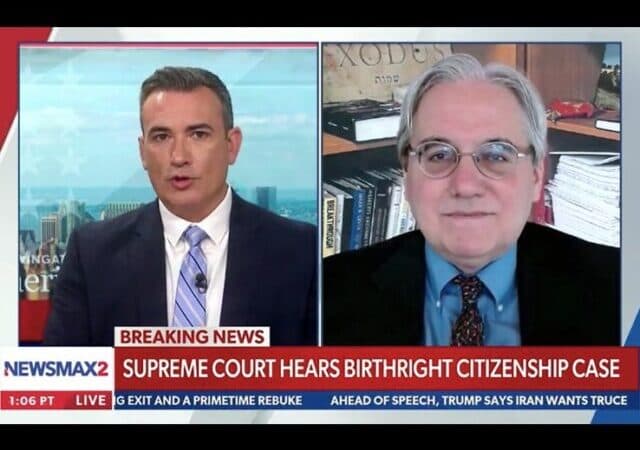
Supreme Court Takes Trump's Birthright Citizenship Challenge Seriously
Intra-Party Split Detected
Some conservatives express concern about abandoning originalist principles to restrict birthright citizenship, while others support ending 'anchor baby' policies
Left says
- •The 14th Amendment's plain text grants citizenship to all persons born in the United States and subject to its jurisdiction, without exceptions for the immigration status of parents
- •Historical precedent from the amendment's drafting shows framers deliberately broadened language beyond freed slaves to include all persons, rejecting attempts to limit citizenship by race or origin
- •Trump's executive order represents an unconstitutional attempt to rewrite the Constitution through administrative action rather than the proper amendment process
- •The administration's argument relies on redefining 'jurisdiction' to mean 'allegiance' despite no textual basis for this interpretation in the amendment
Right says
- •The United States is one of only 28 countries worldwide that grants automatic birthright citizenship, creating incentives for 'birth tourism' and undermining immigration sovereignty
- •The 14th Amendment's phrase 'subject to the jurisdiction thereof' was intended to exclude children whose parents owe primary allegiance to foreign nations
- •Modern global mobility allows anyone to fly to the United States and secure citizenship for their children, a scenario the amendment's framers never anticipated
- •Ending automatic birthright citizenship would restore meaningful borders and prevent exploitation of American citizenship laws by temporary visitors and illegal immigrants
Common Take
High Consensus- The Supreme Court justices took the constitutional challenge seriously during oral arguments rather than dismissing it as frivolous
- The case represents one of the most significant constitutional questions of the current Supreme Court term
- The 14th Amendment's citizenship clause was originally designed to ensure freed slaves and their children could become citizens
- Any changes to birthright citizenship policy would have profound implications for American immigration and citizenship law
The Arguments
Left argues
The 14th Amendment's text is unambiguous: 'All persons born or naturalized in the United States, and subject to the jurisdiction thereof, are citizens of the United States.' The framers deliberately chose broad language and rejected attempts to limit citizenship by race or origin, as evidenced by Senator Trumbull's expansion from 'African descent' to 'all persons.'
Right counters
The phrase 'subject to the jurisdiction thereof' was specifically included to exclude those whose primary allegiance lies elsewhere. The framers never intended for temporary visitors or illegal immigrants to secure citizenship for their children simply by being present on U.S. soil.
Right argues
The United States is one of only 28 countries worldwide that grants automatic birthright citizenship, creating perverse incentives for 'birth tourism' where wealthy foreigners exploit American citizenship laws. Modern global mobility allows anyone to fly to the United States and secure citizenship for their children, a scenario the amendment's framers never anticipated.
Left counters
Constitutional interpretation cannot be based on policy preferences or international comparisons. The Constitution's text and original meaning must govern, regardless of whether modern circumstances create outcomes the framers didn't foresee.
Left argues
Trump's executive order represents an unconstitutional attempt to rewrite the Constitution through administrative action rather than the proper amendment process. The administration's redefinition of 'jurisdiction' to mean 'allegiance' has no textual basis in the amendment and contradicts established legal precedent.
Right counters
The executive order merely clarifies the proper interpretation of existing constitutional text. The government has always had the authority to determine who qualifies for citizenship documentation, and this order aligns with the original understanding of the 14th Amendment's jurisdictional requirement.
Right argues
Historical evidence shows the 14th Amendment was designed to address the specific situation of freed slaves, not to create a universal birthright citizenship system. The jurisdictional clause was intended to exclude children whose parents owe primary allegiance to foreign nations, preserving meaningful national sovereignty over citizenship.
Left counters
The framers consciously broadened the language beyond freed slaves to include 'all persons,' and contemporary debates show they understood this would include children of Chinese immigrants and other foreigners. Senator Trumbull explicitly confirmed the amendment would make citizens of 'children of Chinese and Gypsies born in this country.'
Challenge Questions
These questions target genuine internal contradictions — meant to provoke honest reflection.
Right asks Left
“If the 14th Amendment's text is truly unambiguous and requires birthright citizenship for all persons born on U.S. soil, why did the framers include the qualifying phrase 'subject to the jurisdiction thereof' at all—what purpose does this language serve if not to create some limitation on automatic citizenship?”
Left asks Right
“If the original understanding of the 14th Amendment truly excluded children of temporary visitors and those without legal status, how do you reconcile this with the framers' explicit confirmation that it would grant citizenship to children of Chinese immigrants, who at that time were prohibited from becoming naturalized citizens themselves and thus could never develop the 'direct allegiance' your interpretation requires?”
Outlier Report
Left Fringe
Progressive activists like Elie Mystal and some Squad members who frame any restrictions as white supremacist attacks represent about 15% of the left, taking absolutist positions that reject any discussion of jurisdiction limitations.
Right Fringe
Hard-line immigration restrictionists like Stephen Miller and some America First commentators who want to retroactively strip citizenship from anchor babies represent about 20% of the right, going beyond what most conservatives support.
Noise Assessment
Moderate noise amplification. Legal scholars and constitutional experts are genuinely divided, but social media amplifies the most extreme positions on both sides while the actual case focuses on narrow jurisdictional questions.
Sources (8)
<p>My quick take on SCOTUS oral argument: "I think one of the big takeaways is this challenge to birthright citizenship has been dismissed as frivolous, as meaningless, as bad faith. But these Justices took it very seriously."</p> The post <a href="https://legalinsurrection.com/2026/04/there-is-a-popularized-conception-of-birthright-citizenship-which-may-not-be-accurate/">There is a “Popularized Conception of Birthright Citizenship, Which May Not be Accurate”</a> first appeared on <a href="https://legalinsurrection.com">Le·gal In·sur·rec·tion</a>.
<p>"What was really astonishing yesterday is it appeared that we might have nine originalists on the court because the liberal justices started to channel Scalia"</p> The post <a href="https://legalinsurrection.com/2026/04/professor-jonathan-turley-its-insane-we-continue-to-embrace-birthright-citizenship/">Professor Jonathan Turley: It’s ‘Insane’ We Continue to Embrace Birthright Citizenship</a> first appeared on <a href="https://legalinsurrection.com">Le·gal In·sur·rec·tion</a>.
The constitutional case against birthright citizenship is strongest when dealing with the children of transients through the country. <img src="https://i0.wp.com/www.nationalreview.com/wp-content/uploads/2026/04/scotus-birthright-case.jpg?fit=617%2C360&ssl=1" />
Now that a challenge has finally reached the Supreme Court, is birthright citizenship any safer?
As it happens, there is a direct precedent under U.S. law, well known to the drafters of the 14th Amendment.
Do we want to be the America of John C. Calhoun or Frederick Douglass?
Will the Trump administration lose another high-profile case?
<img alt="Supreme Court" class="webfeedsFeaturedVisual wp-post-image" src="https://thefederalist.com/wp-content/uploads/2026/04/7432022562_ffb903102e_k-e1775071894856-1200x675.jpg" style="display: block; margin: auto; margin-bottom: 5px;" />Supreme Court Chief Justice John Roberts’ “same Constitution” line during Wednesday’s oral arguments over birthright citizenship at first sounded like a defense of originalism. But in fact, it was the exact opposite. The high court heard oral arguments Wednesday in Trump v. Barbara, a case challenging the president’s 2025 executive order restricting birthright citizenship. U.S. […]