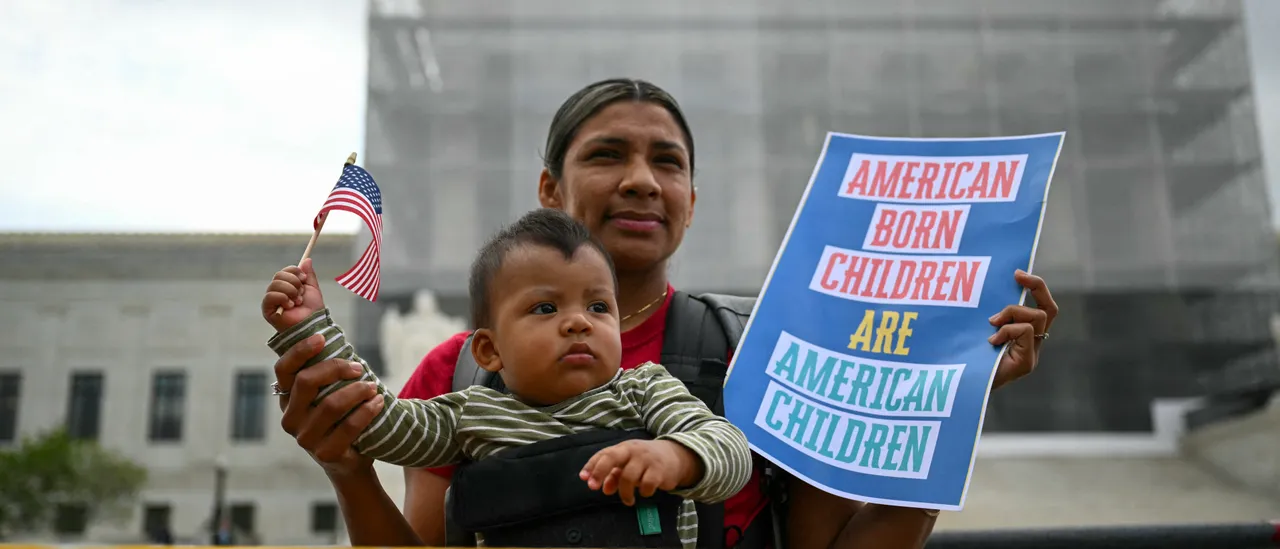
Supreme Court to decide who gets American citizenship at birth
Intra-Party Split Detected
Conservative legal scholars are split on Trump's birthright citizenship order, with some viewing it as constitutionally questionable despite supporting immigration restrictions
Left says
- •The 14th Amendment's plain language guarantees citizenship to all persons born in the United States, a principle upheld by the Supreme Court for 127 years and codified by Congress in 1940
- •Ending birthright citizenship would create a class of stateless children who lack access to essential services like education, healthcare, and social support systems
- •The constitutional protection was designed to ensure equal footing for all children born on American soil, preventing the creation of a permanent underclass
- •Trump's executive order represents an unprecedented attempt to rewrite constitutional law through executive action rather than the proper amendment process
Right says
- •The 14th Amendment's phrase 'subject to the jurisdiction thereof' was intended for freed slaves, not children of temporary visitors or illegal immigrants who lack allegiance to the United States
- •Automatic birthright citizenship incentivizes illegal immigration and undermines the value of legal immigration processes
- •Most developed nations worldwide have moved away from birthright citizenship policies, recognizing citizenship through family lineage instead
- •The current interpretation allows people to exploit American generosity by 'selling citizenships' through birth tourism and illegal border crossings
Common Take
High Consensus- The Constitution does not explicitly define what constitutes citizenship, leaving room for interpretation
- The 14th Amendment was enacted in 1868 specifically to address the citizenship status of freed slaves after the Civil War
- The Supreme Court's decision will have significant long-term implications for American immigration policy and demographics
- This case represents one of the most consequential constitutional questions the Court will decide in decades
The Arguments
Right argues
The 14th Amendment's phrase 'subject to the jurisdiction thereof' was specifically crafted to exclude children whose parents lack allegiance to the United States, as evidenced by the framers' debates about excluding 'Mongolians,' 'Gypsies,' and certain Native American tribes from citizenship.
Left counters
The Supreme Court definitively settled this interpretation 127 years ago, ruling that birthright citizenship applies broadly, and Congress codified this understanding in 1940 federal law that makes no distinction based on parental immigration status.
Left argues
Ending birthright citizenship would create approximately 255,000 stateless children annually who would lack access to essential services like education, healthcare, and social support, fundamentally undermining child welfare and creating a permanent underclass.
Right counters
These children would not be stateless but would inherit citizenship from their parents' home countries, and automatic birthright citizenship currently incentivizes dangerous illegal border crossings and birth tourism that exploits American generosity.
Left argues
Trump's executive order represents an unprecedented attempt to rewrite constitutional law through executive action rather than the proper constitutional amendment process, violating the separation of powers and 160 years of established legal precedent.
Right counters
The executive order simply corrects a misinterpretation of the 14th Amendment's original intent, which was to grant citizenship to freed slaves with established allegiance, not to children of temporary visitors or illegal immigrants who lack ties to America.
Right argues
Most developed nations worldwide have abandoned birthright citizenship policies in favor of citizenship through family lineage, recognizing that automatic citizenship based solely on geography undermines the value and meaning of legal immigration processes.
Left counters
The Constitution's plain language guarantees citizenship to 'all persons born' in the United States, and abandoning this principle would contradict America's foundational commitment to equality and opportunity regardless of parentage.
Left argues
Birthright citizenship ensures equal footing for all children born on American soil, preventing the creation of hereditary castes and upholding the fundamental American principle that citizenship is not determined by the circumstances of one's parents.
Right counters
True equality requires that citizenship be earned through proper legal processes and allegiance, not automatically granted to children whose parents deliberately circumvented immigration laws or are only temporarily present in the country.
Challenge Questions
These questions target genuine internal contradictions — meant to provoke honest reflection.
Right asks Left
“If the 14th Amendment's language is truly as 'plain' as you claim, why did the framers include the qualifying phrase 'subject to the jurisdiction thereof' at all, and how do you reconcile your interpretation with the documented debates showing the framers explicitly intended to exclude certain categories of people born on U.S. soil?”
Left asks Right
“If allegiance and domicile are the true tests for citizenship as you argue, how do you explain that newborn children of any parents—whether citizens, legal immigrants, or illegal immigrants—have identical capacity for allegiance to the United States, and why should a child's citizenship depend on their parents' legal status rather than their own potential as Americans?”
Outlier Report
Left Fringe
Progressive activists like those in certain immigrant rights organizations who argue any restrictions on birthright citizenship are inherently racist, representing roughly 15-20% of the left coalition.
Right Fringe
Immigration hardliners like Stephen Miller and some America First advocates who want to retroactively strip citizenship from anchor babies already born, representing about 25-30% of the right coalition.
Noise Assessment
Moderate noise level - while this is a genuine constitutional debate with real policy implications, much of the discourse is amplified by activists on both sides who use extreme scenarios to mobilize their bases rather than engage with the nuanced legal questions at stake.
Sources (10)
You don't have to delve deeply into the U.S. Constitution to see the word "citizen." The word first appears in Article I, Section 2, which states that to serve in the House of Representatives, a person must have been a citizen for seven years. "Citizen" appears 10 more times in the original seven articles that discuss the qualifications for office, legal disputes and rights. Yet nowhere does the Constitution define what a citizen is. In 1866, when Congress was debating the 14th Amendment, guaranteeing citizenship rights to former slaves, Sen. Edgar Cowan made that point: "I am really desirous to have a legal definition of 'citizenship of the United States.' What does it mean? What is its length and breadth?"
'Selling citizenships to our Country'
The Supreme Court hears arguments on birthright citizenship and whether Trump's executive order complies with the 14th Amendment's citizenship clause.
Before President Trump’s order to limit birthright citizenship, there was widespread agreement that the 14th Amendment guaranteed citizenship for U.S.-born babies.
President Trump claims that there is no automatic guarantee to birthright citizenship in the Constitution. But, will that claim hold up in court?
The Supreme Court will hear arguments Wednesday on whether all children born in the United States can continue to automatically receive citizenship.
All children, regardless of immigration status, have the right to a free K-12 public education. But without birthright citizenship, access to schools and colleges could get complicated.
The call to repeal birthright citizenship is part of the Trump administration's broader crackdown on immigrants. The case presents another test for a high court that has allowed some anti-immigration efforts to continue, even after lower courts had blocked them.
You don't have to go very deep into the U.S. Constitution to see the word "citizen" appear. It's first used in Article I, Section 2, where the founding document says to serve in the House of Representatives someone must have been a citizen for seven years.