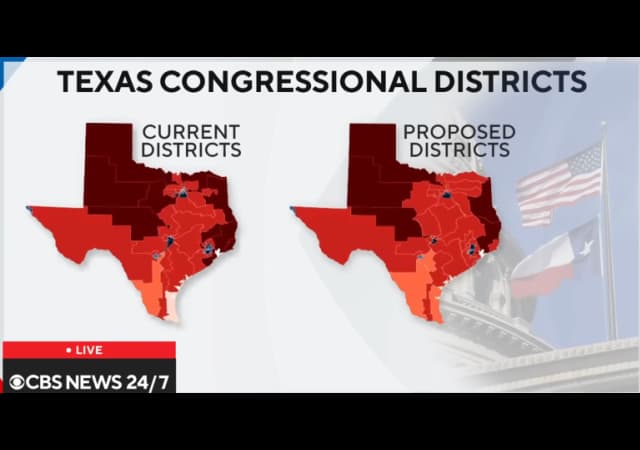
Supreme Court Upholds Texas GOP Gerrymandering Despite Liberal Dissent
Left says
- •The decision enables racial gerrymandering that dilutes minority voting power and undermines fair representation in Congress
- •Mid-cycle redistricting represents an unprecedented power grab that subverts democratic norms and electoral integrity
- •The conservative majority's summary reversal without full written opinions shows disregard for civil rights protections
- •Texas Republicans are manipulating district boundaries to maintain power despite changing demographics that favor Democrats
Right says
- •The Supreme Court correctly rejected meritless legal challenges and upheld Texas's constitutional authority to draw congressional districts
- •The redistricting process followed proper legislative procedures and reflects the legitimate will of Texas voters
- •Lower courts improperly second-guessed the legislature by failing to presume good faith in the redistricting process
- •The decision ensures that partisan redistricting remains a political question for elected officials rather than federal judges
Common Take
High Consensus- The Supreme Court's conservative majority prevailed 6-3 with all three liberal justices dissenting
- The new congressional map will add approximately five Republican seats to Texas's delegation
- Multiple states have engaged in mid-cycle redistricting efforts following the 2024 elections
- The legal battle involved extensive litigation in federal courts before reaching the Supreme Court
The Arguments
Right argues
The Supreme Court correctly upheld Texas's constitutional authority to draw congressional districts through its elected legislature, following proper procedures and reflecting the legitimate will of Texas voters who elected these representatives.
Left counters
Mid-cycle redistricting represents an unprecedented power grab that subverts normal democratic processes, as it allows the party in power to redraw maps outside the standard decennial cycle purely for partisan advantage.
Left argues
The decision enables racial gerrymandering that dilutes minority voting power, with the lower court finding strong direct evidence that Texas engaged in racial gerrymandering to maintain white political control despite changing demographics.
Right counters
The Supreme Court found that the lower court failed to honor the presumption of legislative good faith and improperly construed ambiguous evidence against the legislature, indicating the racial gerrymandering claims lacked sufficient proof.
Left argues
The conservative majority's summary reversal without full written opinions shows disregard for civil rights protections and fails to provide adequate legal reasoning for such a consequential decision affecting voting rights.
Right counters
The Court appropriately relied on established precedent from Abbott v. League of United Latin American Citizens, making lengthy written opinions unnecessary when the legal principles were already clearly established.
Right argues
Lower courts improperly second-guessed the legislature by failing to apply the correct legal standard, and challengers failed to produce viable alternative maps that met the state's legitimate partisan redistricting goals.
Left counters
Courts have a constitutional duty to protect voting rights and prevent racial discrimination, and requiring challengers to solve the legislature's partisan goals essentially makes racial gerrymandering immune from judicial review.
Left argues
Texas Republicans are manipulating district boundaries to maintain power despite changing demographics that favor Democrats, undermining fair representation and the principle that voters should choose their representatives, not the other way around.
Right counters
Partisan redistricting is a legitimate political question for elected officials rather than federal judges, and both parties engage in this practice when they control state legislatures, as evidenced by California's simultaneous Democratic redistricting efforts.
Challenge Questions
These questions target genuine internal contradictions — meant to provoke honest reflection.
Right asks Left
“If partisan redistricting is inherently undemocratic, why do you support California Democrats engaging in the same mid-cycle redistricting practices to gain five seats, and how can you argue for federal judicial intervention only when Republicans benefit?”
Left asks Right
“If you believe partisan redistricting should remain a political question for elected officials, how do you reconcile this position with the constitutional requirement for equal protection under the law when racial minorities are systematically excluded from fair representation?”
Outlier Report
Left Fringe
Progressive activists like those from Common Cause and Fair Fight who call for completely eliminating partisan redistricting through constitutional amendments represent about 15% of the left. They view any partisan redistricting as fundamentally illegitimate.
Right Fringe
Hard-right figures like Steve Bannon and some America First activists who explicitly celebrate gerrymandering as necessary political warfare represent about 10% of the right. They openly advocate for maximum partisan advantage rather than defending procedural legitimacy.
Noise Assessment
Moderate noise level - most discourse focuses on genuine constitutional and procedural questions rather than performative outrage, though some activists on both sides amplify extreme positions for fundraising purposes.
Sources (4)
Texas' newly redrawn congressional map is officially cleared for use, after the U.S. Supreme Court formally overturned a lower court's ruling Monday. In November, the high court allowed the map to be used temporarily. Monday's ruling maintains that status quo permanently, ensuring the new lines will be used for the 2026 midterms and going forward. The ruling ends the lengthy legal battle over Texas' efforts to add as many as five more Republican seats to the U.S. House. Texas took up this unusual mid-decade redistricting effort over the summer, after President Donald Trump pushed the state to help shore up the GOP's narrow majority in what is expected to be a difficult midterm election for the party. The effort drew significant pushback, including from state House Democrats, who left Texas to temporarily deny the chamber the headcount needed to pass the map. After the Democrats returned, the map passed, and legal challenges immediately followed. Several civil rights groups who…
The Supreme Court's conservative majority handed Texas Governor Greg Abbott a win by reversing a lower court's judgment in a case involving congressional maps. An order list released on Monday stated that liberal Justices Sonia Sotomayor, Elena Kagan and Ketanji Brown Jackson dissented from the summary reversal. The justices did not file full written opinions in this case. Texas Attorney General Ken Paxton praised the Supreme Court's decision on X. "Radical left-wing groups attempted to sabotage Texas's lawful redistricting efforts, but the Supreme Court's ruling is a clear rejection of these meritless attacks and a victory for the rule of law," Paxton wrote. "Texas's congressional map is lawful, constitutional, and reflects the will of our citizens, and I will continue to aggressively defend its use ahead of the 2026 midterm elections."
The Supreme Court handed down a victory for the Republican Party on Monday, striking down a lower court's ruling that had blocked Texas' plans for redrawing its congressional districts. The court hung its order on reasoning from a previous ruling in Abbott v. League of United Latin American Citizens but did not elaborate. The three liberal justices, Sonia Sotomayor, Elena Kagan and Ketanji Brown Jackson, dissented. The decision comes after the Supreme Court temporarily greenlit the state's map in December and California's map in February. Both states spearheaded the mid-cycle redistricting fights that have now been cropping up across the country. The high court's approval of both states' maps, giving Republicans and Democrats five-seat advantages, respectively, served to cancel each other's efforts out ahead of the 2026 midterms.
<p>The redrawn map would give Republicans five additional seats.</p> The post <a href="https://legalinsurrection.com/2026/04/supreme-court-allows-texas-to-use-redrawn-congressional-map-in-2026/">Supreme Court Allows Texas to Use Redrawn Congressional Map in 2026</a> first appeared on <a href="https://legalinsurrection.com">Le·gal In·sur·rec·tion</a>.