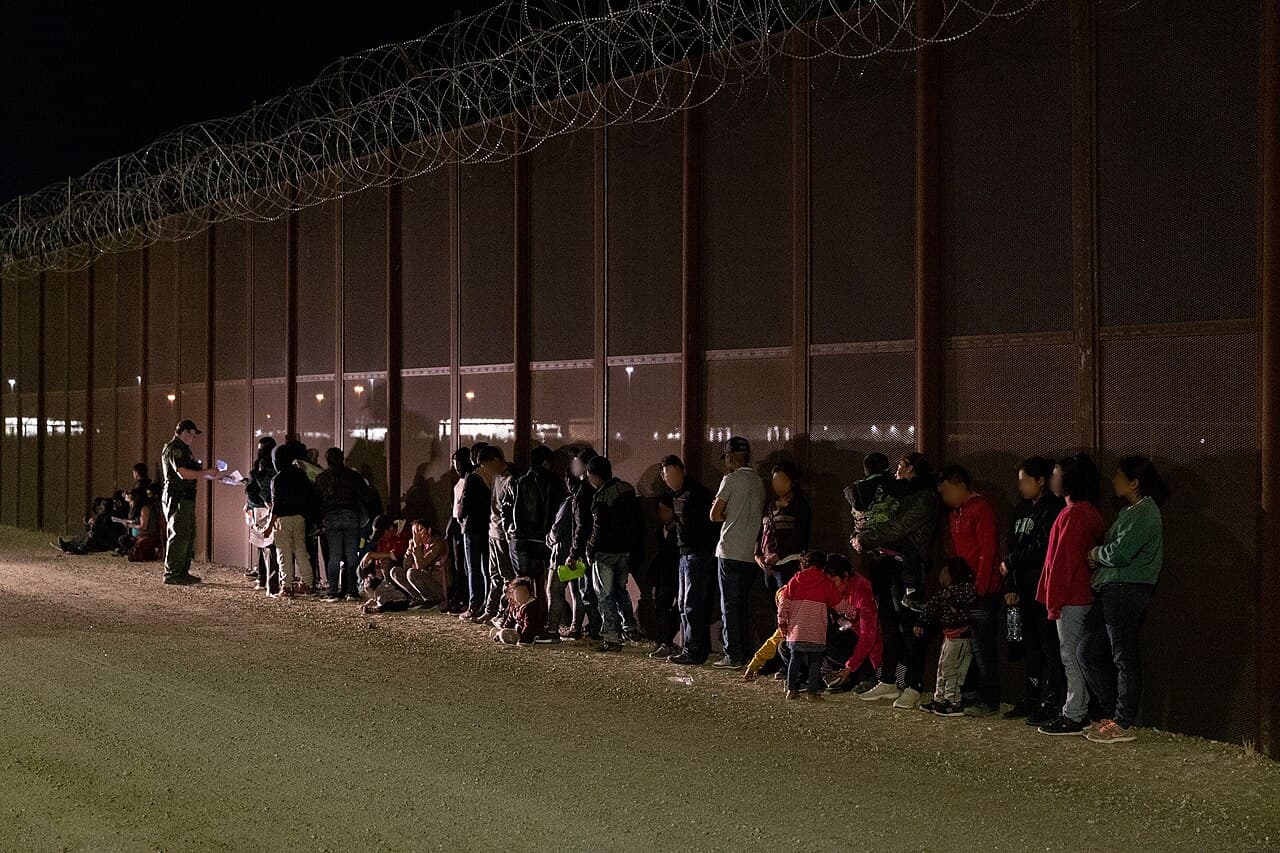
 Migrants wait at U.S.-Mexico border fence with razor wire, highlighting asylum border issues
Supreme Court weighs Trump's power to turn back asylum seekers
Left says
- •U.S. law guarantees anyone who steps foot in America the legal right to pursue asylum claims, and metering policies violate this fundamental protection by physically blocking migrants before they can exercise this right
- •The policy creates a dangerous precedent where border officials can act as gatekeepers who deny legal protections based on capacity constraints rather than individual merit
- •Turning back asylum seekers without any record or return date effectively eliminates their ability to seek protection from persecution, undermining America's humanitarian obligations
- •The practice disproportionately affects vulnerable populations fleeing violence and persecution who have traveled great distances to reach safety
Right says
- •Border officials need practical tools to manage surges and ensure orderly processing when resources are overwhelmed at ports of entry
- •The statutory language 'arrives in the United States' requires physical presence on U.S. soil, and migrants still in Mexico have not yet legally arrived
- •Metering allows for temporary management of border crossings while preserving the ultimate right to seek asylum when capacity permits proper processing
- •Without such policies, border facilities become dangerously overcrowded and officials cannot adequately screen individuals or process claims effectively
Common Take
High Consensus- The case centers on interpreting the specific statutory language of what it means to 'arrive in the United States' under federal immigration law
- Border officials face real capacity constraints and resource limitations when processing large numbers of migrants at ports of entry
- The metering policy was initially implemented during the Obama administration and later formalized under Trump
- Both lower courts ruled against the policy, with the district court and 9th Circuit finding it violated federal law
The Arguments
Left argues
U.S. law explicitly guarantees that anyone who 'arrives in the United States' has the right to seek asylum, and physically blocking migrants at ports of entry before they can exercise this right violates this fundamental legal protection. Metering effectively eliminates asylum claims by preventing migrants from ever establishing their legal presence, creating a dangerous precedent where border capacity constraints override individual legal rights.
Right counters
The statutory language requires that someone actually 'arrives in the United States,' meaning they must achieve physical presence on U.S. soil - migrants still standing in Mexico have not yet legally arrived and therefore cannot claim protections that depend on being within U.S. jurisdiction.
Right argues
Border officials need practical management tools to handle surges when processing facilities are overwhelmed, and metering allows for orderly processing while preserving the ultimate right to seek asylum when capacity permits proper screening. Without such policies, dangerous overcrowding prevents effective processing and adequate security screening of asylum claims.
Left counters
Metering policies provide no return dates or records of encounters, effectively making the 'temporary' delay permanent for many asylum seekers who have traveled great distances to escape persecution and cannot indefinitely wait in dangerous conditions in Mexico.
Left argues
The policy disproportionately affects vulnerable populations fleeing violence and persecution, undermining America's humanitarian obligations by forcing asylum seekers to remain in dangerous conditions without any guarantee they will ever be able to present their claims. This creates a system where border officials act as gatekeepers making life-or-death decisions based on capacity rather than individual merit.
Right counters
Proper asylum processing requires adequate resources and facilities to conduct thorough interviews and background checks - allowing unlimited entry during surges compromises the integrity of the entire system and potentially puts both migrants and communities at risk.
Right argues
The 9th Circuit's interpretation that 'arrives in the United States' includes people still physically in Mexico defies basic statutory interpretation and geographical reality. Legal precedent and common sense dictate that arrival requires actual entry into U.S. territory, not merely approaching the border.
Left counters
When migrants present themselves to U.S. officials at ports of entry and express fear of persecution, they have initiated the legal process of seeking asylum protection - the government cannot circumvent this legal right by simply refusing to allow them to complete the physical act of crossing.
Challenge Questions
These questions target genuine internal contradictions — meant to provoke honest reflection.
Right asks Left
“If the legal right to seek asylum can be triggered merely by approaching U.S. officials regardless of physical location, what prevents this interpretation from extending U.S. asylum protections to anyone who contacts American consulates or officials anywhere in the world, potentially making U.S. immigration law applicable globally?”
Left asks Right
“If border officials cannot manage entry during capacity constraints, and overcrowded facilities prevent proper processing and security screening, how does unlimited entry actually serve asylum seekers' interests when it may result in prolonged detention, inadequate hearings, or compromised safety assessments that could harm legitimate refugees?”
Outlier Report
Left Fringe
Immigration advocacy groups like Al Otro Lado and some progressive Democrats like Alexandria Ocasio-Cortez who argue any border management constitutes a violation of human rights, representing roughly 15-20% of the left coalition.
Right Fringe
Immigration hardliners like Stephen Miller and some America First Republicans who want to eliminate asylum entirely rather than just manage processing, representing about 25-30% of the right coalition.
Noise Assessment
Moderate noise level - while advocacy groups and political operatives amplify extreme positions, the core debate reflects genuine public concern about balancing humanitarian obligations with practical border management.
Sources (9)
Republican groups challenged a law in Mississippi that allows officials to count mail-in ballots received up to five days after polls close.
It turns out that where the U.S. border begins, at least for purposes of asylum, is not clear. The Supreme Court waded into that thorny question Tuesday. The justices were asked to decide whether migrants who reach the vicinity of the boundary but remain in Mexico or Canada are entitled to the same protections as someone clearly in the U.S. The justices struggled with where to draw the line, if not at the actual border. "How do you know under your theory when the person is close enough that we could say they have 'arrives in,' or arrived in, the destination?" said Justice Amy Coney Barrett, a Trump appointee. "How close do you have to be to the border?" Under the law, asylum is available to someone who is already present or who "arrives in" the country. Immigration advocates told the high court that the law stretches beyond U.S. soil to reach into Mexico or Canada to cover all those knocking on America's door. Being on the "threshold" was good enough, said Kelsi Corkran,…
A fight at the Supreme Court over the government's power to block asylum seekers from reaching ports along the Mexican border may come down to the definition of the word "in.". There were some prickly moments as the justices heard arguments Tuesday about the legality of a "metering" policy the Obama administration experimented with — and the first Trump administration adopted more broadly — under which Customs and Border Protection agents turned back asylum seekers at the Mexican border. A federal judge in San Diego and the 9th Circuit Court of Appeals ruled that the practice is illegal because federal law entitles any foreigner who is "physically present in the United States [or] arrives in the United States" to pursue an asylum claim.
The Supreme Court debated Tuesday whether the government can turn back asylum-seekers attempting to reach a port of entry, a practice that originated in the Obama administration that President Trump now wants the right to potentially restore. Known as "metering," border officials would turn back migrants before they could physically cross the border. The policy was rescinded several years ago. The Supreme Court fight turns on the meaning of two words: "arrives in." Under federal law, a noncitizen who "arrives in" the U.S. has the right to apply for asylum. But migrants who are turned back under metering never leave the Mexican side of the border, so the government argues they don't get a chance to apply.
Seeking asylum in the United States is a legal right. What happens when presidents block it?
Activist judges have been defying the Trump administration and making temporary protected status all but permanent. <img src="https://i0.wp.com/www.nationalreview.com/wp-content/uploads/2026/03/supreme-court-building.jpg?fit=617%2C360&ssl=1" />
<img alt="Migrants at the U.S.-Mexico border." class="webfeedsFeaturedVisual wp-post-image" src="https://thefederalist.com/wp-content/uploads/2026/03/U.S.-border-1200x675.jpg" style="display: block; margin: auto; margin-bottom: 5px;" />'If it's not crossing the physical border, what is the magic thing ... that we're looking for where we say, "Ah, now that person we can say 'arrives in' the United States?"' asked Justice Barrett.
The Supreme Court debated Tuesday whether the government can turn back asylum-seekers attempting to reach a port of entry, a practice that originated in the Obama administration that President Trump now wants the right to potentially restore.  Known as “metering,” border officials would turn back migrants before they could physically cross the border. The policy…
The Supreme Court weighed a policy that would allow agents at U.S. borders to block migrants from entering the country to seek asylum.