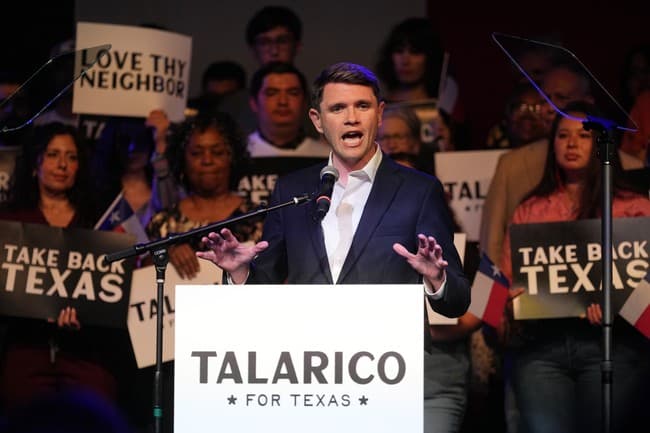
 James Talarico speaking at a campaign event with 'Talarico for Texas' signage.
Talarico Accuses Paxton of Voter Fraud—Then Faces Same Charge
Left says
- •Talarico's residency situation involves redacted voter records due to a state law protecting certain public officials from safety threats, and his campaign cites credible threats against him and his family as the reason for limited comment.
- •Paxton's case is arguably more clear-cut, since ProPublica and the Texas Tribune found he voted from an address his own estranged wife says he hasn't lived at for two years, across six consecutive elections including this year's primary.
- •Paxton has built his political brand and attorney general tenure around aggressively prosecuting voter fraud, making his own alleged violation a matter of hypocrisy rather than a simple technical lapse.
- •Paxton and his campaign have repeatedly refused to answer direct questions from reporters about his residency, dodging the issue at press conferences rather than addressing it.
Right says
- •Talarico leveled a voter fraud accusation at Paxton and then was found to have used his parents' address to vote in five elections after already purchasing his own nearby home, undercutting his attack with his own conduct.
- •This fits a broader pattern of credibility problems for Talarico, including an admitted inappropriate relationship with a former staffer and questions about his personal finances.
- •Talarico's public persona and past statements, including comments on gender, religion, and appearances at LGBTQ youth events, are cited as evidence he is out of step with mainstream Texas values despite ads portraying him as a moderate.
- •Paxton's campaign is focusing on an affordability agenda, including tax relief and homebuyer incentives, arguing this economic message is drawing large crowds and resonating with voters more than the residency dispute.
Common Take
High Consensus- Both Talarico and Paxton have voting registration histories that news organizations say may have violated Texas residency laws.
- ProPublica and The Texas Tribune broke both the Paxton and Talarico residency stories through independent review of voter records.
- Neither candidate has fully answered reporters' detailed questions about their own residency and voting history.
- The U.S. Senate race between Talarico and Paxton is closely contested according to multiple polls.
The Arguments
Left argues
Paxton's case is more clear-cut and arguably more serious because his estranged wife herself confirms he hasn't lived at the address he voted from for two years across six consecutive elections, and this is a man who has built his entire political brand on prosecuting voter fraud.
Right counters
Talarico leveled the fraud accusation first and was then shown to have done functionally the same thing—voting from his parents' address for five elections after already buying his own nearby home—so the hypocrisy charge cuts both ways, and arguably worse since he threw the first stone.
Right argues
Talarico's decision to publicly accuse Paxton of voter fraud invited scrutiny of his own record, and reporters found he used his parents' address to vote in five elections despite owning a home nearby, which undercuts his attack and raises the same legal questions he raised about Paxton.
Left counters
Talarico's residency records are redacted under a state law protecting certain officials due to credible safety threats, which is a materially different situation from Paxton's fully public, unredacted record showing his own wife disputes his residency claim.
Left argues
Paxton and his campaign have repeatedly refused to answer direct, specific questions from reporters about his residency at press conferences, dodging the issue entirely rather than explaining it, which is a notable evasion for someone who has made election integrity his signature issue.
Right counters
Talarico's campaign has also declined to answer detailed questions about his residency and voting history, citing safety threats rather than providing a substantive account of when he actually began living at his own home.
Right argues
Beyond the residency issue, Talarico faces a broader credibility problem including an admitted inappropriate relationship with a former staffer, a shared checking account with his mother, and public comments on gender and religion that many mainstream Texas voters would find genuinely out of step, undercutting his campaign's moderate branding.
Left counters
Attacking Talarico's religious views, LGBTQ event appearances, or personal relationships is a deflection from the substantive legal question of whether Paxton, the state's chief law enforcement officer, broke the same voter residency laws he has aggressively prosecuted others for violating.
Right argues
Paxton's campaign is focusing on a concrete affordability agenda—tax deductions for healthcare and homebuyers, a doubled child tax credit—that is reportedly drawing overflow crowds across Texas, suggesting voters care more about economic relief than the residency dispute.
Left counters
Large rally crowds don't resolve the legal question of whether the state's top law enforcement officer violated election law, and pivoting to an affordability message doesn't answer why Paxton's campaign still refuses to directly address the residency allegations.
Challenge Questions
These questions target genuine internal contradictions — meant to provoke honest reflection.
Right asks Left
“If Talarico's campaign says safety threats justify withholding details about his residency, why did he feel confident enough in his own compliance to publicly accuse Paxton of the same violation before that scrutiny was applied to himself?”
Left asks Right
“If pointing out Paxton's voting from an address his own wife says he hasn't lived at for two years is dismissed as a political distraction, why is the same category of allegation against Talarico treated as a disqualifying scandal rather than a similar distraction?”
Outlier Report
Left Fringe
Progressive commentators and some Democratic strategists who argue the residency comparison is a false equivalence given safety-threat redaction laws (roughly 15-20% of the left actively make this defense; most Democrats simply downplay the story rather than engage it).
Right Fringe
Commentators like those at PJ Media and Daily Wire framing Talarico's personal life (Pride event attendance, staffer relationship, religious statements) as disqualifying moral failures represent a more aggressive culture-war framing than most Republicans use; roughly 25-30% of the right engages this maximalist personal-attack framing versus focusing on the affordability/policy contrast.
Noise Assessment
High noise ratio: much of the right-wing coverage (Daily Wire, PJ Media) blends the voter-residency story with unrelated culture-war material (Pride events, transgender clinic settlements, religious quotes) that amplifies partisan outrage far beyond what average voters likely weigh when judging the residency issue itself.
Sources (7)
A top lawyer tied to a now-defunct transgender program for kids is hosting a high-dollar fundraiser on Saturday for Texas Democratic Senate candidate James Talarico, according to social media posts. The campaign event in Houston will be hosted by Afsheen Davis, senior vice president and general counsel for Texas Children’s Hospital. It comes just days ...
<p>The post <a href="https://www.propublica.org/article/james-talarico-texas-election-law-ken-paxton">James Talarico Accused Ken Paxton of Voter Fraud. His Own Voter Registration Is Raising Questions.</a> appeared first on <a href="https://www.propublica.org">ProPublica</a>.</p>
<p>The post <a href="https://www.propublica.org/article/ken-paxton-voter-registration-james-talarico">Ken Paxton Touts His Efforts to Fight Voter Fraud. His Senate Opponent Is Now Accusing Him of Committing It.</a> appeared first on <a href="https://www.propublica.org">ProPublica</a>.</p>