Trump Administration Prepares Military Options Against Cuba After Castro Indictment
Intra-Party Split Detected
Some Trump advisers oppose potential military intervention, warning it could become a 'quagmire' and preferring the president avoid 'boots on the ground for more than 48 hours'
Left says
- •The Trump administration is using the Castro indictment as pretext for military intervention, following the same playbook used to justify the Venezuela operation that captured Maduro
- •Decades of US sanctions and the recent oil blockade constitute collective punishment of Cuban civilians, creating a humanitarian crisis with widespread hunger and lack of medical care
- •This represents continued US imperialism in Latin America, where Washington seeks to overthrow governments that don't align with American interests regardless of international law
- •The timing coincides with Trump's humiliation in Iran, making Cuba an easier target to demonstrate military strength and distract from foreign policy failures
Right says
- •The Castro indictment addresses legitimate crimes from 1996 when Cuban forces shot down civilian aircraft, killing four people including three US citizens
- •Cuba's communist regime has oppressed its people for decades while enriching military elites through GAESA, which controls 70% of the economy
- •The US is offering $100 million in humanitarian aid and a path to normalized relations if Cuba frees political prisoners and holds democratic elections
- •Military preparations are defensive contingency planning in case the regime collapses or commits mass violence against protesters, not aggressive invasion plans
Common Take
High Consensus- The Cuban people are experiencing severe hardships including food shortages, fuel scarcity, and limited electricity access
- The 1996 Brothers to the Rescue shootdown resulted in the deaths of four people, including three US citizens
- Cuba's economy is in crisis following the end of Venezuelan oil shipments after Maduro's capture
- Both the US and Cuban governments acknowledge the current situation is unsustainable
The Arguments
Right argues
The Castro indictment addresses legitimate crimes from 1996 when Cuban forces shot down civilian aircraft, killing four people including three US citizens, and the US is offering $100 million in humanitarian aid plus normalized relations if Cuba frees political prisoners and holds democratic elections.
Left counters
The timing of this decades-old indictment immediately after the Venezuela operation reveals it as pretext for military intervention, while US sanctions and oil blockades have created the humanitarian crisis that aid supposedly addresses.
Left argues
Decades of US sanctions constitute collective punishment of Cuban civilians, creating widespread hunger and medical shortages, while the recent oil blockade has plunged the country into crisis with only two hours of electricity daily in some areas.
Right counters
Cuba's economic problems stem from the communist regime's control of 70% of the economy through GAESA, which enriches military elites while ordinary Cubans suffer, and the US has offered substantial humanitarian aid through non-governmental channels.
Left argues
This represents continued US imperialism in Latin America, following the same playbook used against Venezuela, where Washington seeks to overthrow governments that don't align with American interests regardless of international law.
Right counters
Military preparations are defensive contingency planning in case the regime collapses or commits mass violence against protesters, not aggressive invasion plans, and the US is pursuing diplomatic solutions first.
Right argues
Cuba's communist regime has oppressed its people for decades, brutally repressing protesters in 2022, while offering no democratic freedoms or economic opportunities that exist in neighboring countries like the Dominican Republic and Jamaica.
Left counters
The timing coincides with Trump's humiliation in Iran, making Cuba an easier target to demonstrate military strength and distract from foreign policy failures, rather than genuine concern for Cuban democracy.
Left argues
The US strategy of 'accelerationism' - deliberately hastening societal collapse through economic strangulation - targets civilians to pressure the government, violating principles of international law and humanitarian norms.
Right counters
The Cuban government chooses to prioritize military spending on 300 attack drones from Russia and China over addressing civilian needs, while rejecting US humanitarian aid that could alleviate suffering.
Challenge Questions
These questions target genuine internal contradictions — meant to provoke honest reflection.
Right asks Left
“If US sanctions are truly the primary cause of Cuban suffering, why does the Cuban government reject $100 million in US humanitarian aid that could be distributed through the Catholic Church and other non-governmental organizations to directly help civilians?”
Left asks Right
“If the primary goal is promoting democracy and human rights in Cuba, why pursue a strategy of economic strangulation that admittedly targets civilians, and why is the timing of this decades-old indictment coinciding with military preparations rather than genuine diplomatic outreach?”
Outlier Report
Left Fringe
Hasan Piker, Code Pink activists, and Democracy Now's Amy Goodman represent the anti-imperialist left that frames all US actions as imperialism, comprising roughly 15-20% of the left coalition.
Right Fringe
Marco Rubio and hardline Cuban-American exile groups in Miami who push for immediate military intervention represent about 25-30% of the right, while most conservatives prefer economic pressure first.
Noise Assessment
Moderate noise level - while activist voices on both extremes are amplified on social media, the core debate reflects genuine public disagreement about US foreign policy approaches to authoritarian regimes.
Sources (7)
<p>The <a href="https://www.axios.com/politics-policy/donald-trump" target="_blank">Trump</a> administration is bracing for the potential collapse of Cuba's totalitarian government as early as this summer, and has war-gamed new military response plans in case the island descends into chaos, U.S. officials tell Axios.</p><p><strong>Why it matters:</strong> President Trump hasn't authorized an invasion and prefers a peaceful transition to a free Cuba, so the administration will keep pushing economic sanctions to try to strangle the regime in Havana in a slow-motion constriction.</p><hr /><ul><li>"The best way to describe it is 'accelerationism,' " one senior administration official said, referring to the <a href="https://www.isdglobal.org/isd-explainer/accelerationism/" target="_blank">philosophy of hastening societal collapse</a>.</li><li>"But we don't want to kill off the regime just yet. There's a method to this. It's in stages."</li></ul><p><strong>Zoom in:</strong> This methodical squeezing of Cuba's communist regime is also designed to buy time for Trump — who's now engrossed in peace talks with Iran — to eventually focus on Cuba and decide how to bring about change there.</p><ul><li>"Iran's not finished, and the president is not in a rush," said another senior administration official. "Trump wants to exhaust all the levers that he can. But at this point, there aren't as many levers as before."</li><li>Said a third senior administration official: "We have a pretty deep toolbox, especially when it comes to sanctions and enforcing them. More is on the way."</li></ul><p><strong>The big picture:</strong> The Cuba operation aims to eliminate Latin America's source of Marxist agitation and anti-U.S. activism ever since Fidel and Raul Castro led their successful revolution in 1959.</p><ul><li>To bring Cuba to its knees this year, the administration first focused on the island's lifeline: Venezuela and its socialist leader, Nicolas Maduro, who kept Havana afloat with shipments of oil that helped power the country and gave it a source of export revenue.</li><li>Maduro, who'd been <a href="https://www.justice.gov/archives/opa/pr/nicol-s-maduro-moros-and-14-current-and-former-venezuelan-officials-charged-narco-terrorism" target="_blank">indicted </a>in the U.S. on "narco-terrorism" charges in 2020, was seized in a daring U.S. raid Jan. 3. After that, Venezuela's free oil shipments stopped, plunging Cuba into a new economic crisis.</li><li>The U.S. blames Cuba for its economic woes. Cuba blames the U.S.</li></ul><p><strong>Inside the room:</strong> Last month, U.S. Southern Command, which oversees military operations in the Caribbean, held a multiagency "tabletop" exercise to prepare for military action in Cuba, one of the senior U.S. officials said.</p><ul><li>"Everything is on the table, but no invasion is planned or imminent," the official said. "When POTUS says go, we're ready for anything."</li></ul><p><strong>In the exercise,</strong> another source said, U.S. officials discussed Cuba's possession of <a href="https://www.axios.com/2026/05/17/us-military-drones-cuba" target="_blank">drones </a>and how to respond to possible unrest in the sweltering Cuban heat as spring turns to summer. </p><ul><li>During the July 11, 2022, uprisings on the island, Cuban authorities <a href="https://www.amnesty.org/en/latest/news/2022/07/five-things-you-should-know-cubas-11-july-protests/" target="_blank">brutally repressed and imprisoned</a> demonstrators demanding more freedoms. Now circumstances are worse.</li><li>"It's going to be hot. People won't have electricity. Food spoils without refrigeration. People get angry. They can take to the streets. And then what happens? I can't see the president doing nothing if there's repression," that source said. </li><li>But another source, a Trump adviser, disagreed: "The president does not want boots on the ground for more than 48 hours. It's a quagmire in the making. This could get messy."</li></ul><p><strong>Zoom out: </strong>One presidential adviser said the approach to Cuba is "classic Trump: Push your enemy off balance. It's pressure, watch the response, apply more pressure, watch the response, apply more pressure."</p><ul><li>On May 1, Trump signed an executive order imposing "secondary sanctions" targeting companies, many of them foreign, from doing business with the mammoth Cuban military-industrial umbrella organization known as GAESA. </li><li>The order led Canadian mining company<a href="https://apnews.com/article/sherritt-cuba-canada-trump-sanctions-d2bd6d9a4188e6b81725c0c8a21a533a%5C" target="_blank"> Sheritt International</a> and the shipping companies <a href="https://www.reuters.com/world/americas/frances-cma-cgm-suspends-cuba-bookings-after-us-executive-order-2026-05-17/" target="_blank">CMA CGM and Hapag-Lloyd </a>to suspend their Cuba operations. Financial institutions and hotel companies in countries such as Spain, Panama and Mexico are expected to pull out of Cuba as well. </li><li>These sanctions differ from the U.S. embargo, which essentially prohibits trade with the island and has existed in one form or another since 1962.</li><li>"We've never seen this kind of pressure," said Max Meizlish, an ex-Treasury official who specialized in Cuba sanctions. "It's an entirely new ballgame."</li></ul><p><strong>Between the lines:</strong> Secretary of State Marco Rubio is a chief architect of Trump's Latin America policy and has led the administration's messaging against GAESA. He <a href="https://www.axios.com/2026/05/07/rubio-cuba-sanctions" target="_blank">announced </a>GAESA sanctions on May 7 and made it the centerpiece of a May 20 Cuban Independence Day video <a href="https://www.axios.com/2026/05/20/rubio-cuba-speech-independence-day" target="_blank">message</a> to the island's citizens.</p><ul><li>That day, the Justice Department unsealed a federal murder indictment of Raul Castro for allegedly ordering the 1996 <a href="https://www.cnn.com/2026/05/19/americas/brothers-rescue-cuba-raul-castro-indictment-intl-latam" target="_blank">Brothers to the Rescue</a> shootdowns. And SOUTHCOM <a href="https://x.com/Southcom/status/2057131106005090406" target="_blank">announced</a> the arrival of the Nimitz Carrier Strike group in the region.</li><li>On May 21, Rubio <a href="https://x.com/SecRubio/status/2057594756377588038" target="_blank">announced</a> the arrest of the sister of the woman running GAESA after he terminated her green card. </li><li>Two days later, Fox News <a href="https://www.foxnews.com/politics/after-your-boy-hasan-piker-lashes-out-over-fed-probe-cuba-trip" target="_blank">reported</a> that Treasury officials were examining leftist streamer Hasan Piker and the activist group Code Pink for potentially violating U.S. sanctions during a March trip to Cuba.</li></ul><p><strong>State of play: </strong>Castro's indictment led to comparisons with the Maduro regime-change operation, but Trump officials and advisers say there are three crucial differences:</p><p><strong>1.</strong> <strong>The U.S. has no</strong>t identified, nor has Trump picked, Cuban officials who could run an interim government in Havana if the current regime collapses.</p><ul><li>In contrast, Trump had decided Maduro could be safely replaced by Venezuela's vice president, Delcy Rodriguez, well before the Jan. 3 raid in Caracas.</li><li>"The problem is not that there's no Delcy in Cuba. There could be Delcy Lites or people who are Delcy-ish. But there's no greenlight from [Trump] to really engage yet," said one official.</li></ul><p><strong>2. Seizing Castro in</strong> the same way Maduro was abducted wouldn't lead Cuba to a dramatic reorientation toward the U.S. because the Castros 30 years ago began transitioning away from one-man rule.</p><ul><li>"The problem with that decentralization, it breeds lack of decision-making and lots of incompetence," the official said.</li></ul><p><strong>3</strong>. <strong>The Cuban embargo</strong> is also codified in U.S. law and can be undone only if the island frees political prisoners, has free elections and guarantees other civil rights. That limits Trump from normalizing relations with a new government by executive fiat as he did in Venezuela, whose sanctions had been imposed by the U.S. executive branch.</p><ul><li>"The problem is that Congress has a say," the official said, noting that Miami's three Cuban-American congressional representatives have hardline positions on Cuba that reflect South Florida's conservative exile community.</li></ul><p><strong>The Cuba policy is not all sticks. </strong>There are carrots as well.</p><ul><li>The U.S. this month announced it's giving $100 million in assistance to Cuba, provided it's not sent to the government and flows instead through the Catholic Church and other charities. It offered $6 million to Cuba after Hurricane Melissa last year.</li><li><strong>"</strong>If we wanted to hasten the collapse, we would not have sent any assistance," said senior administration official who described U.S. policy as a "campaign to show people they can have a better life if the regime got out of their way."</li><li>Cuba's foreign minister, Bruno Rodriguez Parrilla, <a href="https://www.foxnews.com/media/cubas-foreign-minister-accuses-marco-rubio-lying-americans-justify-action-cuba" target="_blank">told Fox News</a> on Sunday that the U.S., and Rubio specifically, are manipulating public opinion to justify military intervention.</li></ul><p><strong>The bottom line:</strong> "The politics are complicated on both sides [of the Strait of Florida]," one of the officials said. </p><ul><li>"But we have time. The regime doesn't."</li></ul>
<p>Secretary of State <a href="https://www.axios.com/2026/05/07/rubio-cuba-sanctions" target="_blank">Marco Rubio</a> marked Cuban Independence Day on Wednesday with a Spanish-language video message to the people of the island that blamed their "unimaginable hardships" on their communist leadership.</p><p><strong>Why it matters:</strong> This is the first time Rubio has addressed the Cuban population directly as secretary of state. It's part of the Trump administration's multi-layered <a href="https://www.axios.com/2026/01/11/trump-cuba-threat-maduro-venezuela-oil" target="_blank">pressure campaign targeting Havana</a>.</p><hr /><ul><li>"The real reason you don't have electricity, fuel, or food is because those who control your country have plundered billions of dollars, but nothing has been used to help the people," Rubio says in the speech.</li><li>Later Wednesday, the Justice Department will unveil the indictment of Cuba's de facto leader, Raúl Castro, for allegedly ordering the shootdown of two Miami-based rescue planes in 1996.</li></ul><p><strong>Zoom in: </strong>Rubio's speech focuses on the Cuban military business conglomerate known as GAESA — founded by Castro — that has an estimated $18 billion in assets and controls 70% of Cuba's economy through its control of hotels, construction, banks, stores and cash remittance from the U.S.</p><ul><li>Rubio contrasts the wealthy elites who run GAESA with the lives of destitute Cubans, seeking to show that revolutionary communism is a kleptocratic sham.</li><li>"Cuba is not controlled by any 'revolution.' Cuba is controlled by GAESA," Rubio says.</li><li>'The only role played by the so-called 'government' is to demand that you continue making 'sacrifices' and repressing anyone who dares to complain."</li><li>He adds: "Today, from media to entertainment, from the private sector to politics, and from music to sports, Cubans have reached the top of virtually ALL industries, in all countries, except one ... Cuba."</li></ul><p><strong>The other side:</strong> Cuba's government and supporters blame the island's troubles on the longstanding U.S. embargo, the Trump administration's new sanctions and the lack of oil it used to receive for free from Venezuela before the U.S. seized leader Nicolas Maduro on Jan. 3.</p><ul><li>"Acting as the world's policeman and in blatant violation of international law and the fundamental principles of free trade in goods and services, the sovereign right of all states that have or wish to maintain economic, commercial, and financial relations with Cuba is being explicitly, blatantly, and directly attacked," read a May 8 <a href="https://en.granma.cu/cuba/2026-05-08/the-executive-order-of-may-1st-and-the-blockade-measures-announced-today-increase-the-harm-to-the-cuban-population-and-reinforce-the-threat-of-aggression" target="_blank">editorial</a> in state-run media that criticized Trump's recent <a href="https://ofac.treasury.gov/media/935581/download" target="_blank">executive order</a> imposing new sanctions.</li><li>At Rubio's suggestion, Trump's executive order was issued on May 1 because it coincided with the communist International Workers Day.</li></ul><p><strong>The big picture:</strong> Cuba's economy and government have never been in such an advanced state of decay as it is now. Food and fuel are scarce. Electricity is available for only two hours a day in some places.</p><ul><li>"President Trump is offering a new relationship between the U.S. and Cuba. But it must be directly with you, the Cuban people, not with GAESA," Rubio says.</li><li>The Trump administration is offering "$100 million in food and medicine for you, the people," he says, but it needs to be distributed by the "Catholic Church or other trusted charitable groups. Not stolen by GAESA to sell in one of their stores."</li></ul><p><strong>Meanwhile,</strong> U.S. officials told <a href="https://www.axios.com/2026/05/17/us-military-drones-cuba" target="_blank">Axios</a>, Cuba's government has found enough money to buy at least 300 attack drones from Russia and China in case hostilities erupt.</p><ul><li>Cuba also hosts Iranian, Russian and Chinese military and intelligence officials.</li></ul><p><strong>Flashback: </strong>In Trump's first term, Rubio was a U.S. senator from Florida and helped the president in 2017 construct a new sanctions regime that revolved around starving GAESA of money.</p><ul><li>A year later, Rubio and his fellow Cuban Americans from Miami called for the indictment of Castro by the Justice Department, which will officially happen today.</li></ul><p><strong>Between the lines:</strong> The Castro indictment signifies that U.S. negotiators aren't making significant progress with Cuban leaders in negotiating a peaceful transition to a more democratic country that's no longer considered a state sponsor of terror by the U.S.</p><ul><li>State Department <a href="https://www.axios.com/2026/04/17/cuba-negotiations-trump-havana-castro" target="_blank">personnel</a> and CIA Director <a href="https://www.axios.com/2026/05/14/cia-ratcliffe-cuba-talks-raulito" target="_blank">John Ratcliffe </a>have flown to Cuba and spoken to leaders there, including Castro's grandson, Raulito Castro, who has also met with Rubio.</li><li>All U.S. officials have delivered the same message urging Cuba to free political prisoners, hold free elections and return land to U.S. persons and businesses that were seized after the 1959 revolution.</li></ul><p><strong>Zoom out: </strong>May 20 marks Cuba's birth as a republic in 1902 following the Spanish-American War, but the holiday isn't celebrated on the island itself.</p><ul><li>Fidel Castro's government scrapped the holiday after the 1959 revolution.</li></ul><p><strong>What's next:</strong> More indictments of other Cuban officials and more sanctions announcements are likely on their way from the Trump administration.</p><ul><li>Rubio's speech doesn't mention that, but instead offers "you, the ordinary Cuban, and not just GAESA," the right to own a business, whether it's a gas station or a media company.</li><li>"A new Cuba," Rubio says, would be a place where people can vote on their government officials and "where you can complain about a failing system, without fear of going to jail or being forced to leave your island."</li><li>"This is not impossible. All of this exists in the Bahamas, the Dominican Republic, Jamaica and even just 90 miles away, in Florida. If owning your own business and having the right to vote is possible around Cuba, why is it not possible for you in Cuba?'</li></ul>
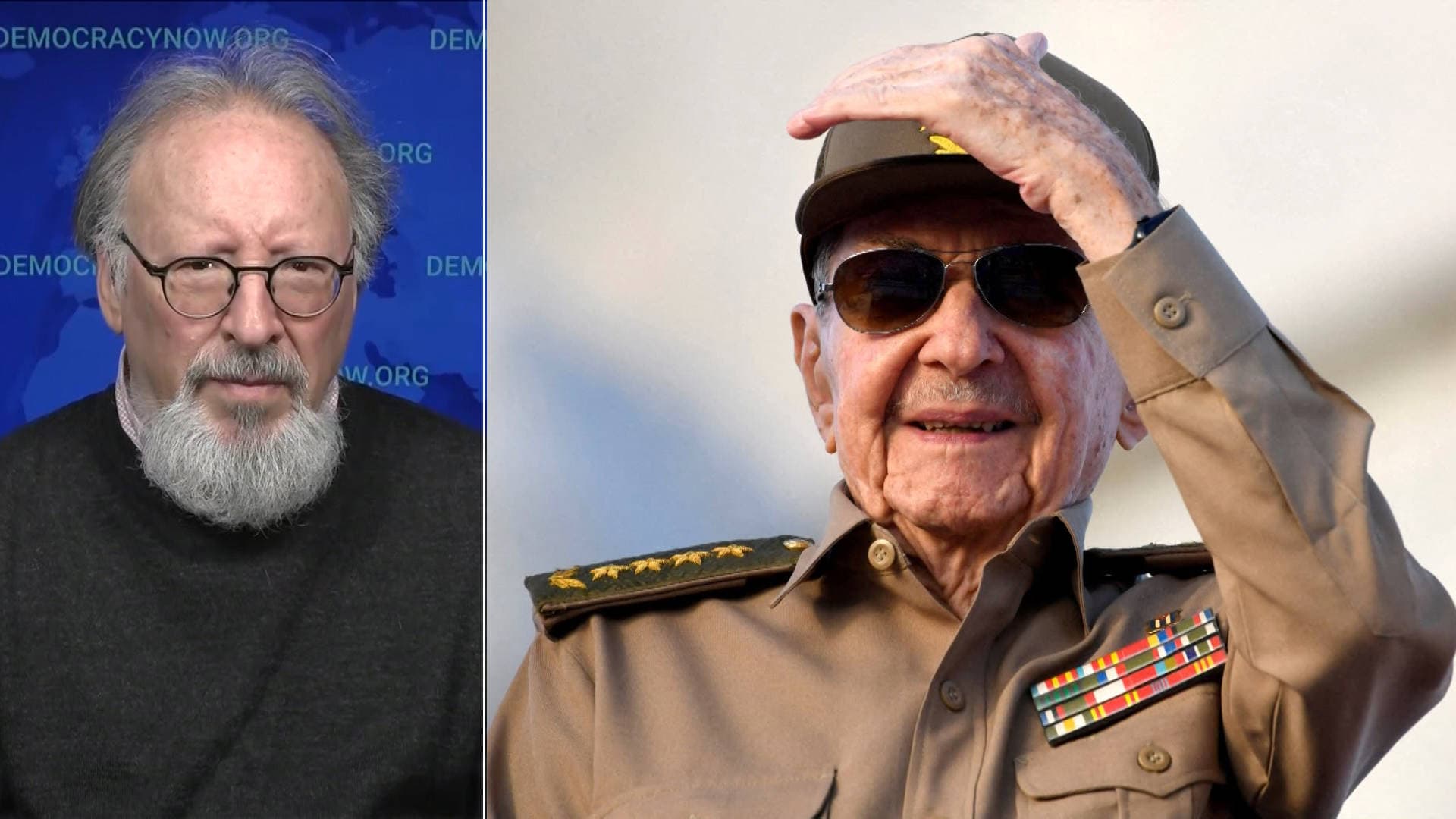
In the latest escalation of the decadeslong U.S. pressure campaign against Cuba’s communist government, the Trump administration is expected to unseal an indictment against Raúl Castro, the 94-year-old former president of Cuba, later today. The charges stem from the 1996 shootdown of four pilots with Brothers to the Rescue, the U.S.-based anti-Castro organization formed by Cuban exiles and dissidents. Peter Kornbluh, a Cuba specialist at the National Security Archive, says that the indictment will send “a clear warning” to Cuban leaders and provide justification for a possible future attempt to capture or assassinate Castro. “Military options are on the table and coming soon,” says Kornbluh. “It is absolutely clear that the U.S. military is preparing contingency operations in case Trump’s impatience runs out because Cuba has not met his imperial demands fast enough.”
In Havana, we speak to journalist Ed Augustin, who calls the Trump administration’s strict fuel blockade of Cuba, in place since the beginning of 2026, “the collective punishment of a population, particularly targeting poor communities, pregnant women, children and the elderly.” Augustin shares stories of hardship faced by everyday Cubans who are increasingly forced to go without electricity, drinking water and medical care.
<p>For centuries, the US has engaged in imperialist intervention in Latin America. The Castro indictment looks like its latest move</p><p>On 20 May, a federal court in the state of Florida <a href="https://www.nytimes.com/interactive/2026/05/20/us/raul-castro-indictment-cuba.html">indicted</a> the former Cuban president <a href="https://theconversation.com/why-has-the-us-indicted-former-cuban-president-raul-castro-283467">Raúl Castro</a> over his <a href="https://www.theguardian.com/world/2026/may/20/cuba-raul-castro-indictment">alleged involvement</a> in downing two civilian planes piloted by US nationals in 1996. Castro was the defense minister of Cuba at the time, and aircraft with the Cuban armed forces carried out the attacks. The charges include one count of conspiracy to kill US nationals, two counts of destruction of aircraft and four counts of murder.</p><p>On the one hand, the indictment was not a surprise. Immediately after the Trump administration’s bombing of Caracas and <a href="https://www.theguardian.com/world/gallery/2026/jan/07/us-venezuela-attack-maduro-arrest-in-pictures">extraction of the sitting Venezuelan president</a>, Nicolás Maduro, in January – actions bolstered by a <a href="https://www.theguardian.com/world/2026/jan/04/maduro-indictment-trump-tren-de-aragua">similar indictment</a> against Maduro emanating from a federal district court in New York – numerous indicators suggested that <a href="https://www.theguardian.com/us-news/2026/feb/27/trump-cuba-regime-change">Cuba was next</a> on the list. The Castro indictment seemingly confirms these suspicions, though questions remain about what comes next: will US forces carry out a similar bombing and extraction operation in Cuba? Will there be a full-scale invasion of the island? Or will the threat of these actions be enough to force concessions that might, at least in the short term, satisfy Trump officials?</p> <a href="https://www.theguardian.com/commentisfree/2026/may/28/cuba-castro-indictment-latin-america-violence">Continue reading...</a>
<p>The decision to charge Raúl Castro is grimly reminiscent of the run-up to Trump’s military operation in Venezuela. Meanwhile, the Cuban people are suffering needlessly</p><p>The US war machine has turned its sights on Cuba. Marco Rubio, the Cuban-American secretary of state who has long craved the fall of the island’s communist government, made that clear again <a href="https://www.theguardian.com/us-news/2026/may/22/marco-rubio-nears-goal-topple-cuba-government">last week</a>. While professing a preference for a “negotiated settlement”, he said the chances of a deal were “not high”. A couple of months ago, <a href="https://www.theguardian.com/commentisfree/2026/mar/25/havana-warfare-donald-trump-oil-blockade">I saw up close the economic devastation</a> already inflicted by decades of US siege – and, since January, by a <a href="https://www.theguardian.com/commentisfree/2026/mar/09/cuba-us-regime-change-iran-war">crippling oil blockade introduced by Donald Trump</a>.</p><p>The <a href="https://www.theguardian.com/world/2026/may/20/cuba-raul-castro-indictment">US has now charged</a> the country’s former president Raúl Castro with conspiracy to kill US nationals, four counts of murder and two counts of destruction of aircraft over the downing of two planes in 1996. The evidence points increasingly in one direction: it is all grimly reminiscent of the indictment of Venezuela’s Nicolás Maduro, used to justify his <a href="https://www.theguardian.com/world/2026/jan/04/tactical-surprise-and-air-dominance-how-the-us-snatched-maduro-in-two-and-a-half-hours">kidnapping by US forces</a>.</p><p>Owen Jones is a Guardian columnist</p> <a href="https://www.theguardian.com/commentisfree/2026/may/28/us-cuba-humiliation-donald-trump">Continue reading...</a>
The United States indicted former Cuban President Raúl Castro in federal court last week, one of its most aggressive actions against the island since the end of the Cold War. The unsealed indictment charges Castro, the 94-year-old brother of deceased Cuban leader Fidel Castro, and five others for alleged involvement in the shooting down of […]