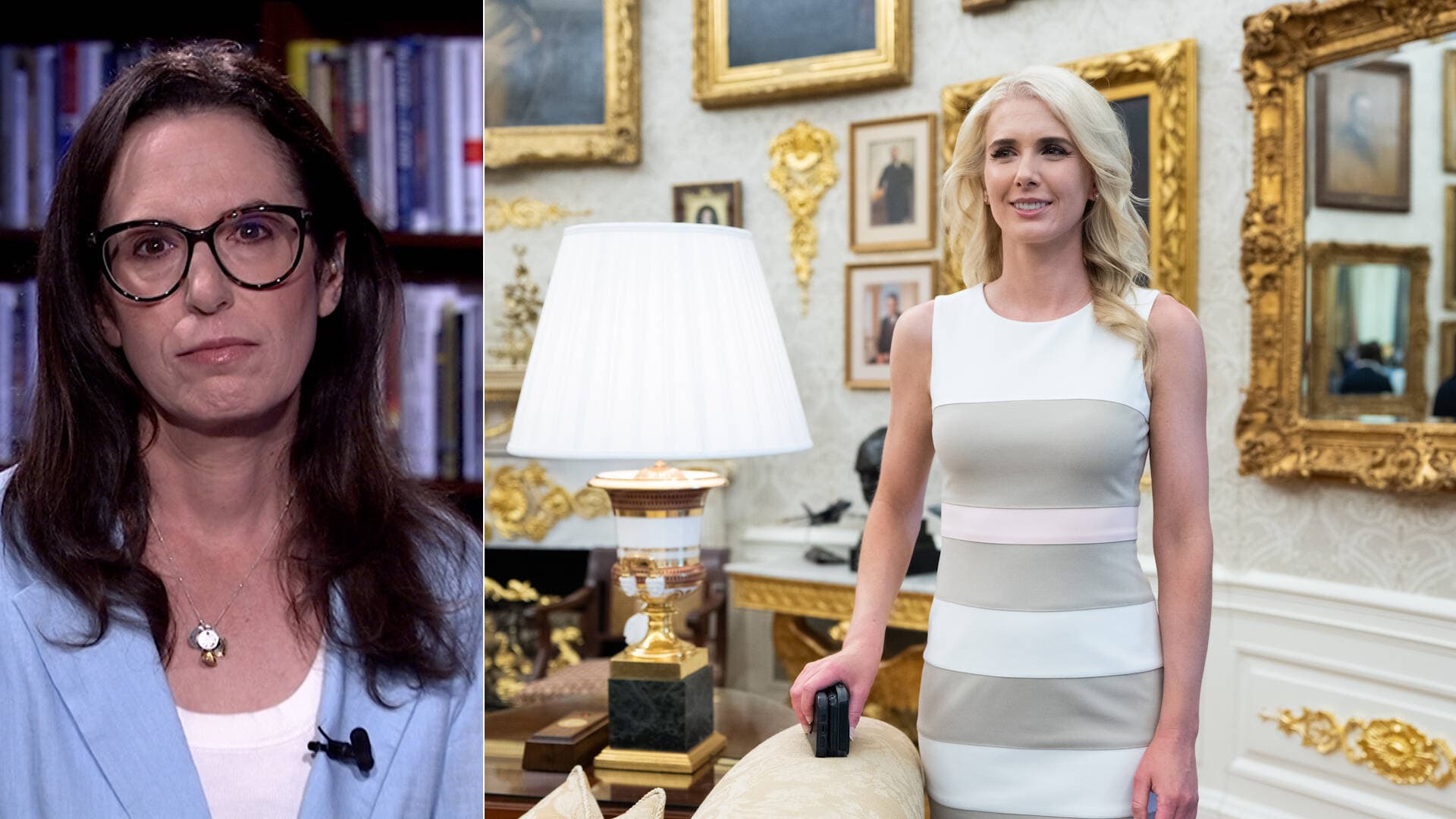
 Natalie Harp standing in an ornate White House room, with Maggie Haberman inset.
Trump Aide's Obsessive Letters Spark Misogyny Debate
Intra-Party Split Detected
Most Republicans defended Harp against Ossoff's remarks as sexist, but some former Trump aides (e.g., Sarah Matthews) and White House colleagues reportedly expressed unease or discomfort about Harp's behavior and closeness to Trump.
Left says
- •Harp's letters, security clearance delays, and inclusion on the emergency evacuation plane over Secretary of State Marco Rubio raise legitimate questions about how access and influence are distributed in the White House, independent of any romantic speculation.
- •Multiple current and former aides reportedly find Harp's devotion to Trump unsettling, suggesting the concern isn't partisan point-scoring but a genuine, widely shared unease within Trump's own orbit.
- •Conservatives who suddenly champion Harp as a wronged professional woman are seen as selectively applying feminist framing only when it shields an ally, not out of consistent principle.
- •Scrutiny of Harp's role — including her reported habit of feeding Trump flattering or inflammatory content — is about power and judgment in government, not about mocking her as a woman.
Right says
- •Jon Ossoff's remark insinuating a romantic or inappropriate relationship between Trump and Harp, without evidence, is an unfair and demeaning smear against a woman simply doing her job.
- •Portraying a professional aide's loyalty and hard work as creepy or obsessive reflects a double standard that wouldn't be applied to a male staffer with similar devotion to a boss.
- •Harp's letters, even if awkwardly worded or emotionally earnest, don't prove wrongdoing or an inappropriate relationship, and publicizing private correspondence to fuel gossip is an invasion of her privacy.
- •Republicans defending Harp argue they are applying a consistent standard against sexist attacks on women in public life, not simply protecting a political ally.
Common Take
High Consensus- Natalie Harp is a 35-year-old special assistant and executive assistant to President Trump who has become one of his closest aides.
- Harp accompanied Trump on the secretive plane transfer during the NATO summit in Turkey while Secretary of State Marco Rubio did not.
- Harp delayed completing her routine security clearance process for nearly a year before Trump intervened.
- Jon Ossoff's reference to 'Natalie' during a campaign speech is what triggered the current wave of national attention on Harp.
The Arguments
Left argues
Harp's year-long delay in completing a security clearance while sitting ten feet from the president, combined with her seat on the emergency evacuation plane over Secretary of State Rubio, raises legitimate institutional questions about how access and influence are allocated in the White House.
Right counters
Personnel and security decisions are the president's prerogative, and scrutinizing them is fair, but that scrutiny has been swallowed by tabloid speculation about romance rather than focused on the actual process failures, which undermines the credibility of the concern.
Right argues
Jon Ossoff's pointed reference to 'Natalie' during a rally, paired with a joke about a 'flying palace,' was clearly designed to insinuate an improper relationship without any evidence, which is a smear against a professional woman doing her job.
Left counters
Ossoff's comment was about Trump's priorities and use of a foreign-gifted jet, not primarily about Harp; reading it as a sexual insinuation says more about the assumptions of those amplifying that interpretation than about what Ossoff actually said.
Left argues
Multiple current and former Trump aides, including Sarah Matthews, independently describe Harp's devotion as unsettling, suggesting this is a widely shared concern inside Trump's own orbit rather than a partisan attack invented by Democrats.
Right counters
Anonymous or politically opposed former staffers characterizing a colleague's work ethic as 'obsessive' or 'creepy' is precisely the kind of gendered judgment that wouldn't be leveled at a male aide who was equally tireless and loyal.
Right argues
Publishing Harp's private, emotionally raw letters to mock her grammar and psychoanalyze her devotion crosses from legitimate journalism into public humiliation of a private citizen's inner life.
Left counters
Harp is not a private citizen but a highly paid, powerful gatekeeper controlling what information reaches the president, including inflammatory content like the AI-generated racist post; her judgment and conduct in that public role are squarely fair game.
Left argues
Conservatives who ignored years of sexist attacks on women like Hillary Clinton or Kamala Harris but suddenly cast themselves as feminist defenders the moment an ally is scrutinized reveal a selective, opportunistic use of gender-fairness arguments.
Right counters
Pointing out inconsistency in when critics invoke feminism doesn't make the current criticism of Harp any less sexist; a valid principle applied selectively is still valid when applied correctly this time.
Challenge Questions
These questions target genuine internal contradictions — meant to provoke honest reflection.
Right asks Left
“If commentators on the left insist their scrutiny of Harp is strictly about power, access, and security process rather than her gender or personal life, why has so much left-leaning coverage focused on mocking her letters' tone, grammar, and emotional language rather than the security clearance timeline itself?”
Left asks Right
“If defenders of Harp argue that publicizing her private letters is an unfair invasion of privacy, how do they reconcile that with the argument that scrutiny of her official conduct and access to the president is fair game, given that the letters are being used as evidence of exactly that conduct?”
Outlier Report
Left Fringe
Commentators like Arwa Mahdawi (Guardian) who frame the entire controversy as conservative hypocrisy on feminism rather than engaging with legitimate security/access concerns represent a more dismissive, mocking wing—roughly 15-20% of the left.
Right Fringe
Figures like Newt Gingrich, who frame Ossoff's comment as a full-blown misogynistic smear deserving political consequences, represent a more aggressively defensive wing—roughly 20-25% of the right—that elevates Harp's treatment into a broader culture-war grievance rather than a nuanced privacy concern.
Noise Assessment
High. Much of the coverage is driven by media figures (Haberman, Wolff, Slate writers) and political actors (Ossoff, Gingrich, Jennings) rather than organic public sentiment; most ordinary Americans likely have only passing awareness of this story compared to the intense media/political class fixation on it.
Sources (9)
Pulitzer Prize-winning reporter Maggie Haberman is the co-author of the new book <em>Regime Change: Inside the Imperial Presidency of Donald Trump</em>. In the book, Haberman and her fellow <em>New York Times</em> journalist Jonathan Swan provide an inside look at how the administration has handled many of the biggest crises of Trump’s second term.</p> <p>Haberman, who has been reporting on Trump since the 1990s, details his frequent attacks on the press over critical reporting, particularly against female reporters. She also discusses the renewed controversy over his close aide Natalie Harp, whom Haberman describes as “something like a human binky” for Trump.
The New York Times insider gave an intriguing security take on Harp’s fawning letters to the president.
“I never want to bring you anything but joy,” Harp allegedly wrote in one of the letters.
Sarah Matthews said “a lot” of Trump 2.0 aides feel the same as she does about the relationship between the president and his “human printer.”
Her writing reads more like the fictional voice-over from a young-adult novel than that of a real person.
Some of her alleged letters to Trump are really, really something.
PLUS we talk about the hotties of the governing body!
<p>A Democrat’s remarks have resulted in impassioned defenses of the Trump aide. The right has discovered misogyny</p><p>Jon Ossoff is quite the miracle worker. Perhaps the Democratic senator can’t turn water into wine, but he has managed to turn whining conservatives into impassioned feminists.</p><p>During a rally last Sunday, the Georgia senator delivered a takedown of Donald Trump, which included a reference to his aide Natalie Harp. “He doesn’t want to do the job,” <a href="https://www.cnn.com/2026/08/17/politics/ossoff-natalie-harp-trump">Ossoff said</a> of the president. “He wants to build his ballroom and travel with Natalie on their apparently defenseless flying palace gifted by the Emir of Qatar.”</p><p>Arwa Mahdawi is a Guardian columnist</p> <a href="https://www.theguardian.com/commentisfree/2026/aug/22/natalie-harp-republicans-feminists">Continue reading...</a>
<p>One of Donald Trump’s closest and most devoted aides, Natalie Harp, has faced intense media scrutiny this week, after a Democratic senator, Jon Ossoff, name-checked her in a speech that went viral. So what do we know about Harp, who is often referred to as the ‘human printer’? And why is everybody talking about her relationship with Trump? Helen Pidd speaks to international news editor Paul Owen</p> <a href="https://www.theguardian.com/news/video/2026/aug/21/why-is-trumps-human-printer-aide-natalie-harp-suddenly-in-the-spotlight-the-latest">Continue reading...</a>