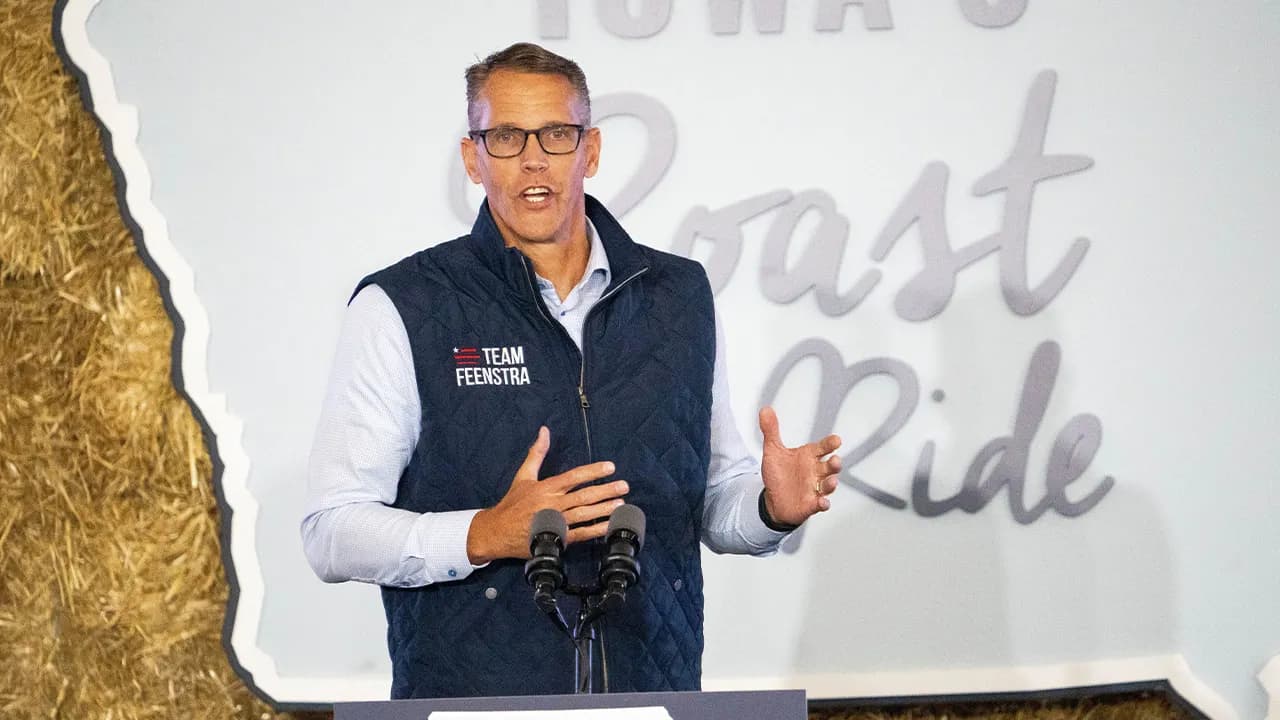
Trump-backed candidate loses Iowa primary to MAHA outsider
Intra-Party Split Detected
Iowa Republican voters rejected Trump's endorsement in favor of MAHA-backed outsider candidate, suggesting tension between Trump loyalists and health-focused populist wing
Left says
- •This marks Trump's first major statewide primary loss of the 2026 cycle, demonstrating potential limits to his endorsement power within the Republican Party
- •The MAHA movement's success suggests growing influence of health-focused, anti-establishment voices that could reshape Republican priorities
- •Lahn's victory despite being significantly outspent shows grassroots organizing can overcome traditional political advantages
Right says
- •Trump's late endorsement just four days before the primary may not have given Feenstra enough time to capitalize on the president's support
- •Lahn's deep Iowa roots as a six-generation farmer and his self-funded independence resonated with voters seeking authentic local representation
- •The narrow 1,600-vote margin suggests this was more about candidate-specific factors than a broader rejection of Trump's influence
Common Take
High Consensus- Zach Lahn defeated Randy Feenstra by approximately 1,600 votes with 99% counted in Iowa's Republican gubernatorial primary
- Feenstra had significant advantages including congressional experience, fundraising superiority, and endorsements from prominent Iowa Republicans
- Lahn will face Democratic State Auditor Rob Sand in the November general election to replace outgoing Governor Kim Reynolds
- The race was closely watched as an indicator of various political movements' influence within the Republican Party
The Arguments
Left argues
This marks Trump's first major statewide primary loss of the 2026 cycle, demonstrating that his endorsement power has meaningful limits and that Republican voters are willing to reject his picks when they find more compelling alternatives.
Right counters
Trump's endorsement came just four days before the primary, giving Feenstra insufficient time to capitalize on the support, and the razor-thin 1,600-vote margin suggests this was more about timing and candidate-specific factors than a broader rejection of Trump's influence.
Right argues
Lahn's victory was driven by his authentic Iowa credentials as a six-generation farmer and his self-funded independence, which resonated with voters seeking genuine local representation rather than establishment politics.
Left counters
The MAHA movement's organizational support and anti-establishment messaging were crucial factors in Lahn's victory, showing that health-focused, outsider voices are gaining real traction within the Republican Party beyond just local appeal.
Left argues
Lahn's ability to defeat a well-funded incumbent congressman despite being significantly outspent demonstrates that grassroots organizing and authentic messaging can overcome traditional political advantages like name recognition and financial resources.
Right counters
Feenstra's loss can be attributed to his failure to effectively utilize his advantages rather than proof of grassroots superiority - he barely won his own congressional district and struggled to convert his institutional support into votes.
Right argues
The narrow margin and candidate-specific factors like Steve King's endorsement of Lahn suggest this was an anomaly rather than evidence of a broader shift away from Trump-backed candidates or toward the MAHA movement.
Left counters
Even a narrow victory represents a significant breakthrough for the MAHA movement in a competitive primary field, and the fact that health-focused messaging could compete with Trump's endorsement signals growing influence of these anti-establishment voices.
Challenge Questions
These questions target genuine internal contradictions — meant to provoke honest reflection.
Right asks Left
“If Trump's endorsement power is truly diminishing as you claim, why did his other endorsed candidates in Iowa and elsewhere continue to win their primaries, and how do you reconcile this single loss with his overall success rate in 2026 endorsements?”
Left asks Right
“If this result was primarily due to Lahn's local credentials and the late timing of Trump's endorsement rather than broader political trends, why should we expect the MAHA movement to replicate this success in other states where candidates lack similar deep local roots?”
Outlier Report
Left Fringe
Progressive activists like Alexandria Ocasio-Cortez's wing and anti-Trump resistance figures like Rick Wilson might frame this as proof of Trump's declining grip on the GOP, representing about 15-20% of the left who see any Trump setback as validation of broader political shifts.
Right Fringe
Trump loyalists like Steve Bannon or Laura Loomer might claim the loss was due to establishment sabotage or RINOs undermining Trump, representing about 10-15% of the right who refuse to acknowledge any limits to Trump's endorsement power.
Noise Assessment
Moderate noise level - political commentators are amplifying this as a 'first major loss' story for clicks, but most voters understand primary dynamics are complex and single races don't define broader political trends.
Sources (7)
Businessman Zach Lahn defeated Rep. Randy Feenstra in Iowa's Republican primary for governor, NBC News projects, as party voters rejected President Donald Trump's late endorsement in the race.
Zach Lahn’s surprise win over Trump-backed Rep. Randy Feenstra sets up a November matchup with Democratic State Auditor Rob Sand in a race both parties are watching closely.
Feenstra had the backing of President Donald Trump, a congressional profile, a fundraising advantage and support from prominent Iowa Republicans, but Lahn came out with a slim lead over his opponent.
Rep. Randy Feenstra conceded to businessman Zach Lahn in Iowa’s Republican primary for governor as party voters rejected President Donald Trump’s late endorsement in the race.
It’s a blow for the president, who has seen most of his chosen candidates this cycle sail to victory or advance to runoff elections — until now.
Zach Lahn defeated Rep. Randy Feenstra in the Iowa Republican gubernatorial primary, marking President Trump's first major primary loss of the 2026 midterm election cycle.