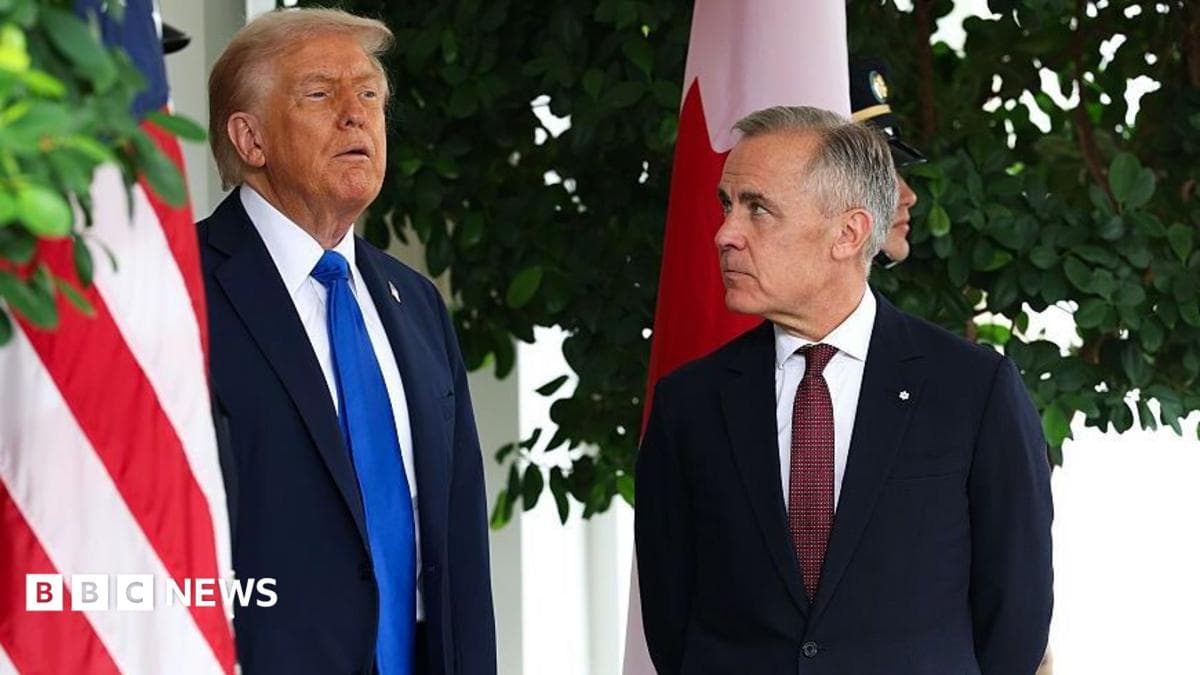
Trump Bans Canadian Alcohol, Dairy, Autos in Trade War Escalation
Intra-Party Split Detected
Most Republicans back Trump's tariff strategy, but some, like Sen. Jerry Moran, have raised concerns over specific impacts (e.g., Bombardier jet ban's effect on Kansas workers), showing limited intra-party dissent over economic fallout.
Left says
- •Escalating to outright bans rather than tariffs cuts off market access entirely, hitting Canadian dairy farmers, distillers and manufacturers who have no recourse to simply absorb a cost increase.
- •Prime Minister Mark Carney's push to reduce reliance on the US reflects a broader recognition that a close ally cannot be treated as a target of economic coercion without lasting damage to the relationship.
- •The bans arrive on top of Trump's repeated remarks about making Canada the 51st state, feeding a narrative that the trade war is as much about political dominance as fair commerce.
- •Deeply integrated supply chains mean American consumers and businesses, not just Canadians, will likely face higher prices and disruptions from the sweeping scope of Section 338 measures.
Right says
- •Canada's own provinces have kept American alcohol off store shelves for over a year, so the US ban on Canadian alcohol simply mirrors restrictions Canada already imposed on US producers.
- •Trump officials argue the targeted products were chosen because Canada holds little US market share in them, limiting the economic fallout while still pressuring Ottawa to negotiate.
- •The administration frames the move as a direct response to Canada's own retaliatory tariffs and its refusal to remove trade barriers, placing responsibility for the escalation on Canadian negotiators who walked away from talks.
- •Officials point to a three-week delay before the ban takes effect as a genuine window left open for a negotiated resolution rather than a final, irreversible break.
Common Take
High Consensus- The bans on Canadian dairy, most alcohol and motorcycles take effect September 29, following Canada's retaliatory tariffs that started September 8.
- The measures were issued under Section 338 of the Tariff Act of 1930, a statute rarely invoked before this trade dispute.
- US-Canada trade talks collapsed in late August, and no new negotiations have been scheduled since.
- Both governments describe the deep economic interdependence between the two countries as a major risk factor in how far the trade war can escalate.
The Arguments
Left argues
Outright bans, unlike tariffs, eliminate market access entirely with no way for Canadian dairy farmers, distillers, and manufacturers to absorb a cost and stay competitive, making the damage more severe and less reversible than a price increase.
Right counters
Administration officials note the targeted products were specifically chosen because Canada holds minimal U.S. market share in them, meaning American buyers can shift to domestic or other foreign suppliers with limited disruption.
Right argues
Canada's own provinces have kept American alcohol off store shelves for over a year, so the U.S. ban simply mirrors a restriction Canada already imposed on U.S. producers, making this reciprocity rather than unprovoked escalation.
Left counters
Matching a provincial retail restriction with a sweeping national import ban under Section 338 is a disproportionate response that escalates the conflict well beyond the scale of the original Canadian measure.
Right argues
The White House frames this as a direct consequence of Canada walking away from negotiations and imposing its own dollar-for-dollar retaliatory tariffs, placing responsibility for the breakdown on Canadian negotiators rather than on Washington.
Left counters
Carney's team says it left the table over 'uneconomic' and 'unfair' U.S. demands, and Trump's simultaneous talk of Canada becoming the '51st state' undercuts the claim that this is purely a good-faith trade dispute rather than a coercive power play.
Left argues
The deeply integrated nature of the two economies means American consumers and businesses will also face higher prices and supply disruptions, since Section 338 measures apply even to USMCA-compliant goods that previous tariffs had spared.
Right counters
Officials say they conducted 'housekeeping' on the tariff list, removing goods like cement and hospital paper where U.S. supply chains were found to be dependent on Canadian imports, showing an effort to limit domestic fallout.
Left argues
Carney's push to reduce reliance on the U.S. reflects a broader recognition that a close ally cannot be treated as a target of economic coercion without lasting damage to the relationship, and Canada's pivot signals that trust, once broken, is costly to rebuild.
Right counters
The three-week delay before the ban takes effect is a genuine window for negotiation, not a final rupture, suggesting the administration still wants a deal rather than a permanent break with Canada.
Challenge Questions
These questions target genuine internal contradictions — meant to provoke honest reflection.
Right asks Left
“If deep economic integration and alliance trust are the priority, why did Canada's provinces choose to unilaterally pull American alcohol from shelves over a year ago rather than pursue negotiation first, before any Section 338 ban existed?”
Left asks Right
“If these bans are calibrated to minimize economic fallout because Canada has little market share in the targeted goods, why include measures like the auto tariff threat and government contract restrictions that reach well beyond those narrow categories?”
Outlier Report
Left Fringe
Progressive commentators and some Democratic politicians near the Canadian border (e.g., voices aligned with Bernie Sanders or Elizabeth Warren) who frame this as reckless economic nationalism harming working people; roughly 15-20% of the left take this more confrontational anti-Trump economic stance versus a more moderate 'this is bad for consumers' view.
Right Fringe
Pure economic nationalists and Trump loyalists (e.g., Steve Bannon-aligned commentators, some MAGA social media accounts) who fully endorse total decoupling from Canada and see any pushback as weakness; this represents maybe 20-25% of the right, while more business-oriented conservatives and free traders (e.g., some in the Wall Street Journal editorial board tradition) are uneasy with the ban's economic disruption.
Noise Assessment
Moderate-to-high; much of the loudest reaction is performative partisan point-scoring on social media, while most ordinary Americans' actual engagement with this specific trade dispute is fairly low compared to domestic economic issues like inflation and jobs.
Sources (7)
<p>President <a href="https://www.axios.com/politics-policy/donald-trump" target="_blank">Trump</a> said the U.S. would ban Canadian alcohol, some dairy products and large motorcycles, sharply escalating a trade war largely fought with <a href="https://www.axios.com/economy/tariffs" target="_blank">tariffs</a>.</p><p><strong>Why it matters:</strong> The measures deepen the <a href="https://www.axios.com/2026/09/08/trumps-next-trade-weapon" target="_blank">economic rift</a> between countries that have spent decades interlinking commerce, threatening disruption for businesses and consumers on both sides of the border.</p><hr /><p><strong>Zoom in: </strong>The import bans take effect Sept. 29, effectively cutting off U.S. market access for the targeted <a href="https://www.axios.com/2026/08/19/trump-canada-tariffs-50-percent-postponed" target="_blank">Canadian goods</a> rather than simply making them more expensive.</p><ul><li>Trump imposed the bans under Section 338 of the Tariff Act of 1930, which allows the president to bar imports from countries that maintain or increase discrimination against U.S. commerce.</li><li>The White House said on Tuesday it would also expand the existing 50% tariffs to dozens of additional Canadian products — including some steel and aluminum goods, furniture and paper — effective Sept. 15.</li></ul><p><strong>What they're saying: </strong>A senior administration official played down the potential economic fallout, noting that the measures target products where Canada has little U.S. market share or buyers can turn to domestic and other foreign suppliers. </p><ul><li>The administration removed a handful of products from the list of goods subject to 50% tariffs — including cement, road salt and certain hospital paper products.</li><li>The official said the administration adjusted the tariff list based on feedback from businesses, removing some products where officials found U.S. supply chains were particularly dependent on Canadian imports.</li></ul><p><strong>Catch up quick:</strong> Trade tensions have ratcheted up swiftly since U.S.-Canada talks collapsed last month.</p><ul><li>The U.S. imposed 50% tariffs on roughly $20 billion of Canadian goods. Canada hit back with tariffs of up to 50% on a similar amount of U.S. goods, a measure that took effect earlier Tuesday.</li><li>Trump has since threatened higher tariffs on Canadian autos starting next year. </li><li>On Monday, he also threatened to ban Canadian aircraft maker Bombardier from selling its jets in the U.S. (Such a measure is not in the proclamations announced today, with a senior official saying it is still under consideration). </li><li>In a <a href="https://truthsocial.com/%40realDonaldTrump/posts/117237309084360726" target="_blank">Truth Social post</a> on Tuesday, Trump said he would direct officials to shut Canadian-made products out of a broad range of U.S. government contracts, "unless Canada restores full and fair reciprocity for American Farmers and Companies."</li></ul><p><strong>Zoom out:</strong> Canada's restrictions on American alcohol have been a particular source of frustration for U.S. officials.</p><ul><li>Most provinces have kept U.S. booze off government-run liquor store shelves for much of the trade war.</li></ul><p><strong>What to watch:</strong> The two economies are so deeply intertwined that escalating trade tensions could run into political and economic limits. </p><ul><li>Unlike many of Trump's earlier tariffs on Canada, the Section 338 measures do not spare USMCA-compliant goods, leaving more of the countries' integrated supply chains exposed.</li><li>Canada initially included U.S. lobster in its retaliatory tariffs, only to soon change course amid concerns that the tariffs would be too painful for Canadian businesses.</li><li>In the U.S., Trump's threat to ban Bombardier jets quickly got the attention of Republican Sen. Jerry Moran, <a href="https://x.com/JerryMoran/status/2097094557817098598?s=20" target="_blank">who warned</a> of the potential impact on Kansas workers.</li></ul><p><strong>Go deeper: </strong><a href="https://www.axios.com/2026/09/08/trumps-next-trade-weapon" target="_blank">Trump's next trade weapon</a></p>
It is the latest escalation in a trade war between the two countries, and comes as Canadian retaliatory tariffs on US goods come into force.
The Trump administration moved Tuesday to ban imports of Canadian motorcycles, some dairy products and most types of alcohol starting later this month, intensifying the trade war between the two countries.
President Donald Trump on Tuesday moved to sharply escalate the trade war with Canada, seeking to block the import of some autos, dairy products and alcohol.
President Donald Trump is escalating the trade war with Canada by ordering a ban on Canadian dairy products, most alcoholic beverages and motorcycles, with the restrictions set to take effect in three weeks.The new measures, reported by Axios and confirmed by other outlets,...
The ban will take effect in three weeks and comes after Canada imposed retaliatory tariffs on $20 billion in U.S. imports earlier Tuesday.
<p>The measure comes as Canada imposes $20bn in retaliatory tariffs and Canadian prime minister Mark Carney vows to reduce his country’s economic dependence on the US</p><p>The US is banning dairy products, most alcoholic beverages and motorcycles from Canada, the White House said Tuesday, as the trade war between the two neighbors and longtime allies escalates.</p><p>The ban will take effect in three weeks and comes after Canada imposed retaliatory tariffs on $20bn in US imports earlier Tuesday.</p> <a href="https://www.theguardian.com/us-news/2026/sep/08/trump-canada-trade-war-dairy-alcohol">Continue reading...</a>