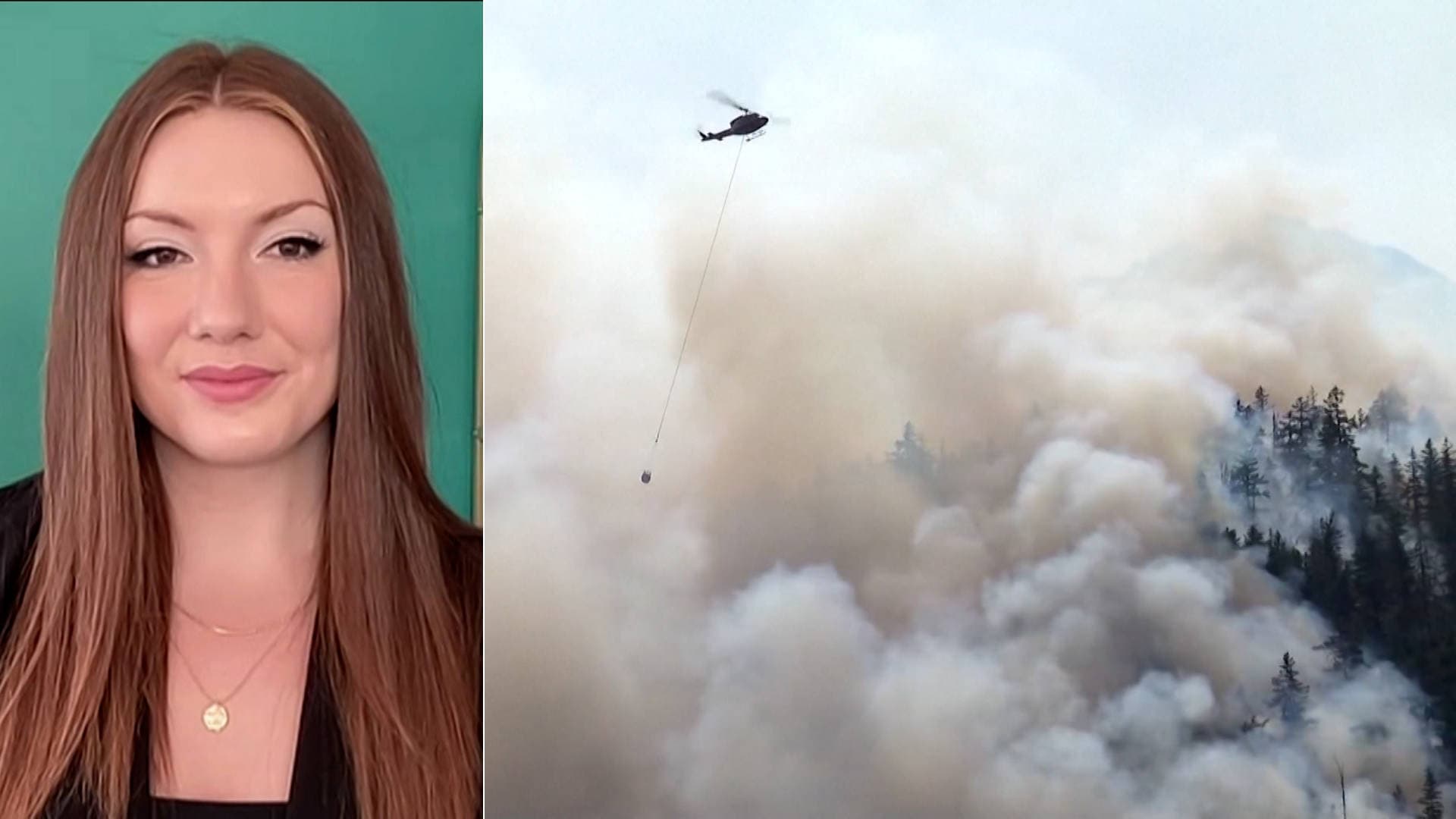
 Helicopter drops water on wildfire amid heavy smoke, alongside a news anchor.
Trump Blames Canada, Not Climate Change, for Wildfire Smoke
Intra-Party Split Detected
Most left-leaning sources unite in blaming climate change and criticizing Trump's tariff threats, but some (like Democracy Now via journalist Rachel Gilmore) also criticize Canadian PM Carney for insufficient climate action and continued fossil fuel expansion, breaking from a purely anti-Trump narrative.
Left says
- •Republicans blaming forest management alone deflects from decades of scientific consensus showing human-caused climate change is intensifying wildfire frequency and severity.
- •Per-person exposure to harmful wildfire smoke in the U.S. has been four times higher from 2020-2024 than in the prior 14 years, showing a worsening trend that mirrors climate projections.
- •Indigenous communities across Canada, who are disproportionately impacted by these fires and chronically underfunded for firefighting infrastructure, are being overlooked in a dispute focused on tariffs and blame.
- •Threatening tariffs and sanctions against a longtime ally over a natural disaster is seen as a diplomatically reckless distraction rather than a genuine solution to the underlying crisis.
Right says
- •Poor forest management, including limits on controlled burns and undergrowth clearing, is a more direct and actionable cause of catastrophic wildfires than broad climate narratives.
- •Wildfires have occurred throughout history long before industrialization, and attributing every fire season to climate change is used to justify costly energy and economic policy changes.
- •Canada's lack of a national fire authority or emergency response agency leaves provinces under-resourced, making mismanagement a legitimate governmental failure worth addressing.
- •Holding Canada accountable for the cross-border economic and health costs of recurring smoke events, including through tariffs, is framed as reasonable pressure for better prevention rather than mere scapegoating.
Common Take
High Consensus- Nearly a thousand wildfires have burned across Canada, sending hazardous smoke into major U.S. cities including Chicago, Detroit, and New York.
- Air quality alerts affecting over 100 million Americans reflect a serious public health concern requiring urgent attention.
- Indigenous and remote communities in Canada have been especially hard-hit, facing evacuations and inadequate firefighting resources.
- Both governments agree the wildfires and their smoke represent a recurring, costly problem that current policies have not resolved.
The Arguments
Left argues
Climate Central data shows per-person exposure to wildfire smoke in the U.S. was four times higher from 2020-2024 than the prior 14 years, a trend consistent with scientific projections of climate change intensifying wildfire frequency and severity.
Right counters
Correlation with warming trends doesn't rule out the more direct, actionable cause: government restrictions on controlled burns and undergrowth clearing have left forests dangerously overloaded with fuel regardless of temperature.
Right argues
Wildfires have occurred throughout history long before industrialization, and forest management practices like controlled burns and brush clearing are proven, actionable tools that provincial and federal governments have neglected or restricted.
Left counters
Acknowledging that fires are a historical fact of forest ecosystems doesn't explain why they are now measurably more frequent, larger, and smoke-heavy than in past decades — a shift climate scientists directly link to hotter, drier conditions extending fire seasons.
Right argues
Canada's lack of a national fire authority or emergency response agency leaves provinces and remote Indigenous communities chronically under-resourced, making this a legitimate governance failure independent of climate debates.
Left counters
That same argument undercuts the tariff-and-blame approach, since punishing Canada economically does nothing to fund the firefighting infrastructure or emergency response capacity that underfunded Indigenous communities actually need.
Left argues
Indigenous communities across Canada, who make up roughly 80% of populations vulnerable to wildfires, are chronically underfunded for firefighting infrastructure and are being sidelined in a dispute that's fixated on tariffs and blame rather than on real relief.
Right counters
Highlighting Indigenous underfunding actually supports the right's core argument — decades of restricted traditional burning practices and inadequate on-the-ground forest management, not global emissions, are the proximate cause of the crisis these communities face.
Left argues
Threatening tariffs and sanctions against a longtime ally over a natural disaster is diplomatically reckless and does nothing to address the underlying drivers of worsening fire seasons.
Right counters
Holding a neighboring country accountable for cross-border economic and health damage it could mitigate through better forest management is a legitimate use of diplomatic and economic pressure, not mere scapegoating.
Challenge Questions
These questions target genuine internal contradictions — meant to provoke honest reflection.
Right asks Left
“If climate change is the primary driver of worsening wildfires, why do prominent Democratic leaders like Carney continue approving new fossil fuel pipelines rather than treating the crisis as the emergency their own rhetoric describes?”
Left asks Right
“If poor forest management is the main cause of these fires, why does the right dismiss the well-documented feedback loop in which hotter, drier conditions independently increase fire risk regardless of how well underbrush is cleared?”
Outlier Report
Left Fringe
Figures like Bill McKibben and outlets like Democracy Now frame this almost entirely through a climate-catastrophe and anti-fossil-fuel lens, minimizing any forest management role entirely; this represents maybe 15-20% of the left, as most Democrats and independents acknowledge multiple contributing factors.
Right Fringe
Sen. Bernie Moreno and commentators at The Daily Signal and Breitbart dismiss climate change's role almost entirely, framing it purely as a forest management and sovereignty issue, sometimes tying it to broader climate-denial rhetoric; this represents roughly 20-25% of the right, with more moderate conservatives acknowledging some climate contribution while emphasizing management solutions.
Noise Assessment
High noise ratio — Trump's tariff threats and Moreno's sanctions bill generate outsized media attention relative to how much ordinary Americans care about punishing Canada specifically; most public sentiment is more concerned with air quality and health impacts than the diplomatic dispute, which is largely elite/political theater.
Sources (7)
More than 100 million Americans are under air quality alerts as smoke from wildfires in Canada and northern Minnesota blankets parts of the U.S. and releases microscopic particles into the atmosphere that can raise serious health risks. Shifting winds have pushed thick haze into major metro areas across the Great Lakes, Northeast and Mid-Atlantic, reducing visibility, tinting skies and sending pollution levels into unhealthy and even hazardous ranges.
<img src="https://images.axios.com/qVUPT6D2RQX46yGrdzua5fVoJbo=/2026/07/16/1784221143666.jpeg" /> <div>Toronto pedestrians walk as wildfire smoke turns the skies orange. Photo: Cole Burston/AFP via Getty Images</div><p>The wildfire smoke drifting into the eyes, throats and lungs of millions of Americans and Canadians this week is a stark reminder that the planet is changing in unsettling ways.</p><ul><li>The smoke, from wildfires raging in northern Minnesota and Canada, is causing dangerously bad air across the Midwest and Northeast — and could soon waft elsewhere.</li><li>Air quality alerts have been issued in New York, Chicago, Toronto and more, with officials urging folks to stay inside.</li></ul><hr /><p><strong>Zoom in: </strong>It's too early to tie these wildfires directly to climate change. </p><ul><li>But researchers have shown that human-caused climate change is making wildfires both more likely and more intense.</li></ul><p><strong>One headline finding</strong> from a Climate Central <a href="https://www.climatecentral.org/climate-matters/climate-change-worsens-wildfire-smoke-2025" target="_blank">report</a> last year: "Per-person exposure to harmful wildfire smoke in the U.S. was four times higher during 2020-2024, on average each year, than during 2006-2019."</p><ul><li>Moreover, it's impossible for those of us in the smoke zone to avoid thinking about climate change as the skies turn to an ominous rust and our lungs begin to sting.</li><li>The fires themselves have also <a href="https://www.cbc.ca/news/canada/wildfires-northern-ontario-federal-help-9.7272287" target="_blank">destroyed homes</a> and <a href="https://www.mprnews.org/story/2026/07/16/boundary-waters-businesses-hit-during-peak-season-by-wildfires" target="_blank">devastated local tourism</a>.</li></ul><img src="https://images.axios.com/71ahd3rItlN0MYSDSXLtDvoUrEQ=/2026/07/16/1784222547693.png" /> <div>A satellite view of wildfire smoke across the Midwest and Northeast. Image: NOAA/STAR</div><p><strong>The big picture: </strong>Massive smoke events like this have happened before — <a href="https://www.axios.com/2023/06/27/smoke-unprecedented-canadian-wildfires-chokes-upper-midwest" target="_blank">most notably</a> in 2023.</p><ul><li>They may get more common as North America's forests keep drying up, creating ideal conditions for megafires sparked by lightning and other causes.</li></ul><p><strong>What's next: </strong>Hot and dry conditions mean the fires causing the smoke could keep burning for some time — and there's elevated risk of new fires.</p><ul><li>We may get periods of reprieve as the smoke stays high (possibly painting our skies but sparing our lungs), or gets carried elsewhere.</li><li>At least one model suggests that the smoke could pour southward next week — reminding us that there's <a href="https://www.axios.com/2023/07/18/best-worst-states-for-climate-change-extreme-weather" target="_blank">no safe port</a> in a changing climate.</li></ul><p><strong>The bottom line: </strong>Americans out West have long understood "fire season." The rest of us need to start thinking about "smoke season," too.</p>
<p>Canadian First Nations members this weekend condemned the government for not sufficiently helping with wildfires in Ontario.</p> <p>The post <a href="https://www.breitbart.com/environment/2026/07/20/canadas-indigenous-community-angry-as-government-abandons-them-wildfires/" rel="nofollow">Canada’s Indigenous Community Angry as Government Abandons Them to Wildfires</a> appeared first on <a href="https://www.breitbart.com" rel="nofollow">Breitbart</a>.</p>
Millions of people across North America have experienced hazardous air pollution this month as nearly a thousand active wildfires continue to rage in Canada. In addition to releasing hazardous chemicals and smoke darkening skies across the continent, the fires in Canada have also disproportionately impacted Indigenous communities, forcing thousands to evacuate their homes. Republican politicians have been loath to acknowledge the role of the climate crisis in making extreme weather events like this more frequent and intense, instead blaming Canadian officials for poor forest management. President Donald Trump has even threatened to impose new tariffs on Canada over the record levels of hazardous air.</p> <p>Independent Canadian journalist Rachel Gilmore says that while Trump’s comments are “extremely offensive” to people in the country, Liberal Prime Minister Mark Carney’s policies — while acknowledging the science — also do little to mitigate the climate crisis as he approves new oil pipelines that would operate for decades.</p> <p>“He’s not exactly taking the climate action that we need here in Canada,” Gilmore says of Carney.
“Maybe they should pay us some damages or something, or we should do some tariffs,” Trump said.
“We will not tolerate this incompetence,” vowed Ohio Sen. Bernie Moreno, who may not understand how climate change works.
It’s the same every fire season: Armchair experts and green campaigners confuse poor forest management with climate change, and then they use that confusion to justify their plans to remake the economy and control your energy use. Just as they did in 2023, true believers are claiming that the Canadian wildfires that last week darkened the...