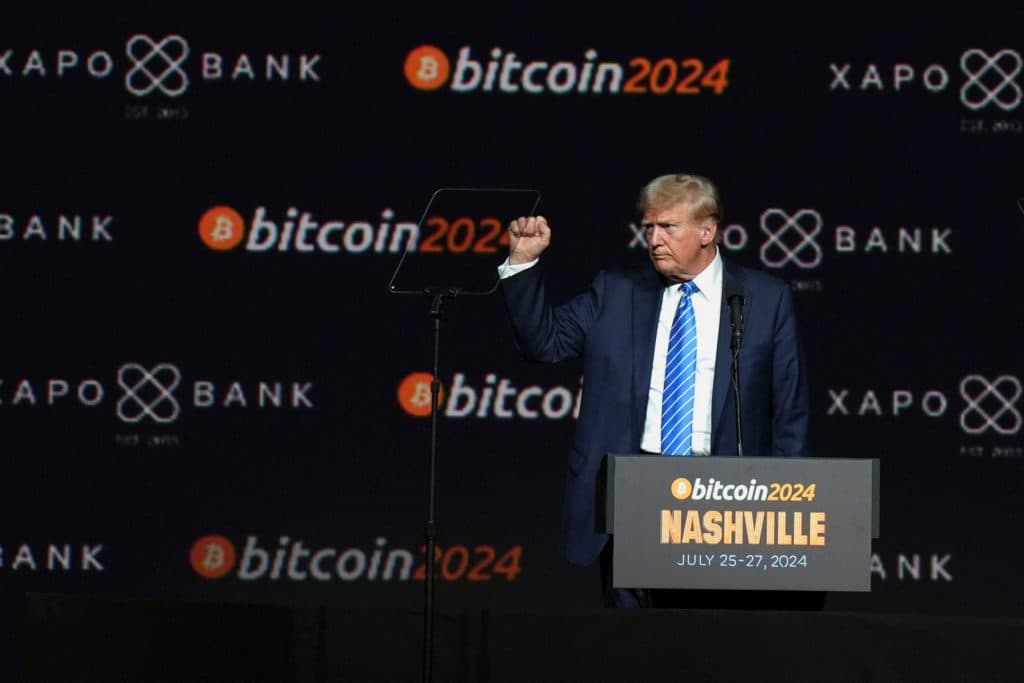
 Donald Trump speaks at the Bitcoin 2024 conference in Nashville.
Trump Bows to Ethics Rules Targeting His Own Crypto Wealth
Intra-Party Split Detected
Sen. Thom Tillis joined Democrats in demanding tougher ethics provisions targeting Trump's crypto conflicts of interest, breaking with the White House's initial preferences, while other Republicans like Lummis, Scott, and Boozman negotiated the compromise.
Left says
- •Trump's personal crypto holdings created a direct conflict of interest that made him uniquely unfit to shape crypto policy without safeguards, and the concessions show sustained Democratic pressure worked.
- •Allowing state attorneys general to enforce the law, not just the DOJ, closes a loophole that would have let a Trump-controlled Justice Department simply decline to police his own administration's violations.
- •The initial meme-coin ban wasn't enough on its own; Democrats like Ruben Gallego and independent-minded Republicans like Thom Tillis had to hold firm to force a broader divest-or-blind-trust requirement.
- •This is a case study in why independent enforcement mechanisms matter when a sitting president has personal financial stakes in the industry being regulated.
Right says
- •Trump and Senate Republicans negotiated in good faith over more than a year, showing responsiveness to Democratic concerns in order to get a genuinely bipartisan bill across the finish line.
- •The White House had legitimate concerns that giving state attorneys general enforcement power could let Democratic state officials weaponize the law against Trump and other Republicans for political purposes.
- •Passing the Clarity Act is framed by bill author Sen. Lummis as tough, evenhanded restriction on all politicians' crypto dealings, not a targeted attack on Trump, and a vote against it is a vote against those broader accountability rules.
- •Bringing crypto into a clear legal framework matters for the $2.3 trillion market and for keeping the U.S. competitive, and Trump's willingness to accept limits on his own wealth helped make that possible.
Common Take
High Consensus- Trump agreed to bar himself and his wife from issuing meme coins and to divest or place significant crypto holdings in a blind trust.
- The Clarity Act's ethics provision will allow both state attorneys general and the Department of Justice to enforce restrictions on officials issuing digital assets.
- Senators Cynthia Lummis, Tim Scott, John Boozman, Thom Tillis, and Ruben Gallego were all central to negotiating the final ethics language.
- The bill's fate hinges on a key Senate vote this Tuesday and carries major implications for how the crypto industry is regulated going forward.
The Arguments
Left argues
Trump's personal crypto holdings created a genuine conflict of interest, so requiring him to divest or place assets in a blind trust—rather than relying on self-policing—was necessary to ensure crypto policy wasn't shaped for personal enrichment.
Right counters
The final bill applies the same divest-or-blind-trust standard to all federally elected officials and judges, not just Trump, so framing it purely as a Trump-specific constraint ignores that it's a general accountability rule Republicans agreed was fair for everyone.
Right argues
Trump and Senate Republicans negotiated for over a year and made real concessions—first the meme-coin ban, then the broader divest-or-blind-trust rule—demonstrating good-faith bipartisan dealmaking rather than stonewalling.
Left counters
The fact that it took sustained pressure from Gallego, Tillis, and other Democrats to extract each successive concession shows this wasn't proactive good faith but reluctant capitulation forced by lawmakers who held their votes hostage until the loopholes were closed.
Left argues
Allowing state attorneys general, not just a Trump-controlled DOJ, to enforce the ethics provisions closes an obvious loophole—without independent enforcement, a president could simply direct his own Justice Department to ignore violations by himself or allies.
Right counters
The White House's concern that Democratic state attorneys general could weaponize enforcement powers for partisan lawsuits against Trump and other Republicans is a legitimate structural risk, not just political self-interest, since it cuts both ways for future Republican AGs targeting Democratic officials.
Right argues
Sen. Lummis is correct that the Clarity Act imposes tough, evenhanded restrictions on all politicians' crypto dealings, and framing a vote against it as merely a stand against Trump obscures that opponents would also be blocking broader accountability rules the industry and market need.
Left counters
Whatever the bill's general language, its entire enforcement fight was driven specifically by concerns about Trump's existing crypto wealth—the negotiation history shows this was fundamentally about closing gaps that would have let Trump's conflicts go unpoliced, not an abstract ethics reform.
Right argues
Bringing the $2.3 trillion crypto market into a clear legal framework is a significant economic and competitiveness win, and Trump's willingness to accept personal financial limits helped make that broader achievement possible.
Left counters
A market-legitimizing bill shouldn't require this much arm-twisting to include basic safeguards against a sitting president profiting from the very industry he's regulating—the need for such intense pressure reveals how weak the initial ethics protections were.
Challenge Questions
These questions target genuine internal contradictions — meant to provoke honest reflection.
Right asks Left
“If the ethics provisions are genuinely necessary safeguards against conflicts of interest, why should state attorneys general—who are themselves partisan elected officials—be trusted as neutral enforcers rather than creating a new avenue for politically motivated prosecutions?”
Left asks Right
“If the White House's concessions were made in good faith over more than a year of negotiation, why did it take repeated threats to withhold votes from Gallego, Tillis, and other senators to secure each successive ethics provision rather than the administration offering them proactively?”
Outlier Report
Left Fringe
Progressive figures like Sen. Elizabeth Warren and commentators who argue the Clarity Act itself is too industry-friendly and that these ethics provisions are inadequate window-dressing represent maybe 15-20% of the left, pushing for far stricter crypto regulation or an outright rejection of the bill.
Right Fringe
Pro-Trump crypto figures and commentators like those aligned with Sen. Cynthia Lummis's harshest critics on the right (e.g., some America First media voices) who view any ethics constraints on Trump as an illegitimate Democrat-driven attack represent roughly 15-20% of the right, opposing the concessions entirely.
Noise Assessment
Moderate-to-high; much of the framing battle is playing out among political and financial media elites and crypto industry advocates rather than reflecting deep engagement from the general public, most of whom have only passing awareness of the Clarity Act's specifics.
Sources (5)
President Donald Trump has agreed to a significant portion of a stringent ethics proposal that is part of a broader cryptocurrency bill headed for a key vote this week
President Donald Trump had been hearing the message loud and clear for weeks about the sweeping cryptocurrency bill being written in the Senate: to get it across the line, he would have to agree to ethics provisions that apply to him, too.
Republicans said Trump had agreed to a requirement to either divest or place in a blind trust any "significant" financial interest in an entity that issues cryptocurrencies.
The White House has agreed to new ethics language in the Clarity Act ahead of a key vote on the cryptocurrency regulation bill in the Senate on Tuesday. The provision, which would bar public officials from issuing or sponsoring digital assets, could be enforced by both state attorneys general and the Department of Justice (DOJ)…
Provision would allow state attorneys general to sue if federal officials violate ethics rules in the Clarity Act barring them from creating assets while in office.