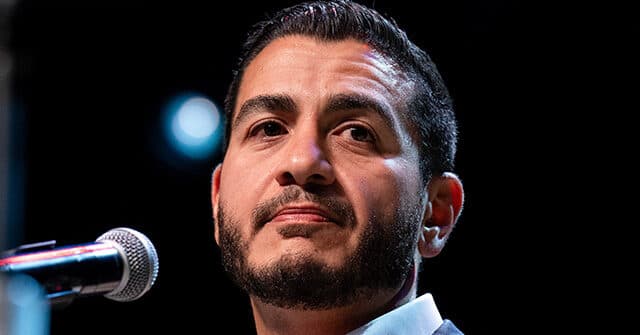
 Abdul El-Sayed speaking at a podium, the subject of Trump's criticism.
Trump Calls Muslim Senate Candidate a 'Jihadist' Over Doctor Title
Intra-Party Split Detected
Rogers distances himself from Trump's harshest rhetoric, denying he called El-Sayed a 'terrorist' and dodging questions on MAGA identification, while Trump and other Republicans like Breitbart/Moreno use harsher 'jihadist' framing.
Left says
- •El-Sayed earned a legitimate medical degree and has worked in public health leadership, including serving as Detroit's health director, which left-leaning commentators say justifies referring to his medical background respectfully
- •Trump's use of 'jihadist' is viewed as an inflammatory and unsubstantiated smear designed to paint a Muslim candidate as a national security threat without evidence
- •Obama and other Democrats argue this rhetoric echoes past attacks that use fear, faith, and ethnicity to delegitimize candidates of color or minority religions
- •El-Sayed's co-signing of a 2012 letter is seen as being stripped of context and weaponized to suggest extremism rather than reflecting any actual support for violence or terrorism
Right says
- •Trump and allies argue El-Sayed has not completed the licensing requirements to practice medicine, making his repeated self-description as a physician misleading to voters
- •Supporters of Rogers point to El-Sayed's 2012 co-signing of a letter supporting the Muslim Brotherhood as a legitimate basis for scrutinizing his judgment and associations
- •Conservative commentators highlight perceived media double standards, noting outlets referred to El-Sayed as 'doctor' far more often than they did Senator Rand Paul, an actual licensed surgeon
- •Rogers campaign emphasizes that multiple Democratic constituencies, including Jewish voters, Black voters in Detroit, and a former state party chairman, have publicly declined to support El-Sayed
Common Take
High Consensus- El-Sayed holds a medical degree but has not completed the post-graduate licensing steps required to practice medicine
- El-Sayed co-signed a 2012 letter related to the Muslim Brotherhood, a fact both campaigns reference though they interpret its significance differently
- The Michigan Senate race between El-Sayed and Rogers is considered one of the most closely watched contests affecting Senate control
- Rogers has publicly stated he never personally called El-Sayed a 'terrorist,' distinguishing his own rhetoric from Trump's
The Arguments
Right argues
El-Sayed holds a medical degree but has not completed the licensing requirements to legally practice medicine, so his continued self-presentation as 'doctor' or physician is misleading to voters about his actual professional credentials.
Left counters
A medical degree reflects genuine training and expertise, and using the title 'doctor' is standard practice for degree-holders even outside clinical practice, particularly given El-Sayed's substantive public health career as Detroit's health director.
Left argues
Trump's use of the term 'jihadist' is an inflammatory, evidence-free smear that frames a Muslim candidate as a security threat, echoing historical patterns of using fear and religious identity to delegitimize minority candidates.
Right counters
El-Sayed's own 2012 decision to co-sign a letter supporting the Muslim Brotherhood is a documented association that voters are entitled to scrutinize and question, not an invention of Trump's rhetoric.
Right argues
Conservative commentators have identified a legitimate media double standard: outlets referred to El-Sayed as 'doctor' dozens of times despite his non-practicing status, while a licensed physician-turned-senator like Rand Paul was simply called 'Mr. Paul,' suggesting inconsistent journalistic standards favor Democratic candidates.
Left counters
Differences in media coverage of two separate candidates years apart reflect varying editorial choices and contexts rather than proof of a coordinated partisan agenda, and such comparisons don't change the underlying fact that El-Sayed earned his degree.
Left argues
El-Sayed's forceful pushback, including his vow to be addressed as 'Senator Mohamed,' demonstrates that the attacks on his faith and name are widely perceived as bigotry rather than legitimate policy critique, a framing reinforced by Obama's direct comparison to attacks he personally faced.
Right counters
Pointing to a candidate's own documented letter-signing and credential claims is a matter of accountability and voter information, not an attack on his religion, and conflating scrutiny of record with bigotry shields candidates from fair examination.
Right argues
The Rogers campaign's claim that key Democratic constituencies, including Jewish voters, Black voters in Detroit, and a former state party chairman, are publicly declining to support El-Sayed suggests concerns about his candidacy extend beyond partisan Republican attacks and reflect genuine unease within his own coalition.
Left counters
A handful of defections or critical op-eds do not represent the broader Democratic coalition, especially when prominent figures like Obama are actively campaigning for El-Sayed and framing the opposition's tactics as fear-based rather than substantive.
Challenge Questions
These questions target genuine internal contradictions — meant to provoke honest reflection.
Right asks Left
“If using an earned-but-non-licensed medical degree as a public-facing title is acceptable, where is the line between legitimate credential description and misleading self-presentation, and would the same standard apply if a Republican candidate did the same thing?”
Left asks Right
“If scrutiny of a 2012 letter and credential claims is presented as purely about record and qualifications rather than religion, why does the rhetoric around it consistently invoke terms like 'jihadist' rather than more precise, religion-neutral language about extremism or professional ethics?”
Outlier Report
Left Fringe
Figures like Rev. Al Sharpton and some progressive activists frame this entirely as racist/Islamophobic dog-whistling with little acknowledgment of any legitimate credential question, representing maybe 15-20% of the left that sees zero nuance in the licensing critique.
Right Fringe
Commentators like Bernie Moreno, who called El-Sayed the 'most extreme socialist' on 'jihadist credentials,' and parts of Breitbart's commentary embrace the 'jihadist' framing uncritically, representing roughly 20-25% of the right that fully endorses Trump's language rather than just raising credential or associational concerns.
Noise Assessment
High noise ratio — this is a highly charged midterm Senate race story where both campaigns and national partisan figures (Trump, Obama) are amplifying rhetoric for base mobilization, meaning the loudest voices (both the 'jihadist' framing and the 'pure Islamophobia' framing) likely overrepresent true public sentiment, which is probably more ambivalent and less engaged than social media and cable news suggest.
Sources (9)
<p>President Donald Trump on Sunday blasted Abdul El-Sayed over his portrayal as a medical doctor and said, “He should not be allowed to serve in our Senate.”</p> <p>The post <a href="https://www.breitbart.com/politics/2026/10/25/trump-criticizes-jihadist-el-sayed-for-portraying-himself-as-doctor-he-should-not-be-allowed-to-serve-in-our-senate/" rel="nofollow">Trump Criticizes ‘Jihadist’ El-Sayed for Portraying Himself as Doctor: ‘He Should Not Be Allowed to Serve in Our Senate’</a> appeared first on <a href="https://www.breitbart.com" rel="nofollow">Breitbart</a>.</p>
President Donald Trump on Sunday intensified his attacks on Michigan Democrat Senate nominee Abdul El-Sayed, accusing him of ties to Islamic extremism as he rallied support for Republican Mike Rogers in a critical race for control of the Senate. "Over the past three weeks ...
Michigan Republican Senate candidate Mike Rogers argued Sunday that his opponent Abdul El-Sayed can count out key Democrat voting blocs ahead of the midterm election, some of whom Rogers says are turning to his campaign. “The Democrat coalitions that we have are the fastest-growing coalitions we have,” Rogers said on NBC’s “Meet the Press.” He then ...
Former Rep. Mike Rogers (R), who is running for Michigan’s open Senate seat, said Sunday he never called opponent Abdul El-Sayed (D) a “terrorist.” Rogers addressed President Trump’s anti-Muslim rhetoric toward El-Sayed during an interview on “Meet the Press” on NBC News. Host Kristen Welker asked whether Rogers agreed with Trump in calling El-Sayed a…
Former Rep. Mike Rogers (R-Mich.) dodged questions on whether he identifies as a MAGA-Republican and avoided clarifying his position on President Trump’s controversial tariffs against Canada ahead of his competitive race against Democrat Abdul El-Sayed in Michigan’s Senate race. During a Sunday appearance on NBC’s “Meet the Press,” Rogers was asked if he considered himself…
Democratic Michigan Senate nominee Abdul El-Sayed is firing back at President Trump's rhetoric about his Muslim faith.
Michigan Senate candidate Abdul El-Sayed (D) on Sunday fired back at President Trump’s anti-Muslim rhetoric toward him, telling supporters that the president will be referring to him as “Senator Mohamed” if he wins in November. “I get that the president of the United States takes personal offense to my first name,” El-Sayed said at a…
Michigan Senate candidate Abdul El-Sayed criticized President Trump on Sunday, saying the president has as much regard for the Constitution as “a piece of toilet paper.” In an interview with the Rev. Al Sharpton on “PoliticsNation,” El-Sayed was asked about the numerous attacks made by the GOP and Trump about his family background and faith…
President Trump called out Michigan’s Democratic Senate candidate Abdul El-Sayed on Sunday, saying he should have to pass through a metal detector to enter the Senate building. “Anyone with that record of support for jihadists would be screened and unable to get a seat on an airplane. They certainly should not give him a seat…