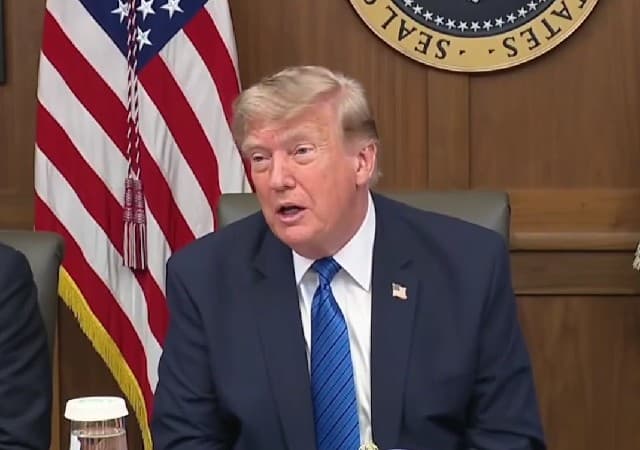
 President Trump speaking at the White House, discussing Iran strike decision.
Trump Calls Off Iran Strike, Cites Deal Iran Denies Exists
Left says
- •Trump's pattern of daily approved strikes followed by a sudden pause underscores how erratic and improvised U.S. Iran policy has become, raising questions about strategic coherence.
- •Regional allies including Saudi Arabia, Qatar, the UAE, Turkey and Pakistan intervened to press for de-escalation, suggesting diplomatic pressure and fear of a wider war — not a genuine breakthrough — drove the decision.
- •Iran's denial that any deal framework exists raises concern that Trump may be overstating diplomatic progress for domestic political benefit, risking credibility and future escalation if the claimed deal collapses.
- •The military and Israeli officials were reportedly left uncertain about Trump's intentions, highlighting the risks of policy driven by social media posts rather than coordinated planning.
Right says
- •Trump's willingness to pause strikes while keeping military options open shows a disciplined strategy of maximum pressure combined with genuine openness to a negotiated resolution.
- •Securing the reopening of the Strait of Hormuz and an end to Iran's nuclear threat, if achieved, would represent a major foreign policy win achieved without a prolonged war.
- •Coordination with Israel and regional partners like Saudi Arabia demonstrates that Trump is managing the crisis diplomatically rather than acting unilaterally.
- •Iran's denial of a deal may simply reflect its own domestic posturing, since Trump has been clear the pause is conditional and strikes can resume quickly if talks fail.
Common Take
High Consensus- Trump ordered a halt to planned strikes on Iran, citing progress toward a deal involving the Strait of Hormuz and Iran's nuclear program.
- Iran has publicly denied that any such deal framework has been agreed to.
- Saudi Arabia's Crown Prince Mohammed bin Salman personally urged Trump to hold off on the attack.
- The U.S. military remains prepared to resume strikes on short notice if negotiations fail.
The Arguments
Left argues
The 13-day streak of daily approved strikes abruptly halted by a single Truth Social post, with the Israeli military and cabinet left uncertain and bracing for a massive offensive, suggests policy is being made impulsively rather than through coordinated interagency planning.
Right counters
Keeping allies and even adversaries guessing about intentions is a deliberate feature of maximum-pressure diplomacy, not a bug; ambiguity forces Iran to negotiate seriously rather than wait out a predictable timeline.
Right argues
Trump pausing strikes while explicitly stating the military remains 'locked and loaded' shows he is preserving leverage and combat readiness while giving negotiators room to close a deal that could reopen the Strait of Hormuz without a prolonged war.
Left counters
If Iran itself denies any such deal framework exists, the claimed 'progress' may be a unilateral overstatement designed for domestic political benefit, which risks Trump's credibility and could force an even more volatile escalation when the gap between rhetoric and reality becomes undeniable.
Left argues
The fact that Saudi Arabia, Qatar, the UAE, Turkey and Pakistan all intervened to press for de-escalation indicates the pause was driven by regional fear of a wider war and outside pressure, not by genuine diplomatic breakthrough on Trump's part.
Right counters
Coordinating with Saudi Arabia and other regional powers before standing down is itself evidence of responsible, multilateral crisis management rather than unilateral impulsiveness — allies helping steer a de-escalation is a sign the process is working, not failing.
Right argues
Trump has been explicit that the halt is conditional and reversible — the military can resume strikes on short notice — meaning this is disciplined pressure diplomacy rather than a naive concession to Iran.
Left counters
A strategy whose central claim (that 'perimeters of a deal' exist) is directly contradicted by the other party involved raises the question of whether there is any real deal to enforce, making the 'conditional pause' more rhetorical than substantive.
Challenge Questions
These questions target genuine internal contradictions — meant to provoke honest reflection.
Right asks Left
“If regional allies stepping in to broker de-escalation is cited as evidence of pressure and incoherence, why would the same allied involvement not count as evidence of coordinated, multilateral crisis management working as intended?”
Left asks Right
“If Iran is publicly denying that any deal framework exists, on what basis can the pause be called a 'disciplined strategy' rather than a public claim of progress that the other party directly contradicts?”
Outlier Report
Left Fringe
Progressive anti-war voices like Rep. Rashida Tlaib or commentators such as Mehdi Hasan who view this as evidence of reckless warmongering and demand immediate withdrawal, representing roughly 15-20% of the left that would go further than the synopsis in condemning the war itself rather than just questioning coherence.
Right Fringe
Hawkish commentators like Mark Levin or figures aligned with John Bolton's worldview who believe Trump should have proceeded with the strikes and view any pause as dangerous weakness toward Iran, representing roughly 10-15% of the right who reject the negotiation framing entirely.
Noise Assessment
High noise ratio: cable news and social media amplify daily whiplash (strike/pause/strike) far beyond what most Americans are tracking closely, with much of the public forming impressions from headlines rather than granular policy details, meaning actual opinion is likely softer and less polarized than online discourse suggests.
Sources (12)
<p>President <a href="https://www.axios.com/politics-policy/donald-trump" target="_blank">Trump</a> said Saturday night that he has called off a <a href="https://www.axios.com/2026/07/31/trump-iran-strikes-energy-infrastructure-war" target="_blank">potential attack</a> on Iran due to progress in negotiations between the two nations. </p><p><strong>The big picture: </strong>There had been indications from some U.S. officials that an attack on Iran's infrastructure was possible, all in an effort to get the Iranians to agree to the U.S.' terms in ceasefire negotiations. </p><hr /><p><strong>What they're saying:</strong> "I have agreed, for the future benefit of the WORLD and, likewise, the survival of a successful and prosperous Iran, to cancel the attack, subject to being able to rapidly make a DEAL," the president wrote on his Truth Social account.</p><ul><li>Trump added that Iran and "other Middle Eastern Countries" had asked the U.S. to hold off on attacking "in that the perimeters of a deal had been agreed to."</li><li>"This would include the Immediate, Complete, and Total OPENING OF THE HORMUZ STRAIT, and an end to Iran's nuclear threat," he wrote.</li></ul><p><strong>Zoom out: </strong>Saudi Crown Prince Mohammed bin Salman and Trump spoke on Saturday, with MBS expressing <a href="https://www.axios.com/2026/08/01/saudi-crown-prince-trump-iran-attacks" target="_blank">concern over the strike plans</a>, Axios' Barak Ravid reported hours before the president's social media post. </p><ul><li>Other regional powers, including Qatar, the United Arab Emirates, Turkey and Pakistan, have also pressed the U.S. and Iran to de-escalate.</li></ul><p><strong>Between the lines: </strong>An attack on Iran's infrastructure and energy sites would escalate the war that the president has repeatedly pressed pause on in order to negotiate with Iran, only for strikes to resume when diplomacy appeared stalled. </p><ul><li>Iranian Foreign Minister Abbas Araghchi warned off the U.S. and Israel — which was expected to join the U.S. in a large-scale strike — from any further action. </li><li>"Any hostile action by the U.S. or Israel — or participation or cooperation by regional countries in such actions — would be met with a decisive and proportionate response from Iran's powerful armed forces," Araghchi said to Saudi Arabia's Foreign Minister Prince Faisal Bin Farhan Bin Abdullah Al Saud, per a post on Araghchi's Telegram channel. </li></ul><p><em>Editor's note: This story has been updated with additional information throughout. </em></p>
<p>President Trump directed the U.S. military not to conduct new strikes in Iran on Friday, breaking a nearly two-week streak of daily attacks, two sources with knowledge of the decision said.</p><p><strong>Why it matters:</strong> The president's directive came after he approved daily strikes over the previous 13 days. It is unclear if Trump's order on Friday was a one-off or whether the lull will continue. </p><hr /><ul><li>Trump's decision reflects both his willingness to provide more space for diplomacy and a recognition that — short of a return to major combat operations — the current level of U.S. strikes has reached the limit of its effectiveness. </li><li>If Trump orders a return to strikes, the U.S. military can mobilize on relatively short notice. </li><li>The U.S. military is still preparing plans for a possible return to major combat operations, but Trump hasn't given orders to move in that direction, the sources said. </li><li>The White House did not respond to a request for comment.</li></ul><p><strong>Driving the news:</strong> Every afternoon for the last two weeks, Trump has approved strike plans submitted by the military. They were conducted within hours.</p><ul><li>On Friday, Trump received a similar plan but did not give a green light. Instead, he directed the military not to conduct strikes, the sources said. </li><li>Shortly after he gave the Friday directive, Trump told reporters at the White House that he has the option of continuing strikes or even escalating them, including "knocking out everything they have." </li><li>But he made clear that he thinks the "smarter strategy" is to "make a deal" with Iran. </li><li>"We're talking to [the Iranians] right now. I think they're getting more and more serious as the days go by. We're locked and loaded and ready to go, but we're talking to them," Trump said. </li><li>Later on Friday, during his remarks at the White House Correspondents Association dinner, Trump said he didn't think Iran is ready to make a deal at the moment, "but I'm willing to listen." </li></ul><p><strong>Behind the scenes: </strong>The Israeli security cabinet and Israel Defense Force expected another round of U.S. strikes on Friday and even prepared for a massive U.S. attack that could trigger a retaliatory attack on Israel, Israeli officials say. </p><ul><li>The cabinet and military didn't feel they had a full picture of what the U.S. would do, so they prepared for a major bombing offensive and remained on high alert. </li><li>On Friday night, the Israelis were notified that Trump did not approve more strikes. </li></ul><p><strong>State of play:</strong> Trump's order to hold fire was given several hours after an Omani delegation arrived in Tehran Friday for talks on a new arrangement to reopen the Strait of Hormuz.</p><ul><li>Two regional sources with knowledge of the negotiations said progress has been made in the talks and that an agreement between Oman and Iran could be reached over the weekend. </li><li>President Trump would then have to decide whether to accept the proposed deal. </li></ul>
<p>Tehran talks tough, denies agreement reached.</p> The post <a href="https://legalinsurrection.com/2026/08/trump-calls-off-strike-says-framework-deal-reached-iran-denies/">Trump Calls Off Strike, Says Framework Deal Reached – Iran Denies</a> first appeared on <a href="https://legalinsurrection.com">Le·gal In·sur·rec·tion</a>.
GOP Sen. James Lankford (Okla.) argued Sunday that President Trump “has no desire” to bomb Iran, hours after the president halted planned strikes on the Middle Eastern country. “The president’s still focused on trying to be able to get a deal,” Lankford told host Shannon Bream on “Fox News Sunday.” The Oklahoma Republican later said,…
President Trump late Saturday said he was halting an attack plan against Iran and pointed to the outline of a deal being reached as the reason why. “The U.S.A. is locked and loaded and ready to go against the Islamic Republic of Iran, at levels of Military Terror, Strength, and Power not seen since World…
<p>President <a href="https://www.axios.com/politics-policy/donald-trump" target="_blank">Trump</a> is seriously considering launching attacks against energy targets in <a href="https://www.axios.com/world/iran" target="_blank">Iran</a> in the next few days, but hasn't given final orders to do it, a U.S. official told Axios on Friday.</p><p><strong>Why it matters:</strong> A new U.S. bombing campaign in <a href="https://www.axios.com/2026/07/27/trump-interview-iran-bombing-pause" target="_blank">Iran</a> against energy and infrastructure targets would be aimed at trying to get the Iranians to agree to the United States' terms in ongoing ceasefire negotiations. </p><hr /><ul><li> The strikes could also involve the Israeli military for the first time in many weeks, and such an escalation would likely lead to Iranian missile attacks on Israel. </li><li>CBS News and the Wall Street Journal first reported about the potential strikes.</li></ul><p><strong>What they're saying:</strong> At the start of Friday's Cabinet meeting, Trump alluded to the potential attack, saying: "Well, we'll be hitting them very hard and, you know, at some point they're going to say, we just can't take it anymore."</p><ul><li>He added that the more the U.S. conducts strikes, the weaker the Iranians get "and then they peter out."</li><li>"As President Trump said at his Cabinet meeting today, the United States will win, and Iran will not have a nuclear weapon under his watch," White House Press Secretary Karoline Leavitt told Axios.</li></ul><p><strong>Between the lines: </strong>A U.S. official said the Iranians have been "very aggressive" in recent days. </p><ul><li>Some U.S. officials were stunned by how much the Iranians were willing to escalate.</li><li>After their surprise missile attack against a U.S. base in Jordan on Wednesday, the Iranians launched additional attacks against U.S. forces in the region, a U.S. official said, declining to give more details.</li><li>The Iranians also attacked commercial ships in the Strait of Hormuz on Thursday. </li><li>President Trump threatened several days ago that any new attacks on ships would be answered with U.S. strikes on power plants and bridges in Iran, including in Tehran.</li></ul><p><strong>The other side: </strong>Tasnim news agency, which is affiliated with Iran's Revolutionary Guards, quoted a senior security official saying that U.S. strikes on Iranian infrastructure targets would be "an act of madness."</p><ul><li>"We have prepared a broad response plan that includes strikes against the Zionist regime's critical infrastructure and U.S. energy infrastructure in the region, and we are fully prepared to carry it out," the Iranian security official told Tasnim. </li></ul><p><em>This is a developing story. Check back for updates.</em></p>
<p>The U.S. military conducted "a heavy wave" of airstrikes in <a href="https://www.axios.com/world/iran" target="_blank">Iran</a> on Wednesday evening, U.S. Central Command said in a <a href="https://x.com/CENTCOM/status/2082651747869147214" target="_blank">statement</a>.</p><p><strong>Why it matters: </strong>These are the first U.S. strikes in Iran since President <a href="https://www.axios.com/politics-policy/donald-trump" target="_blank">Trump</a> paused the bombing campaign Friday to give negotiations another chance.</p><hr /><ul><li>Wednesday's strikes came in retaliation for an <a href="https://www.axios.com/2026/07/28/iran-missile-attack-us-base-jordan" target="_blank">Iranian missile attack</a> targeting a U.S. base in Jordan on Tuesday. All of the Iranian missiles were intercepted, according to the U.S. military.</li></ul><p><strong>What they're saying: "</strong>CENTCOM assets struck dozens of Islamic Revolutionary Guard Corps (IRGC) targets in Iran, including military command centers, missile and drone facilities, coastal surveillance and defense sites, and maritime capabilities," CENTCOM said in a statement.</p><ul><li>"The strikes aimed to further diminish threats posed by Iran and its proxies to American forces, commercial shipping, and neighboring Gulf countries."</li></ul><p><strong>Driving the news: </strong>Trump told reporters Wednesday afternoon that the U.S. would hit Iran "very hard" later in the day.</p><ul><li>"It's our turn," Trump said.</li><li>He claimed Iran had acknowledged that launching the missiles was a mistake and had asked the U.S. not to retaliate.</li></ul><p><strong>The big picture:</strong> Trump paused the strikes Friday after 13 consecutive nights of attacks on Iranian military targets, opening a brief window for diplomacy.</p><ul><li>Iran's missile attack shattered the pause and prompted Trump to resume the military campaign five days later.</li><li>"More than 50,000 U.S. service members are currently deployed to the Middle East and remain highly vigilant, focused, lethal, and ready," CENTCOM said along with <a href="https://x.com/CENTCOM/status/2082651747869147214?s=20" target="_blank">video footage</a> of the strikes.</li></ul><p><em>Editor's note: This is a breaking news story. Please check back for updates.</em></p>
<p><a href="https://www.axios.com/world/iran" target="_blank">Iran</a> launched multiple ballistic missiles toward a U.S. military base in Jordan on Tuesday in what U.S. Central Command described as an "attempted surprise attack." </p><ul><li>All of the <a href="https://www.axios.com/2019/07/29/irans-defiance-on-display-in-new-missile-tests" target="_blank">missiles</a> were intercepted, CENTCOM said in a <a href="https://x.com/CENTCOM/status/2082231500318114110?s=20" target="_blank">statement</a>.</li></ul><hr /><p><strong>Why it matters: </strong>This marks Iran's first ballistic missile attack against a U.S. base in the region since President <a href="https://www.axios.com/politics-policy/donald-trump" target="_blank">Trump</a> paused strikes against Iran on Friday to give diplomacy another chance.</p><ul><li>The attack threatens to unravel the fragile pause and could force Trump to decide whether to resume <a href="https://www.axios.com/2026/07/26/hormuz-bombing-pause-trump-iran" target="_blank">military action</a>.</li></ul><p><strong>What they're saying:</strong> <a href="https://www.axios.com/2026/07/27/trump-interview-iran-bombing-pause" target="_blank">Trump told Axios</a> on Monday that the U.S. was in "very deep talks" with Iran but warned that he would return to "very strong military action" if diplomacy failed.</p><ul><li>"Not much time," Trump said when asked how long he was willing to give the negotiations. "Either it goes fast or not at all."</li></ul><p><strong>State of play:</strong> CENTCOM said forces from Iran's <a href="https://www.axios.com/2026/03/27/iran-military-capabilities-ground-troops" target="_blank">Islamic Revolutionary Guard Corps</a> (IRGC) launched the missiles at 5:45pm ET.</p><ul><li>"U.S. forces remain vigilant and at a high state of readiness," the command said.</li></ul><p><strong>The latest:</strong> CENTCOM <a href="https://x.com/CENTCOM/status/2082260118930956482" target="_blank">said</a> Tuesday evening that U.S. and Saudi fighter aircraft struck multiple logistics and weapons sites in eastern Iraq in response to what it described as more than 30 IRGC-directed drone attacks over the previous 72 hours.</p><ul><li>Saudi Arabia's Defense Ministry later confirmed it participated in the strikes, saying they were coordinated with CENTCOM.</li><li>CENTCOM said the attacks on U.S. forces were unsuccessful.</li><li>There were more than 600 attempted attacks on U.S. citizens and facilities in Iraq by Iran-aligned militias between February and April, according to CENTCOM.</li><li>"The IRGC and its terrorist proxies must cease these attacks to avoid further U.S. military response," CENTCOM added.</li></ul><p><strong>The big picture:</strong> Earlier this month, Iran targeted a U.S. airbase in Jordan, <a href="https://www.axios.com/2026/07/18/iran-jordan-us-deaths-military-two-dead" target="_blank">killing two U.S. service members</a> in a missile and drone barrage, prompting Trump to intensify what became a 13-night campaign of strikes.</p><ul><li>Tuesday's ballistic missile attack by Iran came hours after Trump <a href="https://www.axios.com/2026/07/28/trump-netanyahu-oval-office-iran-war" target="_blank">met Israeli Prime Minister Benjamin Netanyahu</a> at the White House for talks focused heavily on Iran. The White House described the meeting as "positive and productive."</li></ul><p><em>Editor's note: This story has been updated with additional details throughout.</em></p>
<p>President <a href="https://www.axios.com/politics-policy/donald-trump" target="_blank">Trump</a> told Axios on Monday that he decided to pause U.S. strikes on Iran in order to give negotiations another chance, but stressed that he could order a return to expanded military operations if diplomacy fails. </p><p><strong>Why it matters:</strong> The current negotiations are focused on a new deal that would reopen the <a href="https://www.axios.com/2026/07/26/hormuz-bombing-pause-trump-iran" target="_blank">Strait of Hormuz</a> and relaunch talks on a comprehensive nuclear deal.</p><hr /><ul><li>The talks are being conducted mainly between Iran and Oman, but Qatar, Pakistan, Egypt and Trump's envoys, <a href="https://www.axios.com/2026/06/05/iran-oak-ridge-nuclear-witkoff-kushner" target="_blank">Steve Witkoff</a> and Jared Kushner, are actively involved. </li></ul><p><strong>What he's saying:</strong> "We are in very deep talks with <a href="https://www.axios.com/world/iran" target="_blank">Iran</a>. If they don't work out, we will go back to very strong military action," Trump said in the interview. </p><ul><li>Asked how long he's willing to give diplomacy, the president said: "Not much time. Either it goes fast or not at all."</li></ul><p><strong>Behind the scenes:</strong> Trump said he decided to <a href="https://www.axios.com/2026/07/25/trump-iran-war-military-directive-strikes" target="_blank">pause strikes</a> on Friday because the countries that are mediating as well as other countries in the region asked him to<strong> </strong>give negotiations another chance. </p><ul><li>"All of the people that deal with Iran asked me: 'Don't fire,'" Trump said, stressing that he thinks Iran wants to make a deal.</li></ul><p><strong>Between the lines:</strong> "Nothing gained, nothing lost," Trump said when he explained why he agreed to the mediators' request. </p><ul><li>He noted that <a href="https://www.axios.com/energy-climate/oil-companies" target="_blank">oil</a> prices dropped and the stock market went up after he paused the attacks. </li></ul><p><strong>Driving the news:</strong> For the first time in two weeks, Trump ordered the military on Friday to hold fire and not conduct strikes against Iranian targets around the southern coast of Iran and in the Strait of Hormuz area.</p><ul><li>The decision came after a meeting with top advisers and <a href="https://www.axios.com/2026/07/26/hormuz-bombing-pause-trump-iran" target="_blank">military officials</a> who presented him with a new <a href="https://www.axios.com/2026/07/23/b-1-bomber-iran-war" target="_self">strike</a> plan for the day.</li><li>In the days before the meeting, Trump had been leaning toward returning to<a href="https://www.axios.com/2026/07/23/trump-axios-iran-interview" target="_self"> major combat operations</a>, but his mindset started to change on Thursday evening, sources said.</li><li>His decision to <a href="https://www.axios.com/2026/07/25/trump-iran-war-military-directive-strikes" target="_self">pump the brakes</a> on bombing the strait solidified on Friday. </li></ul><p><strong>State of play: </strong>Regional sources said negotiations between Oman and Iran have made progress but that no agreement has been reached. </p><ul><li>Omani Foreign Minister Badr al-Busaidi held phone calls on Monday with a number of his counterparts in Iran, Qatar, Saudi Arabia, Kuwait and Egypt.</li><li>He said in a statement that the discussions "focused on ways to enhance the prospects for reaching practical, fair and sustainable arrangements for maritime navigation ... through the Strait of Hormuz."</li><li>One idea is to allow Iran, Oman and other countries in the region to collect "reasonable service fees" for maritime security, environmental protection and other services, according to one regional source.</li><li>The source pointed to the Strait of Malacca — where Malaysia, Indonesia and Singapore charge vessels for specific services rather than a blanket transit fee — as a possible model.</li><li>Another possibility would be to direct the fees into a joint fund administered with the involvement of the International Maritime Organization.</li></ul><p><strong>What to watch:</strong> Trump will meet Tuesday at the White House with Israeli Prime Minister Benjamin Netanyahu. </p><ul><li>"I am going to talk to Bibi about the fact that if I weren't president, Iran would have had nuclear weapons<strong> </strong>by now and Israel would have been destroyed," Trump said. </li></ul>
President Trump said negotiations with Iran are set to begin Monday after announcing Saturday night that he canceled a pending attack on Iran.
The Trump administration is offering the public less information about the Iran war and its direction, even as the costs continue to mount.