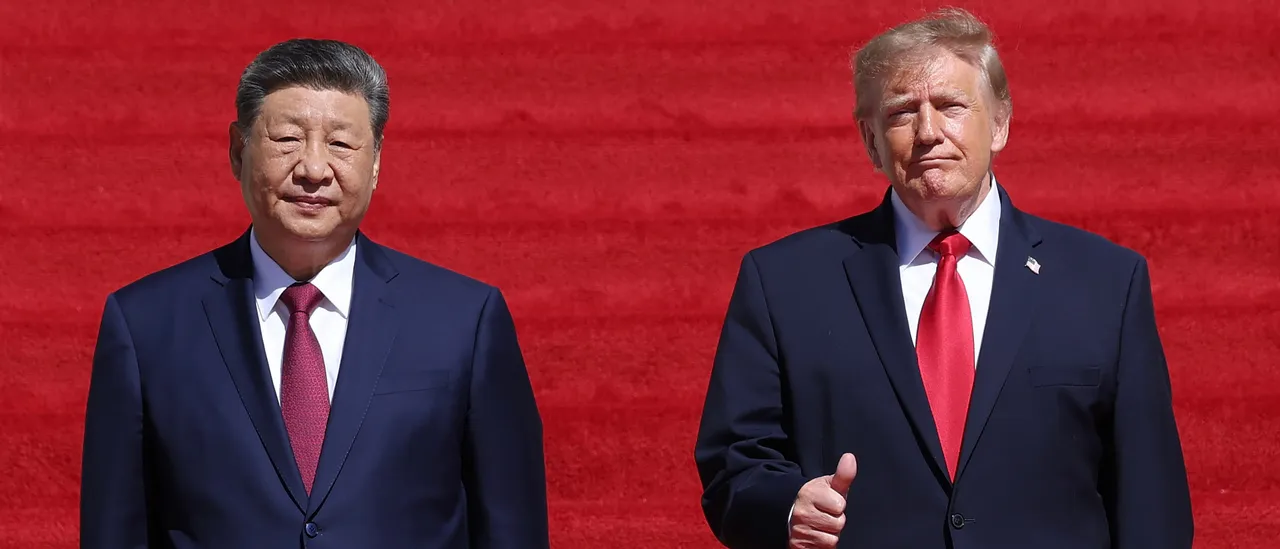
Trump Contradicts Own Ambassador on China Arms Sale Offer
Intra-Party Split Detected
Trump's own ambassador to China, David Perdue, made claims about weapons sales discussions with Xi that Trump directly contradicted, creating a public discrepancy between a Trump-appointed official and the president himself, with the State Department also distancing itself from Perdue's account.
Left says
- •The episode raises questions about whether the administration is willing to loosen U.S. national security safeguards to smooth over trade tensions with a strategic rival.
- •An ambassador publicly stating something the president then denies suggests possible disarray or lack of coordination in China policy at senior levels.
- •Any suggestion of selling advanced American weapons technology to China, even hypothetically, is alarming given long-standing bipartisan concern about technology transfer to a geopolitical competitor.
- •The mixed messaging fuels concern that Taiwan's security interests could be sidelined in pursuit of a broader deal with Beijing.
Right says
- •Trump's swift and direct denial shows he is drawing a clear line against arms sales to China, consistent with existing U.S. law and policy.
- •The confusion likely stems from an honest mix-up between discussions of Taiwan arms sales and China, a distinction Trump himself raised when questioned.
- •The State Department immediately reaffirmed that U.S. law prohibits arms sales to China and that no such offer or plan exists, showing institutional consistency.
- •Trump's comment that China would likely want to buy superior American equipment reflects confidence in U.S. military technology rather than any actual policy shift.
Common Take
High Consensus- U.S. law currently prohibits arms sales to China, and no official proposal to change that exists.
- Ambassador David Perdue said Trump asked Xi Jinping if he would like to buy American weapons, a claim Trump denied making.
- Trump suggested Perdue may have confused the China conversation with discussions about Taiwan arms sales.
- China is widely viewed across the political spectrum as a potential strategic rival to the United States in the Pacific.
The Arguments
Left argues
An ambassador publicly stating that Trump offered to sell weapons to China, only to be directly contradicted by the president himself, suggests real disarray in coordination on a sensitive national security matter.
Right counters
Ambassadors sometimes misspeak or conflate related topics like Taiwan arms sales with China policy, and Trump's immediate correction actually demonstrates functioning oversight rather than dysfunction.
Right argues
Trump's swift, unambiguous denial combined with the State Department's immediate reaffirmation that U.S. law prohibits China arms sales shows the administration's institutional guardrails are working exactly as intended.
Left counters
The fact that guardrails had to publicly intervene at all only underscores that a sitting U.S. ambassador believed, or claimed, such an offer was made — that's not a reassuring sign regardless of the after-the-fact correction.
Left argues
Even a hypothetical or mistaken mention of selling advanced American weapons to China is alarming given decades of bipartisan consensus on restricting technology transfer to a strategic rival.
Right counters
Trump's comment that China would 'probably like to buy' superior American equipment was a statement of confidence in U.S. technology, not a policy proposal, and existing law makes any such transfer illegal regardless of rhetoric.
Right argues
Trump himself raised the plausible explanation that Perdue conflated a conversation about Taiwan arms sales with China, a simple and understandable mix-up given the countries' intertwined status in U.S. Asia policy discussions.
Left counters
Perdue's remarks were detailed and specific, invoking direct quotes attributed to Trump about arms sales to 'other people around the world' and Xi's reaction, which is a strange level of detail to result from a simple Taiwan-China mix-up.
Left argues
The mixed signals over arms sales feed broader concerns that Taiwan's security interests could be quietly deprioritized as Trump pursues a broader trade and diplomatic deal with Beijing.
Right counters
Nothing in the episode shows any actual shift in Taiwan policy; the administration's firm denial and the legal prohibition on China arms sales reinforce, rather than undermine, the existing distinction between Taiwan and China.
Challenge Questions
These questions target genuine internal contradictions — meant to provoke honest reflection.
Right asks Left
“If the State Department and Trump both immediately and consistently denied any China arms offer, and existing law explicitly bars such sales, what specific evidence beyond one ambassador's disputed remark suggests an actual policy shift is underway?”
Left asks Right
“If Perdue's account was simply a mix-up between Taiwan and China, why did he offer specific, detailed language attributed to Trump about offering to sell weapons directly to Xi, rather than a vaguer or more easily explained misstatement?”
Outlier Report
Left Fringe
China hawks like Rep. Mike Gallagher-aligned commentators (though he's Republican, similar hawkish Democrats like Sen. Chris Coons) and pro-Taiwan advocacy voices such as those at the Institute for Taiwan-American Studies may frame this as a genuine crisis of U.S. resolve, representing maybe 10-15% of the left who prioritize Taiwan security above trade normalization.
Right Fringe
Some pro-Trump commentators and accounts on X may dismiss the story entirely as media-manufactured 'gotcha' journalism with no substance, essentially treating Perdue's comments as irrelevant; this dismissive framing likely represents about 15-20% of the right who reflexively defend Trump regardless of specifics.
Noise Assessment
High noise relative to actual public salience; this is a niche foreign-policy process story that will generate outsized commentary among China-policy wonks and partisan media but limited attention from the general public, who are more focused on economic and domestic issues.
Sources (6)
‘We didn’t discuss it’
President Donald Trump asked Chinese President Xi Jinping whether he would be interested in buying American weapons during their recent talks in Washington, according to U.S. Ambassador to China David Perdue, though Trump denied it Monday. “President Trump continues to say, ‘Hey, we sell arms to other people around the world,’” Perdue told Fox News’ ...
The State Department on Monday said that federal law prohibits arms sales to China and no use proposal exists.
Questions about whether the U.S. could change its posture toward China are on the rise after David Perdue, the U.S. ambassador to China, made waves by saying President Trump had asked Chinese President Xi Jinping if he would “like to buy some.” The president on Monday denied making the offer to Xi, while close observers…
President Trump on Monday denied talking about selling U.S. weapons with Chinese President Xi Jinping, but added that China would “probably like to buy it.” Trump took questions from reporters about his recent meeting with Xi and was asked about U.S. Ambassador to China David Perdue’s remark on Sunday that Trump proposed selling weapons to…
President Trump on Monday said he did not discuss an offer to sell U.S. weapons to China during the recent summit with Chinese President Xi Jinping.