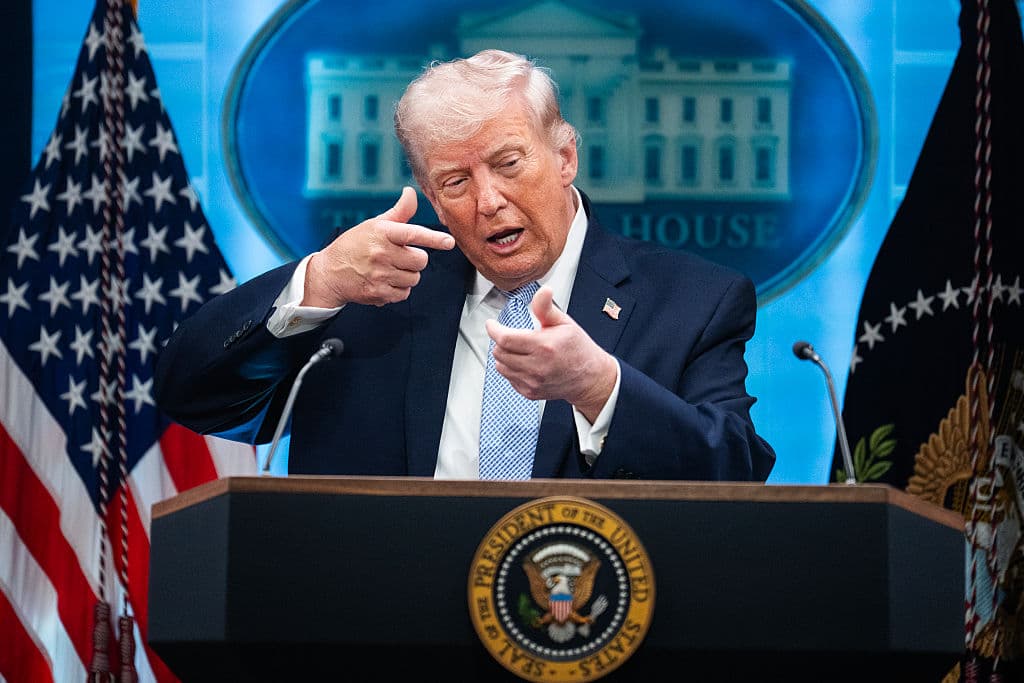
 President Trump gestures while speaking at White House press briefing podium.
Trump Declares Iran Ceasefire 'Over,' Weighs Ground Invasion
Intra-Party Split Detected
Most right-leaning coverage (Forbes, National Review) reports Trump's escalation with limited scrutiny or cautious support for firmness on MOU violations, while some conservative voices (National Review's 'how far is he willing to go?') express unease about open-ended escalation, ground invasion talk, and threats to civilian infrastructure without a clear endgame.
Left says
- •Renewed strikes and talk of a ground invasion risk plunging the region back into an all-out war that both countries badly need to avoid, undermining months of fragile diplomacy.
- •Trump's rhetoric — calling Iranians 'scum' and threatening civilian infrastructure like power and desalination plants — is condemned as reckless and dehumanizing, raising the risk of mass civilian casualties.
- •The collapse is being driven partly by hardline factions on both sides, and mediators from Qatar, Pakistan, and other countries are working urgently to pull the deal back from the brink because they see real progress being squandered.
- •Framing the war as a US-Israeli 'defeat' and highlighting Iranian resilience, including mass public mourning for Khamenei, challenges the narrative that military pressure is working.
Right says
- •Iran violated the memorandum of understanding first by attacking commercial ships in the Strait of Hormuz, so the U.S. response is a justified act of accountability rather than reckless escalation.
- •Keeping the Strait of Hormuz open is a vital American and global economic interest, and Trump and Vance are right to insist that attacks on shipping will be met with force until Iran stands down.
- •Trump's willingness to escalate, including possibly targeting Kharg Island or considering a ground campaign using allied forces, reflects a strategy of maximum pressure meant to force Iran into a durable deal rather than reward bad-faith negotiating.
- •Iran's leadership is described as fractured and unreliable, with radical elements sabotaging diplomacy, making skepticism about their willingness to honor any agreement reasonable.
Common Take
High Consensus- Iran attacked commercial ships in the Strait of Hormuz, triggering the latest round of U.S. strikes and Iranian retaliation against bases in Bahrain and Kuwait.
- Regional mediators including Qatar and Pakistan are actively working to de-escalate the situation and revive the memorandum of understanding.
- Both governments have public factions that are skeptical of or opposed to the deal, complicating efforts to restore the ceasefire.
- The Strait of Hormuz is central to the dispute, with global oil markets and shipping safety at stake for both sides.
The Arguments
Right argues
Iran's attacks on commercial ships in the Strait of Hormuz constitute a clear violation of the memorandum of understanding, so the U.S. response is accountability for bad-faith conduct, not reckless escalation.
Left counters
The MOU's interpretation of shipping lanes was contested from the start, with Iran arguing the U.S. itself violated the deal by rerouting ships without approval, meaning it's not the clean-cut violation the right claims.
Left argues
Trump's rhetoric calling Iranians 'scum' and openly threatening civilian infrastructure like power and desalination plants risks mass civilian casualties and represents a dangerous escalation beyond legitimate military targets.
Right counters
Trump has to this point held off on striking Kharg Island's oil facilities specifically to avoid destabilizing the world economy, showing calculated restraint even amid tough rhetoric aimed at pressuring Iran to stand down.
Right argues
Keeping the Strait of Hormuz open is a vital global economic interest, and a strategy of maximum pressure is more likely to produce a durable deal than tolerating repeated Iranian violations without consequence.
Left counters
Regional mediators from Qatar, Pakistan, and other nations believe real progress had already been made toward a nuclear deal, and renewed strikes risk squandering that progress and triggering the very oil-market chaos the U.S. claims to want to prevent.
Left argues
Iran's mass public mourning for Khamenei and continued defiance suggest military pressure is not breaking Iranian resolve, undermining the premise that escalation will force capitulation rather than entrench resistance.
Right counters
Public mourning reflects cultural and religious tradition, not necessarily political endorsement of the regime's brinkmanship, and U.S. officials attribute the renewed attacks specifically to radical factions losing leverage, not popular momentum.
Right argues
Iran's leadership is fractured, with hardline elements sabotaging diplomacy even when official negotiators want to return to the MOU, making skepticism about Tehran's ability to honor any deal reasonable rather than paranoid.
Left counters
If Iran's government is genuinely fractured and moderates are trying to preserve the deal, that argues for reinforcing diplomacy and mediation rather than launching strikes that empower hardliners and undercut the very officials seeking de-escalation.
Challenge Questions
These questions target genuine internal contradictions — meant to provoke honest reflection.
Right asks Left
“If mediators and even U.S. officials attribute the ceasefire's collapse partly to hardline factions inside Iran deliberately sabotaging diplomacy, why should the U.S. treat renewed attacks on commercial shipping as something other than a violation requiring a response?”
Left asks Right
“If the administration says it has more room to escalate because tankers are already successfully routing around the strait, doesn't that undercut the claim that Iran's actions represent an urgent existential threat requiring strikes on civilian infrastructure like power and desalination plants?”
Outlier Report
Left Fringe
Jacobin and figures like those aligned with the Quincy Institute (e.g., Trita Parsi) who frame the outcome as a U.S.-Israeli 'defeat' and portray Iranian resilience sympathetically represent a more anti-interventionist, anti-imperialist framing held by roughly 10-15% of the left, well to the left of mainstream Democratic officials.
Right Fringe
Hawkish voices like Lindsey Graham-style commentators and some National Review contributors pushing for maximal pressure including potential occupation of Kharg Island or ground campaigns represent a more aggressive interventionist wing, roughly 15-20% of the right, while more isolationist-leaning MAGA figures (e.g., Tucker Carlson-aligned voices) would actually oppose further escalation, creating right-of-center divisions.
Noise Assessment
High — cable news and Truth Social rhetoric ('scum,' desalination plant threats) generate outsized attention relative to actual public appetite for war, and most Americans' views are driven by general war-weariness rather than granular MOU violation debates.
Sources (11)
<p>President Trump said on Friday that the U.S. agreed to <a href="https://www.axios.com/2026/07/09/us-iran-nuclear-deal-mediators-qatar-pakistan" target="_blank">continue talks</a> with Iran, but it will not adhere to <a href="https://www.axios.com/2026/07/08/trump-iran-ceasefire-over" target="_blank">the ceasefire</a> anymore. </p><p><strong>Why it matters:</strong> Trump's <a href="https://truthsocial.com/%40realDonaldTrump/posts/116896167446779964" target="_blank">post</a> on Truth Social follows ongoing <a href="https://www.axios.com/2026/07/09/us-iran-nuclear-deal-mediators-qatar-pakistan" target="_blank">de-escalation efforts by regional mediators</a> over the last 48 hours to prevent the total collapse of the U.S.-Iran deal. </p><hr /><ul><li>While Trump announced on Wednesday that the ceasefire is "over" and stressed he has very little faith that talks with Iran can produce a credible deal, he is allowing negotiators to engage with the Iranians. </li><li>A source with knowledge said another round of negotiations between the U.S. and Iran is expected next week, possibly in Switzerland. </li></ul><p><strong>What he is saying:</strong> "The Islamic Republic of Iran has asked us to continue 'talks.' We have agreed to do so, but the United States has stated to them, in no uncertain terms, that the Cease Fire is OVER! Thank you for your attention to this matter," Trump wrote on Truth Social. </p><p><strong>State of play:</strong> Qatari negotiators travelled to Iran on Friday, in coordination with the U.S., to meet with Iranian officials in an effort to de-escalate the situation and create the conditions for negotiations to resume, according to a diplomat with knowledge of the visit.</p><ul><li>The diplomat said "it's clear both sides want to come back to the MOU."</li></ul>
<p>The White House is preparing for what could become a multi-day or even multi-week exchange of fire with <a href="https://www.axios.com/world/iran" target="_blank">Iran</a> over the <a href="https://www.axios.com/2026/07/07/us-revokes-iran-oil-waivers-hormuz-strait-attacks" target="_blank">Strait of Hormuz</a>.</p><ul><li>The length and severity of the new campaign hinge entirely on Tehran's next moves, U.S. officials tell Axios.</li></ul><p><strong>Why it matters:</strong> A war that began with the goal of degrading Iran's missile capabilities and destroying what remained of its nuclear program has <a href="https://www.axios.com/2026/07/08/trump-iran-ceasefire-over-rhetoric-attacks" target="_blank">evolved</a> into an open-ended fight over the world's most important energy chokepoint.</p><hr /><ul><li>A U.S. official said the current escalation could last a day or two, a week or a month, depending on whether Iran continues its attacks on commercial ships in the Strait of Hormuz.</li><li>"We're going to slap them a bit so they understand we're not f*cking around," the U.S. official said.</li></ul><p><strong>Driving the news: </strong>Diplomacy has stalled for now, and military pressure is back at the center of President Trump's strategy.</p><ul><li><a href="https://www.axios.com/2026/07/08/trump-iran-ceasefire-over" target="_blank">Trump said</a> Wednesday the 60-day ceasefire outlined in the memorandum of understanding (MOU) was "over" after an exchange of fire triggered by Iranian attacks on commercial ships.</li><li>The U.S. then <a href="https://www.axios.com/2026/07/08/us-strikes-iran-targets-strait-of-hormuz-second-day" target="_blank">launched a second round of strikes</a> near the Strait of Hormuz, including attacks on infrastructure targets inside Iran for the first time in months.</li><li>Iran retaliated with attacks on U.S. bases in Kuwait and Bahrain, while insisting it would not back down from its claim to control the strait.</li></ul><p><strong>Shortly after</strong>, Trump signaled the U.S. was ready to de-escalate, telling reporters on Air Force One that Iranian officials had "called a little while ago" and "want to make a deal."</p><ul><li>It was unclear what call Trump was referring to, and Iranian officials did not immediately confirm any direct outreach.</li><li>"I just don't know if they're worthy of making a deal. I don't know that they're going to do honor the deal," Trump added. "They're sort of crazy, to be honest."</li></ul><p><strong>The other side: </strong>Iran's top negotiator, Mohammad Bagher Ghalibaf, accused the U.S. of "bullying and breaking promises" and warned that the strait would only reopen on Tehran's terms.</p><ul><li>"If you strike, you'll get hit," Ghalibaf <a href="https://x.com/mb_ghalibaf/status/2075030287071785174?s=20" target="_blank">wrote on X</a>. "The Strait of Hormuz will only open with 'Iranian arrangements,' not American threats."</li></ul><p><strong>The big picture: </strong>Reopening the Strait of Hormuz and restoring freedom of navigation for commercial ships has become a central goal for the Trump administration, mainly to stabilize global energy markets.</p><ul><li>For Iran, maintaining control over the strait has become a key objective in any deal to end the war.</li><li>The issue was a central provision in the U.S.-Iran MOU, and conflicting interpretations of the strait clauses are now causing the deal to unravel.</li><li>The MOU requires Iran to allow safe passage for ships through the Strait of Hormuz. But soon after it was signed, Iranian officials accused the U.S. of violating the deal by routing ships through a southern lane near the Omani coast without Tehran's approval.</li></ul><p><strong>Between the lines: </strong>U.S. officials say the White House believes it has more room to escalate because hundreds of oil tankers have managed to leave the Gulf through the strait in recent weeks.</p><ul><li>That has eased concerns inside the administration that a renewed clash would immediately trigger a major oil price spike, the officials said.</li></ul><p><strong>Behind the scenes:</strong> A U.S. official claimed the current escalation stems from frustration among more radical elements inside Iran's fractured leadership who believe the MOU has not delivered real benefits for Tehran.</p><ul><li>Iran saw its leverage in Hormuz slipping as hundreds of ships transited through the southern route close to the Omani coast, the official said.</li><li>Despite U.S. sanctions waivers, Iran struggled to sell oil because financial institutions would not approve transactions and countries were reluctant to rely on temporary waivers.</li><li>No Iranian frozen funds have been released because Iran has not yet taken nuclear steps required by the agreement.</li><li>The framework agreement the U.S. brokered between Israel and Lebanon made the Lebanon portion of the MOU unnecessary, the official said.</li></ul><p><strong>What to watch:</strong> "Part of the Iranian leadership was not happy about all of those things," the U.S. official said.</p><ul><li>"They started shooting and we decided it's time to slap them back hard. It's a process. We have patience. If we don't feel we're getting the deal we want, we are not going to do it."</li></ul><p><strong>The bottom line:</strong> Vice President <a href="https://www.aa.com.tr/en/us-israel-iran-war/vice-president-says-us-will-respond-if-iran-attacks-shipping-in-strait-of-hormuz/3992287" target="_blank">Vance said</a> Wednesday the U.S. position is simple: the Strait of Hormuz must remain open.</p><ul><li>"If they try to close it down, there's going to be a response from the American military," Vance said.</li><li>"They can either follow it, or they can have exactly what happened to them last night. It's just going to keep on happening until they open up that lane and stop shooting at ships."</li></ul>
The U.S. launched renewed strikes on Iran on Tuesday in response to Iranian attacks on ships in the Strait of Hormuz.
The president also said he hasn’t ruled out a ground invasion of Iran.
Trump is right not to tolerate violations of the MOU, but how far is he willing to go? <img src="https://i0.wp.com/www.nationalreview.com/wp-content/uploads/2026/07/iran-strike-video.jpg?fit=617%2C360&ssl=1" />
We speak with political analyst Trita Parsi, executive vice president of the Quincy Institute for Responsible Statecraft, about the latest events in the Middle East. The United States has bombed Iran for multiple days after President Donald Trump declared the ceasefire between the countries to be “over.” Iran says it has retaliated by attacking U.S. military bases and other strategic sites in Bahrain, Kuwait and Qatar.</p> <p>Parsi says the renewal of fighting is “a disastrous development” for chances of a long-term peace and a reset in the U.S.-Iran relationship. “Both countries are in dire need of an end to this war.”
<p>Both Trump and Iran declare the ceasefire is over in the wake of the latest flare-up in fighting.</p> <p>The post <a href="https://www.twz.com/news-features/deal-to-end-hostilities-between-u-s-and-iran-faces-most-serious-challenge-yet">Deal To End Hostilities Between U.S. And Iran Faces Most Serious Challenge Yet (Updated)</a> appeared first on <a href="https://www.twz.com">TWZ</a>.</p>
<p>Qatar, Pakistan and other regional mediators are trying to de-escalate tensions between the U.S. and <a href="https://www.axios.com/world/iran" target="_blank">Iran</a> and revive negotiations on a nuclear deal, according to two sources from the mediating countries and a U.S. official. </p><p><strong>Why it matters:</strong> While President Trump announced on Wednesday that the U.S.-Iran memorandum of understanding (MOU) and the ceasefire were "over" and ordered <a href="https://www.axios.com/2026/07/08/us-strikes-iran-targets-strait-of-hormuz-second-day" target="_blank">two rounds</a> of airstrikes, he is <a href="https://www.axios.com/2026/07/09/trump-iran-strait-hormuz-battle" target="_blank">focused on reopening the Strait of Hormuz</a> and still wants to avoid a return to an all-out war with Iran. </p><hr /><ul><li>The mediators think that, regardless of the recent escalation, the parties made progress toward a nuclear deal in earlier rounds of talks and want to prevent <a href="https://www.axios.com/2026/06/17/read-full-us-iran-deal-memorandum-understanding" target="_blank">the MOU</a> from collapsing.</li><li>A regional source from one of the mediating countries said the mediators believe the <a href="https://www.axios.com/2026/07/07/iran-resumes-hormuz-attacks-us-officials" target="_blank">recent Iranian attacks</a> in Hormuz were initiated by elements inside the Iranian regime that oppose the MOU and want to undermine it.</li></ul><p><strong>The latest: </strong>Qatari negotiators travelled to Iran on Friday, in coordination with the U.S., to meet with Iranian officials in an effort to de-escalate the situation and create the conditions for negotiations to resume, according to a diplomat with knowledge of the visit.</p><ul><li>The diplomat said meetings in Mashhad between Qatari and Iranian official are still ongoing "but it's clear both sides want to come back to the MOU." </li></ul><p><strong>Behind the scenes:</strong> Qatari, Pakistani, Turkish, Egyptian and Saudi officials have conducted multiple phone calls on Wednesday and Thursday with both U.S. and Iranian officials in an effort to calm down the situation, the sources said.</p><ul><li>Iran's Foreign Minister <a href="https://www.axios.com/2026/06/12/iran-deal-us-ceasefire-signing" target="_blank">Abbas Araghchi</a> told Pakistani military commander Field Marshal <a href="https://www.axios.com/2026/05/22/pakistan-munir-iran-deal-trump" target="_blank">Asim Munir</a> that the U.S. attacks and rhetoric were violations of the MOU, according to a statement on his Telegram channel. </li><li>"There are extensive diplomatic efforts to first agree with both sides on de-escalation and then set a date for another round of negotiations between the technical teams," one regional source involved in the mediation said. </li></ul><p><strong>State of play:</strong> After two days of exchanges of fire between the U.S. and Iran, Thursday was much calmer. </p><ul><li>Despite reports in some Iranian media outlets regarding explosions in southern Iran, U.S. officials said the U.S. military didn't conduct any new strikes on Thursday. </li><li>One U.S. official said it was a result of the de-escalation efforts. </li></ul><p><strong>What they are saying:</strong> President Trump held a meeting on Thursday afternoon with his top national security team about the tensions with Iran and the way forward. </p><p>After the meeting a U.S. official said the Trump administration is "still committed to finding a resolution, and technical-level talks continue" to reach a nuclear deal.</p><ul><li>"President Trump made his feelings very clear yesterday in no uncertain terms. Iran's attacks on these innocent vessels are acts of terrorism. The MOU is performance-based, and Iran's actions constitute failed performance at an unacceptable level", the U.S. official said. </li></ul>
Iran has destroyed much of the US’s military infrastructure across West Asia and strengthened its position by controlling the Strait of Hormuz — yet Trump has learned nothing from his defeat.
Plus: Lindsey Graham, R.I.P. <img src="https://i0.wp.com/www.nationalreview.com/wp-content/uploads/2026/06/uss-abraham-lincoln-middle-east.jpg?fit=617%2C360&ssl=1" />