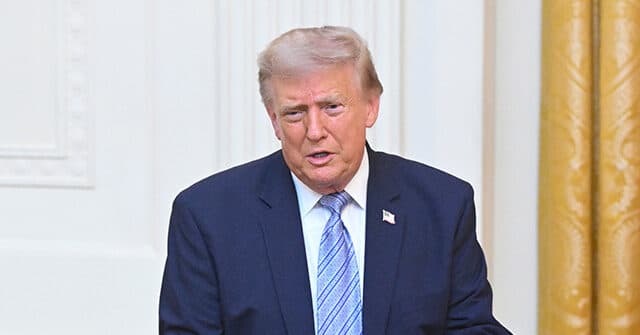
Trump Declassifies Docs Alleging China Hacked 220M Voter Files
Left says
- •The intelligence assessment released by former DNI Avril Haines actually concluded China 'considered but did not deploy' influence efforts to change the 2020 outcome, which complicates Trump's framing of active Chinese election manipulation.
- •Trump has a long history of disputing his 2020 loss to Biden, raising questions about whether this disclosure is aimed at re-litigating that outcome rather than pure election security.
- •Declassifying selectively chosen intelligence documents in a primetime address raises concerns about politicizing classified material for political messaging rather than through standard, nonpartisan security channels.
- •Claims about a 'deep state' and 'shadow government' suppressing information echo previous unproven allegations Trump has made about intelligence agencies acting against him, which warrants scrutiny before accepting at face value.
Right says
- •A data breach of this scale — 220 million voter files including names, addresses, phone numbers, and party affiliation — represents a serious national security failure that deserves public attention regardless of political timing.
- •Intelligence officials allegedly withheld this information from Trump and Congress for years, which suggests a troubling pattern of politicized intelligence-gathering that undermined the previous administration's ability to respond.
- •The DHS finding of roughly 278,000 noncitizens on voter rolls, with several Democrat-led states declining to share data, indicates the true scope of noncitizen registration could be significantly understated.
- •Declassifying these documents brings long-suppressed evidence into public view, allowing citizens and lawmakers to judge for themselves whether election infrastructure needs reform, including proof-of-citizenship and voter ID requirements.
Common Take
High Consensus- Foreign adversaries, including China and Venezuela, have shown sustained interest in accessing or influencing U.S. election systems and voter data.
- A Department of Homeland Security review identified approximately 278,000 noncitizens registered on voter rolls in the states that provided data.
- The declassified intelligence assessment from the Haines era found China considered but did not ultimately deploy efforts to change the 2020 presidential election outcome.
- Protecting the integrity and security of U.S. election infrastructure, including voter data and voting machines, is a shared national priority.
The Arguments
Right argues
A breach exposing 220 million voter files—names, addresses, phone numbers, and party affiliation—is a genuine national security concern that warrants public disclosure regardless of who benefits politically from the timing.
Left counters
The same intelligence assessment underlying this disclosure explicitly found China 'considered but did not deploy' efforts to change the 2020 outcome, meaning the scale of the breach doesn't establish the active manipulation narrative Trump is presenting.
Right argues
If intelligence officials genuinely withheld election security information from the sitting president and Congress for political reasons, as internal documents allegedly show analysts admitting, that is a serious governance failure independent of who occupied the Oval Office.
Left counters
Extraordinary claims about a 'shadow government' suppressing intelligence echo Trump's long pattern of unproven deep-state allegations, and selectively released documents in a primetime political address are not a substitute for independent, nonpartisan verification.
Left argues
Trump has disputed his 2020 loss for years, so a dramatic prime-time disclosure emphasizing Chinese interference and voter roll problems from that same election understandably raises questions about whether this is genuine security reform or an attempt to re-litigate 2020.
Right counters
Whatever Trump's motives, the underlying documents—including FBI investigations into Michigan registration fraud and DHS's noncitizen voter findings—exist independently of his framing and deserve scrutiny on their own merits.
Right argues
The DHS finding of roughly 278,000 noncitizens on voter rolls is likely an undercount since several Democrat-led states refused to share their voter data, suggesting the true scope of the problem is being deliberately obscured.
Left counters
An estimate built on incomplete data from only some states is not proof of a much larger hidden problem, and using an admittedly partial figure to argue the system is 'broken' risks manufacturing alarm ahead of policy pushes like the SAVE America Act.
Left argues
Releasing selectively chosen classified documents through a televised political speech, rather than through standard nonpartisan security review channels, raises legitimate concerns about politicizing intelligence for messaging purposes.
Right counters
If prior officials were already manipulating intelligence flow to the president for political reasons, then bypassing those same channels to bring the information directly to the public and Congress is arguably a correction of politicization, not a new instance of it.
Challenge Questions
These questions target genuine internal contradictions — meant to provoke honest reflection.
Right asks Left
“If your objection is that Trump is politicizing intelligence for personal vindication, does that concern also apply equally to the officials who allegedly altered intelligence flow to shield Trump from unfavorable information—and if so, why does one get called politicization while the other doesn't?”
Left asks Right
“If the same declassified intelligence assessment explicitly concludes China 'considered but did not deploy' efforts to change the 2020 outcome, how can that same assessment be presented as proof that China's hacking was aimed at determining the election's result?”
Outlier Report
Left Fringe
Figures like Rachel Maddow or MSNBC commentators who would dismiss the entire disclosure as fabricated political theater with zero legitimate security concern represent maybe 15-20% of the left; most Democrats likely acknowledge foreign hacking is real even while distrusting Trump's framing.
Right Fringe
Figures like Mike Lindell or fringe MAGA commentators who treat this as definitive proof the 2020 election was 'stolen' via these mechanisms represent maybe 20-25% of the right; most Republicans likely see this as validating security concerns without necessarily claiming it overturns the 2020 outcome.
Noise Assessment
High noise ratio—cable news and social media amplify the most extreme 'stolen election' and 'total hoax' framings on both sides, while the more measured middle-ground reaction (real security issue, exaggerated political framing) gets less airtime despite likely representing majority opinion.
Sources (7)
<p>President Donald Trump said Thursday that a Department of Homeland Security review found roughly 278,000 noncitizens registered to vote in federal elections, arguing the findings expose major weaknesses in the U.S. election system.</p> <p>The post <a href="https://www.breitbart.com/politics/2026/07/16/trump-says-u-s-election-system-is-broken-and-vulnerable-after-dhs-review-found-noncitizens-on-voter-rolls/" rel="nofollow">Trump Says U.S. Election System Is ‘Broken’ and ‘Vulnerable’ After DHS Review Found Noncitizens on Voter Rolls</a> appeared first on <a href="https://www.breitbart.com" rel="nofollow">Breitbart</a>.</p>
The president delivered the speech at the White House on Thursday, which included allegations that China illegally acquired voter information on millions of Americans and that approximately 278,000 non-citizens were found on voter rolls.
According to Trump and subsequent documents to be released Thursday, in the spring and summer of 2020, the intelligence community (IC) began detecting the Chinese illegal acquisition of voter databases.
The documents reportedly reveal that there was a concerted and conscientious effort by the IC not to tell the president (Trump at the time), Congress or the American people.
President Donald Trump announced the release of declassified documents he said are evidence that China has been meddling in U.S. elections by hacking into voter registration databases and by other means. Trump, who spoke Thursday evening in a prime time address to the nation, said the “deep state” had this information and suppressed it from...
<img alt="Smartmatic voting machine" class="webfeedsFeaturedVisual wp-post-image" src="https://thefederalist.com/wp-content/uploads/2026/07/COMELEC_Smartmatic_VCM_Demo_SM_Marikina_subo_Marcos_Highway_Marikina_04-22-2022-e1784296431133-1200x675.jpg" style="display: block; margin: auto; margin-bottom: 5px;" />A newly declassified CIA report says the Venezuelan government “could have” used voting machines to rig elections. President Donald Trump declassified a series of documents and reports related to election integrity on July 16, including a “CIA Note” entitled, “Summary of Select Intelligence Reporting From 2004-2020 on Venezuela’s Electronic Voting Manipulation Capabilities.” The note says […]
<img alt="A Michigan election worker sorts through absentee ballots." class="webfeedsFeaturedVisual wp-post-image" src="https://thefederalist.com/wp-content/uploads/2026/07/Screenshot-2026-07-17-at-3.25.39-AM-1200x675.png" style="display: block; margin: auto; margin-bottom: 5px;" />The declassified records offer a window into a massive voter registration fraud operation in Muskegon, Michigan.