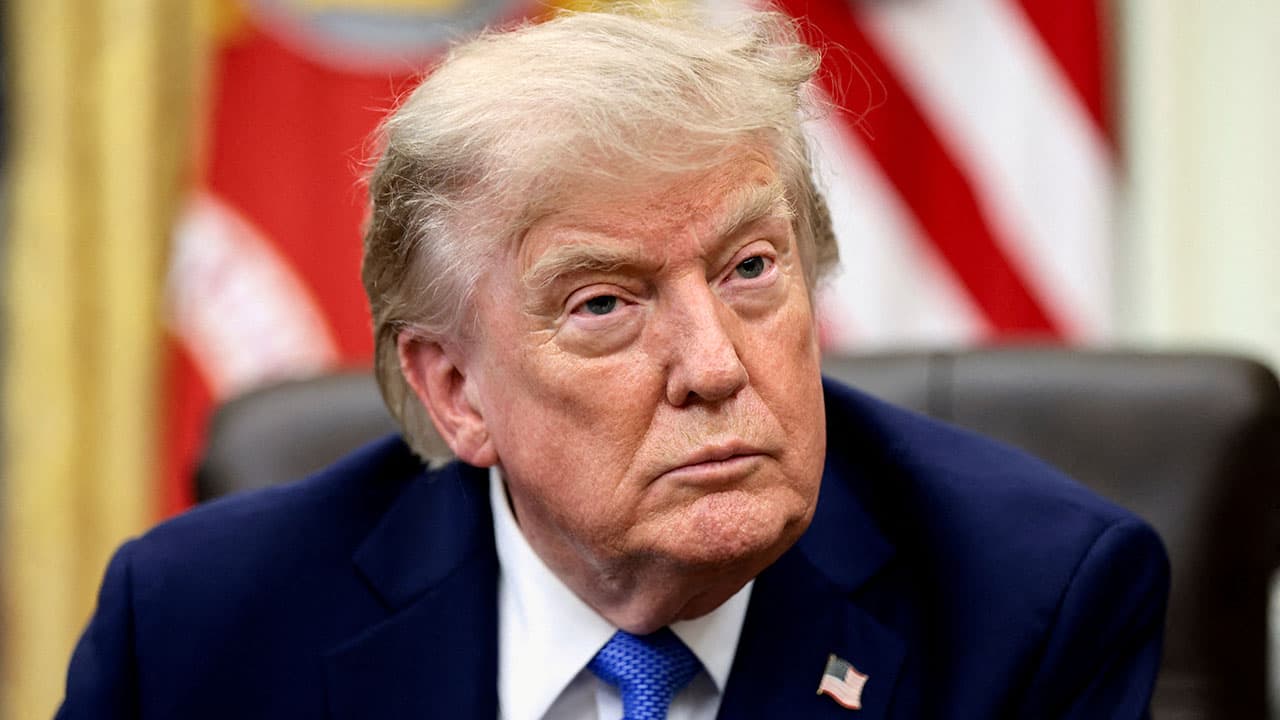
Trump Demands Iran Pay 'Compensation' After Tehran Seeks War Damages
Left says
- •Trump's approach is notably restrained compared to a week earlier, when he was reportedly on the verge of ordering a return to major combat operations, suggesting economic pressure is currently favored over further military escalation.
- •Internal Iranian regime divisions are emerging, with President Pezeshkian's camp reportedly worried about economic collapse and open to a deal, while IRGC hardliners led by Ahmad Vahidi reject concessions, complicating any resolution.
- •Rights groups note the Iranian government has continued cracking down on its own opponents even during the war, complicating any narrative that frames Iran solely as a victim seeking compensation.
- •The compensation dispute is unfolding alongside stalled negotiations over reopening the Strait of Hormuz, a critical global shipping lane, meaning the rhetorical back-and-forth carries real economic stakes for global oil markets.
Right says
- •Iran's request for war reparations is seen as brazen given the regime's decades-long record of sponsoring terrorism, including the USS Cole bombing and roadside bomb attacks that killed and wounded American service members.
- •Trump's counter-demand is framed as turning the tables on a regime that also killed tens of thousands of its own citizens during anti-government protests, undercutting Iran's moral standing to seek damages.
- •Officials argue Iran's economy is the real point of leverage, with Treasury Secretary Bessent's sanctions campaign described as more feared by Tehran than military strikes because of runaway inflation and frozen assets.
- •Trump's shift toward 'low keying' the conflict is portrayed as a strategic chess move, letting economic collapse pressure Iran into concessions without further U.S. military risk.
Common Take
High Consensus- Iran raised compensation for war damages as a new condition tied to reopening the Strait of Hormuz negotiations.
- Trump responded by demanding Iran pay compensation for people killed and wounded in attacks linked to Tehran, including the USS Cole bombing and roadside bomb attacks.
- Iran is experiencing significant economic strain, including high inflation and frozen assets, which is affecting its negotiating position.
- No final deal on reopening the Strait of Hormuz had been reached at the time of reporting, despite earlier expectations of an imminent announcement.
The Arguments
Right argues
Iran's demand for war reparations is brazen given its decades-long record of sponsoring terrorism against Americans, including the USS Cole bombing and roadside bomb attacks, and Trump's counter-demand exposes the regime's lack of moral standing to seek damages.
Left counters
Turning the compensation dispute into a tit-for-tat rhetorical contest sidesteps the substantive issue of the Strait of Hormuz negotiations, where real economic stakes for global oil markets remain unresolved regardless of who has the stronger moral claim.
Left argues
Trump's shift toward 'low keying' the conflict just a week after nearly ordering a return to major combat operations suggests economic pressure, not military escalation, is now the preferred tool, indicating a meaningful de-escalation in approach.
Right counters
This isn't retreat but strategy: officials frame the economic squeeze via Bessent's sanctions campaign as more effective and lower-risk than further strikes, since Iran can absorb military losses but not currency collapse and frozen assets.
Left argues
Internal Iranian regime divisions—with Pezeshkian's camp fearing economic collapse and IRGC hardliners under Vahidi rejecting any concessions—show the conflict's resolution is complicated by factional infighting that no amount of American rhetoric can simply resolve.
Right counters
This infighting actually validates the U.S. economic pressure strategy: if hardliners are being undercut by their own government's economic desperation, sustained sanctions pressure is working exactly as intended to split the regime's coalition.
Left argues
Rights groups note Iran has continued cracking down on its own opponents even during the war, complicating any narrative that frames Iran solely as a victim seeking legitimate compensation.
Right counters
This is precisely Trump's point—Iran's ongoing repression, including the killing of tens of thousands of protesters, is exactly why the regime has no moral standing to demand war reparations while ignoring its own victims.
Right argues
Officials like Ambassador Waltz argue Iran's economy, devastated by Bessent's sanctions campaign and runaway inflation, is the true point of leverage, since the regime will absorb military losses but cannot absorb currency collapse and frozen assets.
Left counters
If economic pressure alone were sufficient, Iran would already be capitulating rather than issuing an expanding list of new demands, including compensation, sanctions relief, and troop withdrawals, suggesting the strategy has not yet forced meaningful concessions.
Challenge Questions
These questions target genuine internal contradictions — meant to provoke honest reflection.
Right asks Left
“If internal Iranian divisions and continued domestic repression are cited as reasons to distrust Tehran's sincerity in seeking a deal, why should Iran's compensation claims be given any serious weight at all in the broader narrative?”
Left asks Right
“If Trump's team says Iran only understands 'cash, cash, cash' and is being squeezed into concession by economic collapse, why has Tehran responded not with capitulation but with an expanding list of demands—doesn't that suggest the pressure campaign may be strengthening hardliner resolve rather than isolating them?”
Outlier Report
Left Fringe
Figures like Code Pink activists or commentators such as Trita Parsi (Quincy Institute) who argue the U.S./Israeli strikes were unjustified aggression and that Iran's compensation claims have merit; likely under 10% of the left.
Right Fringe
Hawkish voices like Sen. Lindsey Graham or commentators pushing for renewed military escalation rather than economic pressure alone, arguing Trump's 'low-keying' is too soft; roughly 10-15% of the right.
Noise Assessment
High performative amplification on social media (e.g., viral posts framing this as Trump 'owning' Iran) likely overstates enthusiasm; most Americans are not closely tracking the granular details of Strait of Hormuz negotiations or compensation claims, so actual attentive public opinion is softer than online reaction suggests.
Sources (9)
REUTERS—President Donald Trump said on Monday he will demand that Iran pay compensation for “all of the people that they have killed and gravely wounded,” in response to Iran seeking compensation for the damages it has incurred from U.S. and Israeli attacks. Trump’s social media post came after Iran said over the weekend it was nearing a deal with Oman defining...
President Donald Trump on Monday demanded that Iran compensate the families of all the people killed or gravely wounded by its "roadside bombs" and many attacks during the past 50 years.
<p>President Donald Trump said Sunday the United States is “low keying” its approach to Iran, signaling he is prepared for now to let mounting economic pressure squeeze Tehran rather than launch another major military offensive.</p> <p>The post <a href="https://www.breitbart.com/politics/2026/08/09/trump-says-u-s-is-low-keying-iran-as-economic-pressure-mounts/" rel="nofollow">Trump Says U.S. Is ‘Low Keying’ Iran as Economic Pressure Mounts</a> appeared first on <a href="https://www.breitbart.com" rel="nofollow">Breitbart</a>.</p>
The U.S. began attacking Iran in late February after failed attempts to get the rogue Middle East nation to wind down its nuclear-enrichment program.
<p>President Trump signaled on Sunday that he's prepared to allow economic pressure on <a href="https://www.axios.com/world/iran" target="_blank">Iran</a> to mount — as opposed to ordering a new military offensive — even as the country continues to defy the U.S.</p><p><strong>Why it matters:</strong> Only a week ago, <a href="https://www.axios.com/politics-policy/donald-trump" target="_blank">Trump</a> was on the verge of ordering a return to major combat operations. But in an interview with Axios, he did not make any new military threats. </p><hr /><ul><li>Trump also didn't express any anger or frustration about the fact that Iran has been holding up an announcement on a deal with Oman to reopen the <a href="https://www.axios.com/2026/06/25/iran-ship-attacked-strait-hormuz-un-sailors-evacuation-paused" target="_blank">Strait of Hormuz</a>. On Saturday, Iran issued a new list of demands to allow shipping through the strait.</li></ul><p><strong>What he's saying:</strong> "We are low-keying it," Trump said during a brief phone call. </p><ul><li>"We are only semi-negotiating with them. We are just watching Iran with its huge <a href="https://www.axios.com/economy/inflation" target="_blank">inflation</a> and the fact they have no money."</li><li>He stressed that Iran "is in very bad shape" economically and has no money to pay its troops. The U.S. naval blockade has exacerbated the Iranian regime's economic crisis, Trump said.</li><li>At the same time, Trump said that with oil down to slightly over $75 a barrel, U.S. consumers are feeling less pain from the war. </li><li>"It will work out. It always works out. It's like a chess game," Trump said of the back-and-forth with Iran. </li></ul><p><strong>Driving the news:</strong> An agreement governing traffic in the Strait of Hormuz was negotiated among Iran, Oman and the U.S. and has been pending for a few days now. </p><ul><li>As part of the new deal, Iran would be given partial control over traffic in the strait — something it didn't have before the war.</li><li>Qatari and Pakistani mediators were confident the deal would be announced Wednesday, but since then its prospects have seemed to fade.</li><li>U.S. officials also say there are growing disagreements inside the Iranian regime. One camp, led by President Masoud Pezeshkian, is extremely worried about an economic collapse and believes Iran needs to reach a deal with the U.S. Another led by the commander of the Islamic Revolutionary Guard Corps, Ahmad Vahidi, rejects any concessions.</li></ul><p><strong>State of play: </strong>On Saturday, the head of Iran's Supreme National Security Council, Mohammad Bagher Zolghadr, laid out new terms for reopening the strait — on top of those negotiated in the Oman agreement.</p><p><strong>Zolghadr said in a statement </strong>that in order for the strait to reopen, the U.S. must: </p><ul><li>"[N]ever threaten nor insult Iran in any language."</li><li>"[P]ermanently end the war against Iran and Iran's allies in Lebanon, Gaza, Yemen, and Iraq."</li><li>Lift the naval blockade and withdraw military forces from the surroundings of Iran. </li></ul><p><strong>He added a demand</strong> for full compensation for war damages, lifting all sanctions and the release of all Iranian frozen funds. </p><ul><li>Until several weeks ago, these demands were a prerequisite for a nuclear deal. Now, Iran is presenting them as conditions just for reopening the strait. </li><li>A diplomat from one of the mediating countries said Zolghadr's statement reflected the political infighting within the regime. </li></ul><p><strong>Behind the scenes:</strong> U.S. officials said Trump was leaning toward resuming major combat operations against Iran a week ago but was convinced to de-escalate for now. </p><ul><li>One of the officials said the fighting allowed the Iranian regime to avoid dealing with the consequences of the war, the damage to infrastructure and the deep economic crisis that has been created. </li><li>When Iran isn't engaged in war, it is forced to confront a grim reality with no real solutions at hand, the U.S. official said. </li><li>At the same time, the U.S. official said, around 8 million barrels of oil are going out of the Gulf every night through the southern lane of the Strait of Hormuz in coordination with the U.S. military. The U.S. is going to try and get more oil out as long as there is no deal. </li></ul><p><strong>What to watch:</strong> "This thing is not over. It's obviously not at the beginning. We're in the middle of the game, and we're applying a whole host of tools — diplomatic, economic, military tools — to ensure that we get the best outcome for the American people," Vice President Vance told Fox News on Saturday.</p>
President Trump on Monday said Iran's demand for compensation over war damage is an "interesting idea" that he will turn into a counter-demand for payment from Tehran for thousands of people killed in regime-sponsored acts of Middle East terror and protest crackdowns.