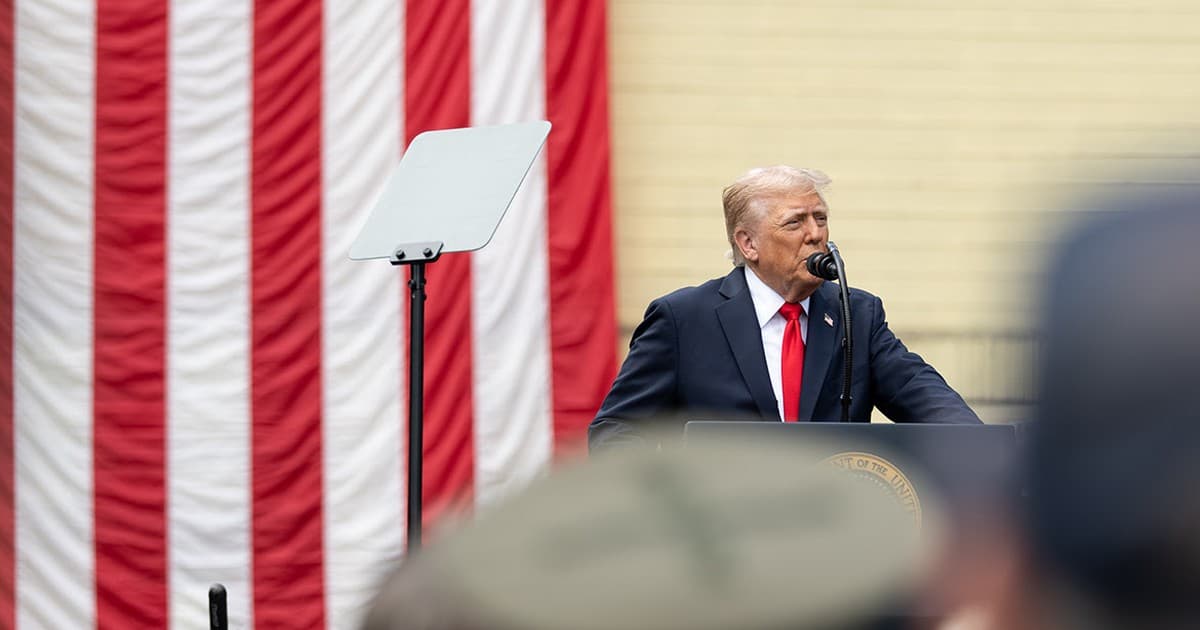
 Trump speaking at podium with American flag backdrop
Trump Destroys Iranian Naval Vessels After Warning Over Strait of Hormuz
Left says
- •Trump's aggressive military actions and rhetoric represent a dangerous escalation that could destabilize the region and provoke broader conflict
- •The president's bragging about military dominance and threats against multiple nations simultaneously demonstrates reckless foreign policy that abandons diplomatic solutions
- •Iran's foreign minister had expressed openness to de-escalation, but Trump's immediate military response killed any chance for peaceful resolution
- •The 'Donroe Doctrine' represents an outdated imperial approach that modern presidents have avoided due to its potential for regional destabilization
Right says
- •Swift military action against Iranian mine-laying vessels protects a critical shipping lane through which 20% of global oil supply travels
- •Trump's decisive response demonstrates American strength and deterrence, preventing Iran from holding vital international waterways hostage
- •The president's clear warnings gave Iran opportunity to de-escalate before military action, showing measured escalation rather than rash aggression
- •Protecting the Strait of Hormuz from terrorist mining operations is essential for global economic security and energy markets
Common Take
High Consensus- The Strait of Hormuz is a critical maritime corridor through which roughly 20% of the world's oil supply transits
- Iran possesses an estimated 2,000 to 6,000 naval mines of various origins
- U.S. intelligence detected Iranian preparations to potentially deploy mines in the shipping lane
- Maintaining secure passage through international waterways is important for global commerce and energy security
The Arguments
Right argues
Swift military action against Iranian mine-laying vessels protects the Strait of Hormuz, through which 20% of global oil supply travels, preventing Iran from holding critical international waterways hostage and threatening global economic security.
Left counters
Military escalation risks broader regional conflict and abandons diplomatic solutions, especially when Iran's foreign minister had just expressed openness to de-escalation before Trump's immediate military response killed peaceful resolution opportunities.
Left argues
Trump's aggressive rhetoric and simultaneous threats against multiple nations (Iran, Cuba) demonstrate reckless foreign policy that could destabilize the entire region through his outdated 'Donroe Doctrine' approach that modern presidents have avoided.
Right counters
Clear warnings and decisive action demonstrate American strength and deterrence, with Trump giving Iran opportunity to de-escalate before taking military action, showing measured escalation rather than rash aggression.
Right argues
Destroying inactive mine-laying vessels before they can deploy their cargo represents proactive defense of international shipping lanes, using precise military technology to eliminate terrorist threats without broader escalation.
Left counters
Bragging about military dominance while threatening consequences 'at a level never seen before' represents dangerous escalation that could provoke Iran into more aggressive responses rather than deterring them.
Left argues
The timing of military action immediately after Iran's diplomatic overture shows Trump prioritizes military solutions over diplomacy, potentially missing opportunities for peaceful resolution of regional tensions.
Right counters
Iran's history of threatening the Strait of Hormuz and deploying thousands of naval mines requires immediate action to protect vital shipping lanes, as diplomatic gestures cannot override active military threats to global commerce.
Challenge Questions
These questions target genuine internal contradictions — meant to provoke honest reflection.
Right asks Left
“If protecting critical shipping lanes through which 20% of global oil travels is genuinely important for global economic security, how can diplomatic approaches realistically prevent Iran from deploying mines that could immediately threaten international commerce?”
Left asks Right
“If Iran's foreign minister genuinely expressed openness to de-escalation, why would Iran simultaneously be taking steps to deploy naval mines in the Strait of Hormuz, and how does this square with claims of seeking peaceful resolution?”
Outlier Report
Left Fringe
Progressive anti-war activists like CodePink's Medea Benjamin and some Squad members like Rashida Tlaib would likely oppose any military action against Iran as escalatory, representing roughly 15-20% of the left coalition.
Right Fringe
Isolationist figures like Tucker Carlson and some America First voices might question military engagement in the Middle East despite supporting Trump, representing approximately 10-15% of the right coalition.
Noise Assessment
Moderate noise level - the story involves concrete military action with video evidence, limiting purely performative responses, though partisan framing around Trump's 'Donroe Doctrine' adds some amplification beyond core security concerns.
Sources (4)
<p>President <a href="https://www.axios.com/politics-policy/donald-trump" target="_blank">Trump</a> said Saturday "we've knocked out 42 navy ships" in three days, adding that the US is doing "very well" in Iran.</p><p><strong>Why it matters:</strong> Trump bragged about dominance in Iran and hinted at possible action in Cuba at the first Shield of the Americas Summit, which has outgoing Homeland Security Secretary <a href="https://www.axios.com/2026/03/05/markwayne-mullin-homeland-security-secretary-nominee" target="_blank">Kristi Noem</a> at the helm.</p><hr /><ul><li>The summit underscores Trump's willingness to reassert American control under his so-called "<a href="https://www.axios.com/2026/01/07/trump-monroe-donroe-doctrine-venezuela-greenland-cuba-colombia" target="_blank">Donroe Doctrine</a>," though modern U.S. presidents have typically shied away from exerting as much American influence over the Western Hemisphere.</li><li><strong>"</strong>We knocked out their Air Force. We knocked out their communications, and all telecommunications has gone," Trump said of Iran. </li></ul><p><strong>The other side:</strong> Iranian foreign minister Seyed Abbas Araghchi <a href="https://x.com/araghchi/status/2030338085783826477?s=20" target="_blank">said</a> on X Saturday the Iranian president "expressed openness to de-escalation within our region-provided that our neighbors' airspace, territory, and waters are not used to attack the Iranian People."</p><ul><li>"Gesture to our neighbors was almost immediately killed by President Trump."</li></ul><p><strong>State of play: </strong>The U.S. president said the focus right now is on Iran but he'll "take care" of Cuba.</p><ul><li>The Trump administration had already indicated an openness to regime change in the country and is investigating the <a href="https://www.axios.com/2026/02/18/marco-rubio-cuba-secret-talks" target="_self">Cuban</a> government's claim it <a href="https://www.axios.com/2026/02/25/us-trump-4-americans-killed-cuba-florida-boat-republican" target="_blank">killed four people</a> aboard a Florida-tagged boat near the Villa Clara coast last month.</li><li>"Cuba's at the end of the line," Trump said. "They're very much at the end of the line. They have no money. They have no oil. They have a bad philosophy. They have a bad regime that's been bad for a long time."</li></ul><p><strong>Context: </strong>The summit comes as the president devotes much of his second term reshaping global trade while strong-arming southern leaders to commit more resources to stopping illegal immigration.</p><ul><li>"After years of neglect, President Trump established the 'Donroe Doctrine' to restore American preeminence in the Western Hemisphere," White House spokesperson Anna Kelly told Axios in an emailed statement.</li><li>"The President has successfully strengthened our relationships in our own backyard to make the entire region safer and more stable."</li></ul><p><em>Here's what to know about the summit:</em></p><h2>Who's attending?</h2><p><strong>Secretary of State</strong> Marco Rubio, Defense Secretary Pete Hegseth, Commerce Secretary Howard Lutnick and United States Trade Representative Jamieson Greer join Trump in Doral, Florida on Saturday.</p><ul><li>Noem also attended in her new role as special envoy to the Shield of the Americas.</li></ul><p><strong>The coalition is stacked </strong>with America's "strongest likeminded allies" in the hemisphere, a brief State Department <a href="https://www.state.gov/releases/office-of-the-spokesperson/2026/03/the-united-states-to-host-the-shield-of-the-americas-summit/" target="_blank">news release</a> notes.</p><p><strong>They include,</strong> per a White House official:</p><ul><li>Argentine Republic President Javier Milei</li><li>Bolivian President Rodrigo Paz Pereira</li><li>Chile President-elect José Antonio Kast</li><li>Costa Rican President Rodrigo Chaves Robles</li><li>Dominican Republic President Luis Abinader</li><li>Ecuadorian Constitutional President Daniel Noboa</li><li>El Salvadoran President Nayib Bukele</li><li>Guyanese President Mohamed Irfaan Ali</li><li>Honduran President Nasry "Tito" Asfura</li><li>Panamanian President José Raúl Mulino Quintero</li><li>Paraguayan President Santiago Peña</li><li>Trinidad and Tobago's Prime Minister Kamla Persad-Bissessar</li></ul><p><strong>The intrigue: </strong>Trump-installed Venezuelan President <a href="https://www.axios.com/2026/03/06/us-venezuela-diplomatic-consular-relations" target="_blank">Delcy Rodríguez</a> — who came to power after Trump captured former leader Nicolás Maduro, in one of Trump's most high-profile examples of executing the "Donroe Doctrine" — will not attend.</p><h2>What's the summit's goal?</h2><p><strong>A White House spokesperson </strong>told Axios that the initiative will "advance cutting-edge strategies to defeat narco-terrorist cartels and stop illegal mass migration to make America and the entire Western Hemisphere safer."</p><ul><li>The president is also expected to tout a newly-signed joint security <a href="https://www.southcom.mil/MEDIA/NEWS-ARTICLES/Article/4423347/hegseth-promotes-regional-border-security-signs-joint-security-declaration-at-i/" target="_blank">declaration</a> that reaffirms the U.S. and 17 leaders across the hemisphere's "commitment to peace, sovereignty and stability in the region."</li></ul><p><strong>Go deeper:</strong> <a href="https://www.axios.com/2026/03/06/kristi-noem-dhs-trump-inside-firing" target="_blank">How the ice finally broke under Kristi Noem</a></p><p><em>Editor's note: This story has been updated with remarks from President Trump and the Iranian foreign minister.</em></p>
<p>President Donald Trump issued a stern warning to the Iranian regime Tuesday against putting mines in the Strait of Hormuz as the United States destroys "inactive mine laying boats."</p> <p>The post <a href="https://www.breitbart.com/politics/2026/03/10/trump-warns-iran-not-to-put-mines-in-strait-of-hormuz-as-u-s-takes-out-inactive-mine-laying-boats/" rel="nofollow">Trump Warns Iran Not to Put Mines in Strait of Hormuz as U.S. Takes Out ‘Inactive Mine Laying Boats’</a> appeared first on <a href="https://www.breitbart.com" rel="nofollow">Breitbart</a>.</p>
The U.S. military said it “eliminated” more than a dozen mine-laying vessels near the Strait of Hormuz on Tuesday after President Donald Trump warned Iran not to plant mines in the area. U.S. Central Command posted a video showing strikes targeting multiple Iranian naval vessels, saying that 16 minelayers have been destroyed. The strikes follow ...