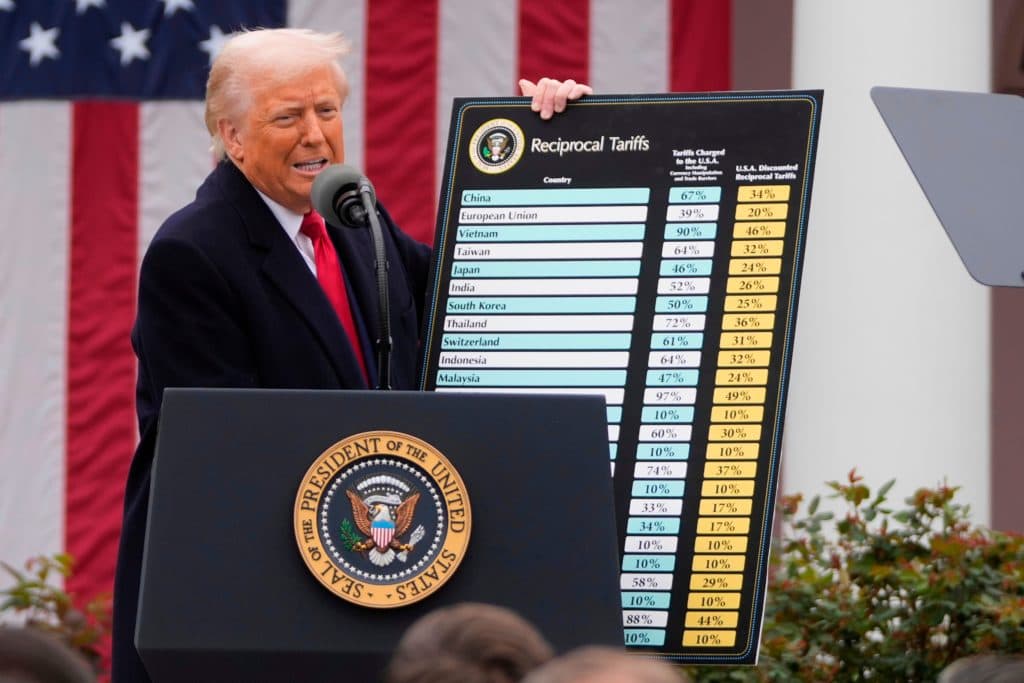
 Trump displays reciprocal tariffs chart during Rose Garden announcement.
Trump Hits Canada with 50% Tariffs, Risking Trade War
Left says
- •The tariffs sidestep a recent Supreme Court ruling that limited Trump's emergency tariff powers, relying on an untested 1930s-era legal provision (Section 338) that Democratic lawmakers previously sought to repeal over fears it could destabilize the economy.
- •The move overrides protections built into the USMCA trade agreement, applying tariffs even to goods that were supposed to be shielded by the pact the U.S. itself signed and later declined to renew.
- •Economists warn this risks fueling inflation and raising costs for American consumers and businesses, undercutting a partnership between two deeply integrated economies.
- •Prime Minister Carney frames the U.S. actions as a violation of trade agreements and cites threats to Canadian sovereignty, including past talk of making Canada the 51st state, while still offering to negotiate in good faith.
Right says
- •Canada has singled out American alcohol, dairy, and auto exports for discriminatory treatment while not applying similar restrictions to other trading partners like the EU.
- •Canada was one of only two nations, along with China, to retaliate against earlier U.S. tariffs, and the administration argues this defiance must come with consequences.
- •The tariffs are carefully targeted to exclude critical goods like energy, fish, potash, and critical minerals, showing the action is a calibrated response rather than a blanket trade war.
- •Officials stress this is a defensive measure to correct unfair treatment of American workers and manufacturers, not an unprovoked escalation.
Common Take
High Consensus- Trump signed three proclamations under Section 338 of the Tariff Act of 1930 imposing 50% tariffs on a range of Canadian goods including wine, hockey sticks, and cement.
- The tariffs take effect in 30 days, leaving a window for further negotiations between the two countries.
- Energy, potash, fish, and critical minerals are excluded from the new tariffs.
- Both governments acknowledge this marks a significant escalation in U.S.-Canada trade tensions following the lapse of the USMCA agreement.
The Arguments
Right argues
Canada has singled out American alcohol, autos, and dairy for discriminatory treatment—provincial liquor boards pulled U.S. products while sparing other countries, and auto quotas push U.S. manufacturers to shift production north—so the tariffs are a targeted correction of specific unfair practices, not a blanket trade war.
Left counters
Even if Canada's practices are objectionable, the U.S. response overrides the USMCA—a treaty the U.S. itself signed—applying tariffs to goods that were explicitly supposed to be shielded, which undermines the credibility of any future trade agreement Washington negotiates.
Left argues
The administration is relying on a never-before-used, untested legal provision (Section 338 of the 1930 Tariff Act) specifically because the Supreme Court recently curtailed Trump's emergency tariff powers, and Democratic lawmakers had previously sought to repeal this same provision over fears it could be used to destabilize the economy.
Right counters
The fact that Section 338 exists in law and grants the president explicit authority to counter discriminatory trade practices means its use here is a legitimate exercise of statutory power, not an end-run around the courts—Congress can amend or repeal the law if it disagrees, but until then it's a valid tool.
Right argues
Canada was one of only two countries worldwide—along with China—that chose to retaliate against earlier U.S. tariffs, and rewarding that defiance with no consequences would invite other trading partners to follow suit rather than negotiate.
Left counters
Canada's retaliation was itself a response to earlier unilateral U.S. tariffs that Carney says violated the USMCA, so framing Canada as the aggressor ignores that this is an escalating cycle the U.S. started by declining to renew the trade pact in the first place.
Left argues
Economists warn that stripping away USMCA protections and imposing 50% tariffs on a deeply integrated economy risks fueling inflation and raising costs for American consumers and businesses, undermining the very manufacturing base the tariffs claim to protect.
Right counters
The administration deliberately carved out exemptions for energy, potash, fish, and critical minerals—inputs crucial to American industry and consumers—showing this is a calibrated, defensive measure designed to minimize collateral damage rather than an indiscriminate trade war.
Left argues
Prime Minister Carney has continued to offer good-faith negotiations even while calling out threats to Canadian sovereignty, including past talk of annexation, suggesting Canada is the more conciliatory party seeking to de-escalate rather than provoke.
Right counters
Words of conciliation ring hollow if Canadian provinces are simultaneously boycotting American alcohol and maintaining auto quotas that specifically disadvantage U.S. manufacturers while leaving other countries untouched—actions speak louder than diplomatic statements.
Challenge Questions
These questions target genuine internal contradictions — meant to provoke honest reflection.
Right asks Left
“If Democrats previously wanted to repeal Section 338 because it could be misused to destabilize the economy, does that concern apply only when Trump wields it, or would the same objection hold if a future Democratic president used it to counter unfair trade practices from another country?”
Left asks Right
“If the goal is genuinely to correct 'discrimination' rather than wage a trade war, why apply the tariffs broadly to consumer goods like wine, cheese, and hockey sticks rather than narrowly targeting the specific auto-quota and alcohol-boycott practices the administration says triggered the action?”
Outlier Report
Left Fringe
Progressive free-trade skeptics and some labor-aligned Democrats (e.g., voices aligned with Bernie Sanders' past tariff sympathies) who might actually support targeted tariffs on autos, complicating a unified anti-tariff left; this represents maybe 10-15% of the left.
Right Fringe
Hardline economic nationalists and Trump loyalists (e.g., Peter Navarro-style advocates) who fully embrace aggressive tariffs as a broader decoupling strategy, going further than the 'defensive/targeted' framing suggests; roughly 20-25% of the right.
Noise Assessment
Moderate-to-high; cable news and social media amplify both the 'Trump trade war chaos' and 'finally standing up to unfair trade' narratives far more than average consumers, who mostly just worry about prices at the grocery store and gas pump rather than the legal mechanics of Section 338.
Sources (11)
<p>The <a href="https://www.axios.com/politics-policy/donald-trump" target="_blank">Trump</a> administration said Monday that it will impose an additional 50% tariff on certain Canadian goods — including hockey sticks, wine and cement — accusing Canada of discriminating against U.S. exports.</p><p><strong>Why it matters:</strong> The move <a href="https://www.axios.com/2026/04/29/trump-trade-tariffs-canada" target="_blank">ratchets up tensions</a> in an increasingly bitter trade dispute between two of the world's closest economic partners.</p><hr /><p><strong>Zoom out:</strong> The <a href="https://www.axios.com/economy/tariffs" target="_blank">tariffs</a>, which take effect next month, will be imposed under <a href="https://www.cov.com/-/media/files/corporate/publications/2016/12/law360_the_presidents_long_forgotten_power_to_raise_tariffs.pdf" target="_blank">Section 338</a> of the Tariff Act of 1930 — a never-before-used authority. The duties cover roughly $20 billion in annual Canadian imports.</p><ul><li>A senior administration official said the tariffs were <a href="https://www.axios.com/2026/07/16/air-quality-wildfire-smoke-side-effects-risk-safety" target="_blank">not the wildfire tariffs</a> that President Trump had earlier threatened, though the official added that options on that front remain under consideration.</li></ul><p><strong>Zoom in:</strong> The administration says that Canada is one of only two countries — alongside China — to retaliate against Trump's earlier tariffs, pointing to provinces that pulled U.S. liquor from store shelves.</p><ul><li>Officials also cited auto policies they say favor Canadian production and dairy rules they argue give European cheese an advantage over American imports.</li></ul><p><strong>The backdrop: </strong>Trump <a href="https://www.axios.com/2026/07/17/canada-wildfire-smoke-trump-tariffs" target="_blank">threatened</a> to impose additional Canadian tariffs last week in a <a href="https://truthsocial.com/%40realDonaldTrump/116936952365066409" target="_blank">Truth Social post</a>, saying that costs related to the wildfire smoke must be added to the tariffs.</p><ul><li>Trump and Canadian Prime Minister Mark Carney were seen together on Sunday at the World Cup final match in East Rutherford, N.J. </li><li>Trump told reporters the two men talked about potential action in response to the wildfires while noting their "good relationship."</li></ul><p><strong>The big picture: </strong>This marks another escalation in U.S.-Canada tensions after the Trump administration <a href="https://www.axios.com/2026/07/01/trump-trade-canada-mexico" target="_blank">declined to extend</a> the <a href="https://www.axios.com/2018/11/30/trump-trudeau-usmca-trade-deal-signing-g20" target="_self">U.S.-Mexico-Canada Agreement</a>, leaving the continent's trade pact in limbo.</p><ul><li>Unlike previous Trump tariffs on Canada, the new duties apply to goods that qualify for duty-free treatment under the USMCA. </li><li>Economists have found that the trade deal has been critical in limiting the tariff impact on consumer prices. </li><li>The exemptions spare some of Canada's most strategically important exports, including potash, critical minerals and most energy products, limiting the potential fallout for U.S. industry. </li></ul><p><strong>The other side: </strong>In a statement<a href="https://x.com/MarkJCarney/status/2079353135126941864?s=20" target="_blank"> posted on X</a>, Carney called the tariffs "in direct violation" of the USMCA and pledged to intensify negotiations in the coming weeks. </p><ul><li>The Canadian Chamber of Commerce called the tariffs a "regrettable escalation" and urged both countries to use the month before they take effect to advance negotiations.</li></ul><p><strong>The intrigue:</strong> This year's<a href="https://www.axios.com/2026/02/20/trump-tariffs-supreme-court-illegal" target="_blank"> Supreme Court decision</a> limiting Trump's emergency tariff powers forced the administration to search for other <a href="https://www.axios.com/2026/03/11/trump-tariffs-trade-301" target="_blank"> legal avenues</a> to impose its trade agenda. </p><ul><li>That includes the administration's temporary 10% global tariffs under Section 122 of the Trade Act — an authority that expires later this week.</li></ul><p><em>Editor's note: This story was updated with additional details.</em></p>
The duties mark a major escalation in trade tensions between the North American neighbours.
<p>President Donald Trump on Monday imposed a 50 percent duty on a variety of Canadian goods, including alcohol, dairy products, hockey sticks, and many others.</p> <p>The post <a href="https://www.breitbart.com/politics/2026/07/20/trump-imposes-50-percent-tariff-on-variety-of-canadian-goods-over-discrimination-of-american-autos/" rel="nofollow">Trump Imposes 50 Percent Tariff on Variety of Canadian Goods Over ‘Discrimination’ of American Autos</a> appeared first on <a href="https://www.breitbart.com" rel="nofollow">Breitbart</a>.</p>
The administration will use an untested legal provision to put significant duties on Canadian exports, reigniting a clash with one of America’s biggest trading partners.
The move, announced Monday, could unleash a new wave of economic chaos, with risks of higher inflation and further fraying of relations between two nations that had been closely woven together before Trump's return to the White House.
<p>Turmoil likely as Trump officials say Canada unfairly discriminated against US autos, alcohol and dairy products</p><p><a href="https://www.theguardian.com/us-news/donaldtrump">Donald Trump</a> is imposing 50% tariffs on most <a href="https://www.theguardian.com/world/canada">Canadian</a> goods in response to the country retaliating against previous US tariffs, the White House announced Monday, declaring Canada has unfairly discriminated against American cars, alcohol and dairy products.</p><p>The tariffs will hit a wide range of products, the White House said, including wine, hockey sticks and cement. They also include goods previously protected from import taxes under the United States-Mexico-Canada (USMCA) agreement.</p> <a href="https://www.theguardian.com/us-news/2026/jul/20/trump-canada-tariffs">Continue reading...</a>
President Trump slapped an additional 50 percent tariff on certain Canadian goods in response to what the administration said were “discriminatory” trade measures from Canada on Monday.  A senior administration official told reporters on a Monday press call that the impacted products range from “wine to hockey sticks to cement.” The tariffs fall under Section…
President Trump plans to impose 50% tariffs on a variety of Canadian goods, such as hockey sticks and cement, in retaliation for Canada's treatment of American exports of alcohol, dairy and motor vehicles.