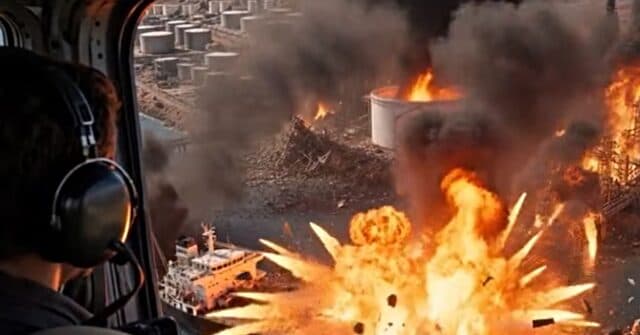
Trump Posts Fake AI Strike Video; Iran Calls It 'Laughable'
Left says
- •Trump makes virtually all major announcements, including military ones, on social media, making Vance's claim that he avoids doing so appear contradictory and evasive.
- •Posting a fabricated video of a strike that never happened risks confusing the public and blurring the line between real military action and propaganda.
- •Iran's dismissal of the video as 'laughable' suggests the stunt may undermine U.S. credibility rather than intimidate an adversary.
- •Using AI-generated imagery to depict destruction of critical infrastructure raises concerns about the normalization of disinformation in matters of war and peace.
Right says
- •Trump is using an unconventional but effective tool to send a clear deterrent message to Iran over its continued attacks on commercial shipping in the Strait of Hormuz.
- •Kharg Island handles roughly 90% of Iran's oil exports, so highlighting it as a potential target underscores real leverage the U.S. holds over Iran's economy.
- •Vance frames the post as psychological pressure rather than a literal military announcement, consistent with Trump's history of using social media for strategic signaling.
- •The warning comes directly after Iran's own aggressive actions, including mine-laying in the Strait and attacks on U.S. forces, justifying a strong show of resolve.
Common Take
High Consensus- Trump posted an AI-generated video depicting an attack on Iran's Kharg Island that did not actually occur.
- U.S. forces did not target Kharg Island in the recent strikes, instead hitting Iranian missile launchers on Larak Island.
- Iran's National Iranian Oil Company called the video 'laughable' and stated Kharg Island operations remain normal.
- Vance confirmed the video was meant to send a deterrent message to Iran regarding attacks on commercial shipping.
The Arguments
Left argues
Vance's claim that Trump 'doesn't make announcements about military actions on social media' is directly contradicted by Trump's long, well-documented pattern of doing exactly that, making the defense sound evasive rather than clarifying.
Right counters
Vance wasn't denying Trump posts about military matters on social media generally, but distinguishing this specific AI video as psychological signaling rather than a literal operational announcement — a distinction consistent with Trump's history of unconventional messaging.
Right argues
Highlighting Kharg Island, which handles roughly 90% of Iran's oil exports, sends a credible deterrent message rooted in real economic leverage, especially after Iran's mine-laying and attacks on commercial shipping and U.S. forces.
Left counters
A threat loses credibility when it's fabricated and the target facility is confirmed by Iranian officials to be undamaged and operational, making the 'deterrent' look like an empty bluff rather than genuine leverage.
Left argues
Using AI-generated footage of an attack that never happened blurs the line between real military action and propaganda, risking public confusion and eroding trust in official government communications about war.
Right counters
The video was an obviously stylized 10-second clip explicitly framed as a warning, not a claim of an actual strike, so treating it as literal disinformation misreads its intended function as a signal rather than a report.
Left argues
Iran's dismissal of the video as 'laughable,' with officials noting the facility is calm and undergoing modernization, suggests the stunt undermined U.S. credibility instead of intimidating an adversary.
Right counters
Iran's public dismissal doesn't prove the message failed privately — regimes routinely downplay threats rhetorically while still recalculating risk, and the underlying vulnerability of Kharg Island remains real regardless of Iran's spin.
Right argues
The warning came directly after Iran's own escalation — mine-laying in the Strait of Hormuz and attacks on U.S. forces — making a strong show of resolve, even an unconventional one, a justified response to continued aggression.
Left counters
Responding to real aggression with a fabricated video substitutes theater for substance, and normalizing disinformation as a tool of deterrence sets a troubling precedent for how future conflicts are communicated to the public.
Challenge Questions
These questions target genuine internal contradictions — meant to provoke honest reflection.
Right asks Left
“If the left agrees that Trump routinely uses social media to signal military intent, why is this particular instance treated as uniquely dangerous disinformation rather than another example of his established communication style?”
Left asks Right
“If Vance says Trump 'doesn't make announcements about military actions on social media' while simultaneously praising this exact post as a deliberate military signal, how can both statements be true at once?”
Outlier Report
Left Fringe
Commentators like those at MSNBC (e.g., Rachel Maddow-style framing) and some Democratic officials may frame this as evidence of authoritarian propaganda tactics akin to state media manipulation, representing maybe 15-20% of the left who take the harshest anti-Trump interpretation.
Right Fringe
Figures like Nick Sortor and pro-Trump social media accounts (e.g., 'Samuel Alito RV' parody account cited in Townhall) celebrate the video uncritically as deserved intimidation, representing maybe 20-25% of the right who fully endorse psy-ops style disinformation without concern for norms.
Noise Assessment
High noise ratio: this is largely an elite media and partisan Twitter/X discourse story, with most ordinary Americans unlikely to have strong or informed views on an obscure AI video about a specific Iranian oil terminal; actual public engagement is likely shallow and driven by pre-existing Trump approval/disapproval rather than the specifics of this event.
Sources (7)
<p>President Donald Trump on Sunday posted a ten-second A.I.-generated video of Iran’s Kharg Island oil terminal being “blown to smithereens,” as he put it, shortly after the first U.S. airstrikes against Iran in a month. None of the actual strikes was confirmed to have targeted Kharg Island.</p> <p>The post <a href="https://www.breitbart.com/middle-east/2026/08/31/watch-trump-posts-a-i-video-of-irans-kharg-island-blown-to-smithereens/" rel="nofollow">Watch: Trump Posts A.I. Video of Iran’s Kharg Island ‘Blown to Smithereens’</a> appeared first on <a href="https://www.breitbart.com" rel="nofollow">Breitbart</a>.</p>
Vice President JD Vance reacted to President Trump's Sunday night social media post of an AI rendering of a Kharg Island bombing, calling it a "message to the Iranians." CBS News' Eleanor Watson has the latest.
Kharg Island is a critical oil depot for the Iranian industry and its destruction would likely cause considerable long-term damage to the Iranian economy.
President Donald Trump was sending a message to Iran with his social media post about Iran's energy hub of Kharg Island being blown to smithereens, Vice President JD Vance said Monday. "The president likes to switch it up on social media a little bit. He would be the ...
The vice president spoke to reporters before he flew to Michigan on Monday about the AI video that President Donald Trump posted on social media over the weekend that featured a stylized imaginary attack on Iran's Kharg Island, which is key to its oil exports and Trump has repeatedly threatened.
Vice President Vance told reporters on Monday that President Trump was sending a message to Iran by posting what appears to be an AI-generated video of Iran’s Kharg Island being blown up.  Trump “would be the first to say he doesn’t make announcements about military actions on social media, but I think that he’s sending…