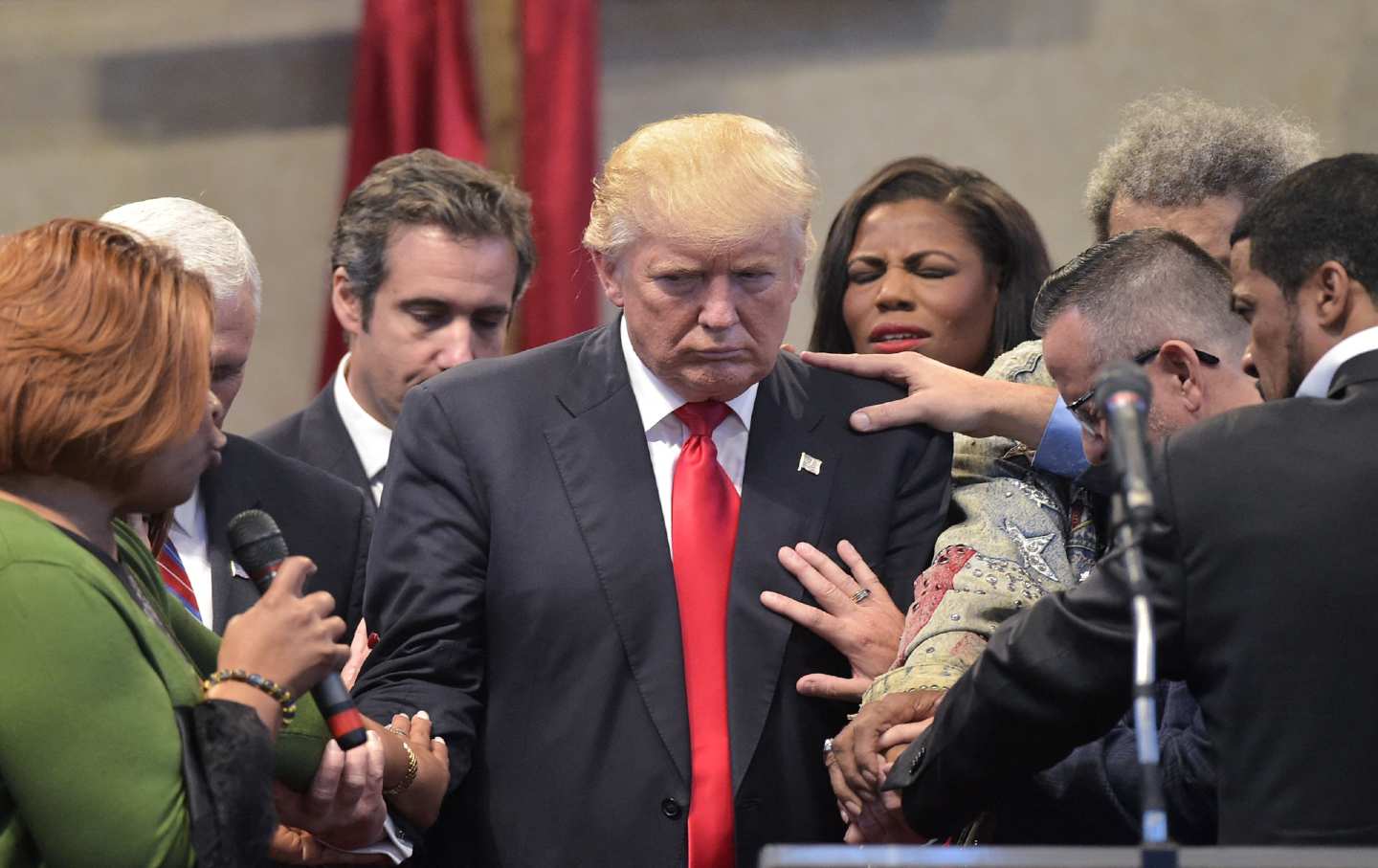
 Donald Trump surrounded by people laying hands on him in prayer
Trump Posts Image of Himself as Jesus, Sparks Religious Backlash
Intra-Party Split Detected
Conservative Christian figures including Marjorie Taylor Greene, Michael Knowles, and Riley Gaines criticized Trump's Jesus image as blasphemous, breaking with typical evangelical support
Left says
- •Trump's self-portrayal as Jesus represents a dangerous pattern of blasphemy that reveals his authoritarian desire to position himself above religious authority and traditional faith
- •The president's attacks on Pope Leo XIV demonstrate his intolerance for moral criticism of his war policies and his attempt to intimidate religious leaders into submission
- •Trump's evangelical support stems from a transactional relationship where Christian nationalism takes precedence over actual Christian values and theology
- •The controversy exposes how Trump views himself as a spiritual monarch who should have authority over religious matters, including naming foreign religious leaders
Right says
- •Trump claimed the image depicted him as a doctor helping people, not as Jesus, and quickly removed it after criticism from conservative Christian supporters
- •The president faced genuine backlash from his own evangelical base, with prominent conservative figures like Marjorie Taylor Greene and Riley Gaines condemning the post as blasphemous
- •Trump's participation in religious events like 'America Reads the Bible' shows his ongoing efforts to maintain relationships with faith communities despite controversies
Common Take
High Consensus- Trump posted and later removed an image that appeared to show him in Jesus-like robes with healing powers
- The post generated criticism from both conservative Christian supporters and liberal commentators who viewed it as blasphemous
- Trump is currently engaged in tensions with Pope Leo XIV over the pope's criticism of war and violence
- The incident occurred during a period of strained relationships between Trump and some of his former evangelical supporters
The Arguments
Right argues
Trump claimed the image depicted him as a doctor helping people, not as Jesus, and quickly removed it after criticism from his own conservative Christian supporters including Marjorie Taylor Greene and Riley Gaines. This shows he remains responsive to his evangelical base when they express genuine concerns about religious propriety.
Left counters
Trump's explanation that he saw himself as a 'doctor' in an image clearly depicting Jesus-like healing with glowing palms and religious robes strains credibility, and his pattern of blasphemous behavior suggests this was intentional provocation rather than an innocent mistake.
Left argues
Trump's attacks on Pope Leo XIV for opposing war demonstrate his authoritarian desire to subordinate religious authority to political power, with reports of Pentagon officials threatening Vatican representatives and invoking historical examples of papal subjugation. This reveals Trump's aspiration to be not just a political leader but a spiritual monarch who controls religious discourse.
Right counters
The Pope's political statements about foreign policy legitimately invite political response, and Trump's criticism of papal positions on war and crime policy falls within normal bounds of political discourse between world leaders with different views on governance and security.
Left argues
Trump's evangelical support represents a transactional relationship where Christian nationalism takes precedence over actual Christian theology, as evidenced by continued support despite behavior that directly contradicts core Christian values of humility, mercy, and reverence for the sacred. This shows how evangelicalism has become more about political style than genuine religious conviction.
Right counters
Trump's participation in events like 'America Reads the Bible' demonstrates ongoing engagement with faith communities, and the genuine backlash he received from conservative Christians over the Jesus image proves that his evangelical supporters do maintain theological boundaries and aren't merely political opportunists.
Right argues
The controversy shows that Trump's religious supporters are willing to criticize him when he crosses clear theological lines, with prominent figures like Marjorie Taylor Greene calling the post 'blasphemous' and demanding he remove it. This demonstrates that evangelical support has genuine religious limits, not just political calculation.
Left counters
The fact that it took an image of Trump literally portraying himself as Jesus to finally provoke criticism reveals how far evangelical standards have already fallen, and the quick return to supporting him shows these objections are performative rather than principled.
Left argues
Trump's pattern of religious transgression—from mocking religious leaders to posting blasphemous imagery—reveals someone who views himself as above traditional faith and seeks to position political power as superior to spiritual authority. His behavior represents a fundamental threat to the separation between temporal and spiritual power that protects religious freedom.
Right counters
Political leaders throughout history have engaged in religious discourse and criticism of religious figures when they enter political debates, and Trump's willingness to challenge religious authorities who oppose his policies represents legitimate democratic pushback rather than authoritarian overreach.
Challenge Questions
These questions target genuine internal contradictions — meant to provoke honest reflection.
Right asks Left
“If Trump's evangelical support is purely transactional and based on Christian nationalism rather than genuine faith, how do you explain the immediate and forceful criticism he received from his own conservative Christian supporters over the Jesus image, including calls for him to remove it and declarations that it was blasphemous?”
Left asks Right
“If Trump genuinely thought the image showed him as a doctor rather than Jesus, and if his evangelical supporters maintain real theological boundaries as evidenced by their criticism, why has this same base consistently overlooked his previous patterns of behavior that seem to contradict core Christian values of humility and reverence?”
Outlier Report
Left Fringe
Writers at The Nation like Jeet Heer who frame this as Trump seeking to become a 'spiritual monarch' and compare him to historical religious authoritarians represent about 15% of the left with more extreme interpretations.
Right Fringe
Hardcore Trump supporters who defend the Jesus imagery or dismiss it entirely as 'fake news' represent roughly 25% of the right, while most conservatives joined figures like Marjorie Taylor Greene in condemning it as blasphemous.
Noise Assessment
Moderate noise level - while partisan outlets amplify the story, the religious backlash from Trump's own base suggests genuine public discomfort rather than manufactured outrage.
Sources (7)
<p>Matthew Avery Sutton</p> <div><img alt="" src="https://www.thenation.com/wp-content/uploads/2026/04/TrumpPrayedOver.jpg" /></div> <div> <div class="wp-block-the-nation-dek article-title__dek"> <p>As the president seeks to mend fences with his evangelical base, it’s crucial to understand how he enlisted its support in the first place. </p> </div> </div> <p>The post <a href="https://www.thenation.com/article/society/donald-trump-evangelicals-the-right/">Donald Trump, Televangelist in Chief</a> appeared first on <a href="https://www.thenation.com">The Nation</a>.</p>
The first-ever pope from the United States is clashing with the White House. Pope Leo <span class="caps">XIV</span>, head of the Catholic Church, which counts more than a billion people in the world as its members, has spoken out forcefully against war. He said in his Palm Sunday address that Jesus “does not listen to the prayers of those who wage war … [whose] hands are full of blood.” In response, President Donald Trump said Pope Leo is “weak on crime, and terrible for foreign policy.” Trump is also under fire for sharing an AI-generated image that appears to show himself as Jesus Christ. Pressed about the controversy in an interview on Fox News, Trump’s Catholic Vice President JD Vance said the pope should “stick to matters of morality.”</p> <p>“I don’t know any other more pressing moral issues than war and peace, taking care of the poor, the sick, the homeless, the stranger,” says Father James Martin, a writer and Jesuit priest. “I don’t understand how Vice President Vance cannot see that war is a moral issue. … This idea that some people don’t deserve mercy is completely against the Christian message.”
The president posted the image after lashing out at Pope Leo XIV.
President Donald Trump has lashed out at some his biggest former supporters in recent weeks after burgeoning opposition to his war on Iran.
<p>Name the deadliest of sins – cruelty, deceit, avarice – and Trump will both exhibit them and celebrate them</p><p>It’s no accident that the figure emerging as the global challenger to the might of Donald Trump is a priest in white, known as Pope Leo XIV. In recent weeks, the pope has issued a string of barely coded denunciations of the US president, unfazed by the insults that have come his way in return. It’s no longer fanciful to imagine that what an eastern European pontiff, John Paul II, did by confronting the Soviet empire in the 1980s, an American-born pope may do in the 2020s by daring to speak truth to the would-be emperor in the White House.</p><p>Of course, several heads of government have stood up to Trump too. Canada’s Mark Carney has done it most explicitly, while his European counterparts have taken a stand by refusing to join the president’s reckless, wrong-headed war on Iran. But none has the global reach of the leader of the world’s 1.4 billion Catholics.</p><p>Jonathan Freedland is a Guardian columnist</p><p><em><strong>Do you have an opinion on the issues raised in this article? If you would like to submit a response of up to 300 words by email to be considered for publication in our<a href="https://www.theguardian.com/tone/letters"> letters</a> section, please <a href="mailto:guardian.letters@theguardian.com?body=Please%20include%20your%20name,%20full%20postal%20address%20and%20phone%20number%20with%20your%20letter%20below.%20Letters%20are%20usually%20published%20with%20the%20author%27s%20name%20and%20city/town/village.%20The%20rest%20of%20the%20information%20is%20for%20verification%20only%20and%20to%20contact%20you%20where%20necessary.">click here</a>.</strong></em></p> <a href="https://www.theguardian.com/commentisfree/2026/apr/24/donald-trump-pope-leo-xiv-catholics-christianity">Continue reading...</a>
<p>Jeet Heer</p> <div><img alt="" src="https://www.thenation.com/wp-content/uploads/2026/04/FotoJet-1.jpg" /></div> <div> <div class="wp-block-the-nation-dek article-title__dek"> <p>Forget being a regular king. Trump is clearly expressing a not-so-secret desire to be a spiritual monarch.</p> </div> </div> <p>The post <a href="https://www.thenation.com/article/politics/trump-pope-leo-attacks/">The Real Reason Trump Hates Pope Leo: He Wants to Take His Place</a> appeared first on <a href="https://www.thenation.com">The Nation</a>.</p>
<p>Chris Lehmann</p> <div><img alt="" src="https://www.thenation.com/wp-content/uploads/2026/04/GettyImages-2270717460.jpg" /></div> <div> <div class="wp-block-the-nation-dek article-title__dek"> <p>Liberals struggle to understand why the president’s evangelical supporters never seem to mind his sacrilegious tendencies. They’re missing the point.</p> </div> </div> <p>The post <a href="https://www.thenation.com/article/society/donald-trump-jesus-image/">How Trump Keeps Getting Away With Blasphemy</a> appeared first on <a href="https://www.thenation.com">The Nation</a>.</p>