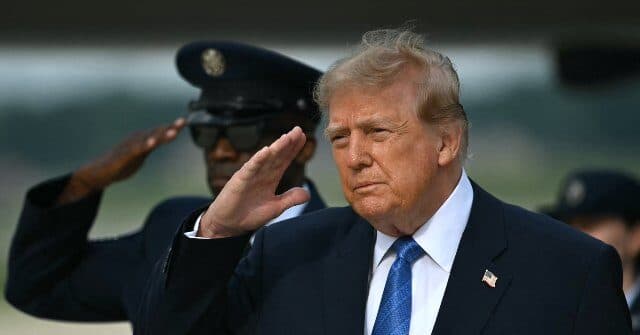
 President Donald Trump salutes while boarding a military aircraft.
Trump Pushes 'AI Force' as Even Tech CEOs Warn of Danger
Intra-Party Split Detected
Tech industry leaders (Amodei, Musk, Altman, Hassabis) who might otherwise align with deregulatory politics are breaking from Trump's anti-regulation stance to warn of AI risks. Meanwhile Democrats are divided on AI policy, with figures like Sanders and Ocasio-Cortez pushing stronger restrictions while the party lacks a unified agenda, and even some Republicans (47% per polling) oppose data center buildouts despite Trump's push.
Left says
- •Public opinion polling shows widespread unease about AI's trajectory, including a majority of voters opposed to new data centers and a strong majority who see at least a moderate risk that advanced AI could be catastrophic for humanity, yet the administration is dismissing these concerns as a 'hoax'.
- •Concentrating AI oversight in a vague new military-style 'Force' and a single czar, without congressional input or defined authority, sidesteps the kind of binding safety standards and public oversight that industry insiders themselves are now requesting.
- •Prominent AI developers—including the CEOs of Anthropic, OpenAI, and xAI, and Google DeepMind's chair—are warning that their own systems may be growing dangerous faster than safeguards can keep up, a rare moment of industry self-criticism that deserves a serious regulatory response rather than dismissal.
- •Some Democrats, like Senator Sanders and Representative Ocasio-Cortez, want firm limits on advanced AI and warn against future taxpayer bailouts of an industry that many worry is inflating an unsustainable financial bubble.
Right says
- •Trump's approach treats rapid AI development as a national security race against China, arguing that whoever leads in AI capability will hold a decisive global advantage and that excessive regulation risks ceding that edge.
- •The administration already has substantial criminal and regulatory tools to punish genuine bad actors in AI, so a new bureaucratic layer of restrictive rules is unnecessary and could slow beneficial innovation.
- •Warnings of AI-driven catastrophe are viewed as overstated fearmongering akin to past predicted crises that failed to materialize, and confidence is placed in strong American leadership and existing legal systems rather than new AI-specific mandates.
- •Data centers and AI infrastructure are framed as economic assets that bring higher salaries, lower taxes, and safer communities, making opposition to them a misguided or even foreign-influenced campaign.
Common Take
High Consensus- Trump publicly confirmed plans to create an 'AI Force' modeled on the Space Force and to appoint a new AI czar, though he has offered few structural or budgetary details.
- Multiple recent polls, including from the New York Times/Siena, AP-NORC, and Politico, show significant public concern about AI's risks and environmental impact.
- Leading AI company executives, including Dario Amodei, Sam Altman, and Elon Musk, have publicly called for slowing or more carefully managing advanced AI development.
- The AI czar role was previously held by David Sacks, who left the position in March 2026.
The Arguments
Left argues
When the CEOs of Anthropic, OpenAI, and xAI, along with Google DeepMind's chair, publicly warn that their own systems may be outpacing safety controls, that rare admission against self-interest deserves serious regulatory engagement rather than dismissal as a 'hoax'.
Right counters
Industry leaders have incentives to call for regulation that entrenches their market position and raises barriers for competitors, so their warnings shouldn't be taken as disinterested safety advocacy, especially when the administration already holds broad criminal and civil authority to punish real harms.
Right argues
AI leadership is a zero-sum national security race with China, and heavy-handed regulation risks ceding the decisive strategic advantage to a rival that won't hesitate to develop AI without similar constraints.
Left counters
Framing safety oversight as a binary choice between 'winning' and 'losing' to China ignores that reckless, unregulated deployment could itself produce the catastrophic failures that undermine American leadership, and most voters—including nearly half of Republicans—already have serious reservations about the infrastructure buildout underpinning this race.
Left argues
Creating a vaguely defined 'AI Force' and a single unaccountable czar, without congressional authorization or specified powers, bypasses the kind of transparent, binding safety standards that could actually constrain dangerous AI behavior.
Right counters
The Space Force model shows that new institutional structures can be stood up quickly to address emerging strategic domains, and demanding exhaustive legislative detail before acting risks paralyzing the government while other nations move forward unchecked.
Right argues
Data centers and AI infrastructure investment bring higher salaries, lower taxes, and tangible economic benefits to host communities, making blanket opposition to their construction economically self-defeating.
Left counters
Majority opposition to data centers, including from many Republicans, reflects real concerns about resource strain, environmental impact, and community disruption that aren't erased by promised economic upside, and dismissing that opposition as foreign-influenced ignores its broad bipartisan basis.
Left argues
Multiple independent polls this month show strong majorities across the political spectrum see AI as a moderate-to-catastrophic risk, meaning the administration's dismissive rhetoric is out of step with a broad public consensus, not just a partisan Democratic complaint.
Right counters
Public anxiety about a new technology's unknown risks has accompanied nearly every major innovation historically, from nuclear power to the internet, and policy should be guided by demonstrated harms and existing legal enforcement rather than by fear-driven polling snapshots.
Challenge Questions
These questions target genuine internal contradictions — meant to provoke honest reflection.
Right asks Left
“If binding safety standards and public oversight are the goal, why have Democrats failed to coalesce around a single concrete regulatory framework, and does relying on industry CEOs' own warnings as the basis for policy risk simply codifying whatever rules incumbent firms find convenient?”
Left asks Right
“If existing criminal and civil authority is truly sufficient to police 'bad actors' in AI, what specific new problem does creating an undefined 'AI Force' and czar solve, and how is that different from the very bureaucratic expansion the administration claims to oppose?”
Outlier Report
Left Fringe
Sen. Bernie Sanders and groups like the AI Now Institute represent a fringe pushing for an outright pause or permanent ban on 'superintelligence' development, a position likely held by only 10-15% of the left; most Democrats favor regulation, not prohibition.
Right Fringe
Commentators like David Sacks and parts of the Trump administration who dismiss AI safety warnings entirely as a 'hoax' represent a fringe within the right—likely 20-25%—since many Republican voters (per the 47% opposing data centers) share some AI anxiety despite party alignment.
Noise Assessment
High noise ratio: Truth Social posts, CEO statements, and viral warnings (e.g., Evan Hubinger's 10% extinction estimate) generate outsized media attention relative to the more measured, mixed anxiety reflected in actual polling data.
Sources (7)
Donald Trump to establish AI Force to manage tech as anxieties mount Read more about Donald Trump to establish AI Force to manage tech as anxieties mount
<p>President Trump <a href="https://truthsocial.com/%40realDonaldTrump/117298821562014906" target="_blank">announced</a> Saturday he is creating an "AI Force" modeled on the Space Force and will soon name a new AI czar, doubling down on his push to <a href="https://www.axios.com/2026/09/14/trump-ai-safety-regulations-congress" target="_blank">accelerate</a> artificial intelligence development with limited regulation.</p><p><strong>Why it matters: </strong>The White House isn't <a href="https://www.axios.com/2026/09/14/trump-ai-safety-anthropic-dario-amodei" target="_blank">backing down</a> from its laissez-faire approach to AI, even as the<a href="https://www.axios.com/2026/09/13/ai-labs-regulation-safety" target="_blank"> industry's biggest leaders</a> call for stronger safety rules and as public concern about AI intensifies.</p><hr /><p><strong>The latest: </strong>Trump offered few details on what this AI Force would actually do, what budget it would have or where it would be placed in the federal government.</p><ul><li>The White House did not immediately respond to a request for comment.</li><li>His Truth Social post said the government would "not in any way hinder or stifle" AI's growth but would look for "BAD" behavior using "our already existing Criminal and Civil Justice System."</li><li>He compared the proposed AI Force to Space Force, a military branch established by Congress in his first term.</li></ul><p><strong>Catch up quick: </strong>Trump has <a href="https://www.axios.com/2026/09/15/trump-ai-doom-safety-regulation-hoax" target="_blank">hardened</a> his anti-regulation position during an extraordinary month of warnings from inside the AI industry.</p><ul><li>Anthropic CEO Dario Amodei, OpenAI CEO Sam Altman, SpaceX CEO Elon Musk and Demis Hassabis — the Nobel laureate who co-founded and chairs Google DeepMind — have all called for slowing AI development as their systems become more powerful.</li><li>Anthropic alignment researcher Evan Hubinger recently said he personally believes there is a greater than 10% chance AI could "kill all humans" within the next decade.</li><li>Trump <a href="https://www.axios.com/2026/09/14/trump-ai-safety-anthropic-dario-amodei" target="_blank">responded</a> by calling technologists' fears that AI could destroy humanity a "hoax" and saying the only guardrail the technology needs is a "strong and smart" president.</li></ul><p><strong>The intrigue: </strong>The AI czar position would revive a role that the White House <a href="https://www.axios.com/2026/03/26/trump-white-house-david-sacks-ai-czar-policy-influence" target="_blank">didn't plan</a> to fill six months ago.</p><ul><li>David Sacks left the formal AI and crypto czar job in March, though he remains influential as co-chair of the President's Council of Advisors on Science and Technology.</li></ul><p><strong>By the numbers: </strong>Public sentiment has not matched Trump's enthusiasm.</p><ul><li>A <a href="https://www.nytimes.com/2026/09/15/us/politics/ai-polls-midterms.html" target="_blank">New York Times-Siena poll</a> of 1,503 likely voters released this week found 61% opposed building data centers to power AI, including 47% of Republicans and 75% of Democrats.</li><li>An <a href="https://apnorc.org/projects/americans-are-increasingly-concerned-about-the-environmental-consequences-of-ai/" target="_blank">AP-NORC-University of Chicago poll</a> also released this week found 53% were highly concerned about AI's environmental impact.</li><li>A <a href="https://www.politico.com/news/2026/09/16/poll-ai-technology-risks-humanity-trump-voters-01078087" target="_blank">POLITICO-Public First poll</a> released this week found 63% of U.S. adults see at least a moderate risk that advanced AI could eventually destroy humanity.</li></ul><p><strong>The other side:</strong> Democrats have <a href="https://www.axios.com/2026/09/16/warren-ai-pause?utm_source=chatgpt.com" target="_blank">increasingly</a> called for intervention, but they <a href="https://www.axios.com/2026/08/23/2028-democrats-ai-bernie-sanders?utm_source=chatgpt.com" target="_blank">haven't united</a> around a single AI agenda.</p><ul><li>Sen. Bernie Sanders (I-Vt.) wants to pause advanced AI development and permanently ban so-called superintelligence — AI more capable than humans and able to operate beyond human control.</li><li>In a <a href="https://x.com/charlesmonaco/status/2101056243863277861?s=20" target="_blank">campaign email</a> Friday night, Rep. Alexandria Ocasio-Cortez (D-N.Y.) called for strict safety standards and public oversight and warned Congress not to bail out Big Tech if the "AI bubble" pops.</li></ul><p><em>Editor's note: This story has been updated with new detail throughout. </em></p><img src="https://images.axios.com/ZYdkzgLY6-Due9WL2R6FK0teRmo=/2026/09/19/1789843796348.jpeg" /> <div>Screenshot: President Trump/Truth Social</div>
<p>President Donald Trump said this weekend he plans to create an "AI Force," modeled on the Space Force he established during his first term, along with appointing a new AI czar</p> <p>The post <a href="https://www.breitbart.com/tech/2026/09/21/trump-announces-ai-force-modeled-on-space-force-will-appoint-ai-czar/" rel="nofollow">Trump Announces ‘AI Force’ Modeled on Space Force, Will Appoint AI Czar</a> appeared first on <a href="https://www.breitbart.com" rel="nofollow">Breitbart</a>.</p>
‘Only High I.Q. individuals need apply!’
President Donald Trump announced Sunday that his proposed 250-foot triumphal arch would serve as both a monument and a “top grade Military Complex.” “At the strong request of the United States Military, and for National Security purposes, I have agreed to convert the magnificent Triumphal Arch…into a top grade Military Complex/Triumphal Arch.” The complex would ...
<p>President <a href="https://www.axios.com/politics-policy/donald-trump" target="_blank">Trump</a> lashed out at calls for new <a href="https://www.axios.com/2026/09/14/trump-ai-safety-regulations-congress" target="_blank">AI guardrails</a> and protections on Monday, arguing AI only needs a "STRONG AND SMART (High IQ!) PRESIDENT" and that AI critics should "BEWARE!"</p><p><strong>Why it matters: </strong>Trump continues to plant himself against calls for AI safety regulations as a growing <a href="https://www.axios.com/2026/09/13/ai-labs-regulation-safety" target="_blank">chorus of AI leaders and CEOs</a>, spearheaded by Anthropic CEO Dario Amodei over the weekend, call for a slowdown in AI's development and better regulations to help keep humanity safe.</p><hr /><ul><li>Amodei, OpenAI CEO Sam Altman and Elon Musk agreed that AI is quickly becoming more powerful, potentially beyond what humans can understand and monitor, prompting calls for a slowdown.</li><li>The Trump administration has repeatedly clashed with Amodei and Anthropic, with the Pentagon previously designating the company as a supply-chain risk and stalling the release of its Mythos model.</li></ul><p><strong>What he's saying: </strong><a href="https://truthsocial.com/%40realDonaldTrump/posts/117270591511950591" target="_blank">Trump</a> said Monday afternoon that fears of "AI taking over the World, destroying Humanity, and all other things bad, is a HOAX," putting it on par with Russian election interference claims and his own impeachments.</p><ul><li>He said the AI development "will not be stopped by brilliantly run Destructive Forces" under his presidency.</li></ul><p><strong>This was the</strong> second time he condemned AI safety fears in a 12-hour span. Early on Monday, he said that "the only control or 'guardrails' that AI needs is a STRONG AND SMART (High IQ!) PRESIDENT, and the U.S.A. has that, in spades!" Trump wrote on <a href="https://truthsocial.com/%40realDonaldTrump/posts/117269745153543631" target="_blank">Truth Social</a>.</p><ul><li>"WHOEVER WINS AI, WINS! We are leading China, and all others, and will continue to do so."</li></ul><p><strong>Trump said his</strong> administration "has stopped AI 'people' from doing bad, or potentially bad, 'things,'" though he didn't elaborate. (The White House did not immediately respond to Axios' request for comment Monday.)</p><ul><li>He also took a swipe at Anthropic CEO Dario Amodei, "who is now pretending to be a 'perfect little angel.'"</li><li>"We already have tremendous CRIMINAL and REGULATORY power over these companies!"</li><li>Trump also suggested there's "a SICK conspiracy going on against AI and Data Centers, and the only one that is happy about it is China."</li></ul><p><strong>Zoom out: </strong>Trump has continued to oppose tighter AI regulations, just as Washington is moving to discuss what can and should be done.</p><ul><li>Trump, who has been pro-AI since his return to the White House, <a href="https://apnews.com/article/trump-artificial-intelligence-guardrails-china-midterms-congress-9df0ebb4c1b0619aa0f88057b5a1092d" target="_blank">downplayed</a> the need for AI safety checks and regulations on Sunday, suggesting to reporters that he didn't want to fall behind China in the race for stronger AI.</li><li>Trump's former AI czar David Sacks <a href="https://x.com/DavidSacks/status/2098973625252708460" target="_blank">similarly pushed back</a> against Altman and Amodei, saying the two can control AI's pace without a regulatory framework.</li></ul><p><strong>The other side:</strong> China's Foreign Ministry also criticized calls to slow AI development Monday, per <a href="https://www.cnbc.com/2026/09/14/china-ai-slowdown-us-tech-ceos.html" target="_blank">CNBC</a>.</p><ul><li>"Fear-mongering, confrontation, competition will just disrupt [the] process of global AI governance," said Guo Jiakun, a spokesperson for China's Foreign Ministry.</li></ul><p><em>Editor's note: This story has been updated with additional information.</em></p>
President Donald Trump's new force has no budget, no powers and no statute. The five it collides with have all three.