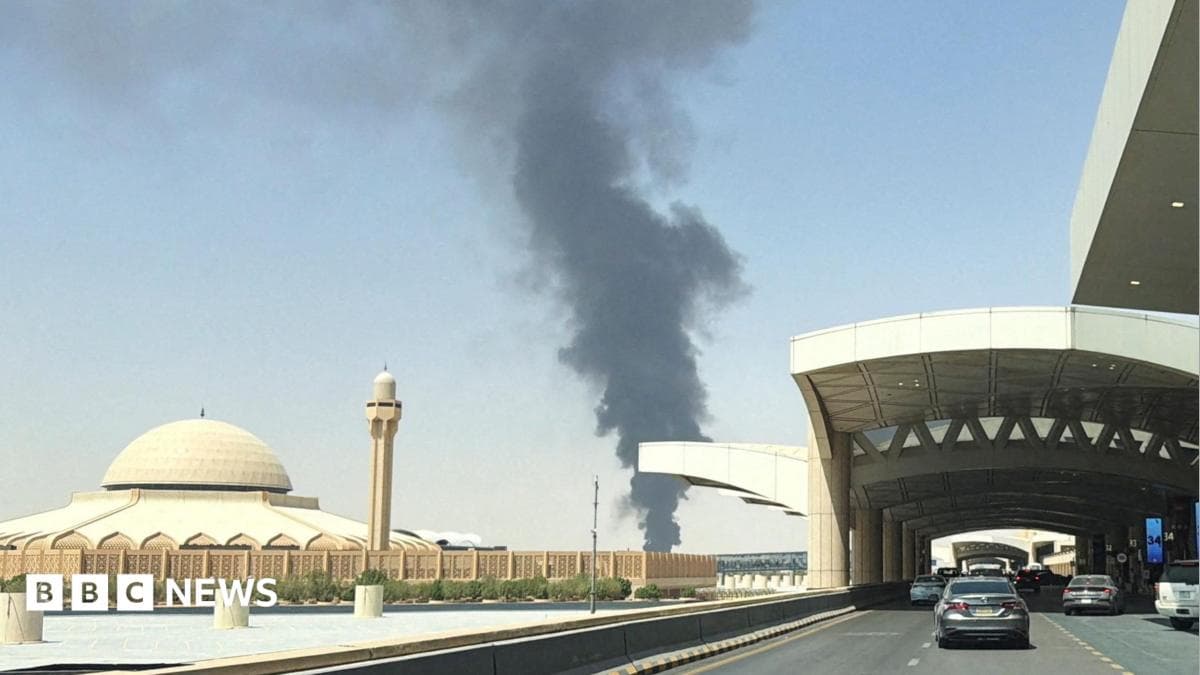
Trump Refuses Saudi Plea to Strike Houthis as Riyadh Comes Under Attack
Left says
- •Trump's restraint reflects a deliberate strategy of avoiding another open-ended Middle East war, prioritizing narrow U.S. interests like freedom of navigation over Saudi requests for direct military intervention.
- •The administration's approach shows an attempt to empower regional partners to manage their own security challenges rather than committing American troops and resources to yet another conflict.
- •Providing intelligence and targeting data while withholding direct strikes represents a calibrated middle path that supports an ally without escalating U.S. military involvement.
- •The rapid escalation, including missile strikes on Riyadh and threats to global shipping lanes, underscores the risks of the U.S. being drawn deeper into a regional proxy conflict with Iran.
Right says
- •Trump's refusal to strike the Houthis despite direct pleas from a key ally raises questions about whether the U.S. is doing enough to protect Saudi Arabia and global energy security.
- •The Houthis' attack on Riyadh, the first direct strike on the Saudi capital, marks a dangerous escalation that could threaten American interests and allies throughout the region.
- •Cutting his weekend short to return to the White House signals the president recognizes the seriousness of the crisis even while holding off on direct military action.
- •Iran's backing of the Houthis and its disruption of the Strait of Hormuz suggest a coordinated effort to threaten global oil supplies, which some argue warrants a firmer U.S. response.
Common Take
High Consensus- The Houthis, backed by Iran, have escalated attacks on Saudi Arabia, including a ballistic missile strike intercepted near Riyadh and attacks on Yanbu oil facilities.
- The conflict threatens critical global shipping and oil chokepoints, including the Bab al-Mandab Strait and the Strait of Hormuz.
- MBS called Trump twice urging direct U.S. strikes, and Trump declined while agreeing to provide intelligence and targeting support instead.
- The State Department issued security warnings urging Americans in the Middle East to exercise caution amid the rapidly escalating conflict.
The Arguments
Left argues
Trump's restraint reflects a deliberate strategy to avoid another open-ended Middle East war, focusing narrowly on freedom of navigation while pushing Saudi Arabia to lead its own regional security response.
Right counters
That framing understates the risk: Saudi Arabia explicitly reversed its earlier confidence and asked for direct U.S. military help, suggesting Riyadh itself believes it cannot contain the threat without American firepower.
Right argues
The first-ever Houthi missile strike on Riyadh, combined with Iranian disruption of the Strait of Hormuz, signals a coordinated effort to threaten global oil supplies and American allies, which may require a firmer U.S. response than intelligence-sharing alone.
Left counters
Escalating to direct strikes risks exactly the kind of open-ended entanglement with Iran that the U.S. has spent two decades trying to avoid, without any guarantee that airstrikes would stop missile and drone attacks that have persisted despite Saudi Arabia's own extensive bombing campaign.
Left argues
Providing intelligence, targeting data, and 200 support personnel while withholding direct strikes is a calibrated middle path that backs an ally without dragging American forces into a Yemeni civil war.
Right counters
A 'calibrated middle path' looks like indecision when missiles are hitting the Saudi capital and threatening a key oil pipeline terminus at Yanbu — allies need reliable protection, not hedged half-measures.
Right argues
Trump cutting his Camp David weekend short to return to the White House shows he recognizes the gravity of the crisis, even as he holds off on military action — a sign that events could still force his hand.
Left counters
A symbolic early return doesn't change the substance of the policy; optics of concern shouldn't be mistaken for a shift in strategy, and rushing into strikes under public pressure is precisely how mission creep begins.
Left argues
The rapid escalation — from Saudi confidence in July that it didn't need U.S. help to missiles hitting Riyadh in September — illustrates exactly why the U.S. should avoid tying itself to every twist of a regional proxy conflict with Iran.
Right counters
That same rapid escalation is the strongest argument for early, decisive U.S. involvement now, before Houthi and Iranian gains around the Bab al-Mandab Strait and Strait of Hormuz become irreversible chokepoints on global trade.
Challenge Questions
These questions target genuine internal contradictions — meant to provoke honest reflection.
Right asks Left
“If the administration's stated priority is 'freedom of navigation' in the Red Sea, how does withholding direct strikes square with Houthi forces reportedly seizing a strategic island at the mouth of the Bab al-Mandab Strait itself?”
Left asks Right
“If critics argue Trump isn't doing enough to protect Saudi Arabia, what specific U.S. military action would decisively stop Houthi missile and drone attacks that Saudi Arabia's own extensive airstrikes and ground offensives have so far failed to stop?”
Outlier Report
Left Fringe
Anti-war progressives like Rep. Ilhan Omar or commentators at outlets like The Intercept who would argue the U.S. shouldn't even be providing intelligence/targeting support to Saudi Arabia at all, representing maybe 15-20% of the left.
Right Fringe
Hawkish interventionists like Sen. Lindsey Graham or Mark Levin who would push for direct U.S. strikes on the Houthis and framing this as Trump being too passive, representing roughly 20-25% of the right; contrasted with America First isolationists like Tucker Carlson who'd oppose any escalation.
Noise Assessment
Moderate-high; cable news and X commentary amplify both the 'Trump is weak' and 'Trump is smart to avoid war' framings disproportionately compared to a general public that is largely disengaged from Yemen/Saudi specifics and mainly reacts to oil price and gas price implications.
Sources (8)
<p>Saudi Crown Prince <a href="https://www.axios.com/2026/08/01/saudi-crown-prince-trump-iran-attacks" target="_blank">Mohammed bin Salman</a> (MBS) called President <a href="https://www.axios.com/politics-policy/donald-trump" target="_blank">Trump</a> twice Thursday, urging him to launch strikes against the <a href="https://www.axios.com/2025/03/26/houthi-rebels-yemen-what-to-know" target="_blank">Houthis</a> as the Iran-backed group closed in on a vital Red Sea chokepoint, two U.S. officials told Axios.</p><ul><li>Trump declined, and U.S. officials stressed the administration has no plans to intervene directly against the Houthis for now.</li></ul><p><strong>Why it matters:</strong> Oil prices surged Thursday as the Houthis <a href="https://www.nytimes.com/2026/09/10/world/middleeast/yemens-houthis-seize-strategic-red-sea-port-officials-say.html" target="_blank">seized a strategic coastal city</a> in Yemen, pushing them closer to the Bab al-Mandab Strait — a vital artery for global trade and Saudi oil exports.</p><hr /><ul><li>With <a href="https://www.axios.com/world/iran" target="_blank">Iran</a> already disrupting traffic through the <a href="https://www.axios.com/2026/09/04/trump-strait-hormuz-oil-claims-iran" target="_blank">Strait of Hormuz</a>, Houthi control of Bab al-Mandab could give Tehran a powerful new point of leverage over the U.S. and its Gulf allies.</li></ul><p><strong>The latest: </strong>Reuters <a href="https://www.reuters.com/world/middle-east/yemens-houthis-reach-strategic-island-mouth-vital-shipping-lane-2026-09-11/" target="_blank">reported</a> Friday morning that the Houthis had taken control of a key island in the strait.</p><ul><li>They also reported that smoke was seen over the key east-west Saudi oil pipeline, though the source was not clear. </li></ul><p><strong>Driving the news: </strong>The U.S. is concerned about the rapidly escalating fight in Yemen and is stepping up support for Saudi Arabia while trying to avoid direct military involvement.</p><ul><li>Adm. Brad Cooper, the commander of U.S. Central Command, traveled to Saudi Arabia on Thursday for urgent coordination meetings, two sources with knowledge of the matter said.</li><li>The Saudi embassy in Washington and the White House declined to comment. </li></ul><p><strong>Catch up quick:</strong> The Saudi-Houthi confrontation reignited in July after Riyadh <a href="https://www.aljazeera.com/news/2026/7/3/yemens-houthis-threaten-saudi-arabia-after-alleged-airspace-intrusion" target="_blank">prevented an Iranian plane</a> carrying senior Houthi officials home from the funeral of former Iranian Supreme Leader Ali Khamenei from landing in Sanaa.</p><ul><li>MBS <a href="https://www.axios.com/2026/07/13/trump-bin-salman-houthis-yemen" target="_blank">asked Trump for political backing</a> to strike the Sanaa airport, but made clear Saudi Arabia did not need U.S. military assistance. Trump gave him his support.</li><li>The Houthis retaliated by attacking Saudi tankers in the Red Sea, threatening a crucial route for the kingdom's oil exports, and later expanded their attacks to Saudi energy facilities.</li><li>Saudi Arabia and its Yemeni allies responded with airstrikes and ground offensives against Houthi positions.</li></ul><p><strong>Behind the scenes:</strong> Saudi Arabia's request for direct U.S. military action marks a sharp reversal from July, when Riyadh told Washington it could handle the Houthis on its own.</p><ul><li>As the fighting intensified, however, the Saudis began seeking increasing levels of U.S. support.</li><li>U.S. military and civilian officials have told their Saudi counterparts in recent weeks that Trump's directive is to keep American forces focused on Iran and the Strait of Hormuz — and avoid opening another front, sources familiar with the discussions said.</li></ul><p><strong>On Thursday,</strong> as Houthi forces advanced on the coastal city of Mokha and Saudi-backed Yemeni forces retreated, MBS called Trump to brief him on the deteriorating situation, U.S. officials said.</p><ul><li>Several hours later, MBS called again and urged Trump to order U.S. strikes against the Houthis.</li><li>Trump declined, but a U.S. official said the administration will provide Saudi Arabia with intelligence on the Houthis and targeting data.</li><li>Roughly 200 U.S. military personnel are already in Saudi Arabia providing non-kinetic support, the official said.</li></ul><p><strong>What they're saying:</strong> A senior Trump administration official signaled that Washington's priority is keeping the Red Sea open while leaving the broader fight to its regional partners.</p><ul><li>"The United States is focused on protecting our core national security interests — such as ensuring freedom of navigation in the Red Sea — while empowering our regional partners to take the lead in managing and resolving regional security challenges," the official said.</li><li>"We are in continuous dialogue with Saudi Arabia and the Republic of Yemen Government regarding regional stability."</li></ul><p><em>Editor's note: This story has been updated with the latest developments. </em></p>
A reported strike on a fuel depot at Riyadh airport caused delays on Saturday, as Saudi Arabia says it shot down a ballistic missile aimed at the capital.
Warnings Went Out The Same Day From U.S. Diplomatic Posts
“In response to the Saudi enemy’s criminal attempts to target the capital Sanaa… the Yemeni Armed Forces carried out two successful military operations using a large number of ballistic and cruise missiles and drones,” said Houthi military spokesman Yahya Saree.
The statement by the Saudi-led coalition fighting the Houthis came long after the dawn attempt, which the coalition said was intercepted.
The Houthis, an Iranian-backed militia, said they had fired a wave of missiles and drones at Riyadh, and on Saudi oil facilities.
The growing conflict near another important global shipping corridor has brought new pressures for markets.
President Trump cut his weekend trip to Camp David short a day early, returning to Washington, D.C., on Saturday evening.  The president touched down at the Ellipse just before 8 p.m., according to a White House pool report. The White House’s official social media account shared a video clip of Trump departing Marine One.  The…