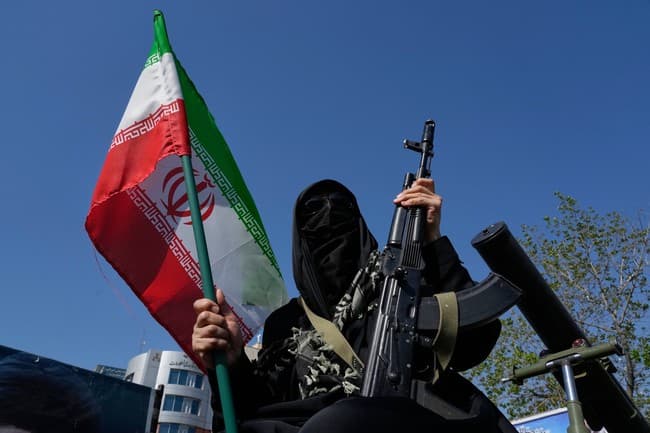
 An armed figure holds an Iranian flag and rifle amid rising tensions.
Trump Reimposes Iran Blockade, Demands 20% Shipping 'Toll'
Left says
- •The unilateral 20% shipping toll raises legal and constitutional questions about executive authority to impose what amounts to a tax on global commerce without congressional approval.
- •Escalating military strikes risk dragging the U.S. into a broader regional war, with Iran already retaliating against Kuwait's water infrastructure and threatening the Red Sea via the Houthis.
- •The blockade could destabilize global energy markets and raise costs for consumers worldwide, disproportionately hurting working families dependent on stable fuel prices.
- •Diplomatic off-ramps and the prior memorandum of understanding were abandoned quickly, suggesting insufficient effort was made to de-escalate before resorting to force.
Right says
- •Iran's repeated attacks on commercial shipping and its declaration that the strait was 'closed' left the U.S. with no choice but to respond decisively to protect global trade.
- •Reasserting American naval dominance in the Strait of Hormuz sends a strong signal that Iran cannot hold the world's energy supply hostage.
- •Charging a toll for U.S.-provided security is a reasonable way to offset the enormous cost of protecting international shipping lanes rather than burdening American taxpayers alone.
- •Iran's attacks on Kuwait's desalination plant and threats to close the Red Sea prove the regime's aggression, not American action, is the true source of regional instability.
Common Take
High Consensus- The Strait of Hormuz and Bab al-Mandeb are critical chokepoints for global energy supply.
- Iran's Islamic Revolutionary Guard Corps resumed attacks on commercial vessels after the collapse of the U.S.-Iran memorandum of understanding.
- Iran has threatened or directed the Houthis to potentially close the Red Sea shipping route in response to further U.S. strikes.
- Continued escalation poses serious risks to global oil prices and shipping costs.
The Arguments
Left argues
Imposing a unilateral 20% toll on global shipping through executive fiat raises serious constitutional questions, since taxing and regulating foreign commerce is a power the Constitution vests in Congress, not the president.
Right counters
The toll is framed as a reimbursement for a security service the U.S. Navy is actively providing, not a tax on domestic activity, and the president has broad Article II authority over military operations that make such protection possible in the first place.
Right argues
Iran's declaration that the Strait of Hormuz was 'closed' and its attacks on commercial vessels amounted to an act of war against global trade, leaving the U.S. with little choice but to respond with force to keep the world's most critical energy chokepoint open.
Left counters
Responding with a full blockade and repeated strikes is an escalation, not merely a defensive reaction, and it abandoned a functioning memorandum of understanding that had been de-escalating tensions just weeks earlier.
Left argues
The rapid escalation—from blockade to strikes to Iranian retaliation against Kuwait's water infrastructure and threats to close the Red Sea—shows the conflict is spiraling toward a broader regional war that could have been avoided with sustained diplomacy.
Right counters
Iran's attack on Kuwait's desalination plant and its threats against the Red Sea demonstrate that Tehran, not Washington, is the aggressor escalating the conflict, and appeasement through diplomacy had already failed once the IRGC resumed attacking ships after the MOU.
Right argues
Having the beneficiaries of U.S. naval protection help cover its cost through a toll is a reasonable alternative to placing the entire financial burden of policing the strait on American taxpayers alone.
Left counters
Iran's foreign minister sarcastically endorsing the toll and offering to undercut it exposes the awkward reality that this 'reimbursement' scheme has no clear legal basis, no international buy-in, and risks being seen as an extortion racket rather than legitimate policy.
Left argues
A blockade and prolonged military confrontation risk driving up global energy prices, hurting working families and consumers far from the Persian Gulf who have no say in this escalating conflict.
Right counters
Allowing Iran to hold the Strait of Hormuz hostage would inflict far greater and more permanent damage on global energy markets than a decisive, time-limited operation to restore safe passage.
Challenge Questions
These questions target genuine internal contradictions — meant to provoke honest reflection.
Right asks Left
“If diplomacy and the memorandum of understanding were working, how do you explain the IRGC's decision to resume attacking commercial ships and declare the strait 'closed' before any U.S. blockade was announced?”
Left asks Right
“If the 20% toll is truly just a reimbursement for a security service rather than a tax, why did even Iran's foreign minister immediately reframe it as a payment owed to whoever controls the strait, and what stops other nations from demanding similar 'tolls' for chokepoints they patrol?”
Outlier Report
Left Fringe
Anti-war progressives like Rep. Ilhan Omar and commentators at The Intercept/Jacobin who would call this an illegal war of aggression requiring immediate congressional intervention and impeachment-level scrutiny; roughly 15-20% of the left.
Right Fringe
Hawkish figures like Sen. Lindsey Graham and some neoconservative commentators who want full regime-change military action against Iran rather than just a blockade, viewing the toll idea as insufficiently aggressive; roughly 10-15% of the right. Conversely, MAGA-aligned isolationists like Tucker Carlson and Rep. Marjorie Taylor Greene oppose the strikes entirely as unwanted foreign entanglement, representing another 15-20% of the right.
Noise Assessment
High noise ratio - this is a fast-moving, complex geopolitical/military story where cable news and social media framing (especially around the unusual 'toll' proposal) will dominate discourse far more than organic public opinion, which is likely still forming and fluid given the story's novelty and rapid escalation.
Sources (6)
The US has attacked an oil tanker in the Gulf, which it said was heading towards Iran's largest oil export terminal, as it reimposed a blockade of Iranian ports. US Central Command (Centcom) said on Wednesday that Belma "ignored multiple warnings" as it was heading towards the Kharg Island oil terminal and an aircraft disabled the tanker by "firing Hellfire missiles into the ship's smokestack".
<p>President Trump announced on Monday that the U.S. is reinstating the naval blockade on <a href="https://www.axios.com/world/iran" target="_blank">Iran</a> and will prevent any ships from leaving or entering Iranian ports. The blockade will go into effect on July 14 at 4pm ET.</p><ul><li><a href="https://www.axios.com/politics-policy/donald-trump" target="_blank">Trump</a> also claimed the U.S. would be "reimbursed" at a rate of 20% for securing safe passage for cargo ships, though the details and seriousness of the initiative were not immediately clear.</li></ul><p><strong>Why it matters:</strong> The blockade — a response to <a href="https://www.axios.com/2026/07/11/iran-strikes-cargo-ship-in-strait-of-hormuz-defying-us-ultimatum" target="_blank">renewed clashes between the U.S. and Iran</a> in recent days — threatens to dramatically escalate tensions in the strait and change the economics of shipping energy and materials in the Middle East. </p><hr /><ul><li>It marks a further unraveling of the U.S.-Iran <a href="https://www.axios.com/2026/06/17/read-full-us-iran-deal-memorandum-understanding" target="_blank">memorandum of understanding</a> (MOU), which <a href="https://www.axios.com/2026/07/10/trump-iran-talks-ceasefire-over" target="_blank">Trump declared</a> "over" last week after the Islamic Revolutionary Guard Corps resumed attacks on commercial ships.</li></ul><p><strong>Driving the news: </strong>After a day of negotiations with regional mediators on Saturday, the IRGC attacked another ship and declared <a href="https://www.axios.com/2026/06/25/iran-ship-attacked-strait-hormuz-un-sailors-evacuation-paused" target="_blank">the strait</a> "closed until further notice" — triggering two round of U.S. strikes on Iran on Saturday and Sunday.</p><ul><li>A U.S. defense official said the U.S. military has plans for several days of additional strikes in <a href="https://www.axios.com/2026/03/05/iran-war-strait-of-hormuz-shutdown-us-global-economy" target="_blank">the Hormuz</a> area and on Iran's southern coastline aimed at degrading the IRGC's ability attack ships. </li><li>The U.S. defense official claimed the southern route in the strait of Hormuz is still open, with at least 20 ships transiting through in coordination with the U.S. and several others without coordination. </li></ul><p><strong>What he's saying:</strong> "The Hormuz Strait is OPEN, and will remain OPEN, with or without Iran. We are reinstating the THE IRANIAN BLOCKADE, so named because it is only stopping Iran's ships or customers from entering or leaving. All other countries will have fair and open use of the Strait," Trump <a href="https://truthsocial.com/%40realDonaldTrump/posts/116913091653271692" target="_blank">wrote</a> on his Truth Social account. </p><ul><li>He added that the U.S. "will be, from this point forward, known as 'THE GUARDIAN OF THE HORMUZ STRAIT'" and will ask to be "reimbursed, at the rate of 20% on all cargo shipped" in exchange for providing security. </li><li>"The process and formation will begin immediately. Thank you for your attention to this matter!" Trump wrote.</li></ul><p><strong>State of play: </strong>The U.S. Navy <a href="https://x.com/CENTCOM/article/2076732825349628250" target="_blank">announced</a> on Monday that the blockade will come into effect on July 14 at 4pm ET. </p><ul><li>"U.S. Central Command will begin enforcement of a naval blockade of all Iranian ports and Iranian coastal areas. All neutral vessels are hereby warned and have the period until enforcement begins to depart the blockaded area," the Navy statement said. </li><li>The Navy said the blockade "encompasses the entirety of the Iranian coastline to include but not limited to Iranian ports and oil terminals," and applies to all vessel traffic, regardless of flag. </li><li>"Any vessel suspected of entering or departing the blockaded area without authorization is subject to interception, diversion, and capture. Non-compliant vessels may be legally compelled with force."</li></ul><p><strong>Between the lines: </strong>Transit of ships through the Strait of Hormuz to or from non-Iranian destinations will not be impeded, according to the announcement.</p><ul><li>Humanitarian shipments like food and medical supplies will be permitted to reach Iranian ports, subject to inspection. </li></ul><p><strong>The intrigue: </strong>A senior Gulf source told Axios the U.S. hasn't discussed the issue of possible tolls for securing the Strait of Hormuz with its allies in the region.</p><p><strong>The other side: </strong>Iranian Foreign Minister Abbas Araghchi used Trump's statement to justify Iran's demand for collecting service fees from ships that pass through the strait. </p><ul><li>"POTUS is absolutely right. Whoever provides secure and safe passage of commercial vessels through the Strait of Hormuz should be compensated for this service. Iran has always been the GUARDIAN of the Strait and will remain so FOREVER. 20% is of course too much. We will be fair," he <a href="https://x.com/araghchi/status/2076728062662557961?s=20" target="_blank">wrote on X</a>. </li><li>Lebanon's Al-Mayadeen TV network, which is affiliated with the pro-Iranian "Axis of Resistance," quoted an Iranian security official who claimed Iran still controls the strait and will escalate its response if the U.S. continues its "provocative behavior."</li><li>"The security and administration of the Strait of Hormuz are determined by Iran's will — not by Trump's tweets and not by the presence of warships," the Iranian official told Al-Mayadeen. </li></ul><p><em>This is a breaking news story. Check back for updates.</em></p>
Iran’s Houthi allies have already prepared drones and missiles for strikes in the strait.
<p>Reuters: "A significant amount of Gulf oil has since been diverted to the Red Sea through a Saudi pipeline, and the waterway now carries around 7% of global energy supplies."</p> The post <a href="https://legalinsurrection.com/2026/07/report-iran-orders-houthis-to-close-strategic-red-sea-strait-if-u-s-escalates/">Report: Iran Orders Houthis to Close Strategic Red Sea Strait if U.S. Escalates</a> first appeared on <a href="https://legalinsurrection.com">Le·gal In·sur·rec·tion</a>.
Iranian officials have asked Yemen’s Houthis to block the Red Sea if the U.S. carries out strikes on Tehran’s energy sites, according to Reuters. Two senior Iranian sources and a regional source familiar with the matter reportedly told the outlet that the Houthis had been informed of the request, which was discussed within the Islamic…