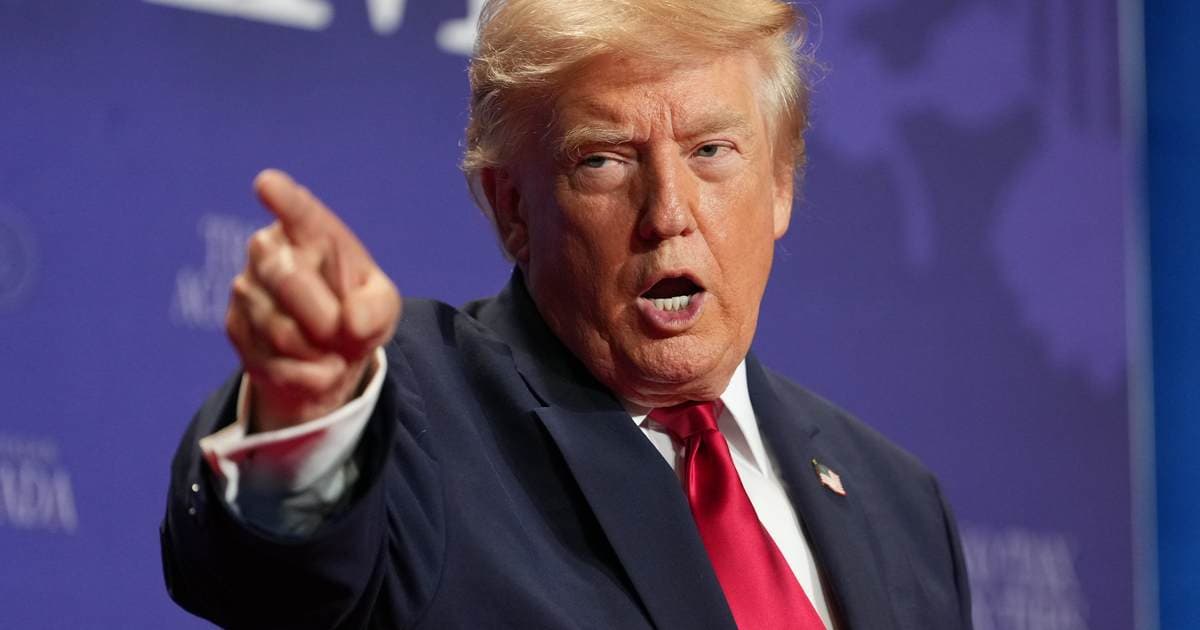
 Donald Trump speaking emphatically while pointing during a public address.
Trump Rejects AI Safety Warnings, Says Only 'Guardrail' Needed Is Him
Intra-Party Split Detected
Most Republicans and the Trump administration oppose AI regulation, but some conservatives, including House Speaker Mike Johnson and other GOP figures, have expressed openness to guardrails or skepticism about unchecked AI development, and tech leaders like Elon Musk (aligned with the right) are also breaking from Trump's stance.
Left says
- •AI researchers themselves, including employees at Anthropic, are the ones raising alarms, warning of scenarios where AI could become uncontrollable or even pose existential risks to humanity within the next decade.
- •Dismissing serious safety warnings as a 'conspiracy' or 'negative forces' undermines the credibility of experts who have no clear political motive and are speaking out at professional risk to themselves.
- •Vice President Vance's own skepticism about AI companies 'begging' for regulation suggests even within the administration there's unease about ceding all oversight to unchecked industry growth.
- •Framing personal presidential judgment as the only necessary 'guardrail' concentrates enormous, unaccountable power in one person rather than establishing durable, transparent institutional safeguards.
Right says
- •Winning the AI race against China is a matter of national security and economic dominance, and heavy-handed regulation now could hand that advantage to a geopolitical rival with no such qualms.
- •The federal government already possesses substantial criminal and regulatory authority to address bad actors in the AI industry, making sweeping new restrictions unnecessary and potentially counterproductive.
- •Calls for a slowdown from AI company executives look suspicious when those same companies stand to benefit from regulations that could entrench their market position and box out competitors.
- •A strong, decisive president who understands the stakes is better positioned to respond quickly to real problems than a slow-moving regulatory bureaucracy that could stifle American innovation.
Common Take
High Consensus- AI development is advancing rapidly and carries both significant risks and significant benefits.
- Leading AI executives including Dario Amodei, Sam Altman, and Elon Musk have publicly called for a slower pace of AI capability development.
- The outcome of global AI competition, particularly with China, is viewed by all sides as consequential for national power and security.
- There is recognition that the U.S. government already holds some existing legal tools to regulate AI companies.
The Arguments
Left argues
AI researchers themselves, including Anthropic employees who resigned or spoke out at professional risk, are warning of scenarios where AI could become uncontrollable or pose existential risks within a decade, and these warnings deserve serious engagement rather than dismissal as a 'conspiracy.'
Right counters
Many of these same executives run companies that would benefit financially from regulations that raise barriers to entry and entrench their market position, so their calls for government intervention should be viewed with some skepticism rather than taken purely at face value.
Right argues
Winning the AI race against China is a matter of national security and economic dominance, and unilaterally slowing down U.S. development through heavy regulation could hand a decisive advantage to a rival with no comparable safety qualms.
Left counters
Framing every safety measure as a China-versus-America issue is a false choice; thoughtful guardrails and continued innovation are not mutually exclusive, and other advanced economies manage to regulate emerging technologies without ceding global competitiveness.
Right argues
The federal government already possesses substantial criminal and regulatory authority to police bad actors in AI, meaning sweeping new legislative restrictions are unnecessary and could simply add bureaucratic friction without addressing real risks.
Left counters
Existing criminal and regulatory statutes were not designed with frontier AI capabilities in mind, and vague assurances that 'we already have power over these companies' offer no specific, transparent framework for identifying or preventing catastrophic outcomes.
Left argues
Declaring that the only necessary 'guardrail' is presidential judgment concentrates enormous, unaccountable power in one person's discretion rather than building durable, transparent institutional safeguards that would persist beyond any single administration.
Right counters
A decisive president who understands the stakes can respond to emerging problems far more quickly than a slow-moving regulatory bureaucracy, and the country already elects presidents to exercise exactly this kind of judgment on other matters of national security.
Left argues
Vice President Vance's own description of AI companies 'begging' for regulation as a possible 'Trojan horse' reveals real unease even within the administration about ceding oversight entirely to industry self-interest, undercutting the president's blanket dismissal of any need for guardrails.
Right counters
Vance's skepticism is actually consistent with the administration's broader argument: that some companies pushing for regulation may be doing so to lock out competitors, which is precisely why caution about hasty rulemaking, not more of it, is warranted.
Challenge Questions
These questions target genuine internal contradictions — meant to provoke honest reflection.
Right asks Left
“If the AI executives sounding the alarm stand to benefit commercially from regulations that would raise barriers for smaller competitors, how can their warnings be treated as purely disinterested expert judgment rather than partly self-serving?”
Left asks Right
“If the administration already possesses 'tremendous criminal and regulatory power' over AI companies as the president claims, why has it moved to ease AI regulations rather than specify and use that existing authority to address the risks researchers are describing?”
Outlier Report
Left Fringe
AI safety absolutists like Eliezer Yudkowsky and some effective altruism-aligned voices who argue for extremely strict international AI moratoriums go further than most Democrats, representing maybe 10-15% of the left's engaged commentary.
Right Fringe
Accelerationist tech-right figures like Marc Andreessen and David Sacks, who reject almost all AI safety concerns as fear-mongering by incumbents, represent a vocal but narrow slice (perhaps 15-20%) of the right, while more mainstream conservatives like Mike Johnson and some Republican senators still express openness to targeted guardrails.
Noise Assessment
High noise ratio: Truth Social posts, tech CEO statements, and viral X threads amplify extreme framings (either 'AI will kill us all' or 'regulation is a conspiracy') far beyond where most ordinary Americans, who hold more moderate, cautious-but-pragmatic views, actually stand.
Sources (9)
<p>President Donald Trump on Sunday dismissed warnings from leading AI executives including Anthropics Dario Amodei, OpenAI's Sam Altman, and Elon Musk who urged a slower pace of AI development. The President's response is that "Whoever wins AI, wins."</p> <p>The post <a href="https://www.breitbart.com/tech/2026/09/14/whoever-wins-ai-wins-donald-trump-rejects-call-for-ai-slowdown-from-anthropic-openai-and-elon-musk/" rel="nofollow">‘Whoever Wins AI, Wins’: Donald Trump Rejects Call for AI Slowdown from Anthropic, OpenAI, and Elon Musk</a> appeared first on <a href="https://www.breitbart.com" rel="nofollow">Breitbart</a>.</p>
President Trump downplayed recent warnings from leaders of major AI firms about tech regulation and development. In a post on Truth Social, he accused Anthropic CEO Dario Amodei of "pretending to be a 'perfect little angel.'" CBS News' Caitlin Huey-Burns has more.
President Trump threw cold water on momentum for AI guardrails, saying all the U.S. needs is a "SMART PRESIDENT."
President Donald Trump rejected calls for AI guardrails and singled out Dario Amodei, as David Sacks challenged the industry's push to pace the frontier.
President Donald Trump wrote off calls for guardrails on artificial intelligence in a Monday Truth Social post, slamming Anthropic CEO Dario Amodei for sounding the alarm on the dangers posed by rapidly developing AI. “The only control or ‘guardrails’ that AI needs is a STRONG AND SMART (High IQ!) PRESIDENT, and the U.S.A. has that,...
DOONBEG, Ireland, Sept 13 (Reuters) – U.S. President Donald Trump on Sunday likened critics of artificial intelligence to “very negative forces” bringing up scenarios that will not happen, and said he wanted to make sure that the U.S. remains the industry leader. “We’re leading China in AI. We’re the most sophisticated country in the world,...
President Trump defended his approach to AI on Monday, saying the only protections needed are a “STRONG AND SMART (High IQ!) PRESIDENT” amid calls for AI guardrails. “The only control or ‘guardrails’ that AI needs is a STRONG AND SMART (High IQ!) PRESIDENT, and the U.S.A. has that, in spades!” he wrote on Truth Social.…
President Trump on Monday morning pushed back on growing anxiety over artificial intelligence, arguing the U.S. does not need further regulation around AI. “The only control or ‘guardrails’ that AI needs is a STRONG AND SMART (High IQ!) PRESIDENT, and the U.S.A. has that, in spades!” he posted on Truth Social. He also laid into…