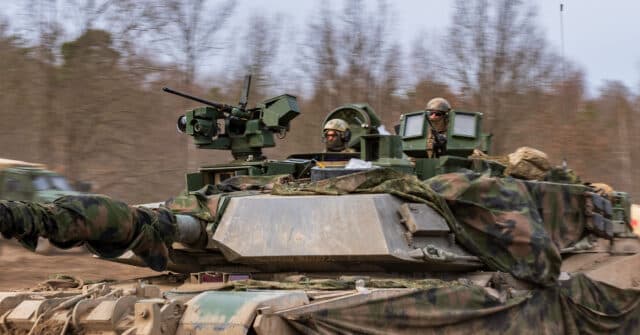
Trump Sends 5,000 Troops to Poland After Pentagon Cancellation
Left says
- •The deployment reverses a concerning Pentagon cancellation that had undermined commitments to a key NATO ally facing Russian aggression
- •Poland faces active security threats including Russian drone violations of its airspace and suspected Russian spy operations targeting NATO
- •Strong U.S. military presence in Eastern Europe deters Russian expansion and reassures vulnerable allies on NATO's frontier
- •The decision demonstrates America's reliability in honoring defense commitments to democratic partners under threat
Right says
- •The deployment rewards Poland as a model NATO ally that meets its defense spending obligations, unlike Germany which has underperformed
- •Poland's new conservative president represents shared values and stronger bilateral cooperation compared to previous leadership
- •The move strategically repositions forces from less committed allies to those demonstrating genuine partnership and burden-sharing
- •Strengthening Poland's defenses advances American interests by supporting a reliable ally that contributes meaningfully to collective security
Common Take
High Consensus- Poland currently hosts approximately 10,000 U.S. troops and will see its garrison increased by up to 50 percent
- Poland faces legitimate security threats from Russia including airspace violations and suspected espionage operations
- The Pentagon had previously cancelled a planned 4,000-troop deployment to Poland before Trump's announcement
- NATO Secretary General Mark Rutte welcomed the troop deployment decision
The Arguments
Left argues
The deployment reverses a dangerous Pentagon cancellation that had undermined America's credibility with a key NATO ally facing active Russian aggression, including drone violations and spy operations.
Right counters
The original cancellation was part of a strategic reallocation from allies who don't meet their defense spending obligations to those like Poland who do, making this reversal reward genuine partnership rather than appease unreliable allies.
Right argues
Poland represents a model NATO ally that meets its defense spending commitments and shares conservative values, unlike Germany which has consistently underperformed on burden-sharing while criticizing American foreign policy.
Left counters
Military deployments should be based on strategic necessity and threat assessment rather than political alignment, and Germany remains a crucial logistical hub for European operations regardless of spending disputes.
Left argues
Strong U.S. military presence on NATO's eastern frontier directly deters Russian expansion and provides essential reassurance to vulnerable allies facing immediate security threats from Moscow.
Right counters
Deterrence is more effective when backed by allies who demonstrate genuine commitment through adequate defense spending and political cooperation, making Poland a more reliable partner for long-term security.
Right argues
The timing with Poland's new conservative president demonstrates that America rewards allies who share democratic values and bilateral cooperation, strengthening relationships with partners who contribute meaningfully to collective security.
Left counters
Linking military deployments to electoral outcomes and political preferences undermines the principle that NATO commitments transcend domestic political changes and should remain consistent regardless of which party holds power.
Challenge Questions
These questions target genuine internal contradictions — meant to provoke honest reflection.
Right asks Left
“If military deployments should be based purely on strategic necessity rather than political considerations, how do you reconcile supporting this deployment specifically because it rewards a 'key NATO ally' while simultaneously criticizing the political timing with Poland's conservative president's election?”
Left asks Right
“If burden-sharing and meeting defense spending obligations are truly important principles for NATO effectiveness, how do you justify maintaining large deployments in countries like Germany that consistently fall short of these commitments while criticizing deployments to countries that do meet them?”
Outlier Report
Left Fringe
Progressive isolationists like Rep. Alexandria Ocasio-Cortez and some DSA members who oppose military deployments generally, representing roughly 15% of the left coalition.
Right Fringe
America First hardliners like Tucker Carlson and some MAGA influencers who oppose any European troop deployments as unnecessary foreign entanglements, representing about 20% of the right coalition.
Noise Assessment
Moderate noise level - most discourse reflects genuine policy preferences rather than performative positioning, though some amplification occurs around NATO burden-sharing talking points.
Sources (3)
<p>The U.S. will send an additional 5,000 troops to Poland, President <a href="https://www.axios.com/politics-policy/donald-trump" target="_blank">Trump</a> said Thursday.</p><p><strong>Why it matters: </strong>Trump's surprise announcement came a week after the Pentagon abruptly <a href="https://www.politico.com/news/2026/05/14/poland-pentagon-hegseth-troop-withdrawl-surprise-00922169" target="_blank">canceled</a> a planned deployment of 4,000 troops to Poland. </p><hr /><ul><li>The Trump administration had previously said 5,000 troops would be withdrawn from Germany and that further troop reductions <a href="https://www.axios.com/2026/05/19/trump-attend-g7-summit-france-iran" target="_blank">in Europe</a> were expected. </li></ul><p><strong>Driving the news: </strong>Trump wrote on Truth Social that his decision was based on the <a href="https://www.bbc.com/news/articles/cx27897vedno" target="_blank">election</a> last year of Poland's conservative President Karol Nawrocki, whom he endorsed.</p><p><strong>Background: </strong>Poland has in recent months faced <a href="https://www.belfercenter.org/research-analysis/russia-nato-baltics-scenarios-europe-security" target="_blank">threats</a> from Russia that included NATO and Polish forces having to <a href="https://www.axios.com/2025/09/10/poland-jets-russian-drones-airspace-nato-ally" target="_blank">shoot down Russian drones</a> that had violated the EU country's airspace.</p><ul><li>Polish officials <a href="https://x.com/TomaszSiemoniak/status/2056991301703188963" target="_blank">announced</a> this week the detention of three citizens who are <a href="https://www.independent.co.uk/news/world/europe/poland-arrests-spies-russia-nato-b2980158.html" target="_blank">suspected</a> of spying on NATO for Moscow and preparing sabotage and disinformation operations.</li><li>The Pentagon referred Axios to the White House for comment on the matter.<strong> </strong>Representatives for the White House did not immediately respond to Axios' Thursday afternoon request for comment.</li></ul><p><strong>By the numbers: </strong>The U.S. has around 80,000 troops stationed in Europe at present, with about 10,000 of those being in Poland, according to a Council on Foreign Relations <a href="https://www.cfr.org/articles/where-are-us-forces-deployed-europe" target="_blank">analysis</a>. </p><ul><li>The largest U.S. presence is in Germany, with more than 38,000 troops.</li></ul><p><strong>Go deeper: </strong><a href="https://www.axios.com/2026/05/21/trump-us-send-troops-poland-5000" target="_blank">Poland, NATO leaders condemn Russian drones in Polish airspace</a></p><p><em>Editor's note: This article has been updated with additional details throughout.</em></p>
<p>The U.S. will boost the number of soldiers on the eastern frontier of NATO, increasing garrison of ally Poland by up to 50 per cent.</p> <p>The post <a href="https://www.breitbart.com/europe/2026/05/22/trump-announces-extra-5000-troops-to-natos-eastern-flank-poland/" rel="nofollow">President Trump Announces Deployment of Extra 5,000 Troops to NATO’s Eastern Flank, Poland</a> appeared first on <a href="https://www.breitbart.com" rel="nofollow">Breitbart</a>.</p>
'Additional 5,000 troops to Poland'