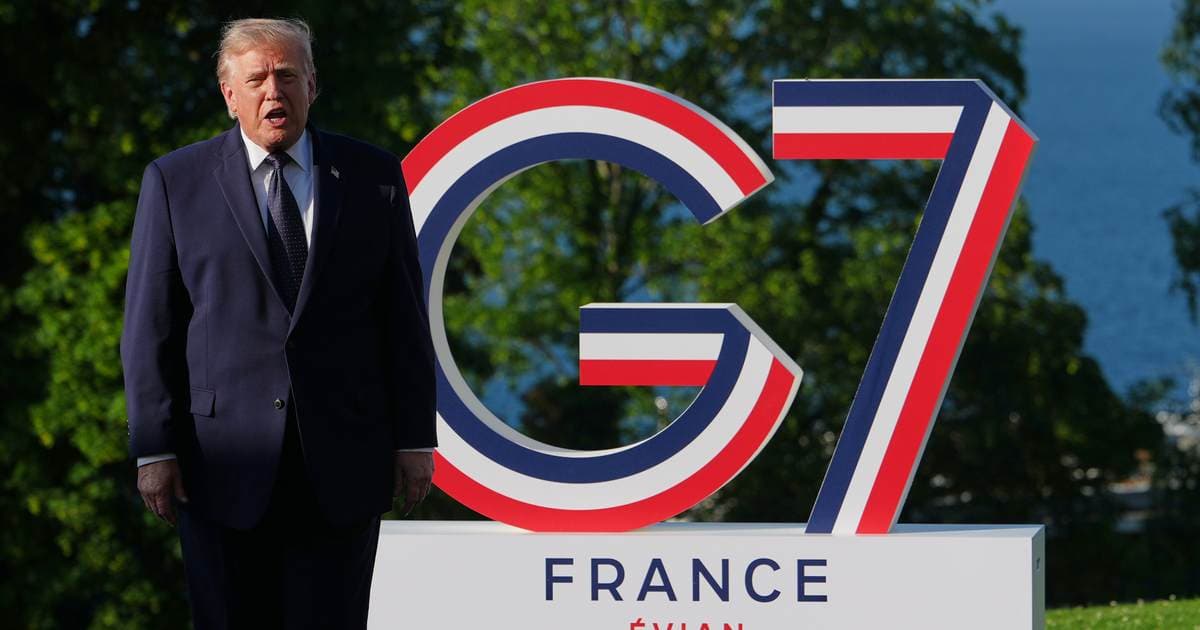
 Donald Trump stands beside a G7 sign at a summit in France.
Trump Threatens Diesel Export Ban, Then Backs Down After G7 Deal
Left says
- •Record-high diesel prices hitting $6.37 a gallon reflect broader economic strain tied to Trump's handling of the Iran conflict and ongoing trade disputes, which have pushed up costs for oil and other goods just weeks before the midterms.
- •Trump's threatened export ban was a pressure tactic aimed at forcing Europe to bear the cost of easing US prices, shifting the burden onto European consumers who were already facing their own record diesel prices.
- •The president's approval ratings on the economy hitting new lows show the political motivation behind the sudden push for relief ahead of the November elections.
- •The eventual G7 agreement shows multilateral cooperation succeeded where unilateral threats and brinkmanship risked destabilizing allies and global energy markets.
Right says
- •Trump used the credible threat of a diesel export ban as effective leverage to get European allies, particularly Germany and France, to finally follow through on commitments to release their own fuel stockpiles.
- •Treasury Secretary Scott Bessent's position that American farmers, truckers, and businesses should not bear the burden of high diesel prices reflects a commitment to putting US consumers first.
- •The ban was never truly necessary once Europe agreed to contribute a 'major world contribution' of diesel, proving the strategy achieved its goal without requiring actual export restrictions.
- •Trump's willingness to blame the Iran conflict and the broader war situation for diesel supply concerns, rather than domestic policy, frames rising prices as a consequence of necessary foreign policy decisions.
Common Take
High Consensus- Diesel prices hit record highs in the US and Europe in recent weeks, reaching $6.37 a gallon in the US and over £2 a liter in the UK.
- The G7 agreed to release 100 million barrels of oil and fuel products over four months, with a substantial diesel release within the first 20 days.
- Trump ultimately decided not to impose a diesel export ban after the G7 reached its coordinated release agreement.
- The ongoing Iran conflict and broader geopolitical tensions have contributed to disruptions in global energy markets and rising fuel prices.
The Arguments
Right argues
Trump's threat of a diesel export ban created real leverage that pushed Germany and France to finally follow through on stockpile release commitments they had been slow-walking.
Left counters
If the threat was simply a negotiating tactic that Trump never intended to execute, as he claimed afterward, then it was reckless brinkmanship that risked spiking prices for US allies and destabilizing markets over a bluff.
Left argues
The G7's coordinated, multilateral release of 100 million barrels demonstrates that diplomatic cooperation—not unilateral threats—was the mechanism that actually stabilized prices and avoided a transatlantic supply crisis.
Right counters
That cooperation only materialized after Trump applied direct pressure on Germany and France; without the threatened ban, there's little evidence Europe would have accelerated its commitments on this timeline.
Right argues
Bessent's framing that American farmers, truckers, and businesses shouldn't bear the burden of high diesel prices reflects a legitimate America-first priority, especially given diesel's critical role in the US economy.
Left counters
That framing ignores that US allies like the UK, which depends on America for roughly a third of its diesel imports, were already facing record prices of their own and had no responsibility for the Iran conflict driving up costs.
Left argues
The timing of this sudden push for price relief, coinciding with Trump's cratering approval ratings on the economy ahead of the midterms, suggests political expediency rather than a coherent energy strategy.
Right counters
Addressing a genuine affordability crisis ahead of an election is not inherently cynical—responding to voter concerns about $6.37 gas is exactly the kind of accountability elections are supposed to produce.
Right argues
Attributing diesel price spikes to the Iran war and broader geopolitical instability rather than domestic policy choices reflects a defensible read of global energy markets, since conflict-driven supply disruptions are a well-documented price driver.
Left counters
Trump's own trade battles and tariff policies have also been cited as contributing factors to rising consumer prices, making it convenient to blame foreign conflict alone while deflecting from self-inflicted economic pressures.
Challenge Questions
These questions target genuine internal contradictions — meant to provoke honest reflection.
Right asks Left
“If the left credits multilateral cooperation for resolving the crisis, how does it explain the fact that European nations only accelerated their stockpile commitments after Trump's unilateral threat, not before?”
Left asks Right
“If Trump insists the export ban was 'never really on the table,' what does that imply about the credibility of his future threats, and does bluffing as policy strategy carry its own risks to US allies' trust?”
Outlier Report
Left Fringe
Progressive commentators like those at Jacobin or The American Prospect who argue the entire episode shows Trump manufacturing crises for electoral gain and that only structural energy policy reform (not G7 deals) can fix price volatility represent a more radical ~15% of the left that rejects any credit to Trump's negotiating tactic.
Right Fringe
Pundits like Steve Bannon or some America First commentators who argue Trump should have actually imposed the export ban to truly punish Europe and prioritize domestic consumers represent a hawkish ~10-15% fringe on the right dissatisfied that Trump 'backed down' rather than following through.
Noise Assessment
Moderate noise; cable news and social media amplify the political theater angle (threat-then-backdown narrative) far more than ordinary consumers, who mostly just want lower prices at the pump and are largely indifferent to the diplomatic maneuvering details.
Sources (9)
The co-ordinated release is aimed at heading off further price spikes and avoiding a ban on US diesel exports.
G7 countries have agreed to release 100 million barrels of oil and fuel products, starting with diesel. Joe Brettell, founder and principal of Forward Energy, joins CBS News to discuss.
President Donald Trump and his Republican Party are under heavy pressure to address surging prices ahead of midterms.
President Donald Trump said Friday the U.S. won't impose a diesel export ban after Group of 7 nations agreed to coordinate the release of 100 million barrels of oil and fuel products from emergency reserves in an effort to ease surging energy prices.
<p>In effort to avoid panic at pumps, Keir Mather insists supply of fuel to Britain is ‘inherently resilient’</p><ul><li><p><a href="https://www.theguardian.com/money/2026/oct/02/uk-diesel-price-record-high-iran-war-oil">UK diesel price hits record high of £2 a litre</a></p></li><li><p><a href="https://www.theguardian.com/business/live/2026/oct/02/french-bond-sell-off-euro-crisis-cuts-tax-rises-eurozone-inflation-us-jobs-report-latest-news-updates">Business live – latest updates</a></p></li></ul><p>The government has sought to avert panic at the pumps, insisting that the UK is not facing a diesel shortage after Donald Trump threatened to cut off US supplies of the fuel.</p><p>The transport minister Keir Mather said on Friday that the UK has a wide range of sources of the fuel and is <a href="https://www.theguardian.com/business/2026/oct/01/britain-talks-european-allies-eu-emergency-diesel-stockpiles-reserves">in talks with other European countries</a> over the potential release of emergency diesel stockpiles.</p> <a href="https://www.theguardian.com/business/2026/oct/02/uk-is-not-facing-diesel-shortage-despite-fears-of-trump-export-ban-minister-says">Continue reading...</a>
<p>Ministers discuss drawing down EU countries’ reserves after Donald Trump threatens to cut off US supplies</p><p>Britain is in talks with European allies over releasing emergency diesel stockpiles after Donald Trump threatened to cut off US supplies of the fuel.</p><p>Ministers held calls with counterparts from the European Commission (EC), Germany, France, Italy and Ireland on Thursday to discuss whether to draw down reserves after the Trump administration told Germany and France to release their stockpiles to help ease soaring global energy prices or face a US export ban.</p> <a href="https://www.theguardian.com/business/2026/oct/01/britain-talks-european-allies-eu-emergency-diesel-stockpiles-reserves">Continue reading...</a>
Major economies will release fuel, including diesel, from their stockpiles as prices have skyrocketed in recent weeks.  The Group of Seven (G7), which includes Canada, France, Germany, Italy, Japan, the U.K. and the U.S., said in a statement Friday that it would “begin immediately” releasing 100 million barrels of fuel over the next four months.…
President Trump has ruled out a ban on diesel exports, a move he floated to reduce domestic prices but which faced doubts about its effectiveness and fears it would backfire.