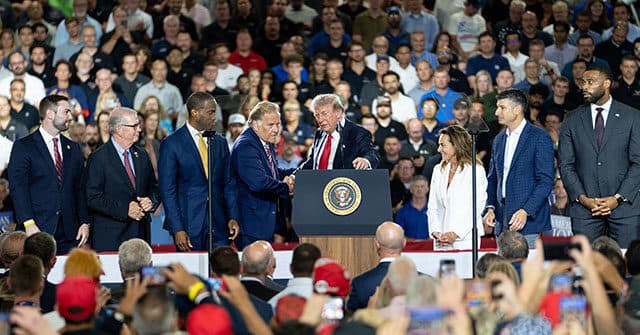
Trump Ties Auto Boom and Senate Endorsement to Tariff Policy
Left says
- •Campaign-style events at taxpayer-adjacent corporate facilities blur the line between official presidential business and midterm electioneering for handpicked candidates like Mike Rogers.
- •Tariff-driven manufacturing shifts come with hidden costs, including higher vehicle prices for consumers and retaliatory tariffs from trading partners like Canada that hurt other industries.
- •Crediting tariffs alone for GM's strong earnings oversimplifies a complex picture that includes broader economic trends, consumer demand, and corporate decisions made over years.
- •Framing past presidents, including fellow Republican Ronald Reagan, as complicit in 'betraying' workers is a rhetorical device to consolidate credit for any current auto-sector gains.
Right says
- •Tariffs on foreign-made vehicles and auto parts are directly incentivizing companies like GM, Ford, and Stellantis to invest billions in U.S. plants and bring jobs back to American soil.
- •Making interest on auto loans tax-deductible for American-made vehicles rewards domestic manufacturing and gives consumers a reason to buy American.
- •Decades of globalist trade policy under both parties allowed manufacturing jobs to leave Michigan and other industrial states, and this administration is finally reversing that trend.
- •Endorsing candidates like Mike Rogers, Lisa McClain, Tom Barrett, and John James reflects confidence that pro-manufacturing, pro-tariff policies are popular with Michigan voters ahead of the midterms.
Common Take
High Consensus- GM announced a $4 billion U.S. investment in June 2025 tied to expanding domestic manufacturing capacity.
- GM posted $48 billion in second-quarter revenue with earnings per share of $3.57, beating Wall Street expectations.
- The event took place at GM's Milford Proving Ground in Michigan just before the state's primary elections.
- Auto manufacturing remains a central economic and political issue in Michigan, a key swing state.
The Arguments
Right argues
Tariffs on foreign-made vehicles and parts are directly incentivizing GM, Ford, and Stellantis to announce billions in U.S. investment, reversing decades of manufacturing flight to Mexico and Asia.
Left counters
Corporate investment announcements often reflect long-planned capital cycles and consumer demand shifts, and crediting tariffs alone ignores that these same companies also face higher input costs that get passed on to buyers.
Left argues
Holding taxpayer-adjacent events at a corporate facility just before a primary, with handpicked candidates like Rogers, McClain, Barrett, and James joining onstage, blurs the line between official presidential duties and midterm campaigning.
Right counters
Presidents routinely tout economic wins at company sites, and highlighting policy results alongside candidates who support those same policies is standard political practice, not an abuse of office.
Left argues
Retaliatory tariffs from Canada on autos and other goods show that Trump's trade approach carries real costs for other American industries and consumers, not just benefits for auto manufacturing.
Right counters
Short-term retaliation is the price of correcting decades of one-sided trade arrangements, and the administration argues that reshored auto jobs and investment will outweigh temporary friction with trading partners.
Right argues
Making auto loan interest tax-deductible only for American-made vehicles directly rewards domestic manufacturing and gives consumers a tangible incentive to buy American, reinforcing the tariff strategy with a demand-side policy.
Left counters
This policy still functions as a subsidy that could raise costs or limit choice for consumers who prefer non-U.S.-made vehicles, and it does nothing to address tariff-driven price increases on vehicles overall.
Right argues
Decades of bipartisan globalist trade policy, including under Reagan, allowed manufacturing jobs to leave Michigan, and this administration is the first to reverse that trend with concrete reshoring commitments.
Left counters
Casting even a fellow Republican icon like Reagan as a betrayer of workers is a rhetorical move designed to erase historical context and monopolize credit for gains that stem from many overlapping economic factors.
Challenge Questions
These questions target genuine internal contradictions — meant to provoke honest reflection.
Right asks Left
“If tariffs are producing verifiable multi-billion-dollar U.S. investment announcements from GM, Ford, and Stellantis, what specific alternative policy would have achieved comparable reshoring without tariffs?”
Left asks Right
“If tariffs are solely responsible for GM's strong earnings and new U.S. investment, how does the administration explain the higher consumer vehicle prices and Canadian retaliatory tariffs that its own trade policy has triggered?”
Outlier Report
Left Fringe
Progressive economists and commentators like Robert Reich who argue tariffs are essentially a regressive consumer tax with no real benefit represent a vocal minority, roughly 15-20% of the left, that dismisses any positive framing of tariffs entirely.
Right Fringe
Free-market/libertarian-leaning conservatives such as those at the Cato Institute or National Review's editorial board who oppose tariffs on principle represent maybe 10-15% of the right and diverge sharply from Trump's protectionist base.
Noise Assessment
High noise ratio - this is a heavily stage-managed campaign event blending policy announcement with midterm electioneering, and both sides' media coverage amplifies talking points (job creation vs. hidden costs) beyond what average voters closely track day-to-day.
Sources (7)
<p>President Donald Trump lauded Michigan Republican Senate candidate Mike Rogers as "one of the best candidates" the GOP has this cycle.</p> <p>The post <a href="https://www.breitbart.com/politics/2026/07/27/trump-in-michigan-mike-rogers-is-one-of-the-best-gop-senate-candidates/" rel="nofollow">Trump in Michigan: Senate Hopeful Mike Rogers Is ‘One of the Best’ GOP Candidates</a> appeared first on <a href="https://www.breitbart.com" rel="nofollow">Breitbart</a>.</p>
Under Trump’s trade policies, companies such as General Motors (GM) are shifting production of certain vehicles stateside.
The American auto industry is protected and thriving—and that’s thanks to Republicans in Congress doing their job, President Donald Trump said in a rally on July 27. Trump spoke at the General Motors facility in Milford, Michigan on Monday ahead of the Senate primary debate to come later that evening. The president emphasized that America...
President Trump on Monday is visiting Milford, Mich., visiting the General Motors Milford Proving Ground, where he will tout manufacturing and give remarks. Before addressing a crowd, he watched a drag race of several GM vehicles, including a 2026 Cadillac CT5-V Blackwing versus a white 2027 Corvette Z06 with orange stripes.  Over the weekend, the…
President Trump is visiting Michigan on Monday in a push to highlight manufacturing and auto industry jobs ahead of the midterm elections. Trump is expected to focus on the economy during a speech at General Motors‘s Milford Proving Ground facility in Milford, Mich., where the automaker tests new vehicles and emerging technologies. He is also expected to…
Trump is heading to Michigan to make his case on jobs, manufacturing and the economy just days before primary voting.
President Trump on Monday said U.S. auto workers will no longer be "sold out" and see their jobs shipped overseas, pointing to multi-billion-dollar investments in swing-state Michigan and tying it directly to his aggressive use of tariffs.