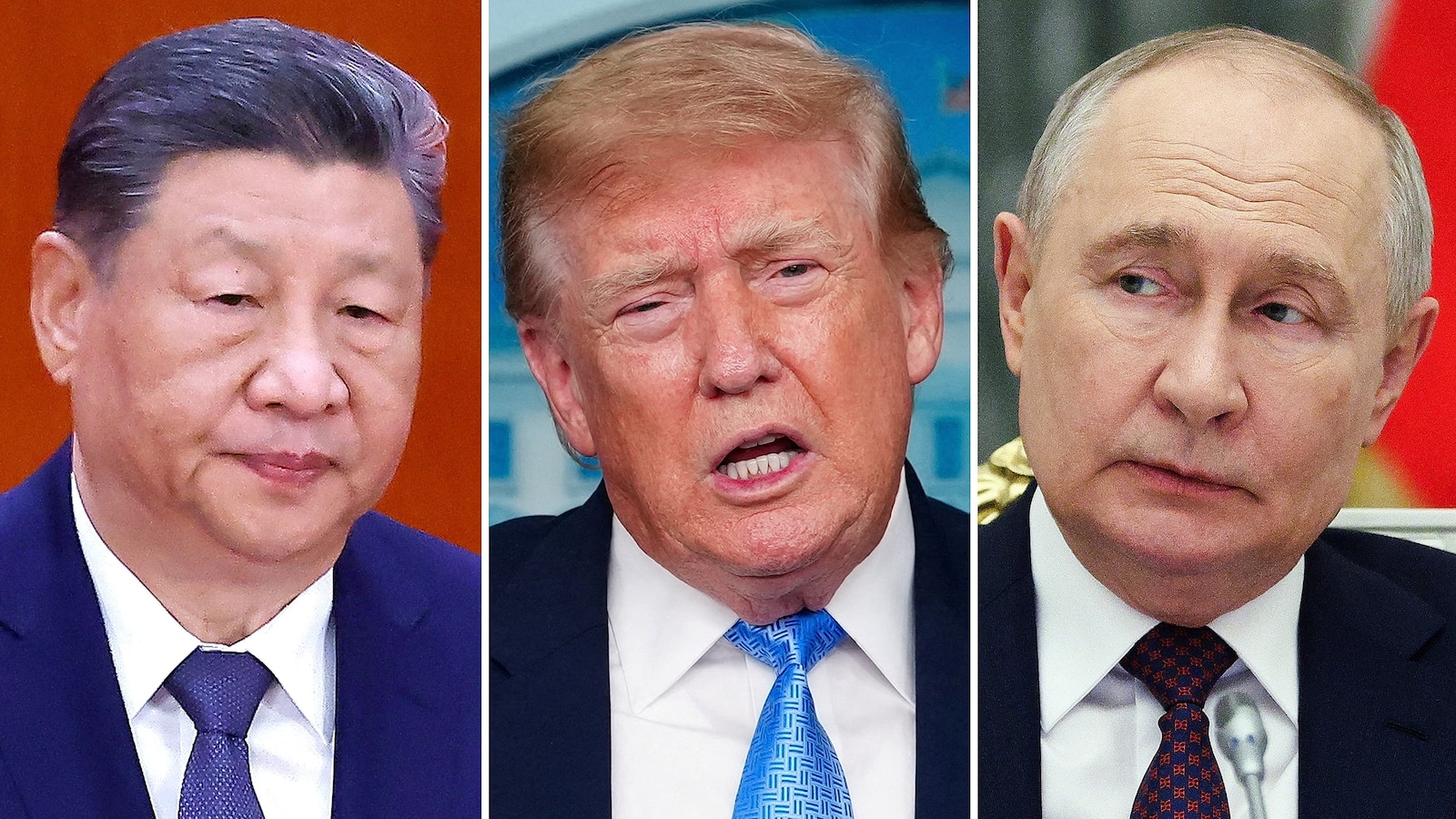
Trump to Hold First-Ever Three-Way Summit With Putin and Xi
Left says
- •Engaging China and Russia directly on nuclear arms control is a responsible step after the collapse of the New START treaty left the world's largest arsenals unconstrained for the first time in decades.
- •Bringing China into nuclear talks addresses a long-standing gap, since Beijing's arsenal has grown significantly but was never covered by prior U.S.-Russia agreements.
- •Deliberately excluding Ukraine from the agenda raises concerns that Trump is sidelining a war with major humanitarian and geopolitical stakes in favor of optics around a historic photo-op.
- •Elon Musk's inclusion in the China trip, given his business interests there, raises questions about blending personal commercial ties with high-stakes diplomacy.
Right says
- •Securing a first-ever three-way meeting with Putin and Xi reflects Trump's deal-making approach and willingness to engage adversaries directly rather than through traditional multilateral channels.
- •Pushing China to finally join serious nuclear arms discussions holds Beijing accountable for a arsenal buildup that previous administrations largely ignored.
- •Focusing the summit narrowly on nuclear proliferation and Iran, while avoiding the Ukraine conflict, keeps the meeting achievable and prevents it from collapsing into an intractable dispute.
- •Treating this as an opening conversation rather than expecting an immediate deal shows a pragmatic, incremental strategy toward reducing global nuclear risk.
Common Take
High Consensus- This will be the first-ever trilateral meeting between the leaders of the U.S., Russia, and China.
- The meeting takes place on the sidelines of the APEC summit in Shenzhen, China, following Trump's stop in Manila for the ASEAN summit.
- Nuclear weapons reduction and nonproliferation are the central agenda items, with Iran also expected to come up.
- No concrete agreement is expected to result from this initial meeting, which officials describe as a starting point for further dialogue.
The Arguments
Left argues
Excluding Ukraine from the agenda while Trump sits down with Putin for a historic summit risks signaling that the war's resolution is secondary to symbolic diplomacy with nuclear optics.
Right counters
Keeping the agenda narrow to nuclear proliferation and Iran is precisely what makes a first-of-its-kind meeting feasible, since folding in Ukraine would likely doom the talks before they start.
Right argues
Bringing China to the table on nuclear arms control for the first time holds Beijing accountable for a arsenal buildup that past administrations let go unaddressed, representing a genuine diplomatic breakthrough.
Left counters
China has historically resisted nuclear arms talks because its stockpile is far smaller than the U.S. or Russia's, so a single informal conversation is unlikely to yield any real commitment and may just be symbolic.
Left argues
Reviving nuclear arms control after the expiration of New START is a necessary and responsible move given that the world's largest arsenals are now unconstrained for the first time in decades.
Right counters
Treating this as an opening conversation rather than rushing to a binding deal is the pragmatic way to rebuild arms control architecture without repeating the failures of past rigid treaty frameworks.
Left argues
Elon Musk's presence on the trip, given his extensive business interests in China, blurs the line between personal commercial gain and high-stakes state diplomacy in a way that invites conflict-of-interest concerns.
Right counters
Musk is reportedly not part of the trilateral meeting itself, and business leaders accompanying presidents on foreign trips to advance American economic interests is a longstanding and unremarkable practice.
Right argues
Securing an unprecedented three-way summit demonstrates Trump's willingness to engage adversaries directly, a deal-making approach that could open doors traditional multilateral diplomacy has failed to unlock.
Left counters
A meeting billed as historic but explicitly expected to produce no concrete agreement risks being more about the spectacle of a photo-op than substantive progress on either nuclear risk or ongoing conflicts.
Challenge Questions
These questions target genuine internal contradictions — meant to provoke honest reflection.
Right asks Left
“If the left supports reviving nuclear arms control as urgent and necessary, why object to a narrowly focused meeting that is specifically designed to make that progress achievable rather than collapsing under the weight of unrelated disputes like Ukraine?”
Left asks Right
“If the right praises this summit as a pragmatic, incremental step precisely because no deal is expected, how does that reconcile with touting it simultaneously as a major deal-making win worth celebrating?”
Outlier Report
Left Fringe
Anne Applebaum-style Russia hawks and Ukraine-aid advocates who view any Trump-Putin summit as appeasement, roughly 15-20% of the left.
Right Fringe
Non-interventionist commentators like Tucker Carlson who may see this as insufficiently transformative or question Trump's broader Asia strategy, roughly 10-15% of the right.
Noise Assessment
Moderate noise; the Musk conflict-of-interest angle and 'photo-op' framing are more likely to generate amplified social media commentary than reflect majority sentiment, while most of the public views the core nuclear talks positively.
Sources (6)
Trump will participate in the first-ever trilateral meeting between the leaders of the U.S., China, and Russia on the sidelines of the APEC Summit in China next week.
Trump will discuss the "reduction of nuclear weapons" during the unprecedented talks, a spokeswoman says.
The meeting will be the president's third with Xi this year and the leaders are expected to talk about the war in Iran and nuclear proliferation, according to the White House.
President Donald Trump will meet with the leaders of China and Russia on the sidelines of the Asia-Pacific Economic Cooperation summit in Shenzen, China’s tech hub, next week, an unprecedented gathering of the heads of the world’s biggest nuclear powers.
The president plans to also discuss the war against Iran, but is not expected to bring up Russia’s war in Ukraine or the scandal that has engulfed Jensen Huang.
President Trump plans to meet with Russian President Vladimir Putin and Chinese President Xi Jinping on the sidelines of the Asia-Pacific Economic Cooperation (APEC) summit in China next week, marking the first-ever trilateral meeting between the three leaders. Trump will be in Asia for The Association of Southeast Asian Nations summit in the Philippines and…