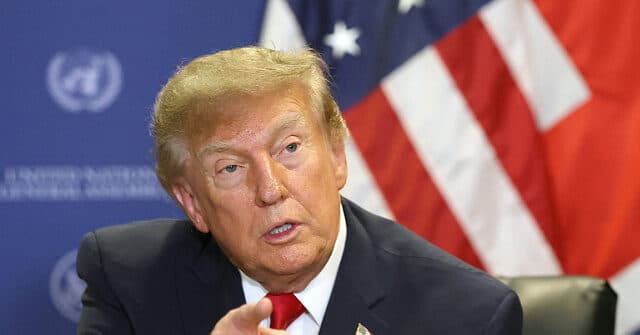
 President Donald Trump speaks at the United Nations General Assembly.
Trump Weighs 'Annihilation' of Iran Even as Talks Show Promise
Left says
- •Trump's repeated threats of 'annihilation' undercut the diplomatic progress made through Witkoff and Kushner's back-channel talks, sending mixed signals that could destabilize fragile negotiations.
- •The administration's bombastic rhetoric risks alienating Gulf allies who fear retaliatory strikes on their oil infrastructure and economic interests if the war resumes.
- •Escalation threats made without clear congressional authorization raise concerns about unchecked executive power to plunge the country into a wider Middle East war.
- •The stalemate and continued high oil prices show that military pressure alone hasn't resolved the conflict, suggesting sustained diplomacy is the more responsible path forward.
Right says
- •Trump's tough talk of 'obliteration' versus 'greatness' is a deliberate negotiating tactic that has pressured Iran back to the table for the first time since June.
- •The naval blockade and sanctions campaign have successfully cut off Iranian oil exports, proving that maximum pressure combined with willingness to negotiate is working.
- •Trump is coordinating closely with Gulf allies before making any major decision, showing measured strategic patience rather than reckless escalation.
- •Iran's history of terrorism and its threat to acquire nuclear weapons justify keeping all options, including decisive military action, on the table until a real deal is reached.
Common Take
High Consensus- U.S. and Iranian officials held a three-hour meeting in New York mediated by Qatar, the first direct contact since June.
- Trump described the talks as 'very good' and 'very productive,' and Witkoff called them 'encouraging, constructive and successful.'
- Iran has set conditions for reopening the Strait of Hormuz, including an end to the naval blockade and economic sanctions.
- Both sides recognize that a full return to major combat operations remains a real possibility if diplomacy fails.
- Gulf Cooperation Council countries have a direct stake in the outcome given past Iranian attacks on their territory and economic disruptions from the conflict.
The Arguments
Left argues
Trump's repeated public threats of 'annihilation' send mixed signals that could destabilize the fragile diplomatic channel Witkoff and Kushner just reopened, since Iran must negotiate while facing simultaneous threats of obliteration.
Right counters
The talks only resumed after months of maximum pressure and explicit threats, suggesting the tough rhetoric is precisely what brought Iran back to the table rather than undermining it.
Right argues
The combination of a naval blockade halting Iranian oil exports, sanctions, and the explicit threat of 'obliteration' created the leverage that produced the first US-Iran talks since June, demonstrating that maximum pressure diplomacy is working.
Left counters
Oil prices remain elevated and the war has settled into an unsustainable stalemate, meaning the pressure campaign has imposed real economic costs without yet producing an actual deal or clear resolution.
Left argues
Gulf allies like Saudi Arabia and Qatar have already had to restrain Trump once before over fears of retaliatory strikes on their oil infrastructure, showing that unilateral escalation threats put US partners' economic and physical security at risk.
Right counters
Trump is explicitly planning to consult Gulf leaders before any decision on resuming major combat operations, which shows he is factoring in allied concerns rather than acting unilaterally.
Left argues
Threatening to 'annihilate' a sovereign nation's regime without any visible congressional authorization raises serious constitutional concerns about executive overreach in decisions of war and peace.
Right counters
Presidents have long used the threat of force as a negotiating tool and Trump has not yet ordered new strikes, so the rhetoric itself doesn't constitute an unauthorized war but rather leverage within an ongoing conflict already underway.
Right argues
Given Iran's documented history of sponsoring terrorism and its pursuit of nuclear weapons capability, keeping military annihilation explicitly on the table is a rational deterrent that reinforces why Tehran should take a deal seriously.
Left counters
Iran's own foreign ministry says its core preconditions—ending the naval siege and economic war—have not been met, suggesting the 'greatness or obliteration' framing may be more performative than substantively closer to a deal.
Challenge Questions
These questions target genuine internal contradictions — meant to provoke honest reflection.
Right asks Left
“If the left credits sustained diplomacy as the responsible path, how does it explain that Iran only returned to the negotiating table after months of blockade, sanctions, and explicit annihilation threats rather than during any prior period of restraint?”
Left asks Right
“If tough talk of 'obliteration' is truly just calculated leverage, why has Trump repeatedly delayed major military escalation at Gulf allies' request, and what happens to that leverage's credibility if he continues delaying strikes he threatens?”
Outlier Report
Left Fringe
Progressive figures like Rep. Ilhan Omar and antiwar commentators (e.g., The Intercept writers, Code Pink activists) who argue any U.S. military posture toward Iran is illegitimate aggression represent roughly 15-20% of the left, more dovish than mainstream Democrats who support conditional diplomacy.
Right Fringe
Hawkish figures like Sen. Lindsey Graham and commentators such as Mark Levin who openly advocate for decisive military strikes regardless of diplomatic progress represent maybe 20-25% of the right, more aggressive than the Trump administration's stated 'pressure plus talks' approach.
Noise Assessment
High noise ratio: cable news and social media amplify Trump's 'annihilation' soundbites and antiwar outrage far beyond what reflects steady, more measured public sentiment, which polling suggests is cautiously supportive of pressure tactics but wary of actual war.
Sources (8)
<p>President <a href="https://www.axios.com/politics-policy/donald-trump" target="_blank">Trump</a> told Axios Thursday that he's approaching a critical juncture in the <a href="https://www.axios.com/world/iran" target="_blank">Iran</a> war over whether to restart massive attacks in an effort to bring the conflict to a close. </p><ul><li>"I have a big decision coming up. Do I want to go in and annihilate them [the Iranian regime] or do I not? It's a big decision. Anything could happen with me." </li></ul><p><strong>Why it matters:</strong> Though Trump has made <a href="https://www.axios.com/2026/07/23/trump-axios-iran-interview" target="_blank">similar threats</a> before, his comments come ahead of a <a href="https://www.axios.com/2026/09/16/trump-iran-talks-gulf-leaders-un" target="_blank">planned meeting Tuesday</a> with leaders from six Gulf countries — Saudi Arabia, the UAE, Qatar, Bahrain, Kuwait and Oman — on the sidelines of the UN General Assembly in New York.</p><hr /><ul><li>The meeting could shape the next phase of the war, including whether to make another push for diplomacy or intensify military action. If Trump wants to resume major combat operations, he would need buy-in from his regional allies. </li><li>The president has said several times in recent days that the war will end soon. Some U.S. officials warn that the conflict has settled into an unsustainable, neither-war-nor-peace stalemate, and they believe Trump could return to major combat operations after the midterms if a deal isn't reached by then.</li></ul><p><strong>What he's saying:</strong> Trump made clear in the interview that he wants to use the meeting at the UN to hear directly from regional allies about the war's next steps.</p><ul><li>"I want to find out where they are and how they are doing. We have been very protective of them," Trump said.</li><li>Trump declined to say whether he'll decide on the path forward before or after the midterms. </li></ul><p><strong>Driving the news:</strong> In early August, Trump held off on resuming major combat operations after Saudi Arabia and Qatar <a href="https://www.axios.com/2026/08/01/saudi-crown-prince-trump-iran-attacks" target="_blank">expressed concern</a> that Iran would bomb Saudi oil and gas facilities in retaliation.</p><ul><li>Since then, Trump has taken a <a href="https://www.axios.com/2026/08/09/trump-iran-interview" target="_blank">"low-key" approach</a>: suspending negotiations with Iran, launching a new <a href="https://www.axios.com/2026/08/24/bessent-dday-iran-secondary-sanctions" target="_blank">economic sanctions campaign</a>, continuing a naval blockade on Iranian ports, and focusing the U.S. military on <a href="https://www.axios.com/2026/08/25/hormuz-mines-remove-oil-iran-trump" target="_blank">reopening the Strait of Hormuz</a> and increasing oil flow to the global energy market. </li><li>The U.S. military has significantly <a href="https://www.axios.com/2026/08/28/trump-iran-hormuz-war-oil" target="_blank">increased</a> oil and gas tanker transit through the strait. But traffic is still below pre-war levels, and oil prices remain high. </li></ul><p><strong>State of play:</strong> Trump and Secretary of Defense Pete Hegseth have ordered the military to maintain its level of forces in the Middle East until the end of the year, U.S. officials say, to remain ready for a potential return to full-scale combat.</p><ul><li>The officials say Trump needs to decide soon on the way forward, partly because the U.S. military can't stay in its current holding pattern much longer. "At some point, you have to decide what is the endgame," one of the officials said.</li><li>Trump told Axios he's very satisfied that the naval blockade has prevented Iran from exporting its oil. "Not one ship has gone to Iran since we started. They tried and we blew them up," he said. </li><li>The president added that Iran is in direct contact with the U.S. and said the Iranians still want to reach a deal. </li></ul><p><strong>The big picture:</strong> The White House has also been working on a <a href="https://www.axios.com/2026/09/04/trump-middle-east-iran-post-war-strategy" target="_blank">post-war strategy</a> that calls for a regional effort to contain Iran while expanding normalization of relations between Israel and its neighbors.</p><ul><li>While the plan is still in the early stages of drafting, it's intended to guide the U.S. approach in the Middle East after the Iran war ends and in the final two years of Trump's term. Two big events loom over the planning: the Oct. 27 election in Israel and the U.S. midterms in November.</li></ul><p><strong>What to watch:</strong> When asked if he will meet with Israeli Prime Minister Benjamin Netanyahu in New York next week, Trump said, "I may."</p>
<p>President <a href="https://www.axios.com/politics-policy/donald-trump" target="_blank">Trump</a> is expected to hold a meeting with Gulf leaders on the sidelines of the UN General Assembly in New York next Tuesday to discuss the next steps in the war with <a href="https://www.axios.com/world/iran" target="_blank">Iran</a>, three sources with direct knowledge tell Axios.</p><p><strong>Why it matters:</strong> The meeting is expected to focus on U.S. ideas for a postwar strategy as Trump and his senior team work on a day-after plan expected to be finalized after the <a href="https://www.axios.com/politics-policy/2026-midterm-elections" target="_blank">midterms</a>.</p><hr /><p><strong>What we're watching:</strong> Israeli Prime Minister <a href="https://www.axios.com/2026/06/18/israel-reaction-trump-iran-deal-netanyahu" target="_blank">Benjamin Netanyahu</a> also wants to meet Trump in New York, but no meeting has been scheduled, an Israeli source said.</p><p><strong>Flashback:</strong> Last year, Trump met during the UN General Assembly with leaders from eight Arab and Muslim countries and presented them with his draft Gaza peace plan.</p><ul><li>He presented it publicly a week later. A deal to end the war was reached shortly afterward."</li></ul><p><strong>Context:</strong> Gulf countries that host U.S. military bases suffered major Iranian attacks during the war as well as significant economic losses from disruptions to oil and natural gas exports."</p><p><strong>Driving the news: </strong>Trump said on Wednesday that "hopefully we are towards the end of the war."</p><ul><li>Trump claimed again that Iran wants to make a deal and said the U.S. heard it from Iran directly. </li></ul><p><strong>State of play: </strong>The sources said Trump will meet with leaders or foreign ministers from the Gulf Cooperation Council countries — Saudi Arabia, the UAE, Qatar, Bahrain, Kuwait and Oman.</p><ul><li>The White House declined to comment. </li></ul><p><strong>What's next: </strong>The State Department sent out initial invitations on Wednesday.</p><ul><li>One of the sources said the meeting could expand to include other Arab and Muslim leaders.</li></ul>
<p>President Donald Trump said a three-hour round of U.S.-Iran negotiations on the sidelines of the U.N. General Assembly “went very well” Tuesday and later told Gulf and other regional leaders there was “a lot of momentum” toward a deal, as Washington and Tehran reopened a negotiating channel for the first time since June.</p> <p>The post <a href="https://www.breitbart.com/politics/2026/09/22/trump-u-s-iran-talks-went-well-momentum-deal/" rel="nofollow">Trump: U.S.-Iran Talks ‘Went Very Well’ — There Is ‘Momentum’ Toward Deal</a> appeared first on <a href="https://www.breitbart.com" rel="nofollow">Breitbart</a>.</p>
U.S. and Iranian delegations met on the sidelines of the U.N. General Assembly, rekindling diplomacy amid Trump's threat to "annihilate" the regime.
<p>Trump says further talks possible as barrel of Brent crude falls to below $100 for first time in two weeks</p><ul><li><p><a href="https://www.theguardian.com/world/live/2026/sep/23/united-nations-general-assembly-unga-zelenksyy-trump-xi-china-ukraine-russia-europe-latest-news-updates">United Nations general assembly – latest updates</a></p></li></ul><p>Iran has pushed back on claims that it dropped former preconditions for reopening the strait of Hormuz in surprise talks held in New York under the mediation of Qatar between Tehran’s foreign minister, Abbas Araghchi, and Donald Trump’s envoys Steve Witkoff and Jared Kushner.</p><p>Trump said the three-hour talks held in a room at the UN headquarters had gone very well and been very productive. He suggested further talks were possible imminently, which led to the price of a barrel of Brent crude to fall to below $100 (£75) for the first time in two weeks. Witkoff said the talks had been “encouraging, constructive and successful”.</p> <a href="https://www.theguardian.com/world/2026/sep/23/iran-denies-dropping-preconditions-very-productive-three-hour-un-talks-new-york">Continue reading...</a>
President Trump said Tuesday that U.S. officials had a three-hour long meeting with Iranian officials on the sidelines of the United Nations General Assembly in New York. Trump described it as a “very good meeting, very productive meeting” when asked about it during his bilateral meeting with Ukrainian President Volodymyr Zelensky and the Ukrainian delegation.…
Before his meeting Ukrainian President Volodymyr Zelensky, President Trump said U.S. leaders had a three-hour conversation with members of the Iranian delegation — a meeting he described as “very good.” Trump said U.S. envoys Steve Witkoff and Jared Kushner — the president’s son-in-law — met with Iranian leaders Tuesday amid the United Nations General Assembly…
The United States and Iran held a rare three-hour meeting in New York to discuss ending the war between the two countries, Trump said.