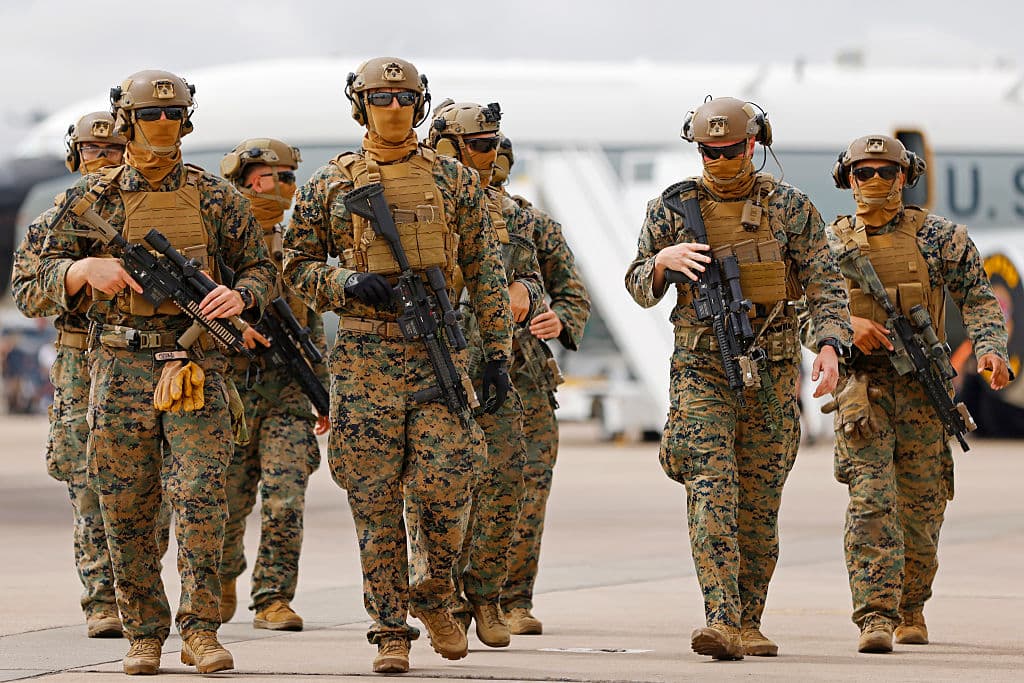
 U.S. Marines in combat gear walking on military airfield
Trump Weighs Ground Invasion of Iran Despite Bipartisan Opposition
Intra-Party Split Detected
Several prominent Trump allies including Matt Gaetz and Nancy Mace oppose ground troop deployment to Iran, breaking with administration war plans
Left says
- •A ground invasion would be a catastrophic military disaster that risks American lives in an unwinnable conflict against a well-defended nation with 150,000+ Revolutionary Guard troops and extensive underground bunker networks
- •Trump has been manipulated into this escalation by hawkish advisors like Lindsey Graham and Benjamin Netanyahu, who wanted to drag America into a war of annihilation against Iran
- •The administration lacks a clear exit strategy and has struggled to respond effectively to Iran's blockade of the Strait of Hormuz since the conflict began
- •Any attempt to seize strategic targets like Kharg Island would be a 'suicide mission' given Iran's proximity to mainland defenses and missile capabilities
Right says
- •Ground operations may be necessary to deliver a decisive 'final blow' that forces Iran to surrender and end its destabilizing regional activities
- •Strategic targets like Kharg Island, which processes 90% of Iran's oil exports, could cripple the regime's ability to fund terrorism and maintain its blockade of the Strait of Hormuz
- •The U.S. has already significantly degraded Iran's military capabilities, destroying over 66% of missile and drone production facilities and sinking 150+ naval vessels
- •America possesses overwhelming military superiority and doesn't need allies to accomplish its objectives in the region
Common Take
High Consensus- Iran continues to launch strikes against Israel and Gulf countries despite weeks of U.S.-Israeli military operations
- The Islamic Revolutionary Guard Corps maintains over 150,000 ground troops plus paramilitary forces
- Iran's blockade of the Strait of Hormuz is disrupting global oil and gas prices
- Both Republican and Democratic lawmakers have expressed opposition to deploying ground troops in Iran
The Arguments
Right argues
Strategic targets like Kharg Island, which processes 90% of Iran's oil exports, could cripple the regime's ability to fund terrorism and maintain its blockade of the Strait of Hormuz, delivering the decisive blow needed to force Iran's surrender.
Left counters
Kharg Island is only 20 miles from Iran's mainland, making any ground force extremely vulnerable to missile attacks and coastal defenses, while the island's seizure would not necessarily end Iran's ability to disrupt global shipping through other means.
Left argues
A ground invasion would be catastrophic given Iran's 150,000+ Revolutionary Guard troops, extensive underground bunker networks, and defensive advantages on their home territory, making this an unwinnable conflict that risks massive American casualties.
Right counters
The U.S. has already demonstrated overwhelming military superiority by destroying over 66% of Iran's missile and drone production facilities and sinking 150+ naval vessels, significantly degrading Iran's defensive capabilities before any ground operations would begin.
Left argues
Trump has been manipulated into this escalation by hawkish advisors like Lindsey Graham and Benjamin Netanyahu, who wanted to drag America into a war of annihilation against Iran without a clear exit strategy.
Right counters
Ground operations represent a calculated military decision to end Iran's destabilizing regional activities and blockade of critical shipping lanes, with America possessing the military superiority to accomplish objectives without needing allied support.
Right argues
The administration's 15-point framework offers Iran a path to sanctions relief and civilian nuclear programs in exchange for dismantling uranium enrichment and severing proxy ties, providing a diplomatic alternative to continued military action.
Left counters
Iran's counter-framework demanding reparations and recognition of Strait of Hormuz control shows the regime believes it's winning, not losing, making the proposed deal essentially a demand for unconditional surrender that guarantees diplomatic failure.
Left argues
The administration has struggled to respond effectively to Iran's blockade since the conflict began, with allies like Germany refusing to help reopen the Strait of Hormuz, demonstrating the isolation and futility of the current approach.
Right counters
America's military strength means it doesn't need reluctant allies to accomplish its regional objectives, and the current bombing campaign has already severely degraded Iran's naval capabilities and missile production infrastructure.
Challenge Questions
These questions target genuine internal contradictions — meant to provoke honest reflection.
Right asks Left
“If Iran's military capabilities have been so severely degraded as you acknowledge, and if the regime is truly a 'zombie regime' with decimated leadership, why would a ground invasion against such a weakened opponent necessarily result in the catastrophic casualties you predict?”
Left asks Right
“If the U.S. has already achieved such overwhelming military superiority by destroying 66% of Iran's production facilities and 150+ naval vessels, why is a risky ground invasion necessary to deliver a 'final blow' rather than continuing the apparently successful air and naval campaign?”
Outlier Report
Left Fringe
Harrison Mann and some progressive anti-war activists who frame this as entirely driven by Netanyahu manipulation represent about 15% of the left - most Democrats oppose ground invasion on practical grounds rather than conspiracy theories about foreign manipulation.
Right Fringe
Lindsey Graham advocating for Marine amphibious assaults and comparing this to Iwo Jima represents about 20% of the right - most Republicans support strong military action but draw the line at ground invasions given recent history.
Noise Assessment
Moderate noise ratio - while there's some performative hawkishness from Graham and anti-war rhetoric from progressives, the broad bipartisan opposition to ground troops reflects genuine public sentiment rather than political theater.
Sources (8)
<p><a href="https://www.axios.com/world/iran" target="_blank">Iran's</a> military has taken a significant beating in the opening weeks of the <a href="https://www.axios.com/2026/02/28/iran-us-israel-strikes-operation-epic-fury" target="_blank">U.S.-Israeli offensive</a> — but Tehran continues to demonstrate a defiant disruptiveness.</p><p><strong>The big picture:</strong> The U.S. is developing military operations for a "final blow,"<em> Axios' Barak Ravid reported, </em>but some hypothetical next steps, like the use of ground forces, could risk intensifying the fight.</p><hr /><p><strong>Context: </strong>Trump has <a href="https://www.axios.com/2026/03/13/trump-iran-surrender-hormuz-oil" target="_blank">repeatedly</a> <a href="https://www.cnn.com/world/live-news/iran-war-us-israel-trump-03-24-26" target="_blank">claimed</a> that the war is essentially over, but Iran continues to <a href="https://www.timesofisrael.com/idf-says-it-struck-islamic-guards-hq-in-tehran-man-lightly-wounded-as-iran-keeps-up-strikes/" target="_blank">launch</a> <a href="https://x.com/modgovae/status/2036027164290605338?s=20" target="_blank">strikes</a> against Israel and other Gulf countries. The nation is also maintaining the closure of the Strait of Hormuz, impacting oil and gas prices worldwide.</p><ul><li>The White House and the Pentagon are considering sending at least 10,000 additional <a href="https://www.axios.com/2026/03/25/82nd-airborne-army-jrtc-louisiana" target="_self">combat troops</a> to the Middle East in the coming days, a senior U.S. defense official told Axios.</li><li>The Islamic Revolutionary Guard Corps (IRGC) <a href="https://www.cfr.org/backgrounders/irans-revolutionary-guards" target="_blank">ground forces</a> number more than 150,000 troops, per the Council on Foreign Relations, on top of the Basij paramilitary force and Iran's larger conventional Army.</li></ul><p><em>Read on for more on what's known about the state of Iran's military:</em></p><h2>Leadership</h2><p><strong>Israel said its opening strikes </strong><a href="https://www.axios.com/2026/02/28/iran-khamenei-killed-israel" target="_blank">took out</a> seven senior defense and intelligence officials and targeted 30 top military and civilian leaders, including Islamic Revolutionary Guard Corps (IRGC) Cmdr. <a href="https://www.axios.com/2026/02/28/iran-attack-supreme-leader-ali-khamenei" target="_self">Mohammad Pakpour</a>.</p><ul><li>Several IRGC leaders have since been <a href="https://x.com/mhmiranusa/status/2031416450888487287" target="_blank">killed</a>, and on Thursday, Israel said it had killed Iranian Navy Cmdr. Alireza Tangsiri.</li></ul><p><strong>It's left behind</strong> what Behnam Ben Taleblu, Foundation for Defense of Democracies' Iran Program senior director, <a href="https://x.com/therealBehnamBT/status/2036292505394729253" target="_blank">described</a> as a "zombie regime."</p><h2>Missiles and drones</h2><p><strong>U.S. officials have</strong> repeatedly <a href="https://www.war.gov/News/News-Stories/Article/Article/4434312/hegseth-says-irans-defense-industrial-base-nearing-complete-destruction/" target="_blank">touted</a> Iran's plummeting missile and drone attack volume and the number of U.S. strikes on military targets, which have hit 10,000.</p><ul><li>But Kelly Grieco, a senior fellow at the Stimson Center, says those two metrics are "problematic," emphasizing that launch rates are a hazy metric to demonstrate diminished capability. </li><li>The fall could signal that the U.S. and Israel have successfully constrained Iran's ability to hit back, but "the problem is, it's not the only hypothesis," she says.</li><li>"If it's not that we've destroyed capability, capacity ... it means that they have more in reserve, which means that at some point they could decide to use that," she said.</li></ul><p><strong>What they're saying:</strong> A Department of Defense official said in a statement provided to Axios that "Iranian missile and air defense systems are heavily degraded" and added that CENTCOM has "damaged or destroyed over 66% of Iranian missile, drone, and naval production facilities and shipyards."</p><p><strong>Israel <a href="https://www.timesofisrael.com/liveblog_entry/idf-says-it-destroyed-or-disabled-around-330-of-irans-470-missile-launchers/" target="_blank">says</a> it </strong>has destroyed or disabled 330 of Iran's estimated 470 ballistic missile launchers. But Iranian <a href="https://www.nbcnews.com/world/iran/iran-fires-missiles-remote-uk-us-base-claiming-long-range-capabilities-rcna264547" target="_blank">responses</a> have persisted.</p><ul><li>A recent report from the Jewish Institute for National Security of America found that while U.S., Israeli and Arab air defenses have intercepted over 90% of Iranian missiles and drones, Iranian strikes on <a href="https://www.cnn.com/2026/03/05/middleeast/radar-bases-us-missile-defense-iran-war-intl-invs" target="_blank">radar</a> systems have eroded the detection network.</li></ul><p><strong>Threat level: </strong>Iran's Shahed drones are cheap and easy to produce, as well as harder to "detect and defeat than its missiles, and produced more than double the hits," per JINSA.</p><ul><li>Open-source estimates on Iran's capacity of those drones vary widely, Grieco says, adding "it's really hard to be able to track" the amount they've built as production can be decentralized.</li></ul><h2>Air and ground forces</h2><p><strong>U.S. intelligence <a href="https://www.dni.gov/files/ODNI/documents/assessments/ATA-2025-Unclassified-Report.pdf" target="_blank">assessed</a> last year</strong> that Iran's ground and air forces were among the largest in the region but had limited training and outdated equipment.</p><ul><li>Notably, the war could signal Iranian F-14s' final days, per <a href="https://www.npr.org/2026/03/24/nx-s1-5752380/f14-tomcats-iran-us-israel-airstrikes-top-gun" target="_blank">NPR</a>. The U.S. sold the crafts to the Iranians in the 1970s before the Islamic Revolution.</li></ul><p><strong>As the Trump administration</strong> weighs a potential ground attack on Kharg Island, CNN <a href="https://www.cnn.com/2026/03/25/politics/iran-kharg-island-us-military-ground-troops" target="_blank">reports</a> from sources familiar that the Iranians are moving additional military personnel and air defenses to the island.</p><ul><li>U.S. forces could be vulnerable to a range of missile and drone threats if a ground escalation ensued, given the island's proximity to the mainland.</li></ul><h2>Iran's Navy</h2><p><strong>Defense Secretary Pete Hegseth <a href="https://www.war.gov/News/News-Stories/Article/Article/4445219/hegseth-relays-death-of-iranian-navy-commander-provides-additional-epic-fury-up/" target="_blank">says</a> </strong>that more than 150 Iranian Navy vessels have been sunk since military strikes began in late February.</p><ul><li>U.S. forces have targeted Iranian minelaying vessels, with CENTCOM <a href="https://x.com/CENTCOM/status/2031489675760640370" target="_blank">saying</a> 16 were taken out near the Strait of Hormuz on March 10.</li></ul><p><strong>Reality check: </strong>While the U.S. and Israel have pummeled Iranian naval vessels and known ballistic missile sites, it would be impossible to fully wipe out Iran's military capacity from the sky.</p><ul><li>Iran uses hundreds of smaller speed boats to harass larger ships in the Gulf, and has networks of underground bunkers on land that have likely survived the bombing campaign. </li></ul><p><strong>A 2017 U.S. <a href="https://www.oni.navy.mil/Portals/12/Intel%20agencies/iran/Iran%20022217SP.pdf" target="_blank">report</a></strong><a href="https://www.oni.navy.mil/Portals/12/Intel%20agencies/iran/Iran%20022217SP.pdf" target="_blank"></a> described naval mines as a<strong> "</strong>critical component" of Iran's Strait of Hormuz strategy.</p><ul><li>Marie-Louise Westermann, a research associate at the Stimson Center, writes that Tehran's mine-laying reflects its "willingness to escalate" by deploying difficult-to-remove weapons capable of sustaining disruption.</li></ul><p><strong>Go deeper: </strong><a href="https://www.axios.com/2026/03/27/iran-war-trump-pentagon-more-troops-middle-east" target="_blank">Pentagon weighs sending 10,000 more combat troops to the Middle East</a></p><p><em>Editor's note: This story has been updated with a statement from the Department of Defense. </em></p>
We get an analysis of the Trump administration’s Iran war strategy from former U.S. Army intelligence analyst Harrison Mann. “From day two of this war, the Trump administration has not known what to do and how to get out of this,” says Mann, who resigned from the U.S. Army’s Defense Intelligence Agency in 2024 over the Biden administration’s policy in Gaza. As Trump is rumored to be eyeing the oil export hub of Kharg Island for seizure, Mann gives his assessment of a potential ground invasion of Iran. “Any attempt to seize this island would be close to a suicide mission,” he says. While U.S. leaders struggle to respond to Iran’s blockade of the Strait of Hormuz and attacks on military bases in U.S.-allied Gulf states, Mann notes that “the people who drove [Trump] into this war pretty much expected this. I don’t think this is a surprise to Lindsey Graham and Marco Rubio or Benjamin Netanyahu — who is very much getting what he wanted, which is dragging the U.S. into what he hopes will be a decisive war of annihilation against Iran.”
<p>Because of a combination of gossip, outright misinformation, and genuine incompetence, it is next to impossible to know at any given time what exactly is happening with Donald Trump’s war on Iran. A slew of indicators now suggests the president is preparing to escalate US involvement any day now and send in ground troops. Then […]</p>
The president wants to avoid a long, messy entanglement, but all of the ground options promise to be just that.
Former Rep. Matt Gaetz (R-Fla.) on Thursday cautioned President Trump against escalating the Middle East conflict by sending U.S. troops to Iran, warning that a ground invasion would harm the U.S. in the long term. “I want President Trump to have every diplomatic tool at his disposal, and I do trust that he knows a…
<p>Government sources tell The Intercept that leadership of the storied 82nd Airborne Division have been ordered to the Middle East.</p> <p>The post <a href="https://theintercept.com/2026/03/24/82nd-airborne-leadership-ordered-to-middle-east-as-trump-iran-war/">Leaders of Elite Paratrooper Unit Ordered to Middle East as Trump Weighs Iran Ground War</a> appeared first on <a href="https://theintercept.com">The Intercept</a>.</p>
<p>Joseph Votel offers insights on securing Iran's uranium, seizing Kharg Island, dwindling stocks of missile interceptors, and how long Epic Fury will last.</p> <p>The post <a href="https://www.twz.com/news-features/former-centcom-commander-on-what-u-s-boots-on-the-ground-in-iran-could-entail">What Boots On The Ground In Iran Could Entail, According To Former CENTCOM Commander</a> appeared first on <a href="https://www.twz.com">The War Zone</a>.</p>