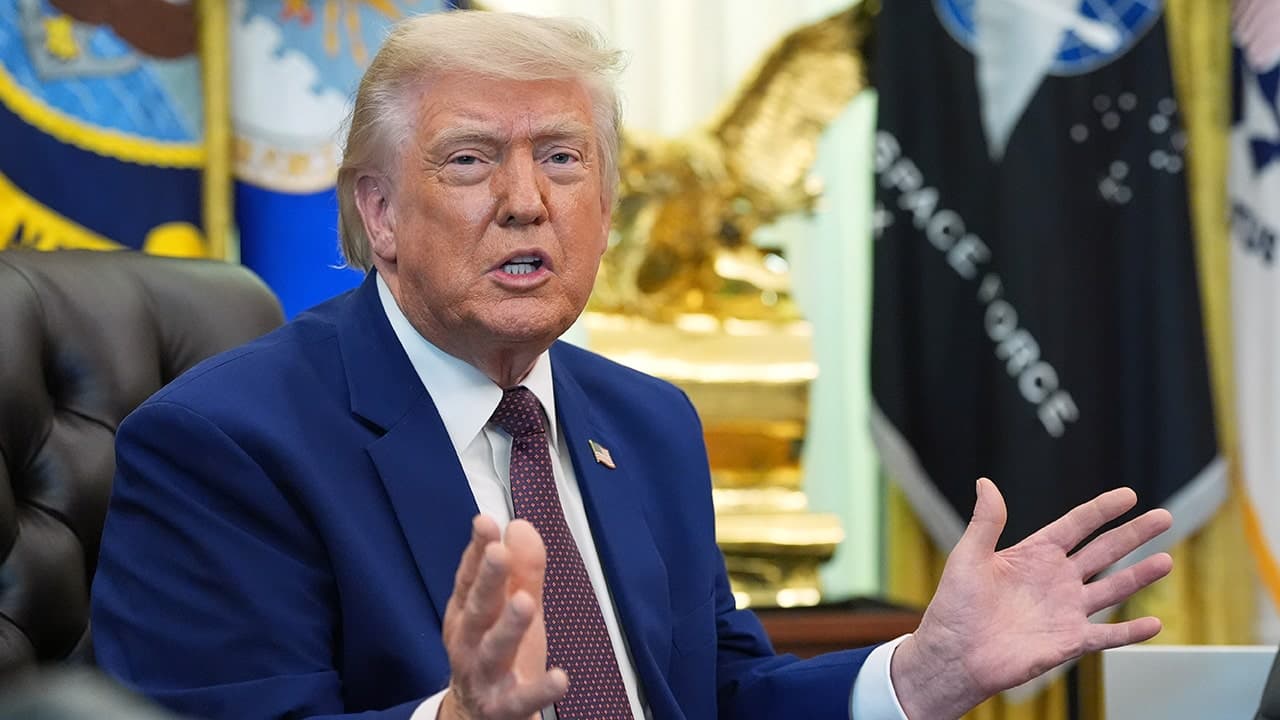
 President Trump speaking at the White House amid the housing bill decision.
Trump Withholds Signature on Housing Bill to Force Voter ID Vote
Intra-Party Split Detected
The housing bill passed with overwhelming bipartisan support (House 358-32, Senate 85-5), meaning most Republicans in Congress backed it despite Trump's opposition and his push to leverage it for the SAVE America Act; House conservatives also reportedly stalled the SAVE Act itself, creating friction within the GOP over priorities and strategy.
Left says
- •Trump's refusal to sign a bill that passed 358-32 in the House and 85-5 in the Senate undermines his own party's midterm-year effort to address voters' top concern about rising costs.
- •The SAVE America Act, which Trump is using as leverage, could disenfranchise more than 21 million Americans who lack easy access to documents like a REAL ID, passport, or military ID paired with proof of citizenship.
- •Dismissing a major housing affordability bill as a 'big yawn' when the White House's own economists estimate a 10-million-home shortage reveals misplaced priorities during an affordability crisis.
- •Democrats see an opening to argue Trump's actions show he values a restrictive voting bill over concrete relief for struggling homebuyers and renters.
Right says
- •Trump argues the SAVE America Act is critical to protecting election integrity, calling it 'saving America from crooked elections,' and notes it polls at 97% within the Republican Party.
- •The president is frustrated that the Senate can't clear a 60-vote threshold for a citizenship and voter ID requirement he considers a top priority, and he's using available leverage to push Congress to act.
- •Because the housing bill was set to become law regardless of his signature, withholding it was a symbolic protest rather than an attempt to block a policy he actually opposes.
- •House conservatives, not Trump, have also stalled a fuller version of the SAVE Act by not including his proposed provisions on mail-in voting and women's sports, showing the holdup involves multiple factions within the GOP.
Common Take
High Consensus- The 21st Century ROAD to Housing Act passed Congress with overwhelming bipartisan majorities, 358-32 in the House and 85-5 in the Senate.
- The bill became law automatically at midnight without Trump's signature, as allowed under the Constitution after the 10-day review window.
- The legislation is described as the most significant federal housing affordability effort in decades, including changes to manufactured and modular housing rules.
- Trump's refusal to sign was explicitly tied to pressuring the Senate to pass the SAVE America Act, not to opposition to the housing bill's substance.
The Arguments
Left argues
Trump's refusal to sign a housing bill that passed 358-32 and 85-5 undermines his own party's midterm-year effort to address affordability, the top voter concern, and gives Democrats a clean line of attack: he values a voter ID bill over concrete relief for renters and homebuyers.
Right counters
Because the bill was guaranteed to become law regardless of Trump's signature, the snub was a symbolic protest with zero practical policy cost, not an actual attempt to block housing relief he opposes.
Right argues
Trump argues the SAVE America Act is essential to election integrity and polls at 97% within the GOP, so using available leverage — even symbolic — to pressure a Senate that can't clear 60 votes on his top priority is a legitimate exercise of presidential influence.
Left counters
Framing a bill that could disenfranchise more than 21 million Americans lacking easy access to REAL ID, passports, or citizenship documents as simply 'election integrity' minimizes serious, well-documented access barriers for the sake of a symbolic gesture.
Left argues
Dismissing a major housing affordability bill as a 'big yawn' while the White House's own economists cite a 10-million-home shortage reveals a disconnect between Trump's stated concern for affordability and his actual priorities.
Right counters
Calling the bill unimportant 'compared to' the SAVE Act is a relative judgment about political priorities, not a claim that housing doesn't matter — and Trump let the bill become law rather than actually killing it.
Right argues
The holdup on the SAVE Act isn't solely Trump's doing — House conservatives have stalled a fuller version by refusing to include his preferred provisions on mail-in voting and women's sports, showing this is an intra-GOP fight, not simply a presidential power play.
Left counters
Even if multiple factions share blame for the SAVE Act's stall, Trump is the one who chose to hold a wildly popular, needed housing bill hostage to that internal GOP dispute, making the political cost his to own.
Left argues
Democrats see a clear opening: a president publicly prioritizing a restrictive voting bill over addressing the cost of housing during an affordability crisis undercuts the GOP's own midterm messaging on economic relief.
Right counters
The bill passing into law unchanged means the substantive economic relief Democrats claim to care about arrived on schedule, suggesting the controversy is more about political theater than actual policy outcomes.
Challenge Questions
These questions target genuine internal contradictions — meant to provoke honest reflection.
Right asks Left
“If the housing bill became law at midnight regardless of Trump's signature, why should his purely symbolic protest be treated as evidence of misplaced priorities rather than simply theater with no policy consequence?”
Left asks Right
“If Trump considers the SAVE Act his top legislative priority, why did he risk delaying a popular, needed housing bill over a fight that even House conservatives in his own party are prolonging by refusing to include his preferred provisions?”
Outlier Report
Left Fringe
Groups like the Brennan Center and figures such as Stacey Abrams represent a more absolutist anti-voter-ID stance (~15-20% of the left) that opposes even modest ID requirements most Democratic voters are open to.
Right Fringe
Hardline House conservatives (e.g., Freedom Caucus members like Chip Roy) who blocked a fuller SAVE Act version over mail-in voting and women's sports provisions represent a narrower faction (~20-25% of the right) willing to sacrifice broader GOP legislative wins for maximalist demands.
Noise Assessment
Substantial performative amplification: Trump's social media framing and partisan press releases dominate coverage, while polling suggests most Americans support both reasonable voter ID and housing affordability measures, making the 'either/or' framing largely elite-driven noise.
Sources (8)
President Donald Trump on Friday announced he would not sign a major housing bill that Congress sent to his desk in protest of the Senate's failure to pass the SAVE America Act.
President Donald Trump will let the bipartisan housing bill approved by Congress become law without his signature, saying Friday that he was refusing to put his name on it because of the little progress made in passing a strict voter ID bill that he has been pushing.
U.S. President Donald Trump said on Friday he would not sign a bipartisan housing affordability bill that he had called "a big yawn," but the measure can become law without his signature.
<p>President <a href="https://www.axios.com/politics-policy/donald-trump" target="_blank">Trump</a> is refusing to sign a landmark <a href="https://www.axios.com/2026/06/23/housing-affordability-senate-trump" target="_blank">bipartisan housing bill</a> to protest Senate Republicans' failure to pass an <a href="https://www.axios.com/2026/06/23/trump-senate-republicans-save-act-thune" target="_blank">unrelated bill</a> that would <a href="https://www.axios.com/2026/02/10/save-america-act-trump-voter-id" target="_blank">tighten voting restrictions</a>.</p><p><strong>Why it matters:</strong> The president's refusal is a symbolic gesture, as the housing bill will become law at midnight — with or without Trump's signature.</p><hr /><p><strong>What they're saying: </strong>"I will not sign the Housing Bill, which has been fully approved by Congress and sent to the White House, in PROTEST over the fact that the United States Senate is not capable of passing THE SAVE AMERICA ACT," Trump wrote in a Truth Social <a href="https://truthsocial.com/%40realDonaldTrump/posts/116895869064122989" target="_blank">post</a> Friday morning.</p><ul><li>"THE SAVE AMERICA ACT'S non-passage is CRAZY, and a serious threat to any politician who votes against it!"</li></ul><p><strong>Context:</strong> The SAVE America Act would require proof of citizenship to register to vote and a photo ID when casting a ballot. Voting rights groups say it could disenfranchise millions of Americans.</p><ul><li>The Brennan Center <a href="https://www.brennancenter.org/our-work/analysis-opinion/new-save-act-bills-would-still-block-millions-americans-voting" target="_blank">estimates</a> that more than 21 million Americans lack easy access to the documents the bill would require to register to vote, including a REAL ID, passport, military ID, or other government-issued photo ID, paired with proof of U.S. birth or citizenship.</li></ul><p><strong>Catch up quick:</strong> Congress <a href="https://www.axios.com/2026/06/24/trump-delays-housing-bill-save-act" target="_blank">overwhelmingly passed</a> the bipartisan housing package in late June to address soaring homeownership costs and bar large investors from snapping up single-family homes.</p><ul><li>It's the most significant housing affordability legislation Congress has passed in decades, clearing the House 358-32 and the Senate 85-5.</li></ul><p><strong>Zoom out:</strong> House Speaker Mike Johnson (R-La.) sent the bill to Trump on June 29, triggering a 10-day window for the president to sign, veto, or allow it to become law without his signature.</p><ul><li>If Trump chooses to veto the bill sometime Friday, Congress — on paper — has enough votes to override that veto.</li></ul><p><strong>Go deeper:</strong> <a href="https://www.axios.com/2026/06/24/trump-delays-housing-bill-save-act" target="_blank">Trump cancels housing affordability bill signing until SAVE Act is passed</a></p>
Trump refused to sign the housing bill to pressure Congress on the SAVE America Act, but the measure became law without his signature at midnight.
Trump’s decision not to sign the bill gave Democrats an opening to criticize him on the issue of affordability: "His priorities couldn’t be clearer."
A sweeping new housing bill is set to become law, even without the president's signature. The measure passed Congress with bipartisan support, but President Trump refused to sign it in protest of the GOP Senate's failure to approve his election legislation, known as the SAVE Act. Barring a last-minute veto, the bill will usher in new housing regulations and incentives. Lisa Desjardins reports.
A bipartisan housing bill automatically became law early Saturday without President Trump’s signature, after Trump sought to stall it in protest of the Senate’s failure to pass his voter ID legislation. The 21st Century ROAD to Housing Act, is a comprehensive measure aimed to address housing affordability by increasing the supply of homes and lowering…