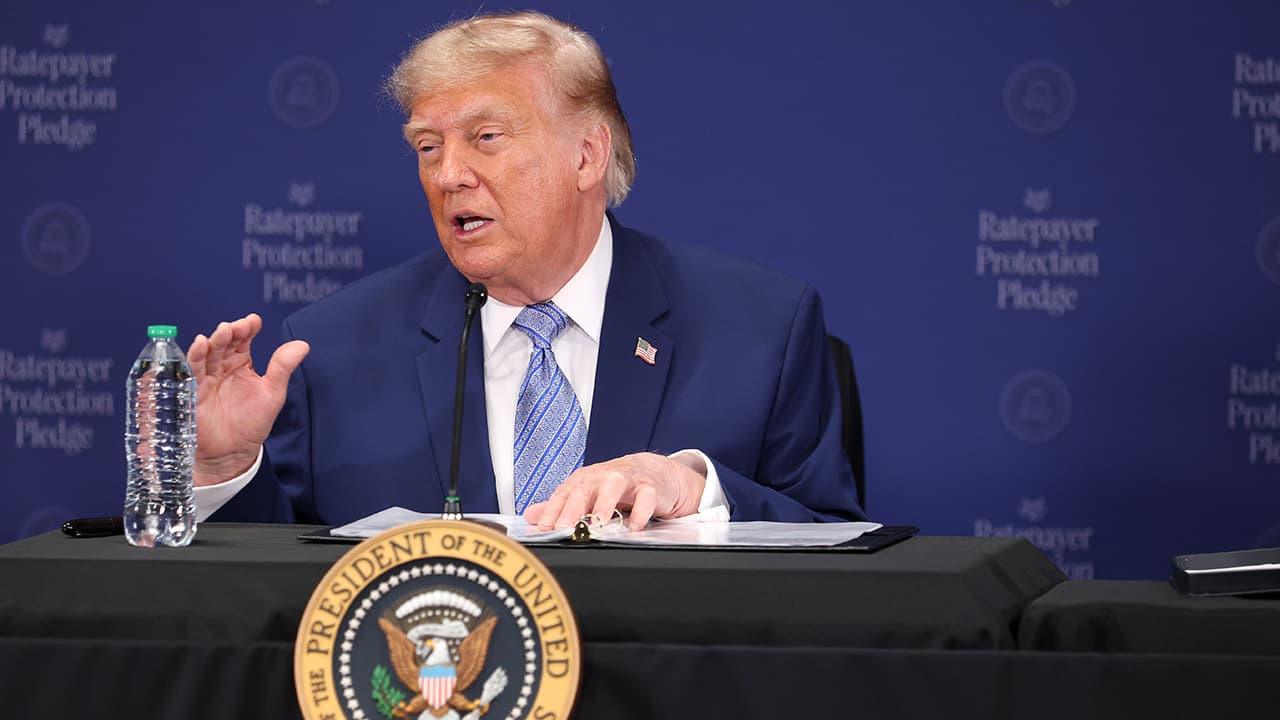
 President Trump speaks at the 'Ratepayer Protection Pledge' event on data centers.
Trump: 'You Can't Fight' Data Centers as Public Opposition Surges
Intra-Party Split Detected
Most Republicans back Trump's pro-data-center stance, but three GOP governors (DeSantis, Ayotte, Scott) declined to sign the pledge, and DeSantis signed legislation preserving local governments' authority to reject data centers, reflecting a states-rights/local-control split from Trump's federal push.
Left says
- •Communities deserve real authority to reject data centers, not just voluntary pledges from the same corporations profiting off the buildout, as seen in DeSantis's Florida law preserving local rejection power.
- •A 71% Gallup opposition rate and surging local blockades ($130 billion in projects delayed or blocked in a single quarter) reflect legitimate grassroots concern over water use, noise, and diminished human agency, not foreign propaganda.
- •Framing skeptics as unwitting tools of Chinese or Russian disinformation, or dismissing them as 'communists,' delegitimizes genuine local anxiety over electricity costs, environmental strain, and corporate overreach.
- •Voluntary, nonbinding pledges from tech giants like Amazon, Google, and Meta lack enforcement teeth, leaving ratepayers vulnerable if companies quietly pass costs along anyway.
Right says
- •America must win the global AI race, and data centers are the indispensable infrastructure for that dominance, so obstruction only hands the advantage to geopolitical rivals like China.
- •The Ratepayer Protection Pledge, now covering 80% of U.S. power delivery and 23 governors, forces tech companies to shoulder infrastructure costs themselves rather than passing them to ordinary consumers.
- •Real-world examples show data centers can lower costs and boost communities, such as Georgia Power freezing rates through 2029, Meta's $27 billion Louisiana project saving residents $2.6 billion, and Columbia County, Georgia potentially eliminating residential property taxes entirely.
- •GOP lawmakers have credible concerns that foreign-linked organizations tied to China and Russia may be funding or amplifying anti-data-center activism to slow U.S. AI progress and disinformation networks deserve scrutiny.
Common Take
High Consensus- Data centers are driving a significant and rapid increase in electricity demand nationwide.
- Ordinary consumers should not bear unfair utility price hikes caused by data center energy needs.
- Local communities should have a meaningful voice in whether and how data centers are built near them.
- Public opposition to data centers has grown substantially over the past year, with polling and protest activity both rising.
The Arguments
Left argues
Communities deserve binding legal authority to reject data centers outright, as Florida's law preserves, rather than relying on voluntary corporate pledges that companies could quietly abandon once public attention fades.
Right counters
The Ratepayer Protection Pledge already covers 80% of U.S. power delivery and 23 governors, showing rapid, voluntary market-driven adoption that would take years to achieve through fragmented state-by-state legislation, and real examples like Georgia Power's rate freeze show it's already delivering results.
Right argues
America cannot afford to cede AI dominance to geopolitical rivals like China, and data centers are the indispensable infrastructure for that race, so local obstruction carries real national security costs, not just local inconvenience.
Left counters
Invoking the China threat to wave away legitimate local concerns about water use, electricity costs, and noise doesn't make those concerns disappear; a 71% Gallup opposition rate reflects widespread lived experience, not manipulation by a foreign adversary.
Right argues
GOP lawmakers have credible reasons to scrutinize whether foreign-linked organizations tied to China and Russia are funding or amplifying anti-data-center activism, given documented histories of foreign actors funneling money through undisclosed nonprofits to shape U.S. policy debates.
Left counters
Branding local activists as 'communists' or foreign propaganda tools is a convenient way to delegitimize homegrown opposition without engaging its substance, and it risks chilling legitimate civic participation by ordinary citizens worried about their utility bills and water supply.
Left argues
Nonbinding pledges from Amazon, Google, Meta, and other tech giants lack enforcement mechanisms, so ratepayers have no real recourse if these same companies later find ways to pass costs along despite their promises.
Right counters
Real-world outcomes already validate the pledge's approach: Meta's $27 billion Louisiana project is saving residents $2.6 billion and funding $50,000 teacher bonuses, and Duke Energy's new framework independently projects billions in customer savings, suggesting the incentives are aligned even without formal enforcement.
Left argues
The unprecedented surge in local blockades, $130 billion in projects delayed in a single quarter, with active opposition groups more than doubling to 833, reflects a legitimate democratic response to a national infrastructure buildout that many feel is happening to them rather than with their consent.
Right counters
Trump's outreach shows that communities who understand the economic upside, such as Columbia County, Georgia potentially eliminating residential property taxes entirely, are eager to host these facilities, suggesting opposition often stems from incomplete information rather than a settled, informed democratic verdict.
Challenge Questions
These questions target genuine internal contradictions — meant to provoke honest reflection.
Right asks Left
“If Florida's law preserving local rejection authority is held up as the model, does the left believe every community should have absolute veto power even over projects that could fund universal tax relief or dramatically boost local schools, and if not, who decides which local objections count as legitimate?”
Left asks Right
“If the administration's own polling shows 71% public opposition and rising, and it simultaneously suggests that opposition is partly driven by foreign propaganda or 'communists,' what evidence would convince Trump officials that this level of resistance is simply genuine democratic sentiment rather than manipulation?”
Outlier Report
Left Fringe
Groups like the Party for Socialism and Liberation (PSL) organizer Jack Tensley, and figures like Erin Brockovich leading nationwide anti-data-center tracking, represent a more activist, anti-corporate fringe pushing for outright moratoriums rather than negotiated reforms; likely 10-15% of the left.
Right Fringe
Rep. Lance Gooden and GOP lawmakers pushing the foreign-influence/China-Russia disinformation narrative around anti-data-center activism represent a smaller but vocal faction; likely 15-20% of the right, with most Republicans more focused on economic/jobs framing than foreign conspiracy angles.
Noise Assessment
Moderate-to-high noise: the 'communist'/foreign-propaganda framing and hardline anti-corporate activism both amplify beyond mainstream sentiment, while most Americans' actual concerns (bills, water, noise) are more pragmatic and less ideological than the loudest voices on either side suggest.
Sources (10)
<img src="https://www.theblaze.com/media-library/you-can-t-fight-it-trump-defends-data-centers-signs-up-23-governors-to-shield-americans-from-price-hikes.jpg?id=67534048&width=1245&height=700&coordinates=0%2C14%2C0%2C27" /><br /><br /><p>President Donald Trump is bullish on American technology and <a href="https://www.epa.gov/newsreleases/president-trump-expands-historic-ratepayer-protection-pledge-protect-american" target="_blank">keen</a> to see America dominate the "global race for AI." He has, accordingly, become a champion of artificial intelligence data centers and has even <a href="https://www.whitehouse.gov/presidential-actions/2025/07/accelerating-federal-permitting-of-data-center-infrastructure/" target="_blank">tasked</a> his administration with using federally owned land and resources to help develop them.</p><p>Trump emphasized during an <a href="https://youtu.be/16_LTu9psZg" target="_blank">event</a> on Thursday at the U.S. Environmental Protection Agency headquarters in the national capital that opposition to the erection of data centers across the country is futile — but that consumers should not fear having to shoulder the burden of supporting such inevitable facilities.</p><p class="pull-quote">'You have to go with it.'</p><p>In his State of the Union address in February, the president <a href="https://www.presidency.ucsb.edu/documents/address-before-joint-session-the-congress-the-state-the-union-31" target="_blank">acknowledged</a> that many Americans are "concerned that energy demand from AI data centers could unfairly drive up their electric utility bills."</p><p>Recent polls show that Americans largely oppose data centers. A Gallup poll <a href="https://news.gallup.com/poll/709772/americans-oppose-data-centers-area.aspx" target="_blank">conducted</a> in March found that 71% of Americans somewhat or strongly oppose the construction of an AI data center in their area. A survey <a href="https://www.politico.com/news/2026/07/21/poll-data-centers-democrats-moratorium-01001799" target="_blank">conducted</a> this month by Public First found that 41% of respondents oppose building a data center within three miles of their homes, up from 28% in January, and only 24% of respondents support such an initiative, down from 37% at the beginning of the year.</p><p>To assuage such concerns, Trump <a href="https://www.presidency.ucsb.edu/documents/address-before-joint-session-the-congress-the-state-the-union-31" target="_blank">announced</a> in his SOTU speech that the negotiation of the "<a href="https://www.whitehouse.gov/wp-content/uploads/2026/07/Ratepayer-Protection-Pledge-Signed.pdf" target="_blank">Rate Payer Protection Pledge</a>," which has companies agree to: spare consumers from price hikes by building, bringing, or buying new power supply; paying for new power delivery infrastructure upgrades; paying special rates "whether they use the electricity or not"; and investing local job creation.</p><p>Within days of the announcement, Amazon, Google, Meta, Microsoft, OpenAI, Oracle, and xAI signed the nonbinding pledge.</p><p>On Thursday, Trump <a href="https://www.epa.gov/newsreleases/president-trump-expands-historic-ratepayer-protection-pledge-protect-american" target="_blank">revealed</a> that the pledge now has among its signatories 23 governors, various state legislators, numerous electricity providers, and data center developers.</p><p><strong>RELATED: <a href="https://www.theblaze.com/columns/opinion/the-path-to-america-first-ai" target="_blank">The path to America-first AI </a></strong></p><p class="shortcode-media shortcode-media-youtube"> <span class="rm-shortcode" style="display: block; padding-top: 56.25%;"></span></p><p>The three Republican governors who did not sign the pledge <a href="https://www.usatoday.com/story/news/politics/2026/07/23/trump-data-centers-governors-ratepayers-protection-pledge/91013327007/?utm_source=taboola&utm_medium=deeperdive&utm_campaign=oc" rel="noopener noreferrer" target="_blank">were </a>Phil Scott of Vermont, Kelly Ayotte of New Hampshire, and Ron DeSantis of Florida. DeSantis <a href="https://www.flgov.com/eog/news/press/2026/governor-ron-desantis-signs-law-protect-floridians-subsidizing-data-centers" rel="noopener noreferrer" target="_blank">ratified legislation</a> in May to ensure that "local governments maintain the authority to reject data center development in their communities" and to protect Florida's water resources from data center consumption.</p><p><a href="https://www.whitehouse.gov/releases/2026/07/president-trumps-ratepayer-protection-pledge-secures-american-ai-dominance-protects-consumers/" target="_blank">According</a> to the White House, the pledge "now covers 80% of all power delivered to U.S. homes and businesses and protects 263 million Americans when a data center is built nearby."</p><p>After suggesting that adherence to the pledge and the construction of additional infrastructure to support the incoming data centers would actually drive down utility rates, Trump stressed that "America's goal must be to dominate the future, and that includes being the number one superpower in artificial intelligence."</p><p>"Whoever wins that race is probably going to win, period," he added.</p><p>Trump suggested that foreign "propaganda" might be partly to blame for those "communists" and others now opposed to having data centers in their back yards. According to the president, communities desirous of data centers "are the smart communities because it means tremendous numbers of jobs, very little actual disruption."</p><p>"You have to convince your community how great these things — you can't fight it. You have to go with it," said Trump. </p><p>"If you don't have it, everybody else wants it."</p><em>Like Blaze News? Bypass the censors, sign up for our newsletters, and get stories like this direct to your inbox. </em><em><a href="https://www.theblaze.com/newsletters/theblaze-articlelink" rel="noopener noreferrer" target="_self">Sign up here</a></em><em>!</em>
<p>WASHINGTON — President Donald Trump said Thursday at a Ratepayer Protection Pledge roundtable that the pledge is how the United States will promote economic growth, lower costs, protect consumers, and dominate the global artificial intelligence race all at once.</p> <p>The post <a href="https://www.breitbart.com/politics/2026/07/23/trump-ratepayer-protection-pledge-ensures-consumer-protected-economy-grows-and-america-leads-ai-race/" rel="nofollow">Trump: Ratepayer Protection Pledge Ensures Consumers Protected, Economy Grows, and America Leads AI Race</a> appeared first on <a href="https://www.breitbart.com" rel="nofollow">Breitbart</a>.</p>
<p>Duke Energy on Thursday rolled out its Customer Protection Plus framework to guide how the company assesses, plans, and manages data center growth, and it projects that data centers' progression will result in a billion in savings being passed along to customers.</p> <p>The post <a href="https://www.breitbart.com/economy/2026/07/23/duke-energy-launches-customer-protection-plus-framework-projects-billions-in-savings-for-customers/" rel="nofollow">Duke Energy Launches Customer Protection Plus Framework, Projects Billions in Savings for Customers</a> appeared first on <a href="https://www.breitbart.com" rel="nofollow">Breitbart</a>.</p>
Communities across the country are fighting to keep data centers out. Columbia County, Georgia, is hoping one moves in so it can eliminate residential property taxes. “The data center will produce more revenue when built and fleshed out,” Columbia County Board of Commissioners Chairman Doug Duncan said. “It’s going to take a couple of years, ...
GOP lawmakers claim foreign-linked organizations tied to China and Russia are working to undermine U.S. data centers and AI infrastructure development.
A Data Center Watch report found that at least 75 projects worth about $130 billion were blocked or delayed in early 2026.
President Donald Trump said 23 governors have signed his pledge to protect everyday Americans from the energy costs associated with new artificial intelligence data centers. Governors, companies, and stakeholders who sign the pledge agree to “protect American consumers from price hikes due to data center energy and infrastructure requirements, and lower electricity costs for consumers...
{beacon} Technology Technology   The Big Story  Ratepayer bill gains steam amid data center backlash A bill that seeks to mitigate data centers’ impacts on Americans’ electric bills is gaining steam in the House, as lawmakers face pressure to act in the face of sharp backlash to the sprawling AI infrastructure. © AP Photo/Jenny Kane…
President Trump on Thursday expanded his pledge that aims to have data centers “pay their own way” for the electricity they use, but he took the opportunity to defend data centers at the same time. Trump announced that entities ranging from utilities to state governments are joining the pledge, which was already signed by major tech companies. The…
President Trump will deliver remarks Thursday afternoon on the White House’s plan to expand a voluntary ratepayer protection pledge aimed at shielding consumers from electricity cost increases tied to AI data center growth. The announcement comes as the Ratepayer Protection Act is gaining steam in the House. The legislation, if passed, would require states to…