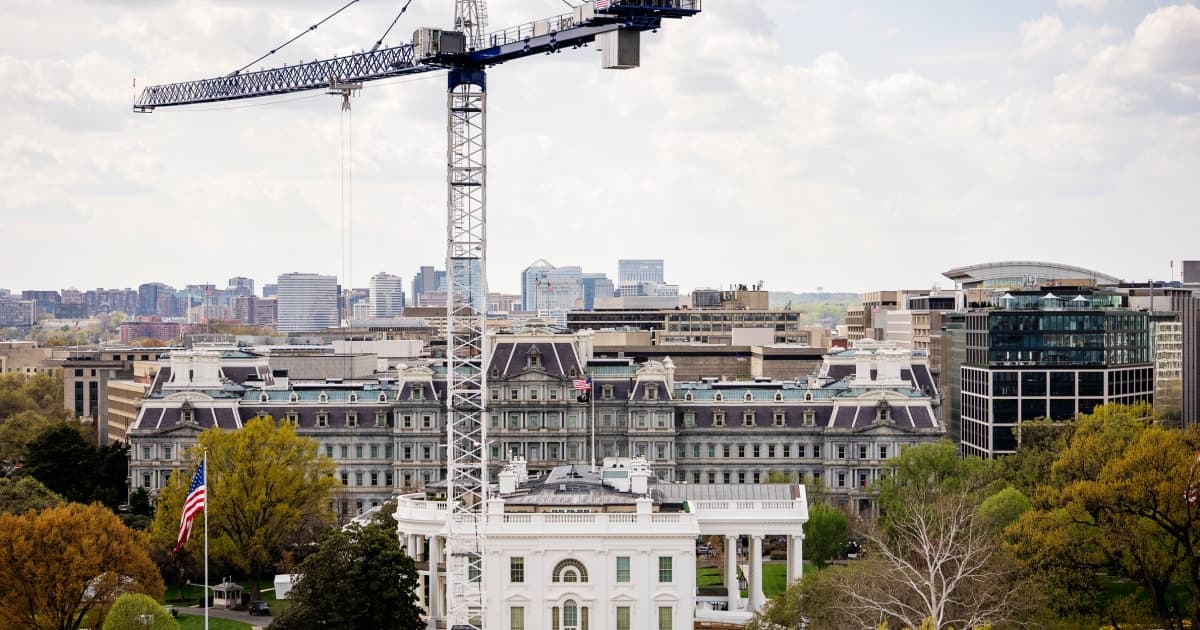
Trump's $400M White House Ballroom Proceeds Despite Congressional Authority Challenge
Left says
- •The president lacks constitutional authority to undertake a $400 million construction project without explicit congressional approval, as federal property and spending decisions require legislative oversight
- •Historic preservation groups have legitimate concerns about demolishing the 1902 East Wing without proper review and public input on such a massive alteration to a national landmark
- •National security claims appear to be a convenient justification for bypassing normal democratic processes and congressional authority over federal buildings and expenditures
Right says
- •Presidential security decisions fall squarely within executive authority and cannot be subject to congressional micromanagement that could compromise national security
- •The project includes critical underground security infrastructure including bomb shelters and medical facilities that protect the president and staff from modern threats like drones and ballistic missiles
- •Private funding eliminates taxpayer burden while addressing urgent security needs, and historical precedent shows presidents have traditionally controlled White House modifications without congressional interference
Common Take
High Consensus- A federal appeals court ruled 2-1 that construction can continue temporarily until April 17 while the case proceeds
- The project involves demolishing the East Wing to build a 90,000 square-foot ballroom estimated to cost $300-400 million
- The construction includes significant underground security infrastructure with military installations and protective features
- The case will likely require Supreme Court review to resolve the constitutional questions about presidential authority versus congressional oversight
The Arguments
Left argues
The Constitution grants Congress explicit authority over federal property and spending, and no president can unilaterally authorize a $400 million construction project on federal grounds without legislative approval, regardless of claimed security benefits.
Right counters
Presidential security decisions have always fallen within executive authority, and subjecting critical security infrastructure to congressional debate and approval processes would create dangerous vulnerabilities and compromise national security.
Right argues
The project includes essential underground security infrastructure like bomb shelters, medical facilities, and military installations designed to protect against modern threats including drones and ballistic missiles that didn't exist when current White House security was designed.
Left counters
National security claims cannot be used as a blanket justification to bypass constitutional requirements for congressional oversight, especially when the project involves demolishing historic structures and spending hundreds of millions of dollars.
Left argues
The demolition of the 1902 East Wing without proper historic preservation review represents an irreversible loss of national heritage that should require public input and congressional authorization given its significance as a national landmark.
Right counters
Presidents have historically controlled White House modifications without congressional interference, and the urgent security needs of protecting the president and staff from contemporary threats outweigh preservation concerns about outdated structures.
Right argues
Private funding eliminates any taxpayer burden while addressing critical security vulnerabilities, making congressional spending approval unnecessary since no federal appropriations are involved in the construction costs.
Left counters
Private funding doesn't eliminate the constitutional requirement for congressional authority over federal property modifications, and the source of funding is irrelevant to the separation of powers issues involved in major alterations to government buildings.
Left argues
The administration's rush to complete construction and claims that any delay poses security risks appears designed to create artificial urgency that prevents proper legal and constitutional review of presidential authority.
Right counters
The construction site is currently exposed and vulnerable after demolition has already begun, creating genuine security risks that require immediate completion rather than prolonged legal delays that leave the White House compromised.
Challenge Questions
These questions target genuine internal contradictions — meant to provoke honest reflection.
Right asks Left
“If congressional oversight of presidential security decisions is so important, how do you reconcile this position with the practical reality that public congressional debates about specific security vulnerabilities and countermeasures would necessarily expose sensitive information to potential threats?”
Left asks Right
“If presidential authority over White House security is truly absolute and historically established, why did the Trump administration seek approval from the Commission of Fine Arts for the ballroom construction, and what distinguishes this project from routine security upgrades that don't require external review?”
Outlier Report
Left Fringe
Progressive activists like those from Democracy Forward and some House progressives like Alexandria Ocasio-Cortez who might frame this as authoritarian overreach or corruption, representing about 15% of the left coalition.
Right Fringe
Hardline Trump supporters and some conservative commentators like Steve Bannon who might argue the president has unlimited executive authority over White House operations, representing about 20% of the right coalition.
Noise Assessment
Moderate noise level - while partisan media amplifies constitutional and security arguments, the core issue of congressional authority versus executive security decisions reflects genuine public concern rather than manufactured controversy.
Sources (7)
A federal appeals court on Saturday temporarily extended a lower court judge's order allowing the construction of Trump's White House ballroom to move forward.
The order comes as the Trump administration challenges a lower court ruling that the estimated $300-million project requires congressional approval.
A three-judge appeals panel ruled Trump's $400 million White House ballroom construction can proceed until Friday as security concerns are reviewed.
A U.S. Court of Appeals on Saturday said that construction of the White House ballroom can carry on temporarily after a judge halted construction late last month. A three-judge panel from the U.S. Court of Appeals for the D.C. Circuit ruled 2-1 that the preliminary injunction be put on pause until April 17, allowing for…
President Donald Trump has claimed that halting the project poses a risk to national security and threatens him.
A federal court of appeals is allowing construction to proceed for President Trump's $400 million White House ballroom, temporarily extending a lower court order.