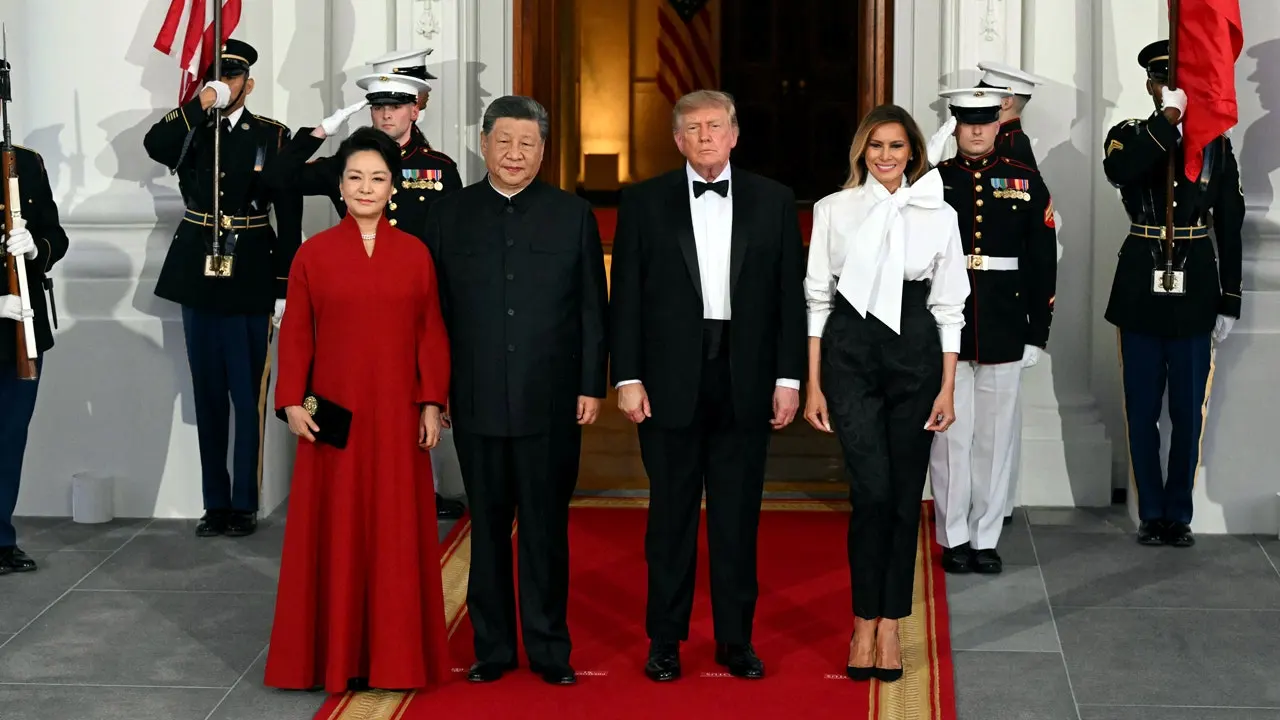
 Trump and Melania host Xi Jinping and wife on red carpet at White House.
Trump's Lavish Red Carpet for Xi, Despite Election Interference Claims
Left says
- •The extravagant welcome, including a personal airport greeting and military flyovers, sends a conciliatory signal to a government the administration itself accused of hacking or stealing data on 220 million American voters just months earlier.
- •Rolling out this level of pageantry for Xi, while human rights protesters chanting for Hong Kong and Uyghur political prisoners were drowned out or ignored, suggests economic and diplomatic priorities are being placed above accountability for authoritarian abuses.
- •The trade truce extension was notably short (just a few months), showing the summit's substance did not match its lavish optics, raising questions about what the spectacle actually achieved.
- •Inviting major American tech CEOs to dine alongside a leader accused of election interference and intellectual property theft raises concerns about whose interests are being centered in these negotiations.
Right says
- •Trump's willingness to combine grand hospitality with visible shows of American military strength, like the B-1 bomber flyovers, demonstrates a negotiating posture of strength rather than weakness or appeasement.
- •Delaying a $14 billion Taiwan arms package was described by Trump himself as a deliberate negotiating tactic, not a concession, showing calculated leverage rather than capitulation.
- •The visit's protocol-breaking gestures reflect a strategic choice to respect a rival power while still extracting commitments on trade, rare earths, and technology that serve American economic interests.
- •Confronting China on election interference in a prime-time address before hosting Xi shows the administration is capable of holding Beijing accountable while still pursuing pragmatic dealmaking.
Common Take
High Consensus- Trump personally greeted Xi at Joint Base Andrews with a red carpet, honor cordon, and military flyovers, an unusual departure from typical presidential protocol.
- The summit addressed unresolved disputes over trade tariffs, rare-earth mineral exports, advanced technology access, and Taiwan.
- A trade truce between the two countries was extended, though only for a few months rather than the longer period China had sought.
- Protesters representing Hong Kong, Uyghur, Tibetan, and Falun Gong groups gathered publicly to call attention to Chinese human rights abuses during the visit.
The Arguments
Left argues
The extravagant welcome, including a personal airport greeting and military flyovers, sends a conciliatory signal to a government the administration itself accused of hacking or stealing data on 220 million American voters just months earlier.
Right counters
The military flyovers were themselves a show of strength, not appeasement, and pairing hospitality with displays of American airpower signals that diplomacy is happening from a position of leverage, not weakness.
Right argues
Delaying the $14 billion Taiwan arms package was explicitly framed by Trump as a negotiating chip, indicating calculated leverage rather than a concession to Chinese pressure.
Left counters
Calling a delay a 'negotiating chip' doesn't change its practical effect: Taiwan's defense capabilities are being held back to satisfy Beijing's stated red line, which is a substantive win for Xi regardless of the framing.
Left argues
Protesters chanting for Hong Kong democracy and Uyghur political prisoners were drowned out by the state dinner's pageantry, suggesting human rights accountability was subordinated to diplomatic optics and economic interests.
Right counters
Hosting a state dinner doesn't preclude holding China accountable elsewhere; the administration's prior prime-time address exposing election interference shows confrontation and diplomacy can coexist without one negating the other.
Right argues
Confronting China publicly over election interference in July, then negotiating from a position of strength in October, demonstrates that pragmatic dealmaking and accountability aren't mutually exclusive.
Left counters
If the interference allegations were serious enough for a prime-time address, then rolling out an unprecedented red-carpet welcome just months later undercuts the credibility of that accountability message and signals it carries no real consequences.
Left argues
The trade truce was extended by only a few months rather than the year Beijing sought, showing that despite the lavish spectacle, the summit produced modest, unstable results that don't match the scale of the pageantry.
Right counters
A short extension actually reflects US leverage, forcing China back to the table sooner and keeping pressure on Beijing to make further concessions rather than granting long-term certainty it hasn't earned.
Challenge Questions
These questions target genuine internal contradictions — meant to provoke honest reflection.
Right asks Left
“If the concern is that diplomatic hospitality legitimizes authoritarian abuses, does that standard imply the US should refuse high-level engagement with any rival power accused of human rights violations, and if not, what distinguishes this case?”
Left asks Right
“If delaying the Taiwan arms package is purely a calculated negotiating tactic rather than a concession, what specific evidence beyond Trump's own characterization would distinguish genuine leverage from simply yielding to Xi's stated red line?”
Outlier Report
Left Fringe
Progressive human rights advocates and China hawks like Rep. Ilhan Omar or human rights organizations (e.g., Human Rights Watch-aligned voices) who view any red-carpet treatment of Xi as morally unacceptable given Uyghur and Hong Kong abuses; roughly 15-20% of the left holds this uncompromising position, while most Democrats focus more on trade/economic critique than moral outrage alone.
Right Fringe
China hawks like Sen. Marco Rubio or Rep. Mike Gallagher-aligned voices (and some MAGA isolationists) who are uncomfortable with any warmth shown to Xi regardless of strategic framing, viewing it as insufficiently tough; this represents roughly 15-20% of the right who would prefer a more openly confrontational posture rather than the pageantry Trump displayed.
Noise Assessment
Moderate-to-high; much of the intense reaction (protester chants, symbolic outrage over bombers/red carpet) is performative theater from activist and media classes, while the broader public engages more with the practical trade and economic outcomes than the pageantry itself.
Sources (7)
China wanted progress on trade, technology and Taiwan - but hasn't got as much as it would have hoped for.
President Donald Trump welcomed Chinese President Xi Jinping to Washington, D.C., on Wednesday, just two months after accusing Beijing of interfering in U.S. elections during a prime-time address. Xi was personally greeted by Trump at Joint Base Andrews with the help of two B-1 bombers that soared overhead after the Chinese president stepped off the ...
President Donald Trump rolled out the red carpet for Chinese President Xi Jinping on Wednesday, before sending two B-1 bombers roaring overhead as the Chinese leader arrived in Washington for a three-day state visit. Xi and his wife, Peng Liyuan, landed at Joint Base Andrews shortly before 6 p.m. Trump and first lady Melania Trump ...
Trump and Xi Jinping cap their United States summit with a National Archives visit to view historic documents before the Chinese leader departs.
Protesters chanting "Free Hong Kong" and demanding freedom for political prisoners were heard over Trump's State Dinner welcoming Xi Jinping.
A sweeping GOP immigration bill would restrict family green cards, scrap the visa lottery and replace employment-based routes.
Trump greeted Xi on the tarmac, an unusual gesture that president's don't typically extend to foreign heads of state, underscoring his desire to court the Chinese leader.