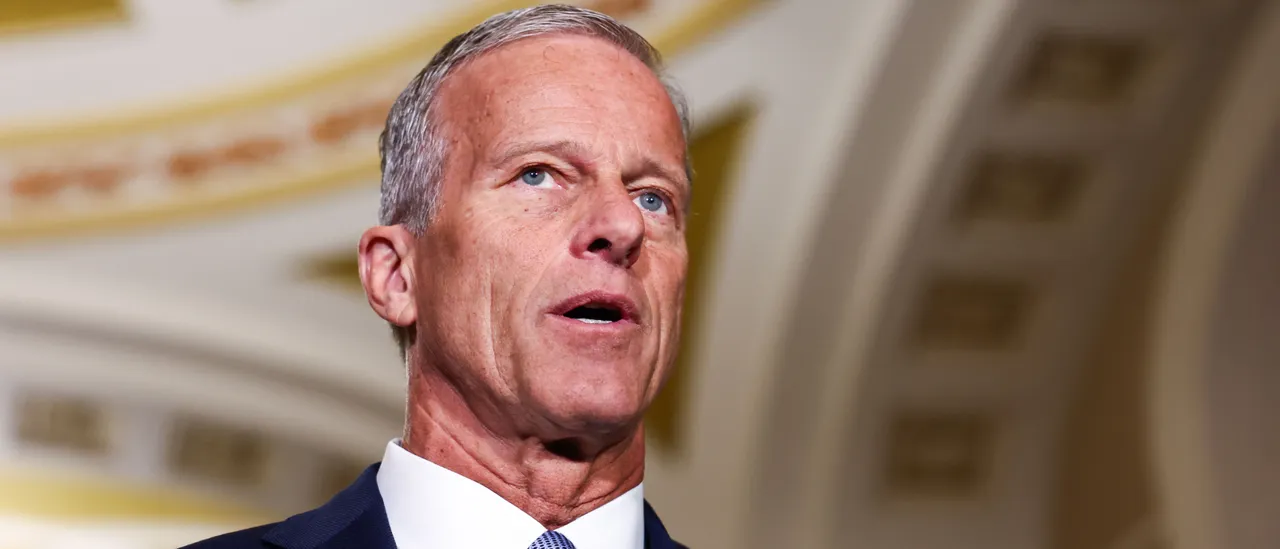
Trump's Patience Runs Out on Thune Over Stalled Voter ID Bill
Intra-Party Split Detected
White House and Trump allies publicly blame Senate Majority Leader Thune and Senate GOP leadership for failing to pass the SAVE America Act, while Thune and Senate Republicans push back, citing the 60-vote filibuster and lack of Democratic support, exposing tension between the administration and Senate GOP leadership.
Left says
- •The SAVE America Act's photo ID and documentary proof-of-citizenship requirements risk disenfranchising eligible voters who lack easy access to birth certificates or passports, including married women who changed their names, low-income Americans, and rural voters.
- •Senate Democrats' unified opposition reflects genuine concern that the bill is a voter suppression effort dressed up as election security, not merely partisan obstruction.
- •The public blame game between the White House and Thune highlights Republican dysfunction, suggesting the party is more interested in political theater and midterm messaging than actually governing.
- •Framing this as a Senate 'failure' ignores that the 60-vote filibuster is a longstanding institutional safeguard, not a Thune-created obstacle.
Right says
- •The SAVE America Act enjoys broad public support, and Senate Republicans should be doing everything possible to deliver on a popular, common-sense election integrity measure voters demanded when they gave the GOP control of Washington.
- •Thune's insistence that he lacks the votes rings hollow to frustrated conservatives who see Speaker Johnson successfully passing legislation through a similarly slim House majority.
- •Trump and the White House argue that Senate leadership should be actively whipping votes and pressuring gettable Republicans and Democrats rather than hiding behind procedural excuses.
- •Democrats are the ones actually blocking the bill on the floor, and critics say the White House's frustration should be directed there as much as at Thune.
Common Take
High Consensus- Both sides agree the SAVE America Act has stalled in the Senate and has not passed despite House approval.
- Both sides acknowledge Senate Republicans hold only 53 seats, short of the 60 needed to overcome a filibuster.
- Both sides recognize the public sparring between Leavitt and Thune reflects real tension within the Republican Party over legislative strategy.
- Both sides agree Democrats in the Senate are unified in opposing the bill as written.
The Arguments
Right argues
The SAVE America Act has broad public support and Republicans control the White House, House, and Senate, so voters expect the party to deliver on a popular, common-sense election integrity measure rather than offer procedural excuses.
Left counters
Popularity in polling doesn't erase the bill's real-world effects; documentary proof-of-citizenship requirements can disenfranchise married women, low-income voters, and rural Americans who lack easy access to birth certificates or passports, regardless of how the question is framed in a poll.
Right argues
Thune's claim that he simply lacks the votes rings hollow when Speaker Johnson has repeatedly passed legislation through an equally slim House majority, suggesting the difference is leadership effort and strategy, not just math.
Left counters
The comparison is misleading because the House operates on simple majority rules while the Senate filibuster requires 60 votes, a structural difference that no amount of whipping or leadership skill can simply will away.
Left argues
Blaming the Senate for 'failure' ignores that the 60-vote filibuster is a longstanding institutional safeguard against one-party rule, not an obstacle Thune invented or can unilaterally remove without broader GOP consensus to change Senate rules.
Right counters
If the filibuster is truly the obstacle, then Senate leadership should be honest that the real fight is over changing that rule rather than quietly acquiescing to inaction while publicly claiming to support the bill's goals.
Left argues
Senate Democrats' unified opposition reflects genuine, substantive concerns that the bill functions as voter suppression dressed up as election security, not mere partisan obstruction, given the documented barriers documentary proof-of-citizenship rules create.
Right counters
If Democrats' objections were purely about specific implementation problems, they could negotiate fixes or amendments; total, unified opposition to any version of a widely-supported integrity measure looks more like reflexive obstruction than principled policy disagreement.
Right argues
Thune is right that Democrats are the ones actually blocking the bill on the floor, so White House frustration constructively directed at whipping gettable Republicans and Democrats — rather than solely blaming Senate GOP leadership — would better serve the shared goal of passage.
Left counters
The public finger-pointing between the White House and Thune shows Republican dysfunction and misplaced priorities: a governing party with unified control should be coordinating a strategy privately, not staging a public blame game that signals disarray to voters ahead of the midterms.
Challenge Questions
These questions target genuine internal contradictions — meant to provoke honest reflection.
Right asks Left
“If proof-of-citizenship and photo ID requirements are genuinely so burdensome, why do many other democracies and even some blue states already require forms of ID for voting without being characterized as inherently suppressive, and what specific alternative safeguards would Democrats accept instead?”
Left asks Right
“If Republicans truly believe the SAVE America Act reflects overwhelming public will and is simple common sense, why hasn't the party pursued a unified, public strategy to formally reform or eliminate the filibuster rather than alternating between blaming Thune and insisting the votes just need better whipping?”
Outlier Report
Left Fringe
Progressive groups like the Brennan Center for Justice and figures like Rep. Alexandria Ocasio-Cortez frame all voter ID measures as inherently racist voter suppression; this represents maybe 20-25% of the left, as many rank-and-file Democrats personally support ID requirements despite party opposition.
Right Fringe
Commentators like Larry Kudlow and some Townhall/Daily Wire writers frame this as pure Thune incompetence and betrayal, pushing for filibuster elimination entirely; this maximalist blame-Thune position represents maybe 30% of the right, with many establishment Republicans more sympathetic to the 60-vote math reality.
Noise Assessment
High noise ratio - the Leavitt-Thune public spat is largely inside-baseball political theater amplified by partisan media, while the underlying policy debate (voter ID vs. proof of citizenship) reflects genuine but more nuanced public opinion than either synopsis captures.
Sources (8)
Karoline Leavitt Says Trump’s Patience ‘Running Out’ On SAVE America Act, Thune Fires Back
Senate Majority Leader John Thune (R-SD) lashed out at White House Press Secretary Karoline Leavitt on Thursday after she said the president’s “patience is running out” over the failure to pass the SAVE America Act. The back-and-forth began with a question from The Daily Caller’s Reagan Reese during the White House briefing. “Look, the president ...
Karoline Leavitt says Trump's patience is wearing thin with John Thune over the SAVE America Act as Senate Republicans face a 50-vote math problem.
Thune, for his part, retorted that Leavitt should "get on the phone and get the votes, right?"
Senate Majority Leader John Thune, R-S.D., pushed back Thursday after the White House voiced frustration over the upper chamber's inability to pass the SAVE America Act, a signature election reform measure of President Donald Trump's second term.
Senate Majority Leader John Thune (R-S.D.) bristled when asked Thursday about White House press secretary Karoline Leavitt’s statement that President Trump’s “patience is running out” with the Senate GOP leader because of the stalled SAVE America Act. “Maybe she or somebody else ought to get on the phone and get the votes. Right? It’s 50…
President Trump expressed growing frustration with Senate Republicans and Majority Leader John Thune over their failure to pass the Safeguard American Voter Eligibility (SAVE) America Act before the August recess.