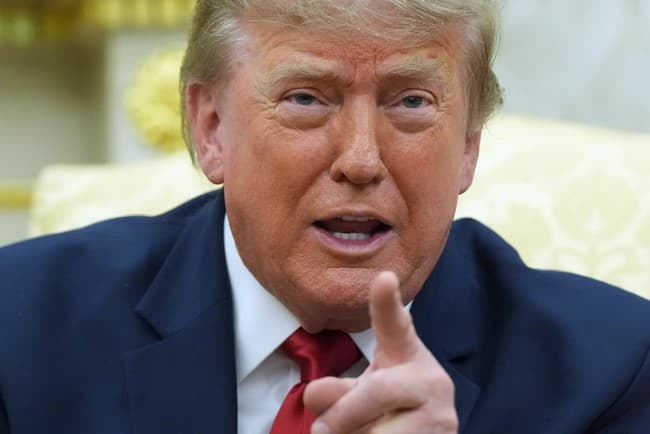
 President Trump speaking emphatically, pointing while making a forceful statement.
Trump's Profanity-Laced Vow to 'Beat the S--t Out of' Iran
Left says
- •The blunt, expletive-filled rhetoric from a sitting president raises questions about diplomatic tone and messaging during an active military crisis, especially after the White House had touted ongoing negotiations with Iran just days earlier.
- •Escalatory language risks undermining the fragile diplomatic track that Trump himself acknowledged was underway, potentially narrowing the path to a peaceful resolution.
- •The rapid shift from talks to threats of military 'beatings' highlights concerns about the administration's consistency and the risk of miscalculation drawing the U.S. deeper into a wider Middle East conflict.
- •Reports of Iranian AI-generated threats against Melania and Barron Trump complicate the narrative, underscoring how personal and volatile the situation has become on both sides.
Right says
- •Trump's blunt language reflects justified anger at an unprovoked Iranian sneak attack on U.S. troops, and plain-spoken resolve is seen as a feature, not a flaw, of his leadership style.
- •Iran's ballistic missile strike on U.S. forces in Jordan, despite ongoing diplomatic overtures, is viewed as proof that Tehran cannot be trusted and that only strength deters further aggression.
- •The successful interception of all Iranian missiles and the coordinated U.S.-Saudi response against Iran-backed militias are framed as evidence of American military competence and growing regional cooperation against Iran.
- •Trump's willingness to call out Iran-backed militias as a 'cancer on the world' resonates with a desire for decisive, unambiguous responses to attacks on American personnel.
Common Take
High Consensus- Iran's Islamic Revolutionary Guard Corps launched ballistic missiles at U.S. forces in Jordan on Tuesday, and all missiles were intercepted with no reported casualties.
- Trump told Fox News's Trey Yingst that the U.S. would 'beat the f---ing s--- out of' Iran and that Iran was 'going to get a beating.'
- U.S. and Saudi Arabian forces conducted coordinated airstrikes against Iran-backed militia sites in eastern Iraq in response to the attacks.
- Diplomatic talks between the U.S. and Iran had been ongoing prior to the attack, and Trump indicated talks could continue despite the strike.
The Arguments
Left argues
A sitting president using profanity to describe military plans, days after touting 'very deep talks' with Iran, sends a jarring and potentially destabilizing signal that undermines confidence in a coherent, consistent diplomatic strategy.
Right counters
The blunt language followed an actual Iranian ballistic missile attack on U.S. forces, not idle diplomacy—matching plain-spoken resolve to a real attack is consistency, not contradiction, and Trump explicitly said talks would continue.
Right argues
Iran launched a sneak missile attack on U.S. troops even while diplomatic talks were ongoing, proving that only demonstrated strength and unambiguous resolve, not soft rhetoric, deters Tehran's aggression.
Left counters
Escalatory presidential rhetoric in the immediate aftermath of an attack risks foreclosing off-ramps and could push a volatile situation toward wider war, especially when the administration itself says it wants a negotiated outcome.
Right argues
The successful interception of every Iranian missile and the new coordinated U.S.-Saudi response demonstrate real military competence and an emerging regional coalition against Iran, validating Trump's tough posture.
Left counters
Battlefield success doesn't erase the risks of profane, personalized threats from a head of state; effective defense and inflammatory rhetoric are separate issues, and the latter can still complicate alliance management and diplomatic follow-through.
Left argues
The reported Iranian AI-generated threats against Melania and Barron Trump show how personal and volatile this conflict has become, and presidential profanity in this climate risks further inflaming an already dangerous cycle of threats and counter-threats.
Right counters
Iran's grotesque threats against the First Family are exactly the kind of unprovoked provocation that justifies forceful, unambiguous language in response—treating aggressors gently invites more aggression, not less.
Left argues
The rapid whiplash from 'very deep talks' to vows of a 'beating' raises legitimate questions about whether the administration has a coherent strategy or is reacting impulsively to events, increasing the risk of miscalculation.
Right counters
Strategies can and should adapt to new facts on the ground; treating an attempted surprise attack the same as ongoing negotiations would be the real strategic failure, not adapting rhetoric to match the moment.
Challenge Questions
These questions target genuine internal contradictions — meant to provoke honest reflection.
Right asks Left
“If Iran had continued negotiating in good faith rather than launching a surprise missile attack, would you still object to Trump's tone—or is the real objection about the profanity itself rather than whether the response fits the provocation?”
Left asks Right
“If plain-spoken, forceful rhetoric is inherently a deterrence asset, why did the 'very deep talks' framing exist at all just days earlier, and how do you distinguish productive toughness from rhetoric that could scuttle the diplomatic track the administration says it still wants?”
Outlier Report
Left Fringe
Anti-war progressives like Rep. Ilhan Omar or commentators at outlets like The Intercept who view the rhetoric as reckless warmongering and oppose any military escalation; likely represents about 15-20% of the left.
Right Fringe
Hawkish commentators like Mark Levin or some in the neoconservative wing who feel Trump's rhetoric doesn't go far enough and want regime change in Iran outright; represents roughly 10-15% of the right, while a small isolationist-leaning faction (e.g., some Tucker Carlson-aligned voices) worries this rhetoric risks unwanted war, representing another 10%.
Noise Assessment
High noise ratio — cable news and social media amplify the profanity itself as spectacle, while the underlying substance (attack on U.S. troops, military response) gets less sustained public attention than the colorful quote does.
Sources (6)
<p>President Donald Trump on Wednesday warned that the U.S. is going to "beat the f*cking sh*t" out of Iran following its attack on U.S. forces in Jordan.</p> <p>The post <a href="https://www.breitbart.com/middle-east/2026/07/29/president-trump-following-iran-attack-on-u-s-forces-were-going-to-beat-the-fking-sht-out-of-them/" rel="nofollow">President Trump Following Iran Attack on U.S. Forces: We’re Going to ‘Beat the F**king Sh*t Out of Them’</a> appeared first on <a href="https://www.breitbart.com" rel="nofollow">Breitbart</a>.</p>
President Donald Trump delivered a scorched-earth warning to Tehran on Wednesday, declaring the United States will “beat the f*cking sh*t out of” Iran following a brazen overnight sneak attack targeting American troops stationed in Jordan. Speaking to Fox News, a furious Trump did not mince words about how the United States intends to handle the ...
President Donald Trump told Fox News "we're going to beat the f---ing s--- out of them" after Iran's fired ballistic missiles at U.S. forces in Jordan in a surprise attack.
President Trump on Wednesday issued a forceful response to Iran’s surprise attack overnight targeting U.S. forces in Jordan, vowing to “beat the f—ing s— out of them.” Trump made the comment in an interview with Fox News, adding that the U.S. will be hitting Iran “hard.” “They’re going to get a beating,” the president added,…