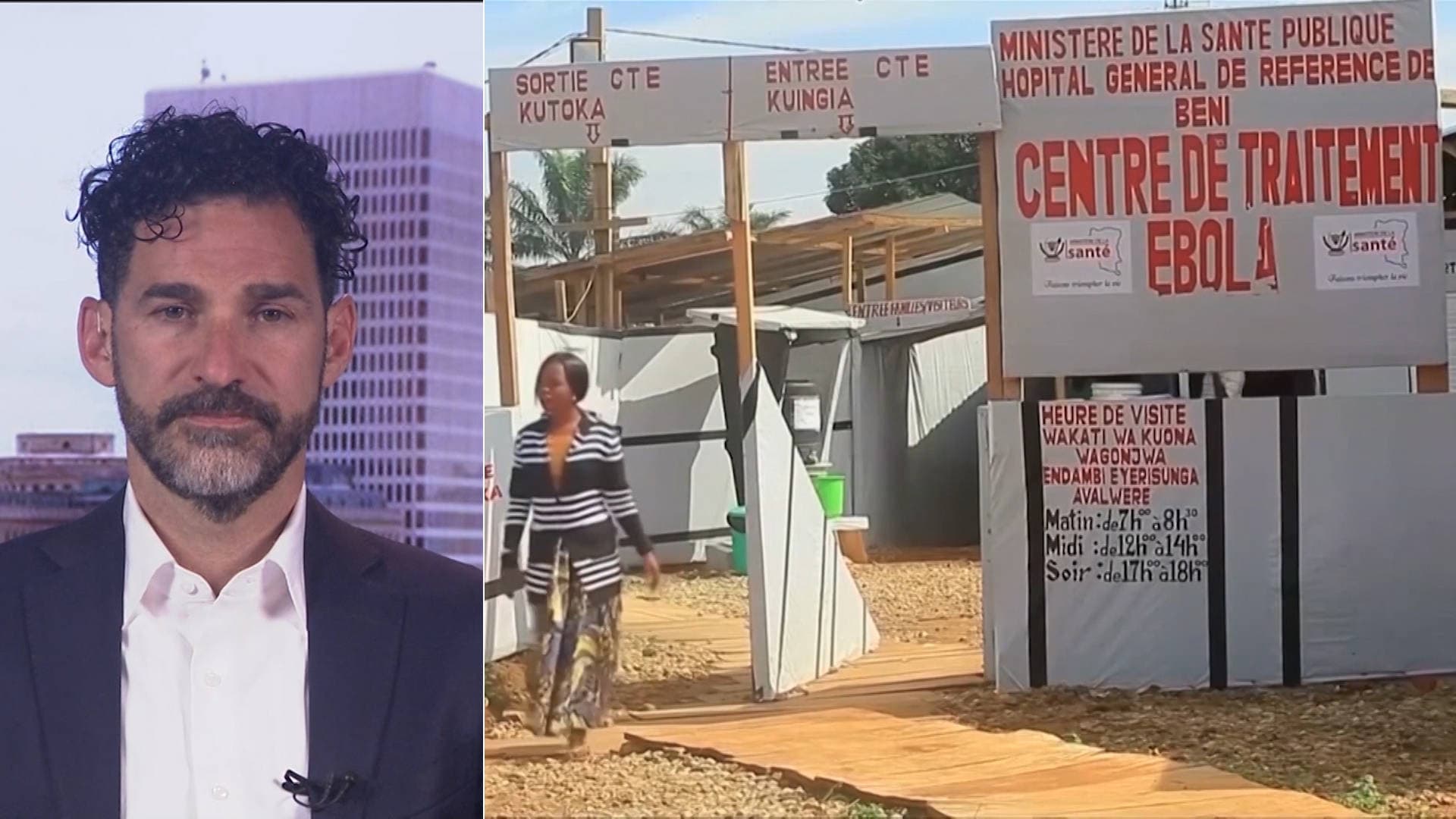
 Ebola treatment center in Democratic Republic of Congo with medical facilities
Trump's WHO withdrawal hampers Ebola response, experts warn
Left says
- •The dismantlement of USAID and withdrawal from WHO delivered a devastating blow to global health infrastructure precisely when coordinated international response is most critical
- •Budget cuts to CDC and international aid programs left surveillance systems weakened, allowing the virus to spread undetected for months before identification
- •Effective Ebola response requires building trust with local communities and meticulous public health work, not just shipping equipment and imposing travel bans
- •The administration's isolationist approach forces the U.S. to operate outside established international frameworks, reducing the effectiveness of any response efforts
Right says
- •The administration has built robust screening and monitoring systems since 2014 and is funding 50 frontline treatment clinics while surging protective equipment to affected areas
- •The U.S. response began within 24 hours of learning about the outbreak, with 130 CDC staff deployed to Uganda and Congo to aid response efforts
- •WHO was slow to identify and inform the world about the outbreak, demonstrating the limitations of relying on international organizations for crisis response
- •Travel restrictions on non-citizens from affected countries represent prudent public health measures to protect American citizens from a deadly virus with no approved vaccine
Common Take
High Consensus- The Ebola outbreak has resulted in over 1,000 suspected cases and more than 230 deaths across the Democratic Republic of Congo and Uganda
- There is no approved vaccine for the Bundibugyo strain of Ebola responsible for the current outbreak, making containment more challenging
- The virus likely spread undetected for months before identification, suggesting the actual scale may be larger than currently reported
- Effective response requires both international coordination and on-ground public health measures including contact tracing and community engagement
The Arguments
Right argues
The U.S. response began within 24 hours of learning about the outbreak, deploying 130 CDC staff to Uganda and Congo while funding 50 frontline treatment clinics and surging protective equipment to affected areas. This demonstrates that America can mount an effective response without being constrained by slow-moving international bureaucracies.
Left counters
The fact that U.S. officials didn't learn of the epidemic until nine days after WHO shows how withdrawal from international frameworks creates dangerous information gaps. Effective outbreak response requires early detection and coordinated action, not just rapid deployment after the crisis has already spread.
Left argues
The dismantlement of USAID and withdrawal from WHO delivered a devastating blow to global health infrastructure precisely when coordinated international response is most critical. These cuts left surveillance systems weakened, allowing the virus to spread undetected for months before identification.
Right counters
WHO itself was slow to identify and inform the world about the outbreak, demonstrating the limitations of relying on international organizations for crisis response. The U.S. has built robust screening and monitoring systems since 2014 that don't depend on these unreliable international frameworks.
Left argues
Effective Ebola response requires building trust with local communities and meticulous public health work, not just shipping equipment and imposing travel bans. The administration's isolationist approach forces the U.S. to operate outside established international frameworks, reducing the effectiveness of any response efforts.
Right counters
Travel restrictions on non-citizens from affected countries represent prudent public health measures to protect American citizens from a deadly virus with no approved vaccine. The U.S. can provide meaningful aid through direct partnerships without being constrained by international bureaucracy.
Right argues
The administration has demonstrated it can respond effectively through direct action and bilateral partnerships, funding treatment clinics and deploying personnel without the delays and bureaucratic constraints of multilateral organizations. This approach allows for more targeted and efficient resource allocation.
Left counters
Operating outside established international frameworks means the U.S. lacks access to critical intelligence networks and coordination mechanisms that are essential for containing outbreaks before they become global emergencies. The delayed awareness of this outbreak proves this point.
Challenge Questions
These questions target genuine internal contradictions — meant to provoke honest reflection.
Right asks Left
“If international frameworks like WHO and USAID were so critical for outbreak response, why did WHO itself fail to detect and report this outbreak promptly, and how do you reconcile criticism of U.S. withdrawal with WHO's own acknowledged delays in identifying the crisis?”
Left asks Right
“If the U.S. can mount an effective response through direct action and bilateral partnerships, why did American officials learn about this outbreak nine days after WHO, and how does this information gap align with claims of maintaining robust surveillance systems independent of international organizations?”
Outlier Report
Left Fringe
Progressive activists like those quoted in Democracy Now segments who frame this as entirely a consequence of Trump policies, representing roughly 15-20% of the left who see this primarily through an anti-Trump lens rather than acknowledging any legitimate protective measures.
Right Fringe
America First isolationists who would completely eliminate all international health aid and cooperation, representing about 10-15% of the right who oppose any foreign engagement even during global health emergencies.
Noise Assessment
Moderate noise level - while partisan outlets are amplifying their preferred narratives, the core debate reflects genuine public disagreement about balancing domestic protection versus international cooperation during health crises.
Sources (6)
<p>The U.S. response to the <a href="https://www.axios.com/2026/05/19/ebola-hantavirus-who-cdc-preparedness-concerns" target="_blank">Ebola outbreak</a> is drawing new warnings from public health experts about the impact of the Trump administration's global health policies, including the dismantlement of USAID and its<strong> </strong>withdrawal from the World Health Organization.</p><p><strong>Why it matters:</strong> While officials <a href="https://www.state.gov/releases/office-of-the-spokesperson/2026/05/united-states-to-fund-establishment-of-up-to-50-ebola-response-clinics/" target="_blank">are rushing</a> to get resources to stricken parts of Africa, infectious disease experts fear the administration's other actions are weakening critical networks needed for a rapid response in a densely populated, politically unstable part of the world. </p><hr /><ul><li>They're also worried that the impact of those changes — along with cuts to the Centers for Disease Control and Prevention — might not end with the Ebola outbreak.</li><li>They point to a <a href="https://www.science.org/content/article/trump-administration-cuts-cdc-s-key-role-global-program-stop-hiv" target="_blank">planned overhaul</a> of the President's Emergency Plan for AIDS Relief that would reduce the CDC's role in the global HIV program.</li></ul><p><strong>Driving the news:</strong> The Ebola outbreak — which has resulted in almost 600 suspected cases and 139 deaths — is already increasing tensions between the U.S. and WHO. </p><ul><li>WHO director general Tedros Adhanom Ghebreyesus defended the Ebola response on Wednesday after Secretary of State Marco Rubio told reporters on Tuesday that the global health organization was "a little late" identifying the virus.</li><li>Tedros said the comments may have been due to a "lack of understanding" about how the WHO works, noting that the organization provides technical support to government health agencies that are responsible for disease tracking.</li><li>WHO officials <a href="https://www.politico.eu/article/who-marco-rubio-ebola-comments-congo-outbreak-travel-bans/" target="_blank">also said</a> countries should focus on public health measures like contact tracing instead of travel bans like the U.S. imposed this week on non-citizens who have been in the Democratic Republic of Congo, Uganda or South Sudan in the previous 21 days.</li></ul><p><strong>Between the lines:</strong> Infectious disease experts say an effective response goes beyond shipping protective equipment and building isolation facilities. </p><ul><li>They say it's also important to build trust with stricken communities and convince residents to do things like changing burial practices to avoid superspreader events.</li><li>"You need meticulous bread-and-butter public health," former CDC director Tom Frieden, who led the agency during the 2014–2016 Ebola outbreak in Africa, said Wednesday during a MedPage Today webinar. "Every hour of delay allows the virus to get ahead of us."</li><li>While Frieden said it was "simplistic" to tie Trump administration actions to late detection of the virus, he said the dismantlement of USAID, the withdrawal from the WHO and deep cuts to CDC staff delivered a "1-2-3 punch to global health architecture."</li></ul><p><strong>Some critics suggested</strong> the administration is doing 11th-hour face-saving after hollowing out agencies that deliver international aid and cutting budgets.</p><ul><li>The International Rescue Committee, a humanitarian aid organization, said the U.S. funded a wide range of range of preparedness measures in the Democratic Republic of Congo before 2025, including treatment for communicable and non-communicable diseases. "Funding cuts have left the region dangerously exposed," Heather Reoch Kerr, the group's country director for the DRC, said in a statement.</li><li>"The sharp rise in reported cases over the last few days reflects the reality that surveillance systems are now catching up with transmission that has likely been occurring for some time."</li></ul><p><strong>The other side: </strong>The Trump administration says it has built a robust system of screening and monitoring for the virus since the 2014 outbreak and has partnerships on the ground that are having a multiplier effect.</p><ul><li>It's funding up to 50 frontline treatment clinics and surging the delivery of protective equipment and diagnostics. The CDC also has about 130 staff in Uganda and Congo aiding in the response.</li><li>"The agency is working with international partners and ministries of health on this evolving situation and is supporting response efforts through its country offices in the DRC and Uganda," Department of Health and Human Services spokesperson Andrew Nixon said in a statement. </li></ul><p><strong>What we're watching:</strong> Whether the unfolding crisis strengthens international cooperation on infectious disease outbreaks.</p><ul><li>In the afflicted areas, we're also watching whether the fear of contracting Ebola keeps people from going to clinics and shuts down local health systems. Frieden noted that this happened during the 2014 outbreak and resulted in many malaria deaths. </li></ul>
The deadly Ebola outbreak spreading across the eastern Democratic Republic of the Congo has killed at least 177 people, with more than 750 suspected cases reported in the <span class="caps">DRC</span> and neighboring Uganda, according to the World Health Organization. Health officials believe the virus may have been spreading undetected for months before the outbreak was identified, raising concerns that the scale of transmission could be far greater than initially understood. The epidemic has spread hundreds of miles away to South Kivu province, now under the control of the Alliance Fleuve Congo, which includes the Rwanda-backed M23 rebels.</p> <p>Jimmy Munguriek, country director for the Democratic Republic of Congo at Resource Matters, tells <em>Democracy Now!</em> that poor road access, insufficient medical facilities and local stigma about the disease are making it hard to respond to the crisis. “Ebola outbreak is really, really a very urgent issue in the Mongbwalu region,” he says from Kinshasa.</p> <p>We also speak with Matthew Kavanagh, director of the Center for Global Health Policy and Politics at Georgetown University, who says U.S. international aid cuts and the Trump administration’s withdrawal from the World Health Organization have hampered the response to Ebola. “This is not just an outbreak of a virus. This really is a politically driven … epidemic.”
The World Health Organization declared a global health emergency on Saturday due to the rapid spread of Ebola virus in the Democratic Republic of Congo and Uganda. Ebola causes severe hemorrhagic fever and is often fatal. There’s no approved vaccine for the strain of Ebola responsible for the current outbreak, known as the Bundibugyo variant. The <span class="caps">WHO</span> said in a statement that the outbreak is potentially much larger “than what is currently being detected and reported.”</p> <p>Public health professor and emergency room physician Dr. Craig Spencer, who is an Ebola survivor, says this Ebola outbreak could be the fourth largest in history. “This is going to be a really difficult outbreak to manage and respond to,” says Spencer. The ability of healthcare workers to address the outbreak in eastern Congo, “given the violence and conflict, is anything but ideal.”</p> <p>Spencer adds that cuts to <span class="caps">USAID</span> and the U.S. withdrawal from the World Health Organization have increased the likelihood for viruses to spread nationally and internationally, citing outbreaks of measles in the U.S. and Ebola and hantavirus abroad. “This is not all just a coincidence,” says Spencer. “This is a consequence of us cutting back our support.”
Politicized public health agencies also make it harder to hold officials accountable
By responding to this outbreak independently, the U.S. is showing the limits of that approach.
The Trump administration has turned inward in response to the Ebola outbreak in Congo and Uganda, with increasingly isolationist policies that are alarming and disappointing infectious disease experts.   According to the World Health Organization (WHO), suspected Ebola cases have passed 1,000, with nearly 250 suspected deaths. The outbreak is growing rapidly, and countries around the world have mobilized with funds, personnel and…