Trump's WHO Withdrawal Hampers Global Ebola Response, Critics Say
Left says
- •The Trump administration's withdrawal from the WHO and cuts to USAID have severely undermined America's ability to coordinate international disease response efforts
- •U.S. health officials learned about the outbreak nine days after the WHO, demonstrating how isolation from global health networks delays critical response times
- •Previous administrations brought exposed Americans home for treatment at specialized facilities, while Trump's policy of sending them to third countries like Kenya creates additional risks and complications
- •The outbreak has reached over 1,000 cases with 230+ deaths partly because reduced U.S. global health leadership has weakened the international response infrastructure
Right says
- •The Trump administration learned valuable lessons from the 2014 Dallas Ebola cases and is implementing smarter containment strategies to protect American communities
- •Restricting entry from high-risk regions and concentrating screening at designated airports prevents the kind of domestic spread that occurred when Thomas Eric Duncan brought Ebola to Texas
- •Treating exposed Americans in overseas facilities rather than transporting them to U.S. soil reduces the risk of introducing the virus into American hospitals and communities
- •The WHO's own delay in informing the world until May 15 demonstrates that international organizations can be slow and bureaucratic during health emergencies
Common Take
High Consensus- The current Ebola outbreak in the Democratic Republic of Congo has reached over 1,000 suspected cases with more than 230 deaths
- This strain of Ebola (Bundibugyo virus) has no approved vaccine or specific treatment, making containment more challenging
- Ongoing conflict in eastern Congo is significantly hampering response efforts and accurate case tracking
- The outbreak has already spread across borders to Uganda and poses risks to neighboring countries
The Arguments
Left argues
The U.S. withdrawal from WHO and USAID cuts have created a dangerous information gap, with American health officials learning about the outbreak nine days after the WHO, demonstrating how isolation from global health networks delays critical response times when every day matters in containing deadly diseases.
Right counters
The WHO itself delayed informing the world until May 15, showing that international organizations can be slow and bureaucratic during health emergencies, while the U.S. began responding within 24 hours of being notified and has contributed $80 million in aid.
Right argues
Trump's policy of treating exposed Americans in overseas facilities like Kenya rather than bringing them to U.S. soil prevents the kind of domestic spread that occurred in 2014 when Thomas Eric Duncan brought Ebola to Dallas, infecting two nurses and requiring presidential intervention.
Left counters
Previous administrations successfully brought exposed Americans home for treatment at specialized facilities without causing outbreaks, while sending them to third countries like Kenya creates additional risks, complications, and has faced legal challenges from local populations.
Left argues
The outbreak has reached over 1,000 cases with 230+ deaths partly because reduced U.S. global health leadership has weakened the international response infrastructure, with experts noting this could become the fourth largest Ebola outbreak in history due to inadequate coordination.
Right counters
The rapid spread is primarily due to the ongoing conflict in eastern Congo and the lack of approved vaccines for this Bundibugyo strain of Ebola, not U.S. policy changes, as the DRC has faced 17 Ebola outbreaks since 1976 regardless of U.S. involvement levels.
Right argues
Restricting entry from high-risk regions and concentrating screening at designated airports implements lessons learned from the 2014 Dallas cases and provides smarter containment strategies to protect American communities from importing infectious diseases.
Left counters
These restrictions hamper the ability of American health experts to deploy to affected regions and coordinate international response efforts, while the CDC's urgent request for volunteers to screen at airports shows the administration is understaffed for even basic containment measures.
Challenge Questions
These questions target genuine internal contradictions — meant to provoke honest reflection.
Right asks Left
“If international cooperation and WHO membership are so critical for disease response, how do you explain the WHO's own nine-day delay in informing member nations about this outbreak, and why should the U.S. rely on an organization that has proven slow to act during health emergencies?”
Left asks Right
“If the primary goal is protecting American lives and preventing domestic outbreaks, how do you reconcile supporting overseas treatment facilities while simultaneously restricting the very international cooperation and expertise deployment that would help contain outbreaks at their source before they require such measures?”
Outlier Report
Left Fringe
Progressive activists like those at Democracy Now and some academic public health experts who frame this as entirely about Trump's isolationism represent about 15% of the left, pushing a more internationalist view than most Democrats hold.
Right Fringe
Anti-WHO conspiracy theorists and some Trump supporters who view any international health cooperation as globalist overreach represent about 20% of the right, going beyond mainstream conservative preferences for American-first policies.
Noise Assessment
Moderate noise level - while partisan outlets frame this dramatically, the core debate reflects genuine policy differences about international health engagement versus domestic protection that resonate with real public concerns.
Sources (10)
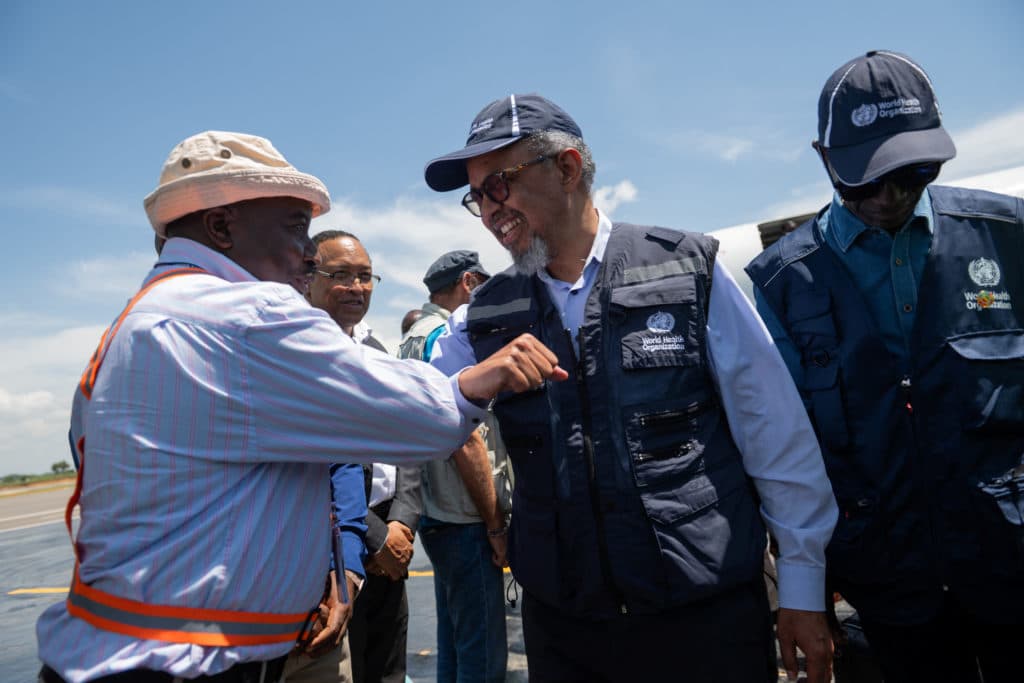
The head of the WHO on Saturday visited eastern Congo's Bunia, a city at the heart of an outbreak of a rare type of Ebola, where the virus is spreading faster than the response despite better-organized health facilities and new aid arrivals.
The medical charity's comments come as the head of the World Health Organization visits the region worst-hit by the virus outbreak.
<p>UN health chief Tedros Adhanom Ghebreyesus landed on Saturday in the eastern Democratic Republic of Congo province worst-hit by a severe Ebola outbreak, an AFP journalist saw.</p> <p>The post <a href="https://www.breitbart.com/europe/2026/05/30/w-h-o-chief-tedros-visits-ebola-outbreak-epicentre-in-dr-congo/" rel="nofollow">W.H.O. Chief Tedros Visits Ebola Outbreak Epicentre in DR Congo</a> appeared first on <a href="https://www.breitbart.com" rel="nofollow">Breitbart</a>.</p>
The deadly Ebola outbreak spreading across the eastern Democratic Republic of the Congo has killed at least 177 people, with more than 750 suspected cases reported in the <span class="caps">DRC</span> and neighboring Uganda, according to the World Health Organization. Health officials believe the virus may have been spreading undetected for months before the outbreak was identified, raising concerns that the scale of transmission could be far greater than initially understood. The epidemic has spread hundreds of miles away to South Kivu province, now under the control of the Alliance Fleuve Congo, which includes the Rwanda-backed M23 rebels.</p> <p>Jimmy Munguriek, country director for the Democratic Republic of Congo at Resource Matters, tells <em>Democracy Now!</em> that poor road access, insufficient medical facilities and local stigma about the disease are making it hard to respond to the crisis. “Ebola outbreak is really, really a very urgent issue in the Mongbwalu region,” he says from Kinshasa.</p> <p>We also speak with Matthew Kavanagh, director of the Center for Global Health Policy and Politics at Georgetown University, who says U.S. international aid cuts and the Trump administration’s withdrawal from the World Health Organization have hampered the response to Ebola. “This is not just an outbreak of a virus. This really is a politically driven … epidemic.”
The World Health Organization declared a global health emergency on Saturday due to the rapid spread of Ebola virus in the Democratic Republic of Congo and Uganda. Ebola causes severe hemorrhagic fever and is often fatal. There’s no approved vaccine for the strain of Ebola responsible for the current outbreak, known as the Bundibugyo variant. The <span class="caps">WHO</span> said in a statement that the outbreak is potentially much larger “than what is currently being detected and reported.”</p> <p>Public health professor and emergency room physician Dr. Craig Spencer, who is an Ebola survivor, says this Ebola outbreak could be the fourth largest in history. “This is going to be a really difficult outbreak to manage and respond to,” says Spencer. The ability of healthcare workers to address the outbreak in eastern Congo, “given the violence and conflict, is anything but ideal.”</p> <p>Spencer adds that cuts to <span class="caps">USAID</span> and the U.S. withdrawal from the World Health Organization have increased the likelihood for viruses to spread nationally and internationally, citing outbreaks of measles in the U.S. and Ebola and hantavirus abroad. “This is not all just a coincidence,” says Spencer. “This is a consequence of us cutting back our support.”
Officials suspect the disease has caused 80 deaths in the Democratic Republic of Congo so far.
<p>Applying lessons learned during the historic 2014 outbreak, the Trump administration is also restricting entry from high-risk regions and concentrating screening at designated airports.</p> The post <a href="https://legalinsurrection.com/2026/05/when-ebola-hit-texas-the-2014-cases-that-shaped-trumps-playbook/">When Ebola Hit Texas: The 2014 Cases That Shaped Trump’s Playbook</a> first appeared on <a href="https://legalinsurrection.com">Le·gal In·sur·rec·tion</a>.
In Central Africa, authorities are still struggling to get their hands around an Ebola outbreak with more than 900 suspected cases. A Kenyan court temporarily blocked the Trump administration's plan to open a quarantine facility there to treat Americans exposed to or infected with the virus. William Brangham discussed the latest with Dr. Craig Spencer, who contracted Ebola during a 2014 outbreak.
Politicized public health agencies also make it harder to hold officials accountable
By responding to this outbreak independently, the U.S. is showing the limits of that approach.