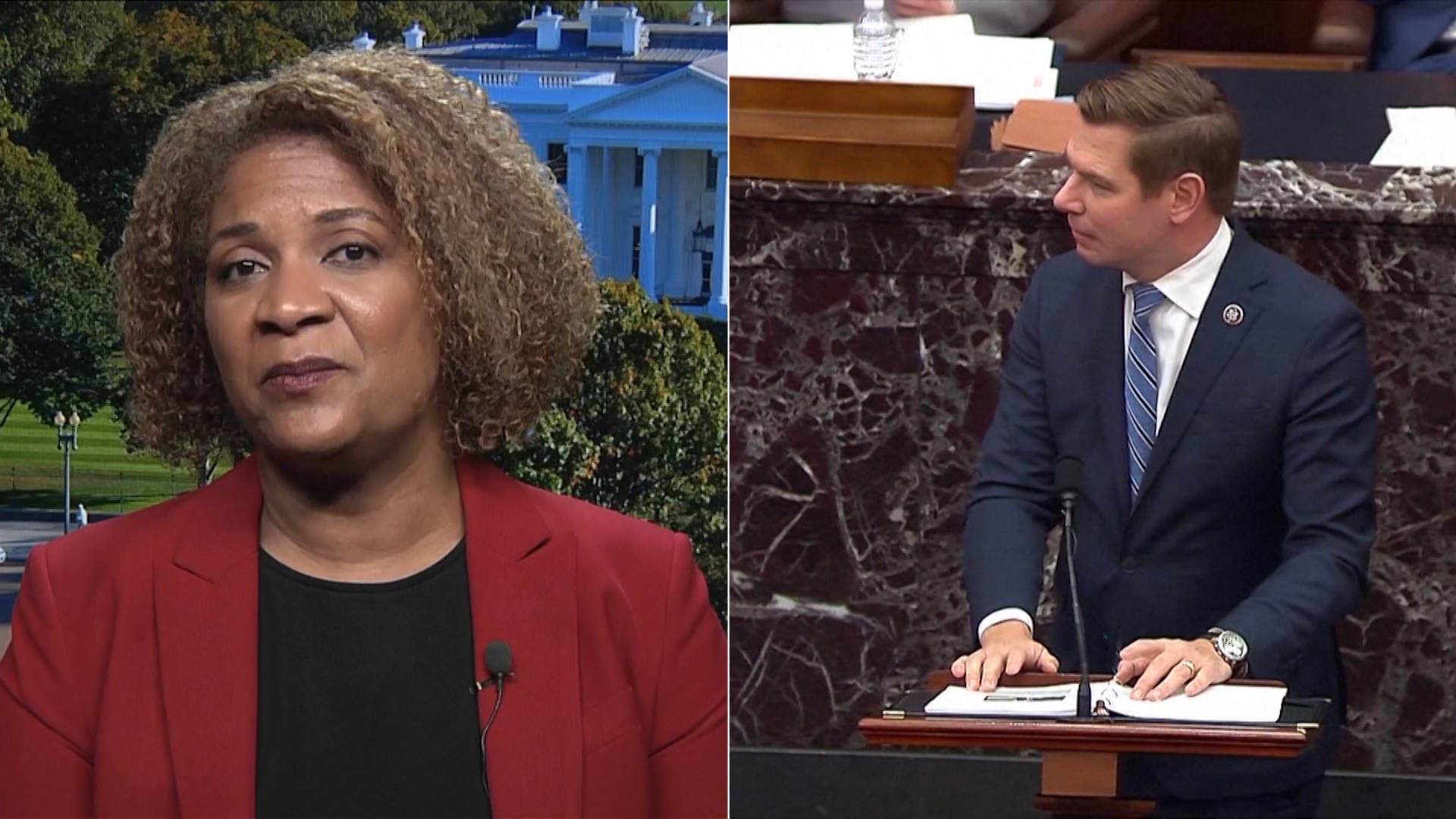
 Split image showing two congresspeople, one in red blazer and one at congressional podium.
Two Congressmen Resign Over Sexual Misconduct Scandals
Left says
- •These resignations demonstrate that accountability mechanisms can work when there is sufficient public pressure and bipartisan condemnation of misconduct
- •Congress must conduct broader systemic investigations to identify patterns of abuse and strengthen protections for staff members who are vulnerable to power imbalances
- •The swift action taken shows that sexual misconduct allegations are finally being taken seriously regardless of party affiliation
- •Workplace harassment and abuse of power should never be tolerated in any institution, especially those serving the public trust
Right says
- •Both members made the responsible decision to resign rather than put Congress through divisive expulsion proceedings that would have distracted from legislative priorities
- •The bipartisan nature of these scandals shows that misconduct is not a partisan issue and both parties must maintain high ethical standards
- •Due process concerns remain valid even when resignations occur, as allegations alone should not automatically end careers without proper investigation
- •Congressional leadership from both parties appropriately applied pressure for accountability while allowing the members to make their own decisions about resignation
Common Take
High Consensus- Both congressmen faced credible allegations of sexual misconduct involving staff members and were likely to face expulsion votes
- Sexual harassment and abuse of power in workplace settings cause serious harm to victims and undermine institutional integrity
- Congressional ethics rules prohibiting relationships between members and staff exist for important reasons related to power dynamics
- The resignations spare Congress from potentially divisive expulsion proceedings while allowing the members' districts to elect new representation
The Arguments
Left argues
These resignations demonstrate that accountability mechanisms can work when there is sufficient public pressure, and Congress must now conduct broader systemic investigations to identify patterns of abuse and strengthen protections for vulnerable staff members.
Right counters
While accountability is important, rushing to broader investigations based on individual cases could lead to overreach and undermine due process protections that are fundamental to fair treatment of all members.
Right argues
Both members made the responsible decision to resign rather than put Congress through divisive expulsion proceedings that would have distracted from legislative priorities and allowed for orderly transitions.
Left counters
Allowing resignations to avoid formal accountability processes may actually enable a culture where powerful individuals can escape consequences by simply stepping down when caught.
Left argues
The swift bipartisan condemnation shows that sexual misconduct allegations are finally being taken seriously regardless of party affiliation, marking important progress in addressing workplace abuse of power.
Right counters
While bipartisan response is positive, the speed of condemnation raises concerns about whether proper investigation and due process were followed before reaching conclusions about guilt or innocence.
Right argues
Due process concerns remain valid even when resignations occur, as allegations alone should not automatically end careers without proper investigation, and congressional leadership appropriately applied pressure while allowing members to make their own decisions.
Left counters
Emphasizing due process in cases involving clear power imbalances and vulnerable staff members can inadvertently protect perpetrators while silencing victims who already face significant barriers to reporting abuse.
Left argues
Workplace harassment and abuse of power should never be tolerated in institutions serving the public trust, and these cases highlight the urgent need for stronger protections for congressional staff who face inherent power imbalances.
Right counters
While protecting staff is crucial, creating overly broad policies or presumptions of guilt could discourage qualified individuals from seeking public service and undermine the principle that accusations require proper substantiation.
Challenge Questions
These questions target genuine internal contradictions — meant to provoke honest reflection.
Right asks Left
“If you believe swift accountability is essential, how do you reconcile this with your broader commitment to due process and civil liberties in other contexts - doesn't this create a double standard where political pressure can override procedural protections?”
Left asks Right
“If you emphasize due process and measured responses, how do you address the reality that traditional institutional processes have historically failed to protect vulnerable staff members from powerful officials who can use those same processes to avoid accountability?”
Outlier Report
Left Fringe
Progressive activists like those in advocacy groups calling for mass resignations of all members ever accused represent about 15% of the left. Some far-left commentators demanding criminal prosecutions without due process represent another 10%.
Right Fringe
Figures like some Trump-aligned Republicans who might defend the accused members or claim partisan witch hunts represent about 20% of the right. Some conservative commentators arguing resignations set dangerous precedents represent another 15%.
Noise Assessment
Moderate noise level - most discourse reflects genuine public concern about misconduct, though some partisan figures are using this for broader political attacks on Congress as an institution.
Sources (4)
<p>Reps. <a href="https://www.axios.com/2026/04/13/eric-swalwell-resigns-congress-sexual-allegations" target="_blank">Eric Swalwell</a> (D-Calif.) and <a href="https://www.axios.com/2026/04/13/tony-gonzales-resigns-congress-republican" target="_blank">Tony Gonzales</a> (R-Texas) submitted their formal resignations from Congress on Tuesday following sexual misconduct scandals.</p><p><strong>State of play: </strong>Swalwell's resignation took effect at 2pm ET on Tuesday — meaning he has already resigned — while Gonzales' takes effect at 11:59 pm ET, according to the House clerk.</p><hr /><ul><li>Swalwell has been accused by four women of sexual assault, harassment and rape, which he denies.</li><li>Gonzales admitted to an affair with a staffer who later died by suicide.</li></ul><p><strong>Between the lines: </strong>Both men had been facing the threat of expulsion, which looked increasingly likely to pass if they chose to try to hang onto their seats.</p>
<p>Rep. <a href="https://www.axios.com/2026/03/04/house-ethics-investigation-tony-gonzales-affair" target="_blank">Tony Gonzales</a> (R-Texas.) said he would seek to leave Congress early Tuesday amid allegations of sexual misconduct. </p><p><strong>Why it matters</strong>: Gonzales was facing a push for his expulsion — along with bipartisan calls for him to step down — after admitting to an affair with a former staffer who died by suicide.</p><hr /><ul><li>"There is a season for everything, and God has a plan for us all. When Congress returns tomorrow, I will file my retirement from office. It has been my privilege to serve the great people of Texas," Gonzales said in a Monday night <a href="https://x.com/RepTonyGonzales/status/2043819211865129159?s=20" target="_blank">post on X</a>. </li><li>The announcement comes just after Rep. <a href="https://www.axios.com/2026/04/13/eric-swalwell-resigns-congress-sexual-allegations" target="_blank">Eric Swalwell</a> (D-Calif.), who is also facing allegations of sexual harassment, announced he would resign from Congress. </li><li>It was not immediately clear when exactly Gonzales would officially leave Congress.</li></ul><p><strong>Catch up quick: </strong>The House Ethics Committee formally launched an investigation into Gonzales last month for sexual misconduct.</p><ul><li>Relationships between members of Congress and their staff are prohibited under the House Code of Official Conduct.</li><li>After initially denying the allegations, Gonzales admitted to having an affair with his former staffer in March, calling it a "lapse in judgement."</li><li>He later announced that he would <a href="https://www.axios.com/2026/03/06/tony-gonzales-drops-re-election-bid-texas-race" target="_blank">not seek reelection</a> after <a href="https://www.axios.com/2026/03/05/mike-johnson-tony-gonzales-affair-staffer-reelection" target="_blank">Speaker Mike Johnson</a> (R-La.) and his House GOP leadership team called on him to drop out of the race. </li><li>GOP leaders notably did not call on Gonzales to immediately step down. </li></ul><p><strong>Zoom in: </strong>Gonzales has been under intensifying scrutiny since the San Antonio Express-News reported that he had an affair with his former regional director, Regina Santos-Aviles.</p><ul><li>Santos-Aviles died last year after setting herself on fire outside her Uvalde home.</li><li>Axios obtained copies of text messages between Gonzales and Santos-Aviles, from her husband, Adrian Aviles, who shared them in a message with his attorney copied on it.</li><li>In one message from May 2024, Gonzales asked Santos-Aviles for a "sexy pic." Santos-Aviles later replied, "this is too far tony."</li></ul><p><em>Editor's note: This story has been updated with additional reporting. </em></p>
<p>Rep. <a href="https://www.axios.com/2026/04/12/swalwell-gonzales-cherfilus-mccormick-mills-expel" target="_blank">Eric Swalwell</a> (D-Calif.) said Monday he will resign from Congress following allegations of sexual harassment, assault and rape by four women.</p><p><strong>What they're saying: </strong>"Expelling anyone in Congress without due process, within days of an allegation being made, is wrong. But it's also wrong for my constituents to have me distracted from my duties," he said in a statement.</p><hr /><ul><li>"Therefore, I plan to resign my seat in Congress,"</li></ul><p><strong>Zoom in: </strong>Swalwell continued to deny some claims of misconduct, saying he will "fight the serious, false allegation made against me."</p><ul><li>"However, I must take responsibility and ownership for the mistakes I did make," he added.</li><li>Swalwell suspended his bid for California governor on Sunday, shaking up a race in which he had been one of the Democratic frontrunners.</li></ul><p><strong>Yes, but: </strong>Swalwell's resignation is not taking any heat off of Rep. Tony Gonzales (R-Texas), who is facing calls to resign or be expelled after admitting to an affair with a staffer who later died by suicide.</p><ul><li>Democratic Women's Caucus chair Teresa Leger Fernández (D-N.M.) plans to announce that she will move forward with her resolution to expel Gonzales, a source familiar with the matter told Axios.</li><li>"Tony Gonzales should resign immediately," Rep. Anna Paulina Luna (R-Fla.) told Axios, adding that she has "not heard that the Tony Gonzales resolution is cancelled and will support his expulsion."</li></ul><p><strong>What's next: </strong>The California Democrat indicated he does not plan to resign immediately.</p><ul><li>"I will work with my staff in the coming days to ensure they are able, in my absence, to serve the needs of the good people of the 14th congressional district," he said.</li></ul><p><em>Editor's note: This story has been updated with additional reporting. </em></p>
Democratic Congressmember Eric Swalwell of California and Republican Tony Gonzales of Texas resigned Tuesday. Both of them faced potential expulsion votes after they were accused of sexual misconduct involving former staffers.</p> <p>Swalwell’s resignation came just days after <span class="caps">CNN</span> and the <em>San Francisco Chronicle</em> reported multiple allegations against him, including twice raping a former staffer. Swalwell denied the allegations. He dropped out of the California gubernatorial race on Sunday. Gonzales had been facing calls to resign since February, when the <em>San Antonio Express-News</em> revealed he had an affair with a staffer who later took her own life, and also sent explicit text messages to another staffer.</p> <p>“Congress itself shouldn’t see these resignations as the end of the story here,” says Fatima Goss Graves of the National Women’s Law Center. “They actually should see it as the beginning of investigating not only what happened with these two individuals, but they need to understand whether or not they have a problem that is more of a pattern.”