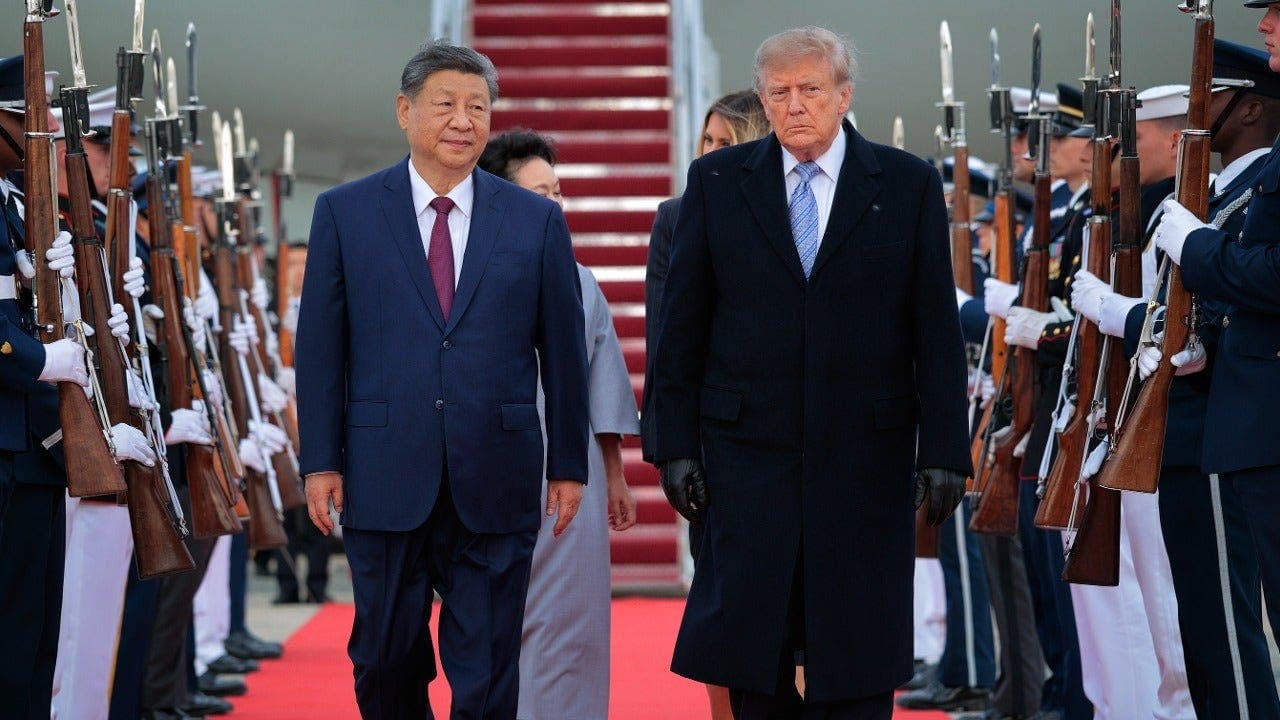
 Presidents Xi Jinping and Donald Trump walk together during a state visit ceremony.
US-China Deal Cuts Tariffs on $60B Goods, Rare Earths Unresolved
Left says
- •The deal offers modest relief for consumers facing inflation on goods like small appliances, toys, and holiday decorations, but the scale of the cuts remains small relative to the broader trade war Trump initiated in 2025.
- •The unresolved rare earths issue exposes a structural vulnerability in U.S. supply chains that tariff rollbacks alone cannot fix, raising questions about whether the administration has a coherent long-term industrial strategy.
- •China's coal purchase commitment revives fossil fuel demand at a moment when climate advocates argue trade diplomacy should instead be steering markets toward cleaner energy sources.
- •The lack of finalized tariff rates and vague language on critical minerals suggests the announcement may be more symbolic than substantive, prioritizing a photo-op summit over durable policy.
Right says
- •The agreement represents a tangible, negotiated de-escalation of a trade conflict that Trump initiated to hold China accountable on fentanyl and unfair trade practices, showing that tough tariffs can produce leverage and results.
- •Reopening Chinese markets to American agricultural products, seafood, wood, cosmetics, and medical devices directly benefits U.S. exporters and farmers who suffered under retaliatory tariffs.
- •The new U.S.-China Board of Trade and coal import commitments demonstrate a durable institutional framework for managing the relationship, not just a one-off gesture.
- •Continuing to press China on rare earths rather than settling for a quick concession shows the administration is holding firm on the issue most critical to U.S. manufacturing and national security.
Common Take
High Consensus- The U.S. and China each agreed to lower tariffs on $30 billion worth of goods, totaling $60 billion in reciprocal reductions.
- The deal followed a three-day summit in Washington between President Trump and President Xi Jinping.
- Rare earths and critical mineral supply chains remain unresolved and are described as an ongoing area of negotiation.
- China committed to importing 10 million metric tons of U.S. coal in both 2027 and 2028.
The Arguments
Right argues
The deal proves that Trump's tough tariff strategy generated real leverage, producing a negotiated agreement that reopens Chinese markets to U.S. agricultural products, seafood, wood, cosmetics, and medical devices, directly benefiting American exporters who suffered under retaliation.
Left counters
The relief covers only $30 billion in goods each way, a small fraction of total trade, meaning most exporters and farmers hurt by the original trade war still face the tariffs that caused their losses in the first place.
Left argues
The vague language on rare earths and absence of finalized tariff rates suggest the announcement is more of a symbolic photo-op than a substantive resolution, since the most critical supply chain issue remains unresolved after a high-profile summit.
Right counters
Holding firm on rare earths rather than accepting a rushed, weak concession shows discipline and seriousness about the issue most vital to U.S. manufacturing and national security, rather than settling for empty symbolism.
Right argues
The creation of the U.S.-China Board of Trade and multi-year coal purchase commitments through 2028 establish an institutional framework for managing the relationship, signaling durability rather than a one-time gesture.
Left counters
A new bureaucratic body and a coal deal don't address the structural rare-earth vulnerability at the heart of the trade war, so the institutional framework may simply formalize continued uncertainty rather than resolve it.
Left argues
Reviving Chinese coal purchases at a moment when trade diplomacy could instead incentivize cleaner energy sourcing reflects a missed opportunity to align economic policy with climate goals.
Right counters
Restoring coal exports rebuilds a major U.S. industry and job base that was decimated when China cut off purchases during the trade war, and energy policy shouldn't be subordinated to trade negotiations aimed at fixing unrelated economic harms.
Left argues
The unresolved rare earths issue exposes a structural vulnerability in U.S. supply chains that tariff cuts alone cannot fix, raising doubts about whether the administration has any coherent long-term industrial strategy beyond deal-by-deal negotiation.
Right counters
Deliberately continuing negotiations on rare earths rather than folding them into this deal indicates the administration recognizes their strategic importance and is pursuing a longer-term fix rather than a superficial one.
Challenge Questions
These questions target genuine internal contradictions — meant to provoke honest reflection.
Right asks Left
“If the left believes trade diplomacy should be leveraged to advance climate goals, does opposing this coal deal risk undermining broader U.S.-China cooperation that could also be used to negotiate rare earths and other supply chain fixes the left says are urgently needed?”
Left asks Right
“If tough tariffs are credited with producing this deal's leverage, why does the administration still lack finalized tariff rates or a resolved rare earths agreement months into negotiations, and what does that gap suggest about how much leverage was actually gained?”
Outlier Report
Left Fringe
Progressive economists and outlets like Robert Reich and some Bernie Sanders-aligned commentators frame any tariff rollback as a capitulation to corporate interests rather than genuine consumer relief, representing maybe 10-15% of the left.
Right Fringe
China hawks like Senator Marco Rubio and Steve Bannon-aligned nationalists argue any tariff reduction is premature appeasement of Beijing before rare earths and fentanyl issues are fully resolved, representing roughly 15-20% of the right.
Noise Assessment
Moderate; cable news and partisan social media amplify both triumphalist and skeptical framings, but most ordinary Americans are focused narrowly on whether prices on everyday goods will fall, a concern that doesn't map cleanly onto either synopsis's political framing.
Sources (6)
The U.S. and Chinese governments unveiled $30 billion each worth of products subject to lower tariffs, after President Trump and Chinese President Xi Jinping met last week in Washington, D.C., according to the White House. Chinese products subject to lower tariffs under the new “30-by-30” framework include fireworks, kitchenware, flashlights, baseballs and softballs and fishhooks,…
<p>The U.S. and China have reached a deal to lower tariffs on $30 billion of "non-sensitive goods" as part of a trade package agreed at this week's <a href="https://www.axios.com/2026/09/24/xi-trump-panda-diplomacy-zoo-atlanta" target="_blank">summit</a> between President Trump and Xi Jinping, the White House said.</p><p><strong>Why it matters: </strong>Such a deal would mark a thaw in the trade war that engulfed the two countries last year.</p><hr /><ul><li>As laid out by the White House, it would also potentially lower prices on a variety of consumer goods where American shoppers have felt the pinch of inflation. </li></ul><p><strong>How it works: </strong>The Trump administration said <a href="https://www.whitehouse.gov/fact-sheets/2026/09/fact-sheet-president-donald-j-trump-advances-a-fair-and-reciprocal-relationship-with-china-while-hosting-historic-state-visit/" target="_blank">China</a> would lower its tariffs on some agricultural goods and seafood, wood products, cosmetics, and medical devices.</p><ul><li>The U.S. will cut tariffs on small appliances, toys, holiday decorations, and kids' car seats. </li></ul><p><strong>Between the lines: </strong>The White House also said China would import 10 million metric tons of U.S. coal in 2027 and again in 2028.</p><ul><li>The country was a <a href="https://www.congress.gov/crs-product/R48587" target="_blank">top-five importer</a> of U.S. coal until <a href="https://www.eia.gov/todayinenergy/detail.php?id=67405" target="_blank">slashing imports</a> in 2025 amid the trade war. </li></ul><p><strong>The intrigue: </strong>The fact sheet released by the White House was more vague on the fate of the crucial rare earth minerals that have been at the heart of the trade dispute.</p><ul><li>"The United States and China continue to work on U.S. concerns regarding supply chain shortages related to rare earths and other critical minerals, with the goal of ensuring shipment levels return to appropriate levels," it said,.</li></ul>
The United States and China agreed to slash tariffs on $30 billion in goods after Trump and Xi Jinping's three-day Washington summit this week.
The U.S. and China agreed to lower tariffs on $30 billion worth of goods each country imports from the other and launch new talks on artificial intelligence following President Trump’s summit with Chinese President Xi Jinping. The agreements were part of an eight-point consensus reached during Xi’s three-day state visit to Washington, D.C., which ended…
The U.S. and China have agreed to reduce tariffs on a subset of each other's goods, the White House said Saturday.
The two countries unveiled separate lists covering thousands of products as they seek to ease trade tensions and stabilize relations ahead of further negotiations.