U.S. Demands 20-Year Iran Nuclear Freeze, Tehran Counters Single Digits
Left says
- •Iran showed flexibility by offering a shorter-term nuclear freeze and agreeing to monitored down-blending of enriched uranium rather than complete removal
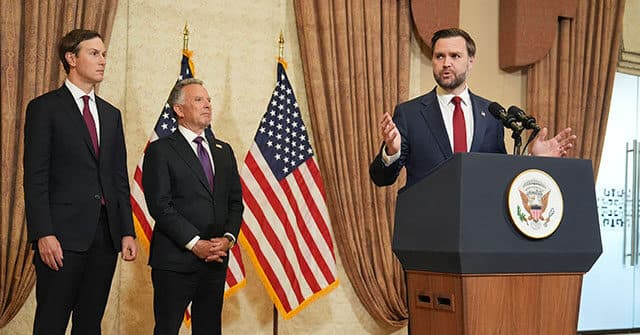
- •Vice President Vance's abrupt departure and blame-focused press conference caught Iranian negotiators off guard and undermined progress toward a potential deal
- •The 20-year moratorium demand represents an unrealistic starting position that ignores Iran's legitimate energy and sovereignty concerns
- •Regional mediators from Pakistan, Egypt, and Turkey remain actively engaged in bridging the gaps between both sides
Right says
- •Iran failed to meet the United States on six critical red lines including ending uranium enrichment, dismantling nuclear facilities, and stopping support for terrorist proxies
- •Iranian negotiators fundamentally misunderstood their lack of leverage and entered talks with unrealistic expectations about their bargaining position
- •The core U.S. objective remains preventing Iran from obtaining nuclear weapons capability, which Iran has not committed to abandoning long-term
- •Iran's refusal to fully open the Strait of Hormuz and end tolls demonstrates their continued attempts to hold global energy markets hostage
Common Take
High Consensus- Both sides engaged in 21 hours of substantive negotiations in Islamabad with Pakistani mediation
- The talks ended without agreement, putting the two-week ceasefire in jeopardy when it expires April 21
- Nuclear enrichment and uranium stockpiles remain the primary sticking points preventing a deal
- Regional mediators continue working to bridge remaining gaps between the negotiating positions
The Arguments
Left argues
Iran demonstrated meaningful flexibility by offering a shorter-term nuclear freeze and agreeing to monitored down-blending of enriched uranium rather than complete removal, showing genuine willingness to compromise on core issues.
Right counters
Iran's refusal to commit to abandoning nuclear weapons capability long-term and their insistence on maintaining enrichment facilities shows they're not serious about preventing nuclear proliferation, just buying time.
Right argues
Iran fundamentally misunderstood their negotiating position and entered talks believing they held leverage they don't actually possess, making realistic compromise impossible.
Left counters
Vice President Vance's abrupt departure and blame-focused press conference caught Iranian negotiators off guard when they believed progress was being made, undermining diplomatic momentum.
Left argues
The 20-year moratorium demand represents an unrealistic starting position that ignores Iran's legitimate sovereignty concerns and energy needs, while regional mediators remain actively engaged in bridging gaps.
Right counters
The core U.S. objective of preventing Iranian nuclear weapons capability requires long-term commitments, and Iran's counter-offer of only single-digit years shows they're not willing to provide the security guarantees necessary.
Right argues
Iran failed to meet the U.S. on critical red lines including ending uranium enrichment, dismantling nuclear facilities, and stopping support for terrorist proxies, while continuing to hold global energy markets hostage through Strait of Hormuz restrictions.
Left counters
Iran's willingness to engage in 21 hours of substantive negotiations and offer monitored uranium down-blending shows they're taking the process seriously, unlike the U.S. which walked away from potential progress.
Challenge Questions
These questions target genuine internal contradictions — meant to provoke honest reflection.
Right asks Left
“If Iran was truly showing flexibility and good faith, why did they refuse to commit to the core U.S. demand of never seeking nuclear weapons capability, and how can you reconcile their 'single digit' counter-offer with the long-term security guarantees needed to prevent nuclear proliferation?”
Left asks Right
“If the U.S. genuinely wanted a negotiated solution, why did Vice President Vance abruptly leave and hold a blame-focused press conference when Iranian negotiators believed progress was being made, and how does this approach differ from simply imposing terms rather than negotiating?”
Outlier Report
Left Fringe
Progressive foreign policy activists like CodePink's Medea Benjamin and some Squad members like Rashida Tlaib who advocate for immediate sanctions relief and view most U.S. demands as imperial overreach. They represent roughly 15-20% of the left.
Right Fringe
Hardline Iran hawks like Senator Tom Cotton and John Bolton who oppose any negotiations with Iran whatsoever and advocate for immediate military strikes regardless of diplomatic progress. They represent about 25-30% of the right.
Noise Assessment
Moderate noise level - most discourse reflects genuine policy disagreements rather than performative positioning, though some partisan framing amplifies differences beyond actual public opinion gaps on core Iran nuclear issues.
Sources (9)
<p>The U.S. proposed that <a href="https://www.axios.com/world/iran" target="_blank">Iran</a> accept a 20-year moratorium on uranium enrichment during <a href="https://www.axios.com/2026/04/12/iran-talks-pakistan-vance-no-deal" target="_blank">negotiations in Islamabad</a> over the weekend, according to a U.S. official and a source with knowledge.</p><ul><li>The Iranians countered with a shorter "single digit" period, according to the sources.</li></ul><p><strong>Why it matters:</strong> The differences over Iran's nuclear program — and in particular, whether Tehran will agree not to enrich uranium and to give up its existing stockpile — were the main sticking point that prevented a deal, the sources say.</p><hr /><p><strong>Driving the news: </strong>Pakistani, Egyptian and Turkish mediators are now <a href="https://www.axios.com/2026/04/13/us-iran-nuclear-talks-ceasefire-deal" target="_blank">trying to bridge</a> the remaining gaps and reach a deal to end the war before the ceasefire ends on April 21. </p><ul><li>Meanwhile, President Trump announced a blockade on Iran as part of the efforts to increase his leverage in the talks.</li><li>"There is continued engagement between the U.S. and Iran and forward motion on trying to get to an agreement," a U.S. official said.</li></ul><p><strong>Behind the scenes:</strong> The U.S. demand for a moratorium on uranium enrichment was a critical issue in the marathon talks over the weekend. "The United States suggested 20 years at a minimum with all kinds of other restrictions," a source familiar said.</p><ul><li>The U.S. also asked Iran to remove all highly enriched uranium from the country. The Iranians said they would agreed to a "monitored process of down-blending" it instead, according to the two sources.</li><li>While no agreement has been reached, the Iranians thought they were close to an initial agreement by Sunday morning and were caught off guard by Vice President Vance's press conference. The VP gave no indication a deal was close, blamed the Iranians, and announced the U.S. delegation was leaving Islamabad.</li><li>"The Iranians were pissed off about that press conference," a source with knowledge said. </li></ul><p><strong>What they're saying: </strong>An Iranian member of parliament who was part of the Iranian negotiating team, Seyyed Mahmoud Nabavian, <a href="https://nournews.ir/fa/news/309704/%D8%B3%D9%87-%D8%AE%D9%88%D8%A7%D8%B3%D8%AA%D9%87-%D8%B2%DB%8C%D8%A7%D8%AF%D9%87-%D8%AE%D9%88%D8%A7%D9%87-%D8%A2%D9%85%D8%B1%DB%8C%DA%A9%D8%A7-%D8%A7%D8%B2-%D8%A7%DB%8C%D8%B1%D8%A7%D9%86-%D8%A7%D8%B2-%D9%82%D9%88%D9%84-%D9%86%D8%A8%D9%88%DB%8C%D8%A7%D9%86" target="_blank">said</a> on Monday that the two U.S. demands on the nuclear issue were the reason no deal was reached. </p><ul><li>Israeli Prime Minister Benjamin Netanyahu said Monday that Vance told him in a phone call on his way back to Washington that the main sticking point was removing all enriched material from Iran and ensuring no enrichment "in the coming years, and that could be in decades."</li><li>The White House didn't immediately respond to a request for comment.</li></ul><p><strong>What to watch:</strong> Pakistani Prime Minister Shehbaz Sharif said on Monday that the mediators were working to resolve the remaining differences between the U.S. and Iran. </p><ul><li>Egyptian Foreign Minister Badr Abdelatty, who is also playing a key role in the mediation efforts, is expected to visit Washington this week and meet Secretary of State Marco Rubio and other senior officials.</li></ul><p><strong>What they're saying: </strong>Turkish Foreign Minister Haqan Fidan and intelligence chief Ibrahim Kalin are also involved in trying to bridge the gaps. </p><ul><li>Fidan told Anadolu news agency that "initial positions are always somewhat maximalist. Later, the parties try to find common ground with the support of mediators. As long as they have the intention to reach, maintain, and permanently achieve a ceasefire. What I see is that both sides are sincere about the ceasefire."</li><li>Fidan said he thinks the Iranians will evaluate the U.S. proposal and give their response in the coming days. He said an extension of 45-60 days of ceasefire could be considered to allow negotiations to continue.</li><li>"If the nuclear issue becomes an 'all or nothing' situation, especially regarding enrichment, I think we may encounter a serious obstacle. We will try to overcome this with the support of some mediators and other countries," he said. </li></ul>
<p>Iranian negotiators failed to meet the United States on six of its key red lines during talks in Islamabad, Pakistan, over the weekend, according to a U.S. official.</p> <p>The post <a href="https://www.breitbart.com/politics/2026/04/12/inside-the-u-s-iran-negotiations-iran-failed-to-meet-u-s-on-6-key-red-lines/" rel="nofollow">Inside the U.S-Iran Negotiations: Iran Failed to Meet U.S. on 6 Key Red Lines</a> appeared first on <a href="https://www.breitbart.com" rel="nofollow">Breitbart</a>.</p>
Iran-U.S. negotiations fell apart after Tehran misjudged its leverage, a U.S. official says, as Vice President JD Vance departed Pakistan without a deal.
<p>DAILY CALLER NEWS FOUNDATION—Vice President JD Vance told reporters early Sunday morning that talks between the United States and Iran failed to reach an agreement... <a class="call-to-action" href="https://www.dailysignal.com/2026/04/12/jd-vance-no-deal-with-iran-after-21-hour-negotiation/">Read More</a></p> <p>The post <a href="https://www.dailysignal.com/2026/04/12/jd-vance-no-deal-with-iran-after-21-hour-negotiation/">JD Vance: No Deal With Iran After 21-Hour Negotiation</a> appeared first on <a href="https://www.dailysignal.com/">The Daily Signal</a>.</p>
Vice President JD Vance’s negotiations in Pakistan with Iran failed to end the war, but progress was reported on building goodwill.
The United States and Iran ended face-to-face talks on Sunday without an agreement, leaving a fragile two-week ceasefire in doubt. U.S. officials said the negotiations collapsed over what they described as Iran's refusal to commit to abandoning a path to a nuclear weapon, while Iranian officials blamed the U.S. for the breakdown of the talks without specifying the sticking points.
<p>The U.S. and <a href="https://www.axios.com/world/iran" target="_blank">Iran</a> didn't reach an agreement during marathon negotiations on Saturday in Pakistan.</p><p><strong>Why it matters:</strong> The deadlock in <a href="https://www.axios.com/2026/04/11/us-iran-negotiations-pakistan" target="_blank">the talks</a> puts the two-week ceasefire agreed last week in limbo, with the possibility of renewed and escalating warfare.</p><hr /><ul><li>According to a source briefed on the talks, some of the disagreements had to do with Iran's demand to control the Strait of Hormuz and refusal to give up on its enriched uranium stockpile.</li></ul><p><strong>What he's saying: </strong>Vice President Vance said the U.S. and Iran had "substantive discussions" over 21 hours but couldn't bridge the gaps.</p><ul><li>"This is bad news for Iran much more than this is bad new for the U.S.," he stressed. "We have made very clear what our red lines are…and they have chosen not to accept our terms."</li><li>Vance said the U.S. wanted to a long-term "affirmative commitment" from Iran not to seek a nuclear weapon or the tools that would enable them to produce one quickly. "We haven't seen that yet, we hope that we will," he said. </li><li>Vance claimed the U.S. was "quite flexible and accommodating" and negotiated "in good faith" but couldn't make significant progress. </li><li>Immediately after the four-minute press conference, Vance departed Islamabad for Washington. </li></ul><p><strong>The other side: </strong>Several Iranian media outlets said after Vance's press conference that the talks failed because the U.S. side was not realistic and had "excessive demands."</p><p><strong>Behind the scenes: </strong>The U.S. and Iranian delegations met over several rounds in multiple formats. The talks began on Saturday and ended in the early hours of Sunday local time.</p><ul><li>Vance said the U.S. negotiating team spoke with President Trump at least half-a-dozen times during the day. </li><li>They also spoke with Secretary of State Marco Rubio, Defense Secretary Pete Hegseth, Treasury Secretary Scott Bessent and CENTCOM commander Amd. Brad Cooper.</li></ul><p><strong>Between the lines:</strong> No one expected a final agreement on Saturday, but the U.S. side hoped for sufficient momentum to keep negotiating, even if that meant extending the ceasefire.</p><ul><li>Vance's brief remarks conveyed little such optimism, though he did not say the U.S. was walking away.</li></ul><p><strong>What to watch: </strong>"We leave here with a very simple proposal. A method of understanding that is our final and best offer. We will see if the Iranians accept it," Vance said. </p><p><em>This is a breaking news story and will be updated.</em></p>
<p>Vice President JD Vance said on Saturday evening that the U.S. delegation has decided to leave peace talks with Iran in Pakistan after the Islamist regime refused to agree to America's terms.</p> <p>The post <a href="https://www.breitbart.com/europe/2026/04/11/no-deal-vance-walks-away-from-iran-talks-in-pakistan-after-tehran-rejects-american-requirements-for-peace/" rel="nofollow">No Deal! Vance Walks Away From Iran Talks in Pakistan After Tehran Rejects American Requirements for Peace</a> appeared first on <a href="https://www.breitbart.com" rel="nofollow">Breitbart</a>.</p>
As the U.S.–Iran ceasefire talks ended without an agreement in Islamabad, Pakistan, both sides blamed each other for the failure. Negotiators will now return to their capitals and reconsider their next moves.