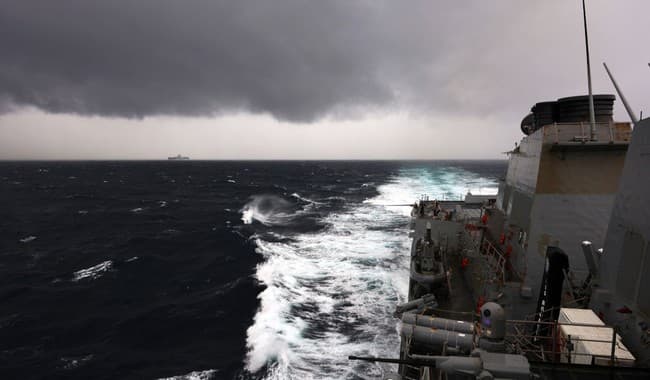
US Warships Cross Strait of Hormuz Without Iran's Permission
Left says
- •The operation demonstrates American commitment to freedom of navigation in international waters during a critical moment in ceasefire negotiations
- •Mine-clearing efforts will restore vital commercial shipping lanes that carry 20% of global oil supplies, benefiting the international economy
- •The mission prioritizes diplomatic solutions while maintaining necessary military presence to ensure Iran honors ceasefire agreements
Right says
- •America projects strength by refusing to seek Iran's permission for transit through international waters, establishing clear sovereignty principles
- •The operation exposes Iran's attempt to renege on ceasefire commitments by claiming 'technical limitations' in mine removal
- •Swift military action demonstrates that Iran cannot hold global commerce hostage through illegal mining of international shipping lanes
Common Take
High Consensus- Two U.S. Navy destroyers successfully transited the Strait of Hormuz for the first time since the conflict began
- The Strait of Hormuz is a critical waterway carrying approximately 20% of global oil shipments
- Iran placed naval mines in the strait during the conflict, effectively halting commercial shipping traffic
- U.S. and Iranian officials are currently engaged in direct ceasefire negotiations in Pakistan
The Arguments
Right argues
The operation demonstrates American resolve by refusing to legitimize Iran's illegal attempts to control international waters, establishing clear precedent that no nation can hold global commerce hostage through mining vital shipping lanes.
Left counters
While asserting navigation rights is important, conducting military operations during active ceasefire negotiations risks undermining diplomatic progress and could escalate tensions when peaceful resolution is within reach.
Left argues
The mine-clearing mission serves the global economy by restoring access to shipping lanes that carry 20% of world oil supplies, benefiting all nations while maintaining diplomatic engagement through ongoing Pakistan talks.
Right counters
Iran's claim of 'technical limitations' in mine removal is clearly a pretext to renege on ceasefire commitments, making military action necessary to prevent Iran from using false promises to buy time while maintaining its stranglehold on global commerce.
Right argues
Iran's attempt to backtrack on its agreement to reopen the strait through claims of 'technical limitations' exposes their bad faith negotiating, justifying immediate action to prevent further manipulation of ceasefire terms.
Left counters
Military operations conducted without coordination during sensitive negotiations could be perceived as provocative escalation, potentially derailing the first direct US-Iran talks since 1979 and undermining long-term diplomatic solutions.
Left argues
The operation prioritizes freedom of navigation in international waters while supporting diplomatic efforts, demonstrating that military presence can coexist with peaceful negotiation to achieve shared goals of reopening vital trade routes.
Right counters
Diplomatic engagement with Iran has proven futile as they immediately began reneging on agreements; only decisive military action that ignores Iranian objections can effectively restore international shipping and deter future Iranian aggression.
Challenge Questions
These questions target genuine internal contradictions — meant to provoke honest reflection.
Right asks Left
“If Iran is genuinely committed to reopening the strait as part of ceasefire negotiations, why conduct uncoordinated military operations that could provide Iran with justification to withdraw from talks entirely, potentially sacrificing long-term diplomatic progress for short-term tactical gains?”
Left asks Right
“If Iran's 'technical limitations' excuse is accepted and military action is avoided, what prevents Iran from indefinitely delaying mine removal while using ongoing negotiations as cover to maintain control over global oil supplies, essentially rewarding their initial aggression?”
Outlier Report
Left Fringe
Progressive anti-war activists like CodePink's Medea Benjamin and some Squad members who might oppose any military presence in the region represent roughly 15-20% of the left coalition.
Right Fringe
Hardline hawks like Senator Tom Cotton or commentators calling for immediate escalation rather than mine-clearing operations represent about 25-30% of the right, though this position isn't extremely outlying given the context.
Noise Assessment
Moderate noise level - most discourse reflects genuine policy differences rather than performative positioning, though some social media amplification occurs around 'strength vs diplomacy' themes.
Sources (9)
<p>Several U.S. Navy ships crossed the <a href="https://www.axios.com/2026/04/09/iran-us-strait-of-hormuz-khamenei" target="_blank">Strait of Hormuz</a> on Saturday, a U.S. official told Axios. </p><p><strong>Why it matters:</strong> The move was not coordinated with Iran. It is the first time U.S. warships crossed the strait since the beginning of the war.</p><hr /><ul><li>The operation was aimed at increasing confidence for commercial ships to cross, sources say. It came as <a href="https://www.axios.com/2026/04/11/us-iran-negotiations-pakistan" target="_blank">peace talks</a> between the two sides kicked off in Pakistan. </li><li>"This was an operation that focused on freedom of navigation through International waters," the U.S. official said.</li></ul><p><strong>Driving the news:</strong> The official said the Navy ships crossed the strait from east to west to the Gulf, and then made their way back through the strait to the Arabian Sea. </p><ul><li>The Iranian government reportedly called the crossing a ceasefire violation and threatened to attack the ships, per state media reports.</li><li>A U.S. official says the U.S. received no such warning. </li></ul><p><strong>The big picture: </strong>The reopening of the strait was a key provision in the U.S.-Iran ceasefire deal. </p><ul><li>The narrow waterway off Iran's southern coast is vital to the normal functioning of the global economy.</li><li>For several days after the ceasefire was announced very few ships crossed. There were <a href="https://x.com/JavierBlas/status/2042933002339033355" target="_blank">reports</a> Saturday morning that at least three oil-carrying supertankers crossed — a tentative sign of movement, though a tiny fraction of normal. </li><li>A U.S. official admitted earlier this week that ships were not moving through because they were intimidated by the Iranians. </li></ul><p><strong>What they're saying:</strong> President Trump <a href="https://truthsocial.com/%40realDonaldTrump/posts/116386190374675994" target="_blank">posted</a> on Truth Social on Saturday that the threat that a ship may "bunk" into sea mines was the only thing Iran had to intimidate them from crossing the strait. </p><ul><li>'We're now starting the process of clearing out the Strait of Hormuz as a favor to Countries all over the World, including China, Japan, South Korea, France, Germany, and many others," he wrote. </li></ul><p><em>Editor's note: This story has been updated with additional details on the crossing. </em></p>
The destroyers were beginning mine-clearing operations in the vital waterway, U.S. Central Command said Saturday.
President Trump said the U.S. is "clearing out" the Strait of Hormuz on social media Saturday. Meanwhile, U.S. officials are meeting face-to-face with Iranian and Pakistani officials in Islamabad. CBS News' Taurean Small has the latest.
This marked the first time such U.S. ships passed through the waterway since the beginning of the war with Iran.
U.S. forces begin clearing Iranian mines from the Strait of Hormuz as Trump warned talks must succeed or the U.S. will "reset."
The U.S. military has launched operations to begin de-mining the Strait of Hormuz, U.S. Central Command (Centcom) said on Saturday. Centcom said in a social media post highlighted by Defense Secretary Pete Hegseth that two Navy guided-missile destroyers began “setting conditions” for this mission on Saturday morning. The USS Frank E. Peterson and USS Michael…