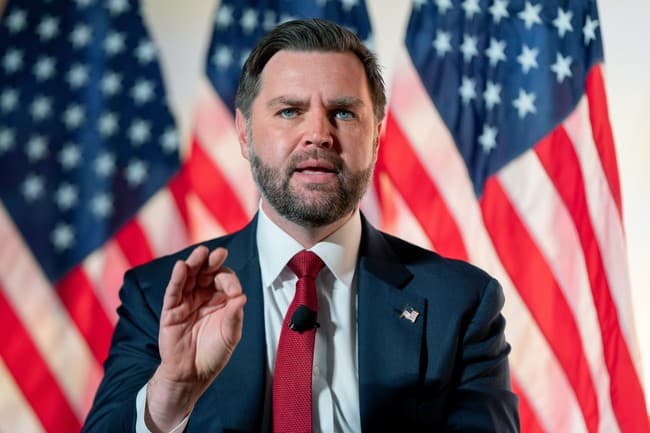
 J.D. Vance speaks at podium with American flags in background
Vance to lead Iran peace talks as Lebanon strikes threaten ceasefire
Left says
- •Israel's continued strikes in Lebanon that killed over 250 people represent a deliberate violation of ceasefire terms that Iran understood to include all fronts
- •The Trump administration's failure to clearly communicate ceasefire boundaries has created dangerous confusion that threatens to collapse fragile peace negotiations
- •Iran's threats to withdraw from talks and close the Strait of Hormuz demonstrate the urgent need for the U.S. to restrain Israeli military actions to preserve diplomatic progress
Right says
- •Iran is attempting to manipulate ceasefire terms by falsely claiming Lebanon was included when no such promise was made by the United States
- •Israel has voluntarily offered to restrain strikes in Lebanon to support negotiations, demonstrating good faith despite having no obligation under the ceasefire agreement
- •Iran's threats to abandon talks over Lebanon reveal their bad faith negotiating tactics and unwillingness to engage seriously in peace efforts
Common Take
High Consensus- Vice President Vance will lead the U.S. delegation in high-stakes peace talks with Iran scheduled for Saturday in Pakistan
- Israeli military strikes in Lebanon have killed hundreds and created tensions that threaten the ceasefire agreement
- The Strait of Hormuz remains a critical issue that must be resolved for any lasting peace agreement
- These represent the highest-level U.S.-Iran negotiations since the 1979 Islamic revolution
The Arguments
Right argues
Iran is attempting to manipulate ceasefire terms by claiming Lebanon was included when the U.S. explicitly states no such promise was made, demonstrating Iran's bad faith negotiating tactics from the outset.
Left counters
The confusion over Lebanon stems from Pakistan's announcement that the ceasefire would apply 'everywhere, including Lebanon,' creating legitimate expectations that the U.S. failed to clarify until after Iran had already agreed to the broader framework.
Left argues
Israel's massive coordinated strikes killing over 250 people in Lebanon directly undermine the fragile peace process and validate Iran's concerns about U.S. inability to control its ally's military actions.
Right counters
Israel voluntarily offered to restrain strikes in Lebanon to support negotiations despite having no obligation to do so, demonstrating good faith while Iran threatens to abandon talks entirely over an issue outside the agreed ceasefire scope.
Left argues
Iran's threats to close the Strait of Hormuz and withdraw from negotiations reflect genuine frustration with what they perceive as U.S. failure to honor ceasefire commitments, threatening to collapse crucial diplomatic progress.
Right counters
Iran's immediate resort to economic warfare threats over a misunderstood ceasefire term reveals their unwillingness to engage seriously in peace efforts and preference for coercive tactics over genuine diplomacy.
Right argues
The Trump administration has successfully brought Iran to the negotiating table through strength, with Iran publicly acknowledging they 'can no longer tolerate being bombed' and agreeing to reopen the Strait of Hormuz.
Left counters
The administration's failure to clearly communicate ceasefire boundaries before the announcement has created dangerous confusion that threatens to derail the very diplomatic breakthrough they claim to have achieved.
Left argues
The U.S. must demonstrate credible commitment to restraining Israeli actions to preserve Iranian participation in negotiations that could prevent a wider regional war and nuclear escalation.
Right counters
Allowing Iran to dictate terms about conflicts outside the agreed ceasefire scope would set a dangerous precedent of rewarding Iranian manipulation and undermine U.S. credibility with its actual allies like Israel.
Challenge Questions
These questions target genuine internal contradictions — meant to provoke honest reflection.
Right asks Left
“If the U.S. truly wants successful negotiations with Iran, how can it justify allowing continued confusion about ceasefire terms that it knew would be interpreted differently by the mediating country and Iran, rather than ensuring crystal-clear communication from the start?”
Left asks Right
“If Iran is genuinely committed to peace negotiations, why would they immediately threaten to abandon talks and resume economic warfare over a single misunderstood provision rather than working through the disagreement diplomatically within the negotiation framework?”
Outlier Report
Left Fringe
Progressive Squad members like Alexandria Ocasio-Cortez and Rashida Tlaib, along with anti-war activists like CodePink's Medea Benjamin, who would likely frame any Israeli military action as unjustified aggression regardless of context. They represent roughly 15-20% of the Democratic base.
Right Fringe
Hardline hawks like Senator Tom Cotton and former UN Ambassador John Bolton who would oppose any negotiations with Iran entirely and advocate for immediate military escalation. They represent about 25-30% of the Republican base who view any diplomacy with Iran as appeasement.
Noise Assessment
Moderate noise level - while partisan media amplifies extreme positions, most Americans focus on practical outcomes rather than ideological purity on foreign policy issues.
Sources (9)
<p>Vice President Vance said Wednesday <a href="https://www.axios.com/world/israel" target="_blank">Israel</a> has proposed to restrain itself when it comes to strikes in Lebanon as long as the negotiations between the U.S. and Iran are taking place. </p><p><strong>Why it matters: </strong>The Israeli military's renewed attacks in Lebanon posed an immediate challenge to the stability of the ceasefire and led <a href="https://www.axios.com/world/iran" target="_blank">Iran</a> to threaten to pull out of <a href="https://www.axios.com/2026/04/08/us-iran-peace-talks-vance-pakistan-saturday" target="_blank">negotiations with the U.S.</a> planned for Saturday. At least 254 people have been killed in Israel's strikes, according to Lebanese Civil Defense.</p><hr /><p><strong>The big picture:</strong> Stopping the Israeli strikes against Hezbollah, Tehran's proxy in Lebanon, was one of Iran's key demands for the ceasefire. </p><ul><li>The Iranians are now threatening to resume the fighting and close the Strait of Hormuz if the fighting in Lebanon continues.</li><li>"The Iran–U.S. Ceasefire terms are clear and explicit: the U.S. must choose— ceasefire or continued war via Israel. It cannot have both. The world sees the massacres in Lebanon. The ball is in the U.S. court, and the world is watching whether it will act on its commitments," Foreign Minister Abbas Araghchi wrote on X.</li><li>Egypt, which helped mediate the ceasefire, accused Israel of a "premeditated" attempt to undermine the truce. </li></ul><p><strong>The latest</strong>: Vance told reporters at the end of his <a href="https://www.axios.com/2026/04/07/vance-hungary-election-orban-russia-ukraine" target="_blank">visit to Budapest</a> there's a "legitimate misunderstanding" between the U.S. and Iran regarding the ceasefire in Lebanon.</p><ul><li>"I think the Iranians thought that the ceasefire included Lebanon and it just didn't. We never made that promise. We never indicated that would be the case. What we said is that the ceasefire will be focused on Iran and America's allies both Israel and the Gulf Arab states," he said. </li><li>"That said, the Israelis have actually offered to check themselves a little bit in Lebanon because they want to make sure that our negotiation is successful. That's not because that is part of the ceasefire. I think that's the Israelis trying to set us up for success."</li><li>If Iran withdraws from the negotiations over Lebanon "that would be dumb but that's their choice," Vance added.</li></ul><p><strong>State of play:</strong> Hezbollah launched missile strikes at Israel soon after the U.S. and Israel attacked <a href="https://www.axios.com/world/iran" target="_blank">Iran</a> five weeks ago, opening a new front in the war.</p><ul><li>Israel responded with airstrikes in Beirut and other parts of the country, and later with a ground invasion and occupation of large swaths of southern Lebanon. </li><li>Thousands of Israeli soldiers are in positions as deep as six miles into Lebanese territory. </li><li>The Israeli government says it will not pull out its troops and will not allow hundreds of thousands of displaced Lebanese civilians to return home until Hezbollah is disarmed.</li></ul><p><strong>Driving the news: </strong>On Tuesday, when Pakistani Prime Minister Shehbaz Sharif announced the ceasefire, he said it would apply "everywhere, including Lebanon and elsewhere."</p><ul><li>Shortly afterward, Israeli Prime Minister Benjamin Netanyahu issued a statement claiming the ceasefire did not include Lebanon. </li><li>The U.S. did not make its own position clear prior to Leavitt's statement to Axios.</li><li>It's not clear whether the U.S. agreed at any point in the negotiations that the ceasefire would apply to Lebanon.</li></ul><p><strong>Behind the scenes:</strong> A senior U.S. official said Netanyahu raised the issue of Lebanon in a phone call with President Trump shortly before the announcement of the ceasefire. </p><ul><li>Trump and Netanyahu agreed during the call that the fighting in Lebanon could continue, the U.S. official and an Israeli official said.</li><li>The U.S. official said the White House is not currently concerned that the situation in Lebanon would cause the ceasefire with Iran to collapse.</li></ul><p><strong>On Wednesday,</strong> the Israel Defense Forces conducted a massive wave of strikes against Hezbollah targets in Beirut, in the Beqaa Valley and in southern Lebanon.</p><ul><li>The IDF said it was "the largest coordinated wave of strikes in Lebanon" since the start of the war in Iran. </li><li>50 Israeli Air Force fighter jets participated in the strikes and attacked 100 Hezbollah command centers and military infrastructure sites using approximately 160 munitions, the IDF said. </li><li>According the the Lebanese Red Cross, more than 80 people have been killed and 200 wounded.</li></ul><p><strong>The other side:</strong> Iran's Tasnim news agency quoted sources who said Iran would withdraw from the ceasefire agreement if the attacks on Lebanon continue. </p><ul><li>Fars news agency said oil tankers passing through the Strait of Hormuz had been stopped on Wednesday after the massive Israeli strikes. </li></ul><p><strong>What they're saying:</strong> Lebanese Prime Minister Nawaf Salam also accused Israel of breaching the ceasefire. The Lebanese presidency called the Israeli strikes "a new massacre." </p><ul><li>Araghchi said in calls with several foreign ministers that the Israeli strikes in Lebanon were a breach of the ceasefire.</li><li>Sharif wrote on X that ceasefire violations had "been reported at few places across the conflict zone which undermine the spirit of peace process. I earnestly and sincerely urge all parties to exercise restraint and respect the ceasefire for two weeks, as agreed upon, so that diplomacy can take a lead role towards peaceful settlement of the conflict."</li><li>Hezbollah said it had a right to respond to Israeli's attack.</li></ul><p><em>Editor's note: This article has been updated with additional details throughout.</em></p>
<p>Vice President <a href="https://www.axios.com/2026/03/27/vance-iran-peace-talks" target="_blank">JD Vance</a> will head the U.S. negotiating team for the peace talks with Iran on Saturday, White House press secretary Karoline Leavitt said on Wednesday. </p><p><strong>Why it matters:</strong> It's the highest level meeting between the U.S. and <a href="https://www.axios.com/world/iran" target="_blank">Iran</a> since the 1979 Islamic revolution, as ceasefire negotiations hit a crucial tipping point that could lead to the resumption and escalation of the war if the high-stakes talks fail.</p><hr /><ul><li>This will be the most significant and challenging mission in Vance's political career, testing his line of trying to avoid war with Iran and preferring diplomacy as a way to reach a deal. </li><li>Vance said in Budapest on Wednesday that President <a href="https://www.axios.com/politics-policy/donald-trump" target="_blank">Trump</a> is "impatient to make progress" with Iran and stressed that if Iranian officials don't engage in good faith "they're going to find out that President Trump is not one to mess around with".</li></ul><p><strong>Driving the news:</strong> Leavitt said Trump's adviser and son-in-low <a href="https://www.axios.com/2026/03/21/trump-peace-deal-iran-kushner-witkoff" target="_blank">Jared Kushner</a> and White House envoy Steve Witkoff will also participate in the negotiations. </p><ul><li>Iranian state media reports Iranian Parliament Speaker Mohammad<a href="https://www.axios.com/2026/03/27/iran-war-parliament-speaker-mohammad-bagher-ghalibaf-us-talks" target="_blank"> Bagher Ghalibaf</a> is expected to lead Tehran's delegation, with Foreign Ninister Abbas Araghchi also joining the talks. </li></ul><p><strong>State of play:</strong> <a href="https://www.axios.com/world/israel" target="_blank">Israeli</a> airstrikes in Lebanon generated harsh condemnation from Tehran and claims that it was a breach of the ceasefire. </p><ul><li>Araghchi <a href="https://x.com/araghchi/status/2041929940678144097" target="_blank">hinted</a> on X that Tehran could abandon the ceasefire if Israeli strikes continue. </li><li>"The Iran–U.S. Ceasefire terms are clear and explicit: the U.S. must choose—ceasefire or continued war via Israel. It cannot have both," he said. "The world sees the massacres in Lebanon. The ball is in the U.S. court, and the world is watching whether it will act on its commitments."</li><li>A senior American official said the U.S. is not currently concerned that the strikes in Lebanon would jeopardize negotiations. </li><li>Leavitt told reporters that "it has been relayed to all parties" that Lebanon is not part of the <a href="https://www.axios.com/2026/04/07/iran-2-week-ceasfire-trump-pakistan" target="_blank">ceasefire agreement</a>.</li><li>Trump and Israeli Prime Minister Benjamin Netanyahu would continue to discuss this, "but for now Lebanon is not included," she added. </li></ul><p><strong>Zoom in:</strong> The basis for the peace talks has been one of the issues over which the U.S. and Iran issued contradictory statements. </p><ul><li>In a series of Truth Social posts on Wednesday, Trump wrote that the 10 points Iran published and claimed were the basis for negotiations were different than the 10 that were given to the U.S. and would be discussed "behind closed doors during these Negotiations."</li><li>"These are the POINTS that are the basis on which we agreed to a CEASEFIRE. It is something that is reasonable, and can easily be dispensed with," he said.</li><li>In a briefing with reporters, Leavitt confirmed Axios' reporting that the 10-point counter-proposal that Iran sent to the White House on Monday was rejected and later amended and redrafted by the mediators in a way that was workable and in line with the White House's <a href="https://www.axios.com/2026/03/25/iran-rejects-trump-plan-end-war-15-points" target="_blank">15-point proposal</a>. </li><li>Leavitt claimed that what Tehran says publicly about the issues it has agreed to "is very different from what they say privately." One example she gave is the highly enriched <a href="https://www.axios.com/2026/03/08/iran-ground-troops-special-forces-nuclear" target="_blank">uranium stockpile</a>. "We were given indications that they will turn over the enriched uranium," she said. </li></ul><p><strong>The other side: </strong>Ghalibaf said three out of 10 clauses in the framework the U.S. and Tehran agreed to have been violated and, therefore, "a bilateral ceasefire or negotiations is unreasonable",</p><ul><li>He said the first violation was regarding the ceasefire in Lebanon, which was a commitment Pakistan's<a href="https://www.axios.com/2026/04/08/iran-ceasefire-questions-strait-lebanon" target="_blank"> prime minister had mentioned</a> in his statement announcing the ceasefire.</li><li>Ghalibaf claimed the second violation, was the entry of a drone into Iranian airspace and the thirdwas Trump's statement that denies "Iran's right to enrichment, which was included in sixth clause of the framework."</li></ul><p><strong>What to watch:</strong> Raz Zimmt, director of the Iran program at the Institute for National Security Studies in Tel Aviv tells Axios the primary concern is the extent to which the upcoming talks will address the nuclear issue. </p><ul><li>"There are three minimum requirements that must be met: the removal of 60% enriched uranium from Iran, the dilution of 20% enriched material to a low level, and the suspension of uranium enrichment for as many years as possible," he said.</li><li>"If these demands — some of which Iran rejected before the war — are accepted, the war can end with at least one significant achievement. If the war ends with these nuclear capabilities still in Iran, it would constitute a major failure."</li></ul><p><strong>Go deeper: </strong><a href="https://www.axios.com/2026/04/08/exclusive-how-irans-supreme-leader-reached-a-truce-with-trump" target="_blank">Exclusive: How Iran's supreme leader reached a truce with Trump</a></p>
"We look forward to those in-person meetings," she added.
<p>Vice President JD Vance will lead the United States’ negotiating team in Pakistan to work out the details of a peace agreement with Iran, White... <a class="call-to-action" href="https://www.dailysignal.com/2026/04/08/vance-to-lead-iran-negotiating-team-in-pakistan/">Read More</a></p> <p>The post <a href="https://www.dailysignal.com/2026/04/08/vance-to-lead-iran-negotiating-team-in-pakistan/">Vance to Lead US Negotiating Team in Pakistan</a> appeared first on <a href="https://www.dailysignal.com/">The Daily Signal</a>.</p>
President Trump said Wednesday that Vice President Vance may not attend the in-person talks with Iran in Pakistan for security reasons. Trump told the New York Post that he expects the peace talks with Iran to happen in Islamabad “very soon” after a ceasefire deal was agreed to on Tuesday. Trump told the Post that…
Vice President Vance characterized the two-week ceasefire deal between the U.S. as “a fragile truce” while speaking in Hungary on Wednesday. “If the Iranians are willing in good faith to work with us, I think we can make an agreement,” Vance said. “If they’re going to lie, if they’re going to cheat, if they’re going…
The vice president traveled to Budapest as Trump’s deadline for an Iran deal loomed Tuesday, backing the administration’s closest ideological ally in Europe.
The White House and wider world clung to a "fragile truce" in the Middle East on Wednesday as President Trump worked to declare military victory over Iran and pivot to a negotiation phase that would lead to lasting peace.