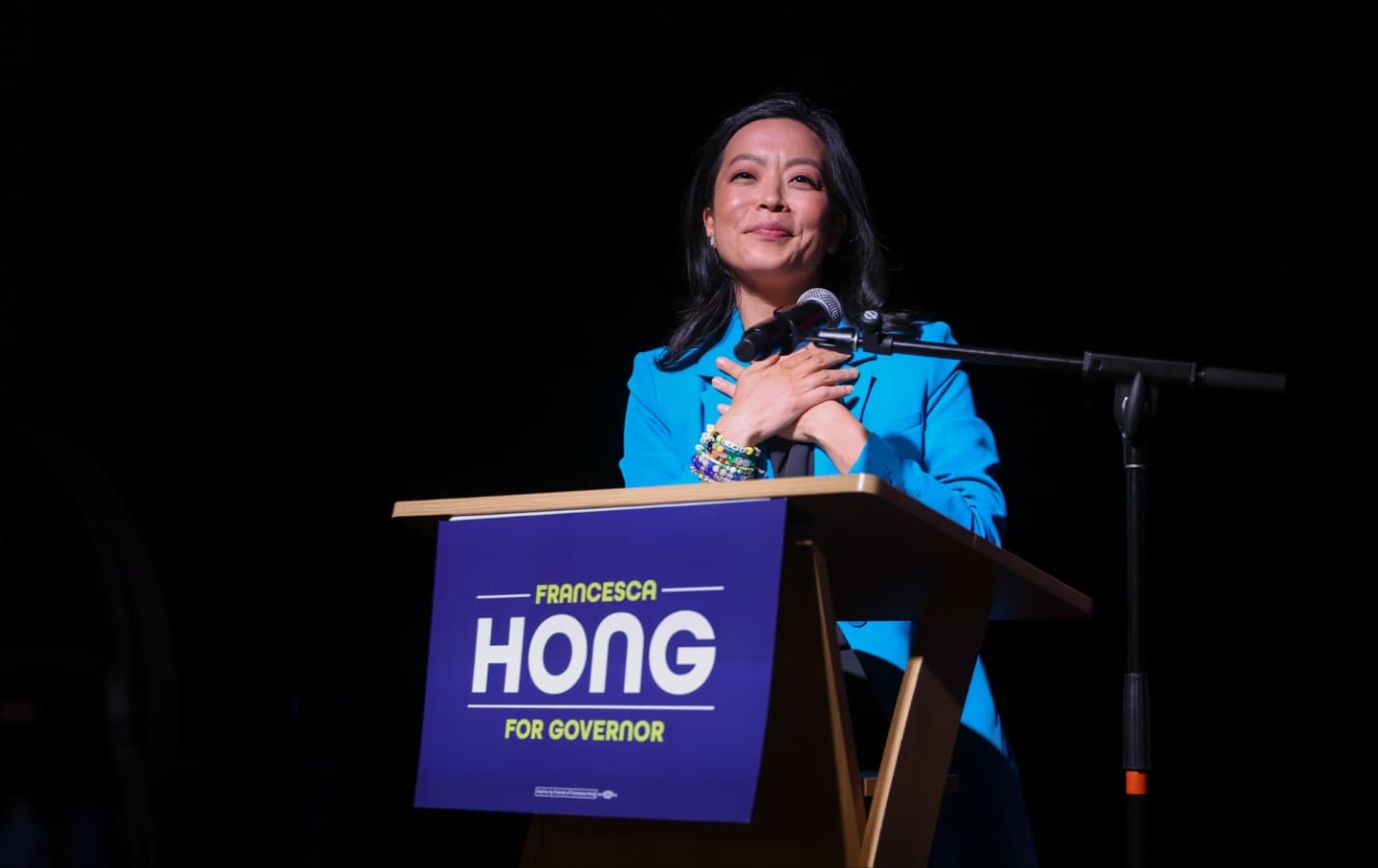
 Francesca Hong at podium with campaign sign, hand over heart, emotional moment.
Was Hong's Narrow Loss a Progressive Defeat or a Win?
Intra-Party Split Detected
Progressive and left-leaning outlets sharply disagree on how to interpret Hong's loss: some (Jacobin, The Nation, The Intercept) frame it as a near-win and proof of socialist momentum, blaming media narratives and establishment sabotage, while others (Salon, HuffPost) argue Hong was a flawed candidate whose defeat benefits Democrats and progressives alike, and some progressives publicly blame Bernie Sanders and other leaders for not endorsing her.
Left says
- •Hong lost by fewer than 3,500 votes and earned around 312,000 votes, one of the highest totals ever for a contested Wisconsin Democratic gubernatorial primary, showing socialist politics can compete in a swing state.
- •Pre-election polls had her leading by double digits, so the loss reflects a late collapse driven by media fixation on old tweets rather than genuine rejection of her platform by voters.
- •National media rushed to declare the loss a definitive verdict on the left, even though a near-tie against establishment backing, the outgoing governor's opposition, and a fierce opposition-research campaign is a remarkable showing.
- •Her defeat spares progressives from nominating a candidate who struggled to control her own narrative and could have been vulnerable in the general election, so some see it as a blessing in disguise for the movement's long-term credibility.
Right says
- •Hong's record, including calls to defund police, abolish prisons, cancel Thanksgiving, and label gentrification as 'violence,' made her a liability that Republicans were fully prepared to exploit with a nearly 350-page opposition file.
- •Establishment Democrats, including outgoing Governor Tony Evers, judged Hong too radical to win a general election against Republican Tom Tiffany and rallied late behind Crowley to stop her.
- •Bernie Sanders and other national progressive leaders declined to endorse Hong, showing hesitance within the movement itself to fully back a self-described democratic socialist in a swing state.
- •Her inability to clearly explain or disavow past inflammatory statements, especially on Thanksgiving, created doubts among educated primary voters about her readiness for national scrutiny in a general election.
Common Take
High Consensus- Hong lost the Democratic primary to David Crowley by a narrow margin of about 3,000 to 3,500 votes.
- Pre-election polling showed Hong with a substantial lead before the race tightened dramatically.
- Hong's past statements on Thanksgiving, policing, and other social issues became a central focus of the campaign's final days.
- Outgoing Governor Tony Evers declined to support Hong and ultimately backed Crowley.
The Arguments
Left argues
Hong earned roughly 312,000 votes, one of the highest totals ever in a contested Wisconsin Democratic gubernatorial primary, and lost by fewer than 3,500 votes despite facing the sitting governor's opposition and a coordinated late establishment rally behind Crowley — evidence that socialist politics can genuinely compete in a swing state.
Right counters
A near-miss is still a miss, and the fact that establishment Democrats, including Governor Evers, mobilized specifically because they judged her unelectable in November suggests the party's own insiders saw fatal general-election weaknesses that raw primary turnout doesn't erase.
Right argues
Hong's record — including calls to defund police, abolish prisons, cancel Thanksgiving, and label gentrification 'violence' — handed Republicans a nearly 350-page opposition file, and her inability to clearly disavow or explain these statements raised legitimate doubts among primary voters about her readiness for national scrutiny.
Left counters
The Thanksgiving controversy was a manufactured distraction from substantive policy debate, since no serious observer believed she intended to literally cancel the holiday, and the media's fixation on old tweets over her platform reflects establishment discomfort with her politics rather than a genuine voter concern.
Left argues
Pre-election polls showed Hong leading by double digits — even 22 points in one survey — meaning her loss represents a late collapse driven by opposition research and media narrative rather than a considered rejection of her platform by the electorate.
Right counters
A late collapse under scrutiny is itself the problem: if a candidate's support evaporates once voters learn more about her record and see her struggle to explain it, that is precisely the vulnerability Republicans would have exploited relentlessly in a general election against Tiffany.
Right argues
Even Bernie Sanders and other national progressive leaders declined to endorse Hong, and Sanders explicitly said he wouldn't back her, signaling hesitance within the socialist movement itself about backing a self-described democratic socialist in a genuine swing state.
Left counters
Sanders' non-endorsement reflected limited resources and strategic triage among many worthy candidates, not a verdict on Hong's viability, and he explicitly praised her grassroots campaign as 'very strong' rather than distancing himself from her politics.
Left argues
National media outlets like the New York Times and Politico rushed to declare Hong's razor-thin loss a definitive verdict on the entire progressive movement, an interpretation that ignores how remarkable a near-tie was against the combined weight of establishment backing, gubernatorial opposition, and a fierce opposition-research campaign.
Right counters
Calling the coverage overblown doesn't change the outcome: Democratic primary voters, including the highly educated bloc that dominates Wisconsin's electorate, chose the more moderate, harder-to-attack candidate specifically because electability mattered more to them than ideological purity.
Challenge Questions
These questions target genuine internal contradictions — meant to provoke honest reflection.
Right asks Left
“If Hong's near-win truly proves socialism's viability in a swing state, why did the campaign's own allies concede that her inability to control the narrative around her past statements — not just media bias — was a decisive factor, and what does that suggest about the movement's readiness to withstand general-election scrutiny rather than favorable primary conditions?”
Left asks Right
“If Republicans were confident Hong was an easily beatable extremist, why did they invest nearly 350 pages of opposition research and active campaigning in the Democratic primary itself, rather than simply waiting to run against her in the general election?”
Outlier Report
Left Fringe
Outlets like The Intercept and Jacobin, along with DSA-aligned activists, represent perhaps 15-20% of the left that fully embraces Hong's platform including defund-police rhetoric and dismisses the Thanksgiving controversy as manufactured outrage.
Right Fringe
Figures like those at the Washington Free Beacon and RNC Research who amplify minor stories (e.g., 'Feast of the Feminine') represent a fringe (~10-15% of the right) focused on cultural mockery rather than substantive policy critique of Hong.
Noise Assessment
High noise ratio: much of the coverage (Thanksgiving tweets, opposition research files, Sanders non-endorsement drama) is performative media narrative-building on both sides, disproportionate to how most voters weigh gubernatorial primaries, which are typically decided on bread-and-butter issues rather than viral social media controversies.
Sources (9)
Her defeat in the state’s gubernatorial primary shows why the left needs happy warriors like AOC and Mamdani
<p>Sen. Bernie Sanders (I-VT) is reportedly ignoring criticism over his decision not to get involved in the Wisconsin gubernatorial primary that Democrat socialist Francesca Hong lost on Tuesday. </p> <p>The post <a href="https://www.breitbart.com/politics/2026/08/14/report-bernie-sanders-dismisses-criticism-over-wi-democratic-socialist-francesca-hongs-primary-loss/" rel="nofollow">Report: Bernie Sanders Dismisses Criticism over WI Democratic Socialist Francesca Hong’s Primary Loss</a> appeared first on <a href="https://www.breitbart.com" rel="nofollow">Breitbart</a>.</p>
The socialist candidate’s inability to avoid Turkey Day talk raised doubts among voters.
Francesca Hong’s campaign both showed the potential that exists for the socialist left in purple states and what the Left needs to do to reach it.
Several high-profile progressives are blaming the Vermont senator. Sanders told POLITICO he has “limited resources” and can't endorse everyone.
The movement had been riding high off a string of primary victories this cycle. But Francesca Hong’s loss Wednesday led to an immediate round of finger-pointing.
<p>Today’s Democratic gubernatorial primary in Wisconsin has featured increasingly desperate attacks against the frontrunner.</p> <p>The post <a href="https://theintercept.com/2026/08/11/francesca-hong-thanksgiving-wisconsin-governor/">Francesca Hong’s “Thanksgiving-Gate” Shows Her Detractors Are Totally Out of Ideas</a> appeared first on <a href="https://theintercept.com">The Intercept</a>.</p>
<p>One year before Wisconsin gubernatorial hopeful Francesca Hong called to "Cancel Thanksgiving" in October 2019, the socialist state representative, who is a professional chef, hosted an event she dubbed a "Feast of the Feminine," a "6course [sic] dinner inspired by menstruation." An invitation posted to the events website Eventbrite describes the "feast" as a "celebration of menstruation with conversation and dinner." It also lists a menu featuring on-theme ingredients like "Soondae-Korean blood sausage."</p> <p>The post <a href="https://freebeacon.com/democrats/move-over-thanksgiving-francesca-hong-hosted-feast-of-the-feminine-a-6-course-dinner-inspired-by-menstruation/">Move Over, Thanksgiving: Francesca Hong Hosted 'Feast of the Feminine,' a '6 Course Dinner Inspired By Menstruation'</a> appeared first on <a href="https://freebeacon.com"></a>.</p>
<p>John Nichols</p> <div><img alt="" src="https://www.thenation.com/wp-content/uploads/2026/08/GettyImages-2289635341.jpg" /></div> <div> <div class="wp-block-the-nation-dek article-title__dek"> <p>More than 300,000 Wisconsin voters backed a democratic socialist’s gubernatorial bid. That’s the measure of the strength of a new kind of politics.</p> </div> </div> <p>The post <a href="https://www.thenation.com/article/politics/francesca-hong-wisconsin-election-aftermath/">Francesca Hong: “Our Movement Is Strong, and the Work Isn’t Done”</a> appeared first on <a href="https://www.thenation.com">The Nation</a>.</p>