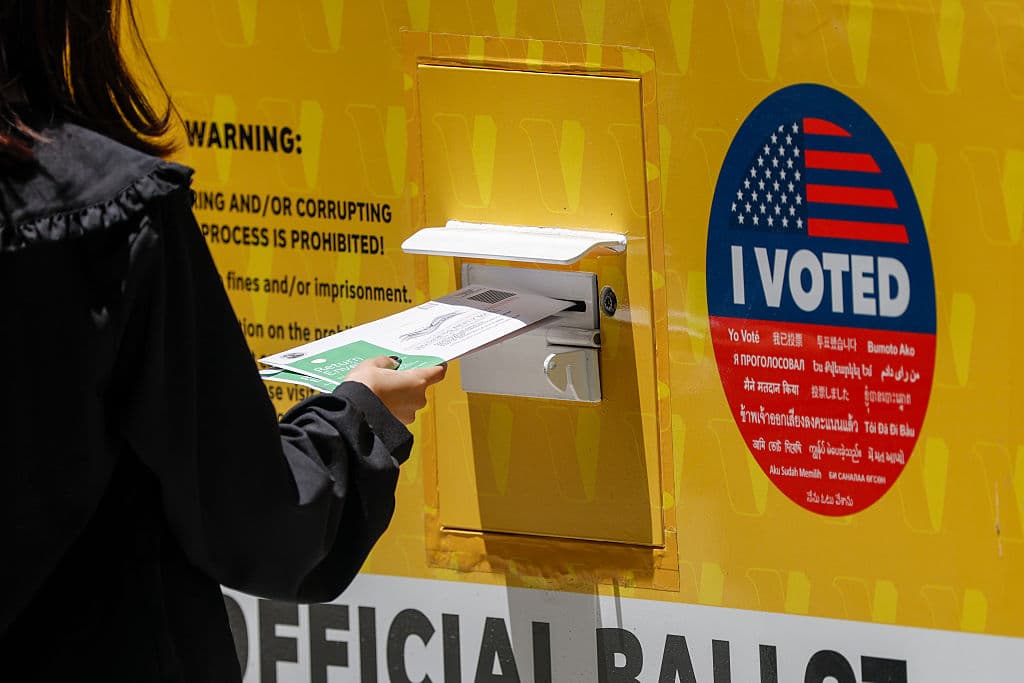
 Voter inserting mail ballot into official drop box with 'I Voted' sticker.
Whistleblower: New USPS Mail Voting System Could Disenfranchise Millions
Left says
- •The rules stem from an executive order requiring USPS to reject ballots for voters not on federally compiled citizenship lists, a mechanism critics say was designed to suppress turnout rather than improve security.
- •Internal USPS officials reportedly raised their own concerns about mass disenfranchisement during the rulemaking process but were overruled, suggesting leadership knowingly proceeded despite known risks.
- •A single scanning error across tens of thousands of ballot envelopes could block an entire batch from reaching voters, exposing the system's fragility just weeks before the midterms.
- •Building a system of this complexity normally takes over a year, and compressing it into three months while defying court orders reflects a rushed, chaotic process that endangers a method one-third of voters rely on.
Right says
- •The executive order's goal is to ensure only eligible voters receive mail ballots, and the Postal Service describes the new requirements as modest informational steps that should not stop anyone from voting.
- •The administration maintains it is still refining the voluntary portal and has not currently mandated envelope review, suggesting the rollout is more flexible than critics portray.
- •Legal and procedural objections are being litigated through the courts, and the administration plans to seek Supreme Court review, reflecting a normal constitutional process rather than an attempt to bypass judicial oversight.
- •Concerns raised by a single anonymous whistleblower and unnamed internal sources represent one perspective inside a large bureaucracy and may not reflect the full operational reality of the rollout.
Common Take
High Consensus- A federal judge has temporarily blocked the USPS mail voting rule while litigation continues.
- State and local election officials, across party lines in various jurisdictions, have identified significant logistical challenges in implementing the new requirements before the midterms.
- The dispute originates from President Trump's March executive order directing USPS and other agencies to restrict mail ballot delivery based on voter eligibility lists.
- Both sides agree the timeline is extremely tight, with ballots already going out in some states as the legal fight continues.
The Arguments
Left argues
Internal USPS officials and an independent whistleblower both warned during the rulemaking process that the compressed timeline and complex verification requirements could block ballots for eligible voters, yet leadership proceeded anyway, suggesting the risks were known and accepted rather than overlooked.
Right counters
Internal disagreement during rulemaking is normal bureaucratic process, not evidence of malicious intent, and the fact that officials raised concerns shows the system was being scrutinized rather than rubber-stamped.
Right argues
The Postal Service has repeatedly stated the requirements are modest, voluntary in their current form, and should not prevent a single voter from voting by mail, meaning the rollout is more flexible and less coercive than critics claim.
Left counters
USPS's own declarations to the court reveal it still cannot explain how the system would function 70 days before the election, and 'voluntary for now' does not preclude a hard mandate being imposed once litigation resolves, potentially with even less lead time.
Left argues
Election officials across multiple states have testified that compliance would be logistically impossible—one California official estimated scanning every ballot would take 43 years using USPS's own methodology—indicating the plan is not just risky but functionally unworkable at scale.
Right counters
These worst-case estimates come from officials and advocacy groups actively suing to block the rule, giving them incentive to present the most alarming interpretation rather than the system as it may actually be implemented.
Right argues
The administration is pursuing its objectives through the courts, including an anticipated Supreme Court appeal, which reflects adherence to constitutional process rather than an attempt to impose the rule unilaterally or bypass judicial review.
Left counters
A federal judge explicitly noted the whistleblower's disclosure suggests USPS continued development work in defiance of court orders, meaning the administration's court engagement may be more about seeking permission after the fact than genuine deference to judicial authority.
Right argues
The concerns driving this story rest heavily on a single anonymous whistleblower and unnamed internal sources, which represent one vantage point inside a massive bureaucracy and may not capture the full operational picture or final implementation details.
Left counters
The whistleblower's account is corroborated by independent reporting on internal USPS deliberations, sworn court declarations from the agency itself, and testimony from election officials in multiple states, forming a consistent pattern rather than a single isolated claim.
Challenge Questions
These questions target genuine internal contradictions — meant to provoke honest reflection.
Right asks Left
“If Democratic-led states and voting rights groups have successfully obtained court orders blocking the rule and are litigating aggressively, how does the administration's use of the same legal process to seek Supreme Court review constitute bypassing judicial oversight rather than participating in it?”
Left asks Right
“If the requirements are truly modest and voluntary, why has USPS been unable to tell a federal judge 70 days before the election how the system would actually function, and why would a whistleblower describe development as defying court orders to meet a hard deadline?”
Outlier Report
Left Fringe
Figures like Sen. Richard Blumenthal and some progressive commentators (e.g., on Democracy Now) frame this as deliberate, intentional voter suppression ('designed malfunction') rather than bureaucratic dysfunction; this more conspiratorial framing represents roughly 20-25% of the left.
Right Fringe
Figures aligned with Stephen Miller-style immigration hawks and some conservative commentators argue noncitizen voting is a serious ongoing problem justifying aggressive verification even amid disruption risk, representing roughly 15-20% of the right; this is more absolutist than the administration's own 'modest requirements' framing.
Noise Assessment
High noise ratio: much of the coverage is driven by litigation-stage claims, anonymous sources, and partisan officials (Blumenthal, DOJ lawyers) rather than settled facts, and cable/online amplification likely exceeds the average voter's actual awareness or concern about this specific USPS process.
Sources (10)
A whistleblower at the U.S. Postal Service is warning that a new mail-in voting system could create major problems and prevent millions of Americans from receiving their ballots. Democratic Rep. James Walkinshaw of Virginia, who sits on the House committee the whistleblower contacted, joins "The Takeout" to discuss.
One official in California said that scanning individual ballots for every voter in the state would take roughly 43 years based on the Postal Service's estimates.
A federal judge is considering whether to continue blocking a U.S. Postal Service rule imposing new requirements for mail voting.
An anonymous federal whistleblower has warned that the Trump administration’s new system for handling mail ballots through the U.S. Postal Service is untested, fatally flawed and likely to lead to a “catastrophic failure” if it’s implemented ahead of November’s midterm elections. This follows President Trump’s executive order in March directing his administration to create federal lists of citizens and to refuse delivery of mail-in ballots to people not on those lists. The legality of Trump’s executive order is being challenged.</p> <p>The new hurdles raised by the executive order for mail ballots and the rushed software system built to administer them “create this potential for grave, catastrophic failure,” says David Kligerman from Whistleblower Aid, the organization representing the whistleblower.
In internal meetings, officials worried the rules they were drafting could delay or block ballots from reaching large swaths of eligible voters for the upcoming midterms.
“The Postal Service has designed a system to disenfranchise millions of Americans,” Sen. Richard Blumenthal (D-Conn.) said before releasing the whistleblower statement.
U.S. District Court Judge Indira Talwani is deciding whether to extend her prohibition on the proposed regulation of mail ballots, an effort undertaken as part of an executive order by President Donald Trump.
<p>The post <a href="https://www.propublica.org/article/mail-voting-usps-officials-concerns-disenfranchisement">New Mail Voting Rules Moved Forward Despite USPS Officials’ Concerns About Mass Disenfranchisement</a> appeared first on <a href="https://www.propublica.org">ProPublica</a>.</p>
Officials worried the rules they were drafting could delay or block ballots from reaching large swaths of voters
The anonymous whistleblower described the Postal Service’s work on systems as “secretive, rushed, chaotic"