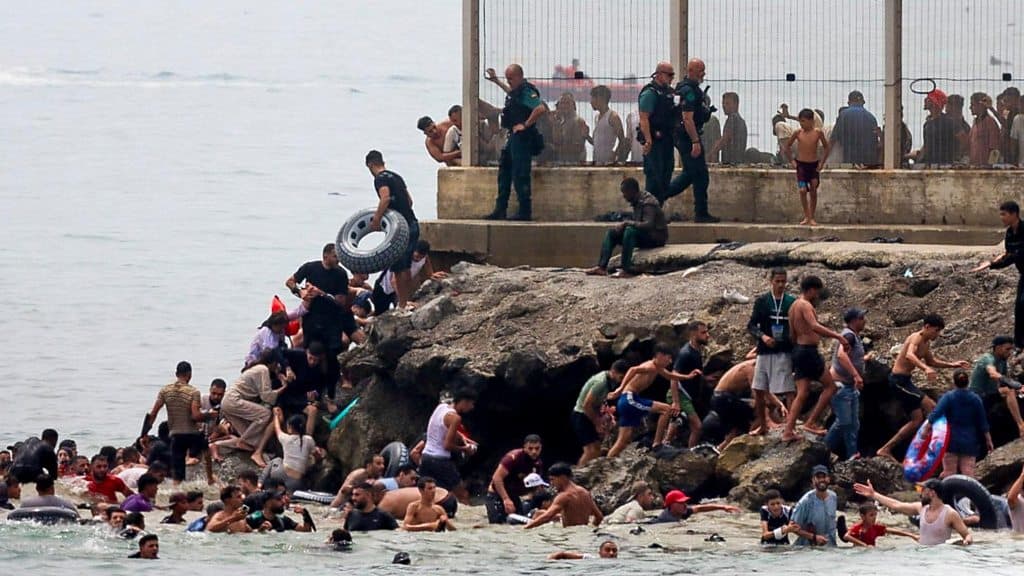
 Migrants scale a fence into Ceuta as Guardia Civil officers watch.
Who's to Blame for Ceuta? Sanchez, Morocco, or Migration Policy
Intra-Party Split Detected
Most left-leaning outlets (Democracy Now, Jacobin, The Nation, The Intercept) defend migrants and criticize border militarization or frame Morocco/geopolitics as the cause, but The Intercept specifically criticizes liberals and centrists (including mainstream Democratic-aligned outlets) for adopting anti-immigrant framing similar to the right, revealing a split between progressive/left activists and liberal centrists on how to discuss the crisis.
Left says
- •The border regime around Ceuta has hardened dramatically since the 1990s, making desperate mass crossing attempts a predictable outcome of decades of restrictive EU policy rather than a sign of laxity.
- •Economic inequality in Morocco combined with limited legal pathways gives young people a powerful incentive to attempt dangerous crossings, and this dynamic will recur unless Morocco's government improves jobs, education, healthcare, and rights for its citizens.
- •Video evidence suggests Moroccan authorities organized and facilitated the crossing, using trucks to ferry migrants to the border and waving them through, indicating this was a state-orchestrated provocation rather than a spontaneous migrant-driven event.
- •Morocco may have staged the crisis to punish Spanish PM Sánchez for warming relations with Algeria, and liberals and centrists risk legitimizing far-right, anti-immigrant framing by treating migrants themselves as the security threat rather than examining the geopolitical and economic forces driving them.
Right says
- •Twenty-two EU member states signed a letter blaming Spain's legalization of over one million undocumented migrants and court rulings protecting illegal crossings as 'pull factors' that caused the mayhem.
- •Spain's own Interior Minister admitted receiving no intelligence warning of an invasion of this scale, raising serious questions about government competence and preparedness despite a similar, smaller incident in 2021.
- •The scale of the crossing, initially estimated at 50,000 but revised upward to 72,000, shows the crisis was far worse than Spanish authorities first acknowledged or were willing to admit.
- •Migrants respond rationally to incentives, and a surge of this kind was foreseeable given Spain's permissive asylum and regularization policies, making the crisis a consequence of left-wing governance rather than an unpredictable external shock.
Common Take
High Consensus- At least 67 to 86 people died during the crossing attempt, many by drowning or being crushed at the breakwater.
- Roughly 50,000 to 72,000 people crossed from Morocco into Ceuta over a two-day period, and the vast majority voluntarily returned to Morocco within days.
- Morocco's increased border enforcement was a key factor in stopping the crossings, and Spain responded by installing a floating sea barrier and deploying additional security personnel.
- Ceuta's status as the EU's only land border with Africa makes it a recurring flashpoint for migration crises, as seen in a similar incident in 2021.
The Arguments
Left argues
The Ceuta border has hardened dramatically since the 1990s, and the desperate mass crossing attempts are a predictable outcome of decades of restrictive EU policy rather than evidence of Spanish laxity.
Right counters
Whatever the border's long-term trajectory, 22 EU member states specifically identified Spain's recent legalization of over a million undocumented migrants and court rulings protecting illegal crossings as new pull factors that triggered this particular surge, not decades-old fencing.
Right argues
Spain's own Interior Minister admitted receiving no intelligence warning of an invasion of this scale, and the death toll and crossing numbers were repeatedly revised upward from initial estimates, raising serious questions about government competence and transparency.
Left counters
A lack of advance intelligence about a specific event's scale doesn't prove policy failure; it may instead reflect the reality that Morocco itself orchestrated and logistically organized this crossing as a sudden geopolitical provocation, which by design would evade normal intelligence-gathering.
Left argues
Video evidence of trucks ferrying migrants to the border and Moroccan guards waving them through suggests this was a state-orchestrated provocation, likely retaliation against Sánchez for warming relations with Algeria, rather than a spontaneous migrant-driven event.
Right counters
Even if Morocco facilitated or encouraged the crossing, that doesn't erase the underlying pull factors on the Spanish side; a government can be manipulated by a hostile actor and still bear responsibility for having created exploitable incentives through its own asylum and regularization policies.
Right argues
People respond rationally to incentives, and a migrant surge of this kind was foreseeable given Spain's permissive asylum and regularization policies, making the crisis a consequence of left-wing governance rather than an unpredictable external shock.
Left counters
Framing migrants as rational actors responding to 'pull factors' obscures the deeper economic inequality and lack of opportunity in Morocco driving people to risk their lives, and it lets liberals and conservatives alike slide into treating migrants themselves as the security threat rather than examining the geopolitical forces at play.
Left argues
Unless Morocco's government improves jobs, education, healthcare, and rights for its citizens, this dynamic will recur regardless of any single policy change Spain makes, since economic desperation is the deeper driver of these crossings.
Right counters
That structural argument doesn't explain why the crisis happened now, at this scale, immediately after Spain's mass legalization program and favorable court rulings; timing strongly suggests immediate policy incentives mattered as much as long-term economic conditions.
Challenge Questions
These questions target genuine internal contradictions — meant to provoke honest reflection.
Right asks Left
“If the crossing was substantially state-orchestrated by Morocco using trucks and organized logistics, as your own sources suggest, how much weight can genuinely be placed on the narrative of desperate, spontaneous economic migration driven by Spanish pull factors or EU border hardening?”
Left asks Right
“If 22 EU governments and Spain's own Interior Ministry failed to anticipate this surge despite supposedly obvious 'pull factor' incentives from regularization policy, doesn't that undermine the claim that the crisis was clearly foreseeable and simply a product of left-wing governance rather than a genuine external shock?”
Outlier Report
Left Fringe
The Intercept and Nation writers (e.g., Stephen Zunes) framing this as Moroccan state provocation tied to Western Sahara/Algeria geopolitics represent a more niche, geopolitically-driven analysis held by perhaps 10-15% of the left; most Democrats would default to a simpler 'poverty drives migration, EU policy is harsh' view without the deep conspiracy angle.
Right Fringe
Figures like Donald Trump framing this explicitly as an 'invasion' tied to 'radical left-wing globalist policies,' and European nationalists like Giorgia Meloni calling for Spain's suspension, represent a more inflammatory faction (~20-25% of the right) compared to the more measured 'pull factors' critique in the EU letter and National Review piece.
Noise Assessment
High noise ratio: this story is largely a European political football amplified by U.S. partisan commentators (Trump, Breitbart, The Intercept) projecting domestic immigration debates onto a foreign crisis; actual American public engagement with Ceuta specifics is likely low, with opinions mostly inferred from pre-existing immigration attitudes rather than direct knowledge of the event.
Sources (10)
Spain faces a backlash from Europe, while Trump warns of an ‘invasion’
<p>Spain's Interior Minister Fernando Grande-Marlaska pleaded ignorance Tuesday saying his office received no prior report from the nation's intelligence institutions warning of last week's massive illegal migrant invasion of Ceuta.</p> <p>The post <a href="https://www.breitbart.com/europe/2026/08/05/spanish-interior-minister-claims-there-was-no-intel-report-warning-of-ceuta-invasion/" rel="nofollow">He Knows Nothing: Spanish Interior Minister Claims No Prior Warning of Mass Ceuta Invasion</a> appeared first on <a href="https://www.breitbart.com" rel="nofollow">Breitbart</a>.</p>
An estimated 60,000 people from Morocco crossed into the Spanish enclave of Ceuta, on the African side of the Strait of Gibraltar, in an unprecedented mass movement last week. At least 72 people died during the attempt. The sudden influx of migrants overwhelmed the city’s residents, leading to a humanitarian crisis while border police deployed water cannons, tear gas and warning shots to deter people from crossing. According to Spain’s Interior Ministry, nearly all of the migrants returned to Morocco just a day later.</p> <p>Miriyam Aouragh, an anthropologist and the daughter of Moroccan immigrants to Europe, says the driving factors for the mass movement are a combination of shifting entry policies to Spain and increasing economic inequality in Morocco that “has given a sort of empowering incentive to people to try to go to Spain” via Ceuta. The city, which is surrounded by Morocco along a five-mile-long border, dates back to the Phoenician era and has been under Portuguese or Spanish control since 1415. The Moroccan government claims that Ceuta is occupied and colonized territory, while Spain considers it an integral part of the Spanish state.
When 50,000 people briefly crossed into Ceuta in North Africa, many pundits damned the lax Spanish line on migration. In truth, the hardening of the border around Ceuta since the 1990s has made such desperate attempts to storm the barrier more common.
People respond to incentives, whether real or imagined. Some sort of migrant surge was foreseeable. <img src="https://i0.wp.com/www.nationalreview.com/wp-content/uploads/2026/08/spain-1.jpg?fit=617%2C360&ssl=1" />
Unless Morocco's government provides better jobs, education, healthcare, and human rights to young people, the crisis we witnessed this last week will happen again.
Last week's invasion of the Spanish cities Ceuta and Melilla by hordes of North Africans has triggered a unified response from Europe but not the one that the European Union's ruling globalists want. The presidents of 22 EU countries signed a letter to European Commission president Ursula von der Leyen denouncing Spain's recent legalization of over one million illegal migrants and court decisions protecting illegal border crossings as "pull factors" responsible for the mayhem that has sent shock waves throughout the troubled continent. (RELATED: I'm a Spanish Taxpayer. This Is Why the West...
Spain rushed to reinforce its border as European leaders debated new controls after thousands crossed into Ceuta
<p>From the New York Times to the EU, liberals defending Spain from far-right fearmongering are regurgitating the right’s anti-immigrant premise.</p> <p>The post <a href="https://theintercept.com/2026/08/03/ceuta-spain-morocco-refugee-border/">Liberals Are Ceding Ground to the Far Right on Ceuta Border Crossings</a> appeared first on <a href="https://theintercept.com">The Intercept</a>.</p>
<p>Stephen Zunes</p> <div><img alt="" src="https://www.thenation.com/wp-content/uploads/2026/08/ceuta.jpg" /></div> <div> <div class="wp-block-the-nation-dek article-title__dek"> <p>Did the Israeli and US hostility toward Spain embolden Morocco to think it could get away with creating a border control crisis?</p> </div> </div> <p>The post <a href="https://www.thenation.com/article/world/ceuta-spain-morocco-border-crisis-western-sahara-geopolitics/">The Real Story Behind the Human Wave That Entered Ceuta</a> appeared first on <a href="https://www.thenation.com">The Nation</a>.</p>