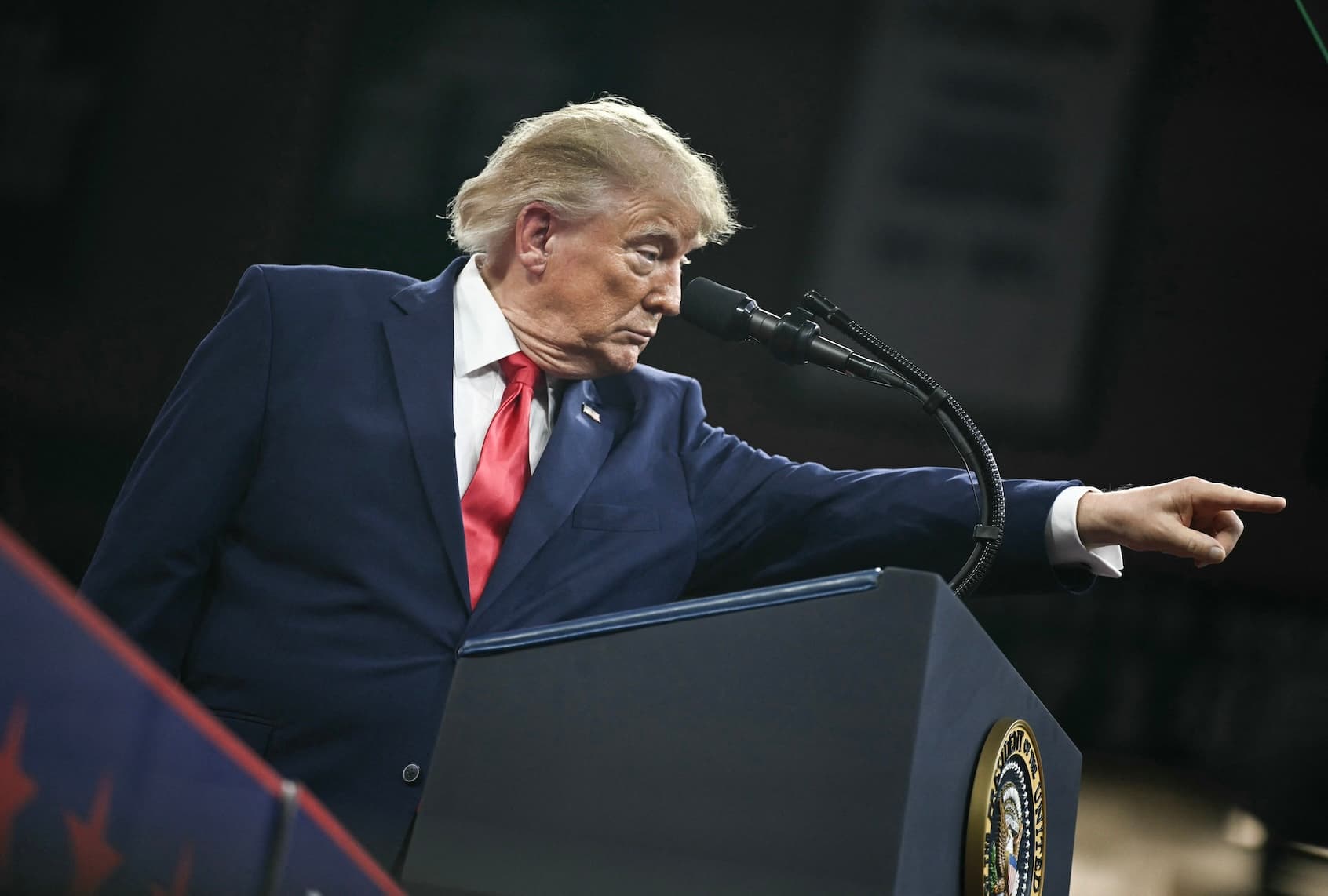
 Donald Trump speaks at a podium, pointing while addressing a crowd.
Witkoff Calls Putin a 'Humanitarian,' GOP Senators Erupt
Intra-Party Split Detected
Republican senators John Cornyn and Thom Tillis publicly criticized Trump envoy Steve Witkoff for calling Putin a 'humanitarian,' breaking with the administration's conciliatory approach toward Russia amid ongoing sanctions relief and peace negotiations.
Left says
- •The remark reflects a broader pattern of the Trump administration softening its posture toward Putin, including lifting sanctions on Russian diesel sales, even as Russia continues its invasion of Ukraine.
- •Calling Putin a 'humanitarian' for releasing a single wrongfully detained American, without any formal prisoner swap, downplays the Kremlin's responsibility for years of unjust detentions and the war itself.
- •Critics see this language as part of a troubling trend of U.S. envoys flattering Putin to extract concessions, which risks legitimizing his actions rather than holding him accountable.
- •The optics undermine Ukraine's position, especially as Zelensky has been pushing for a trilateral summit with Trump and Putin that Russia continues to resist.
Right says
- •Witkoff's comment, even if poorly phrased, came in the context of securing the release of Stephen Hubbard, an American citizen held in Russia for over four years, which is a tangible win worth acknowledging.
- •Republican senators like Thom Tillis and John Cornyn pushed back immediately, showing that GOP lawmakers are not uniformly deferential to Putin and still view him as a dangerous actor.
- •Trump's team frames the release as achieved through strength and negotiation rather than concessions, noting no swap was required, which they argue demonstrates effective diplomacy.
- •The broader goal of restarting trilateral peace talks to end the Ukraine war is a legitimate diplomatic priority, and harsh rhetoric alone shouldn't derail progress toward negotiations.
Common Take
High Consensus- Stephen Hubbard, an American held in Russia for more than four years, was released ahead of the Witkoff-Putin meeting in St. Petersburg.
- Vladimir Putin is widely regarded across the political spectrum as an adversarial and untrustworthy actor in these negotiations.
- Both sides want the war in Ukraine to end through a durable and credible peace agreement.
- There is bipartisan concern about ensuring any deal does not simply reward Russian aggression without real security guarantees for Ukraine.
The Arguments
Left argues
Calling Putin a 'humanitarian' for releasing one wrongfully detained American, without any formal exchange, whitewashes years of unjust detentions and an ongoing war of aggression, legitimizing the Kremlin's narrative rather than holding it accountable.
Right counters
A single ill-chosen word from an envoy shouldn't overshadow the concrete fact that Stephen Hubbard, held for over four years, is now home, and diplomats often use flattering language strategically to extract real results.
Right argues
Securing Hubbard's release without conceding a prisoner swap is a tangible diplomatic win, and Trump's team frames it as leverage achieved through strength rather than appeasement.
Left counters
Even if no formal swap occurred, the broader context shows the U.S. simultaneously lifting sanctions on Russian diesel and softening its posture, suggesting Russia is extracting concessions regardless of how the release is framed.
Right argues
The swift, bipartisan-style pushback from Republican senators Tillis and Cornyn proves the GOP is not monolithically deferential to Putin and that accountability checks exist within the party itself.
Left counters
Isolated senatorial criticism doesn't change the administration's broader trajectory of easing sanctions and pursuing Putin-friendly deals, suggesting the pushback is more rhetorical than substantive.
Left argues
The 'humanitarian' framing undermines Ukraine's negotiating position at a critical moment when Zelensky is pushing for a trilateral summit that Russia is actively resisting, signaling to Kyiv that Washington may prioritize optics with Moscow over solidarity with Ukraine.
Right counters
Diplomatic rhetoric toward Putin doesn't necessarily translate into policy concessions to Russia, and the administration's stated goal remains restarting trilateral talks that could ultimately benefit Ukraine by ending the war.
Right argues
Restarting trilateral peace talks is a legitimate and urgent priority given the ongoing deaths in Ukraine, and getting bogged down in rhetorical missteps risks derailing progress toward a deal that could save lives.
Left counters
Prioritizing talks at any rhetorical cost risks normalizing Putin's war crimes and detentions, and history shows that appeasing dictators rhetorically can embolden rather than restrain them in negotiations.
Challenge Questions
These questions target genuine internal contradictions — meant to provoke honest reflection.
Right asks Left
“If diplomatic flattery of adversarial leaders can sometimes produce real humanitarian outcomes, as it arguably did with Hubbard's release, how does the left distinguish acceptable strategic rhetoric from illegitimate 'legitimizing' language in a consistent, principled way?”
Left asks Right
“If Republican senators like Tillis and Cornyn believe Putin is a 'stone cold killer' undeserving of praise, how does the right reconcile that view with the administration's simultaneous policy moves—like lifting sanctions on Russian diesel—that materially benefit the Kremlin?”
Outlier Report
Left Fringe
Figures like MSNBC's Rachel Maddow and some progressive commentators who frame this as evidence of Trump administration being Russian assets or deliberately pro-Putin; roughly 15-20% of the left holds this more conspiratorial framing versus a more measured 'bad optics' critique.
Right Fringe
Pro-Trump commentators and accounts aligned with figures like Tucker Carlson who defend warming relations with Russia and dismiss GOP senators' criticism as performative; this represents maybe 20-25% of the right, with mainstream Republicans (Tillis, Cornyn) still viewing Putin skeptically.
Noise Assessment
High noise ratio on social media where the 'humanitarian' quote is being used as a rhetorical cudgel by both sides, but the underlying sentiment (Putin is bad, ending the war is good) is fairly consensus-driven among the broader public, with the controversy mostly confined to political and media elites.
Sources (6)
In the early hours of March 3 2022, Richard Conn, a lawyer in Weston, Connecticut, took a call from Moscow warning that the world was on the brink of nuclear war. Conn had only spoken to the person at the end of the phone once since leaving Russia 15 years earlier. But these, the man yelled down the encrypted line, were desperate times. It was a week since Vladimir Putin had ordered the full-scale invasion of Ukraine, and the Russian president's war was not going according to plan.
Russia is ready to resume trilateral negotiations with the United States and Ukraine after 4 November, Kremlin foreign policy adviser Yuri Ushakov said on Sunday. Speaking on Russian state television channel Rossiya 1, Ushakov identified Russia's National Unity Day as the next key date for restarting the talks. Ushakov said Moscow had also been prepared to resume negotiations after Russia's parliamentary elections on 18–20 September, but claimed Ukraine had thwarted the effort by launching its largest drone attacks on those dates.
<p>Russian President <a href="https://www.axios.com/world/russia" target="_blank">Vladimir Putin</a> told White House envoy Steve Witkoff on Wednesday that he "agrees in principle" resuming trilateral peace talks between Russia, Ukraine and the U.S. to end the war, according to Russian and U.S. officials.</p><p><strong>Why it matters:</strong> The White House hopes Putin will show more willingness to compromise after President Trump agreed to lift sanctions on <a href="https://www.axios.com/2026/10/13/trump-russian-diesel-deal-betrayal-bipartisan-letter" target="_self">Russian diesel sales</a> and took other steps welcomed by Moscow. For now, it seems the only concession Putin agreed to is to negotiate.</p><hr /><p><strong>Driving the news: </strong>During a three-hour meeting in St. Petersburg, Witkoff presented Putin with an updated proposal to end the war in <a href="https://www.axios.com/world/axios-explains-ukraine" target="_self">Ukraine</a>. Trump envoy Jared Kushner joined virtually. </p><ul><li>Before the meeting, Russia released U.S. citizen Stephen Hubbard, 74, who had spent more than four years in captivity after being seized by Russian troops in eastern Ukraine in April 2022.</li><li>Putin announced his release at the top of the meeting with Witkoff. "He is at Pulkovo Airport," Putin told Witkoff in front of the cameras. </li><li>Witkoff in response thanked Putin and called him <a href="https://x.com/Gerashchenko_en/status/2112855746442318329" target="_blank">"a humanitarian."</a> Sens. John Cornyn (R-Texas) and Thom Tillis (R-N.C.) expressed outrage at Witkoff's comment. </li><li>"WTF, Steve? Look up the definition of 'humanitarian'. What an embarrassing and outrageous thing to say," Tillis <a href="https://x.com/SenThomTillis/status/2112890374163235086" target="_blank">wrote</a> on X. Cornyn <a href="https://x.com/JohnCornyn/status/2112876842537402446" target="_blank">wrote</a>: "No. Putin is stone cold killer."</li><li>"Stephen is on his way back home and will soon be with his family. The United States, out of respect for President Trump, was not required to give anything in return - an unprecedented situation for Russia. There was no 'swap' necessary for this release," Trump wrote on Truth Social. </li></ul><p><strong>State of play:</strong> Witkoff arrived in Russia after a day of <a href="https://www.axios.com/2026/10/20/russia-ukraine-peace-talks-trump-witkoff-oslo" target="_self">talks in Oslo</a>, Norway, with Ukrainian President Volodymyr Zelensky, as well as the leaders of Norway and Finland and representatives from France, the U.K., Germany, Poland, the EU and NATO.</p><ul><li>Zelensky said Tuesday that the next step should be a trilateral meeting between him, Putin and Trump — a format Russia has so far rejected.</li><li>The discussions in Oslo focused on developing a unified proposal for a "framework agreement" to end the war.</li></ul><p><strong>What he's saying:</strong> "I believe the talks [in Oslo] were productive, and I would like to say that there is progress, and I will update you on this. I hope that we have truly laid the groundwork for a successful end to hostilities in this Ukrainian-Russian conflict," Witkoff told Putin. </p><ul><li>Witkoff asked Putin to "consider resuming trilateral talks involving Ukraine, Russia, and the United States, where we could discuss the next steps toward achieving a settlement."</li><li>Witkoff said the talks could include representatives of technical groups of specialists who could discuss these issues in detail. </li><li>"We have brought several documents outlining approaches to achieving a peaceful settlement in the Ukrainian-Russian conflict. I would ask you, Mr. President, to review these documents a little later," Witkoff said. </li></ul><p><strong>The other side:</strong> After the meeting, Putin's foreign policy adviser, Yuri Ushakov, told Russian reporters that Putin agreed to hold trilateral talks between negotiation teams. </p><ul><li>"Our president informed Steve Witkoff that we are, in principle, ready to resume the aforementioned trilateral negotiations on the main topic around the 10th of November," he said, adding that the talks could take place in Abu Dhabi.</li><li>Ushakov claimed Putin was ready to resume the trilateral talks several weeks ago, but the Ukrainian strikes on Russia on the day of the parliamentary elections led to their cancelation. </li><li>Putin's adviser said Witkoff briefed Putin on the discussions in Oslo. "The Oslo talks didn't contain much that was useful in the context of resolving the Ukrainian crisis," Ushakov said. </li></ul><p><strong>The latest: </strong>A U.S. official said Witkoff and Kushner proposed a trilateral meeting at the technical level between the U.S., Russia, and Ukraine. "This was accepted by the Ukrainians in Oslo yesterday and by the Russians in St. Petersburg today," the official said.</p><p><strong>The intrigue</strong>: Putin also told Witkoff he wants to discuss the possibility of Russia mediating between the U.S. and Iran. </p><ul><li>"You know that we have a special, trusting relationship with Iran, with our partners in Iran, our friends, built over decades, and if there's anything we can do to resolve this crisis, we'll be happy to do so. You're also well aware of our proposals in this area," Putin said. </li></ul><p><strong>What's next:</strong> Putin told Witkoff he wants to discuss a possible meeting with Trump in China in mid-November. </p>
<p>White House envoy Steve Witkoff will meet <a href="https://www.axios.com/world/russia" target="_blank">Russian</a> President Vladimir Putin in St. Petersburg on Wednesday and present him with an updated proposal to end the war in <a href="https://www.axios.com/world/axios-explains-ukraine" target="_blank">Ukraine</a>, a U.S. official said.</p><ul><li>President <a href="https://www.axios.com/politics-policy/donald-trump" target="_blank">Trump's</a> son-in-law and adviser Jared Kushner will join the meeting virtually.</li></ul><p><strong>Why it matters:</strong> The White House hopes Putin will show more willingness to compromise after Trump agreed to lift sanctions on <a href="https://www.axios.com/2026/10/13/trump-russian-diesel-deal-betrayal-bipartisan-letter" target="_blank">Russian diesel sales</a> and took other steps welcomed by Moscow.</p><hr /><p><strong>Driving the news:</strong> Witkoff will arrive in Russia after a day of <a href="https://www.axios.com/2026/10/20/russia-ukraine-peace-talks-trump-witkoff-oslo" target="_blank">talks in Oslo</a>, Norway, with Ukrainian President Volodymyr Zelensky, as well as the leaders of Norway and Finland and representatives from France, the UK, Germany, Poland, the EU and NATO.</p><ul><li>Zelensky said Tuesday that the next step should be a trilateral meeting between him, Putin and Trump — a format Russia has so far rejected.</li><li>The U.S. hopes the new proposal will "create a pathway toward direct trilateral and broader multilateral negotiations," a U.S. official said. </li></ul><p><strong>Zoom in: </strong>The discussions in Oslo focused on developing a unified proposal for a "framework agreement" to end the war.</p><ul><li>The U.S. official said Ukraine "brought forward new ideas and proposals, which were discussed in detail."</li><li>The official said the parties made "meaningful progress" and now have "strong alignment at the working level" on next steps.</li></ul><p><strong>Behind the scenes:</strong> Kushner joined the meeting virtually and again pressed Trump's demand that Ukraine halt strikes on Russian oil refineries, according to a source with knowledge. </p><ul><li>"Jared was very direct," the person said. </li><li>Zelensky said after the meeting that he's prepared to cease strikes on Russian oil refineries if Moscow takes reciprocal steps. </li></ul><p><strong>What he's saying:</strong> Trump said Tuesday that he thinks "Russia would like to get it done," but he expressed doubt that Zelensky wants to end the war.</p><ul><li>"If he does not, it's gonna be a very bad thing," Trump added. "We want Zelensky to make a deal … If they don't make a deal, it's just gonna get worse [for Ukraine]."</li></ul>
<p>White House envoy <a href="https://www.axios.com/2026/10/18/zelensky-witkoff-kushner-ukraine-russia-crisis" target="_blank">Steve Witkoff</a> is traveling to Oslo for talks Tuesday with <a href="https://www.axios.com/world/axios-explains-ukraine" target="_blank">Ukrainian</a> President Volodymyr Zelensky and European leaders, a U.S. official said.</p><p><strong>The big picture: </strong>The talks will bring together Ukraine, European allies and the U.S. as they seek to develop a peace proposal to present to <a href="https://www.axios.com/world/russia" target="_blank">Russia</a>.</p><hr /><ul><li>The Oslo talks are expected to include <a href="https://www.axios.com/2026/10/19/zelensky-blumenthal-tillis-ukraine-russia-war-intelligence" target="_blank">Zelensky</a>, Norwegian Prime Minister Jonas Gahr Støre, representatives of the E4 nations (the U.K., France, Germany and Poland) and officials from the EU and NATO.</li></ul><p><strong>Driving the news: </strong>The U.S. official said that following Oslo, Witkoff is also planning to travel to Russia, where he hopes to meet with President <a href="https://www.axios.com/2026/10/19/trump-summit-xi-putin-denuclearization-ukraine" target="_blank">Vladimir Putin</a> and present ideas developed in close consultation with Ukraine and European partners.</p><ul><li>Trump adviser<a href="https://www.axios.com/2026/10/08/ukraine-russia-war-kushner-witkoff-negotiations-winter" target="_blank"> Jared Kushner</a> has the flu and will not attend the Oslo meeting in person, but will participate virtually, the U.S. official said.</li><li>The planned meetings in Oslo build on the discussions held at Witkoff's Miami-area <a href="https://www.axios.com/2025/12/22/ukraine-gaza-meetings-witkoff-golf-club" target="_blank">Shell Bay club</a>, where Zelensky committed to reviewing and advancing a series of proposals aimed at creating a pathway toward a comprehensive and durable peace agreement, the U.S. official added.</li></ul><p><strong>Zoom in: </strong>The U.S. official said American, Ukrainian and European representatives worked together over the past week to develop the proposals.</p><ul><li>"Steve and Jared also spoke with President Zelensky on Sunday to review progress and discuss next steps," the U.S. official said.</li><li>The trip is also expected to include efforts to secure the release of Stephen Hubbard, a retired American teacher whom the U.S. says has been wrongfully detained in Russia.</li></ul><p><strong>What's next: </strong>The U.S. official said the discussions are focused on two parallel tracks:</p><ol><li>Securing Ukraine's future: Establishing a sovereign, secure, and prosperous future for Ukraine, including credible security guarantees, European integration, and a comprehensive postwar economic framework that addresses Ukraine's financial needs and creates opportunities for long-term growth and investment.</li><li>Creating the conditions for a durable peace: Developing a comprehensive proposal to Russia that addresses the issues necessary to end the war, establishes a new and enduring security architecture between Russia and Europe, and explores opportunities for postwar economic cooperation.</li></ol><ul><li>"President Trump has directed an intensive process to develop a comprehensive peace proposal with Ukraine and Europe, and the next step is to test whether that work can form the basis for serious negotiations with Russia," the U.S. official said.</li><li>"These discussions remain fluid, and substantial work remains. President Trump's objective is clear: to end the killing, bring the war to a close, and establish the conditions for a lasting peace that benefits Ukraine, Russia, Europe, and the United States."</li></ul>
Meanwhile, fighting in the Middle East continues as oil prices climb